
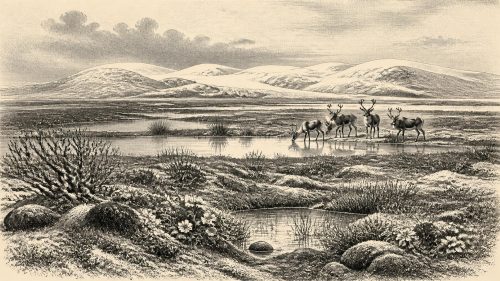
BIRM-166’s Fossil Pool
At 30,887 BCE, Ireland’s history can only be reconstructed through environmental evidence, not annual events. Derryvree, County Fermanagh, preserves freshwater sediments between glacial tills, dated broadly to an interval encompassing this year. Its pollen, plants and insects reveal open, cold tundra-like wetlands with sedges, mosses, bogbean, dwarf willow and seasonal meltwater. Castlepook Cave, County Cork, documents a wider MIS 3 fauna including mammoth, reindeer, giant deer, wolves, hyaenas and Arctic foxes, though its deposits are chronologically mixed. A potentially cut-marked reindeer bone suggests human presence, but no secure contemporary settlement exists. Ice conditions, habitats and connections changed continually over millennia.
View Record
Derryvree Silt and Mammoth Bone
Although 30,888 BCE cannot be tied to a specific Irish event, it falls within the unstable MIS 3 Late Pleistocene. Derryvree, County Fermanagh, preserves freshwater organic sediments between glacial tills, indicating a cold, treeless mosaic of wet hollows and sparse vegetation during an ice-free interval. Other northern sites and Crag Cave confirm variable regional conditions. Castlepook Cave, County Cork, contains a diverse, chronologically mixed fauna including mammoth, reindeer, giant deer, hyaena and wolf. A cut-marked reindeer femur may indicate human carcass processing, but cannot prove settlement. Subsequent glaciation destroyed evidence; no polity, farming, trade or established human occupation is known.
View Record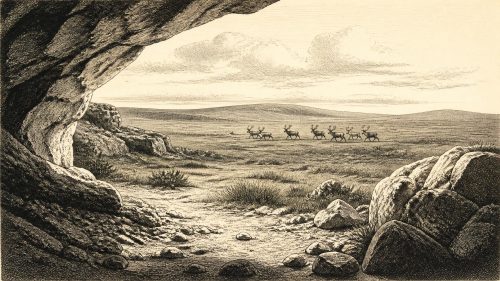
Castlepook’s Mammoth Passages
Around 30,889 BCE, Ireland’s evidence is environmental rather than historical. Castlepook Cave in County Cork preserves over 2,000 Late Pleistocene animal bones, including mammoth, reindeer, giant deer, hyaena, bear, Arctic fox and lemmings, accumulated and disturbed over many millennia. These remains indicate a fluctuating, cold, open landscape within the wider north-west European ecosystem as ice sheets expanded towards the Last Glacial Maximum. A marked reindeer bone may represent exceptionally early human butchery, but its interpretation remains uncertain and does not prove settlement. Routes into Ireland are unknown. Castlepook remains an active research site, potentially refining understanding of Ireland’s deep prehistory.
View Record
The Derryvree Silt Archive
Nominally dated to 30,890 BCE, Ireland’s evidence belongs to a broad late Marine Isotope Stage 3 interval rather than a recoverable year. At Derryvree, County Fermanagh, freshwater silts between glacial tills record a temporary ice-free wetland, supporting tundra plants and aquatic life amid severe periglacial conditions. Later ice sealed the deposit as glaciation intensified before its maximum. Castlepook Cave, County Cork, preserves remains of reindeer, mammoth, giant deer and predators, demonstrating cold-stage ecosystems. A marked reindeer femur may indicate human butchery around 33,000 years ago, but lacks associated settlement evidence. Ireland’s earliest secure human trace is later, from County Clare.
View Record
Doneraile Before the Ice
Around 30,891 BCE, Ireland lay within the unstable cold conditions of Marine Isotope Stage 3, not a precisely datable historical moment. Derryvree, County Fermanagh, preserves organic sediments indicating ice-free, open tundra-like wetlands with herbs, sedges, mosses and shallow freshwater before renewed glaciation. Castlepook Cave, County Cork, contains a mixed, long-lived fauna including mammoth, reindeer, giant deer, bear, wolf, lemmings and hyaena, evidencing varied cold-stage ecosystems. A marked reindeer bone may suggest human butchery, but cannot prove settlement. No contemporary Irish tools, hearths, art, burials, political structures or trade are securely known. Environmental change and advancing ice dominate the sparse record.
View Record
Maguiresbridge’s Periglacial Herbarium
Around 30,892 BCE, Ireland was within climatically unstable MIS 3, not a recoverable historical year. Derryvree near Maguiresbridge preserves freshwater sediments between glacial tills, dated broadly to later MIS 3. Its mosses, sedges, aquatic plants, pollen and insects indicate treeless periglacial wetland within open tundra-like terrain. Castlepook Cave yielded Ice Age fauna, including mammoth, giant deer, reindeer, bear and hyaena, accumulated across millennia, not a single landscape. A marked reindeer bone may suggest early human carcass processing, but proves neither settlement nor continuous population. Expanding British-Irish ice later buried or destroyed evidence, leaving these exceptional archives of locally changing environments.
View Record
Derryvree’s Mountain-Avens Pool
At the modern reference date of 30,893 BCE, Ireland has no year-specific historical record; evidence instead describes unstable Late Pleistocene environments. At Derryvree, County Fermanagh, freshwater sediments sealed between glacial tills, radiocarbon-dated broadly to 36,900–31,700 calibrated years before present, preserve cold, treeless wetland flora including mosses, sedges, bogbean and mountain-avens. They demonstrate a locally ice-free tundra interval, not island-wide conditions. Castlepook Cave, County Cork, contains Ice Age mammals, but disturbed contexts prevent a single-date fauna. No secure human settlement is known. A possibly tool-marked reindeer bone may indicate brief human activity, yet remains inconclusive. These fragmentary deposits constitute recoverable history.
View Record
Mammoth Cave’s Open Tundra
About 30,894 BCE, Ireland cannot be assigned a specific historical event, but evidence from Derryvree, County Fermanagh, and Castlepook Cave, County Cork, illuminates Middle Devensian conditions. Derryvree sediments, broadly dated to 34,950–29,750 BCE, indicate ice-free, wet, treeless tundra with sedges, mosses, herbs and pools. Castlepook bones show intermittent cold-adapted fauna, including mammoth, reindeer, giant deer, Arctic fox and hyaena, in open habitats. A marked reindeer femur may suggest brief human presence, but remains unproven. Later ice expansion erased much evidence, leaving Ireland an intermittently habitable Atlantic frontier rather than a documented society, with no recoverable annual narrative or settled population.
View Record
Maguirebridge’s Moss Horizon
Modern calendar-year precision is not available for Ireland in 30,895 BCE. No person on the...
View Record
Elephant Hall’s Mammoth Country
Around 30,896 BCE, Ireland’s evidence records environmental change rather than events. At Derryvree, County Fermanagh, freshwater sediments beneath glacial till preserve tundra-like wetland vegetation, showing that cold, ice-free intervals supported plant life before renewed glaciation. Castlepook Cave, County Cork, contains diverse MIS 3 fauna, including mammoth, reindeer, giant deer, hyaena, wolves and Arctic foxes, though species need not have coexisted. These remains demonstrate intermittent connections with Britain and Europe under shifting climates and sea levels. A possibly tool-marked reindeer bone suggests brief human presence, but cannot prove settlement. Ireland was a dynamic, sparsely evidenced Ice-Age landscape during this remote period.
View Record