

John Daly, a stalwart of Irish republicanism and a prominent figure in the Irish Republican Brotherhood, passed away on June 30, 1916. His demise marks the end of an era for Limerick and Ireland, as the nation reflects on the life and legacy of a dedicated patriot.
Born on October 18, 1845, Daly emerged as a formidable voice in the struggle for Irish independence. His familial ties to Kathleen Clarke, the wife of executed rebel Tom Clarke, and her brother Ned Daly, further cement his place in the annals of Irish history. A leading member of the Irish Republican Brotherhood, Daly exemplified unwavering commitment to the cause of Irish freedom.
Daly’s journey as a revolutionary was not without its trials. Despite his fervent dedication to the republican cause, he faced persecution from the British authorities, enduring a conviction for treason against the British state. His steadfast defiance in the face of oppression earned him admiration among his compatriots, even as he faced the consequences of his convictions.
In addition to his activism on the national stage, Daly’s political career included a brief stint as a member of the British Parliament. However, his past convictions for treason cast a shadow over his tenure, eliciting resentment from some quarters. Nevertheless, Daly remained undeterred in his pursuit of justice and freedom for Ireland.
Limerick, the city that Daly proudly called home, mourns the loss of one of its most illustrious sons. As Mayor of Limerick for three years at the turn of the century, Daly left an indelible mark on the local community. His leadership, marked by a deep sense of duty and integrity, endeared him to the people of Limerick, who fondly remember his contributions to the city’s development and prosperity.
Throughout his life, Daly embodied the spirit of resilience and determination that defines the Irish struggle for independence. His unwavering commitment to the principles of republicanism served as a beacon of hope for generations of Irish nationalists.
As Ireland grapples with the aftermath of the 1916 Rising and looks towards an uncertain future, the memory of John Daly serves as a reminder of the sacrifices made by those who dared to dream of a free and sovereign nation. In the streets of Limerick and beyond, his legacy lives on, inspiring new generations to carry forth the torch of Irish freedom.
The passing of John Daly marks the end of a chapter in Ireland’s history, but his legacy as a patriot and a champion of liberty endures, casting a long shadow over the landscape of Irish politics and society. As the nation bids farewell to one of its most revered sons, Limerick stands as a testament to his enduring spirit and unwavering commitment to the cause of Irish independence.

John Daly: From Lath Splitter to Republican Luminary
John Daly, born in Limerick city on October 18, 1845, began his remarkable journey amidst the timber yards of James Harvey & Son, where his father toiled. At the tender age of 16, Daly followed in his father’s footsteps, joining him as a lath splitter, a profession that would lay the foundation for his later involvement in Irish republicanism.
Daly’s entry into the realm of political activism came swiftly. At 18, he took the solemn oath of allegiance to the Irish Republican Brotherhood (IRB), colloquially known as the Fenians, marking the beginning of his dedicated involvement in Republican activities. His fervent commitment to the cause of Irish independence propelled him into the heart of the nationalist movement, where he would emerge as a prominent figure.
However, Daly’s path towards Republicanism was not without its challenges. His steadfast adherence to his convictions led to a momentous decision following a refusal of absolution in confession due to his affiliation with the Fenians. Determined to reconcile his faith with his political beliefs, Daly resolved that his loyalty henceforth would be to “God and Fatherland,” a testament to his unwavering commitment to both his religious convictions and his nationalist ideals.

Daly’s evolution from a humble lath splitter to a fervent advocate for Irish independence epitomises the spirit of resilience and determination that defined the Republican movement of his era. His decision to align himself with the cause of Irish freedom underscored his unwavering dedication to the pursuit of justice and sovereignty for his homeland.
As Daly immersed himself deeper into Republican activities, his influence within the movement grew, earning him respect and admiration among his peers. His unwavering commitment to the principles of Republicanism, coupled with his indomitable spirit, positioned him as a formidable force within the nationalist landscape.
The legacy of John Daly, rooted in his humble beginnings and forged through his unwavering dedication to the cause of Irish independence, endures as a testament to the resilience and determination of the Irish people. From the timber yards of Limerick to the hallowed halls of Republicanism, Daly’s journey serves as a poignant reminder of the enduring struggle for freedom and justice that defines the Irish experience.
As Ireland continues to navigate the complexities of its history and chart a course towards a brighter future, the memory of John Daly stands as a beacon of hope and inspiration, guiding future generations in their quest for a truly free and sovereign nation.

The Arrest of John Daly: A Trial of Resolve
The 22nd of November 1866 marked a pivotal moment in the life of John Daly, as he and his brother Edward were apprehended at their family residence, betrayed by an informant. The charges laid against them pertained to their involvement in operating a clandestine munitions factory situated in the Pennywell district, in proximity to their home. This arrest would prove to be a crucible for Daly, testing his resolve and fortifying his dedication to the cause of Irish republicanism.
Imprisonment did not break Daly’s spirit; instead, it served to strengthen his resolve. Released on bail in February 1867, Daly emerged from confinement emboldened by the experience, more resolute than ever in his commitment to the ideals of Irish independence.
The betrayal and subsequent arrest served as a stark reminder of the risks inherent in the pursuit of liberty and sovereignty for Ireland. Despite the setbacks and challenges posed by the oppressive forces of the British state, Daly remained undeterred in his quest for justice and freedom for his homeland.

The ordeal of imprisonment only served to fuel Daly’s determination, propelling him further into the heart of the Republican movement. His unwavering dedication to the cause of Irish independence, tempered by the trials he endured, positioned him as a steadfast champion of liberty within the nationalist landscape.
As Daly emerged from the crucible of confinement, his resolve hardened, his dedication unwavering. The experience served as a catalyst for his continued involvement in Republican activities, driving him forward in the struggle for Irish freedom.
The arrest of John Daly stands as a testament to the sacrifices made by countless individuals in the pursuit of justice and sovereignty for Ireland. His unwavering commitment to the cause of Irish republicanism, even in the face of adversity, serves as an inspiration to generations past, present, and future.
As Ireland continues to grapple with the complexities of its history and chart a course towards a brighter future, the memory of John Daly remains indelibly etched in the annals of Irish nationalism. His resilience in the face of adversity, his unwavering dedication to the cause of Irish independence, serves as a beacon of hope and inspiration, guiding the nation forward on its journey towards a truly free and sovereign state.

John Daly: A Fateful Retreat and Exile
March 5, 1867, marked a pivotal moment in the tumultuous history of Irish republicanism, as the ill-prepared Fenian Rising unfolded across the nation. John Daly, entrusted with leading the Limerick detachment of the Irish Republican Brotherhood (IRB), found himself thrust into the midst of a desperate struggle for Irish independence.
In Limerick, one of the few areas where the Fenians could muster some semblance of force, Daly assumed command, marshalling his men for what would prove to be a futile endeavour. Despite their valiant efforts, hampered by a lack of numbers and resources, the Fenians were unable to mount a significant challenge against the overwhelmingly superior forces aligned against them.
Undeterred by the odds stacked against them, Daly made the strategic decision to relocate his men from the city to the countryside, where they joined forces with fellow Fenians in a daring assault on the Irish Constabulary barracks at Kilmallock. However, their efforts were swiftly met with staunch resistance, and the attack was repelled, forcing Daly to disperse his men in the face of insurmountable odds.

With the failure of the uprising and the spectre of British reprisals looming large, Daly found himself compelled to flee his homeland in a bid to evade capture and persecution. His journey into exile began with a perilous voyage, as he clandestinely stowed away aboard the vessel Hollywood bound for England. From there, he embarked on a further journey across the Atlantic, boarding the Cornelius Grenfel destined for the shores of the United States of America.
The decision to flee his homeland marked a poignant moment in Daly’s life, as he left behind the land of his birth in search of refuge and sanctuary. Forced into exile by the crushing weight of British oppression, Daly’s departure underscored the harsh realities faced by those who dared to challenge the might of the empire.
In the United States, Daly found solace among fellow exiles and sympathisers of the Irish cause, where he would continue his tireless advocacy for Irish independence. His journey into exile served as a testament to the resilience and determination of the Irish people in the face of adversity, as they sought to keep the flame of liberty burning bright in the darkest of times.
As Ireland grappled with the aftermath of the failed uprising and the onset of a new era of repression, the memory of John Daly’s valiant efforts in the struggle for independence remained etched in the annals of Irish history. Though forced into exile, his spirit endured, serving as an enduring reminder of the sacrifices made by countless individuals in the pursuit of freedom and justice for Ireland.

John Daly’s American Odyssey: From Labourer to Tram Brakeman
For John Daly, like many Irish immigrants of his time, the shores of America offered the promise of opportunity tempered by the harsh realities of life for working-class newcomers. Following his clandestine arrival on the shores of the United States, Daly embarked on a journey of survival and adaptation, navigating the rugged terrain of immigrant life with resilience and determination.
His first foray into the American workforce saw Daly digging a cellar, a testament to the arduous and menial tasks often undertaken by newly arrived immigrants struggling to make ends meet. Undeterred by the backbreaking labour, Daly persevered, determined to carve out a better life for himself in his newfound homeland.
Subsequent employment in a white lead factory further exposed Daly to the harsh realities of industrial labour, as he toiled alongside fellow immigrants in hazardous conditions. Yet, despite the challenges he faced, Daly’s indomitable spirit remained unbroken, fuelled by a fierce determination to succeed against all odds.

Transitioning to work as a mason’s helper provided Daly with new skills and experiences, expanding his repertoire and opening doors to new opportunities. However, it was his eventual employment as a brakeman on a tram system that marked a turning point in Daly’s American odyssey.
As a brakeman, Daly found himself entrusted with the responsibility of ensuring the safety and efficiency of the tram system, a role that offered stability and a degree of financial security. It was here that Daly’s resilience and adaptability shone brightest, as he navigated the bustling streets of urban America with poise and determination.
In his later years, Daly would reflect on these formative experiences in his Recollections of Fenians and Fenianism, offering a poignant glimpse into the trials and tribulations faced by Irish immigrants in the land of opportunity. His journey from labourer to tram brakeman serves as a testament to the resilience and tenacity of the immigrant spirit, as Daly navigated the challenges of life in America with courage and determination.
As Daly forged ahead on his American odyssey, he carried with him the indelible mark of his Irish heritage, infusing his journey with a sense of purpose and identity. Though far from the shores of his homeland, Daly remained steadfast in his commitment to the cause of Irish independence, drawing strength from the struggles of his past as he charted a new course in the land of the free.

John Daly: A Tireless Advocate for Irish Freedom
Following his return to Ireland in 1869, John Daly wasted no time in resuming his dual roles as a labourer in the timber yard and a dedicated activist within the ranks of the Irish Republican Brotherhood (IRB). His unwavering commitment to the cause of Irish independence saw him immerse himself once again in Republican activities, as he embarked on a mission to reorganise the IRB and keep its agenda at the forefront of public consciousness.
Daly’s resurgence within the Republican movement saw him emerge as a leading voice in the struggle for justice and freedom. As part of his efforts to galvanise support for the cause, Daly played a pivotal role in agitating for the release of Fenian prisoners still languishing in jail. His tireless advocacy and steadfast determination endeared him to his fellow activists, as he emerged as a beacon of hope in the fight against British oppression.
In November 1869, Daly found himself at the centre of a pivotal moment in Irish history, as he spearheaded the IRB’s objections to a major tenants’ rights meeting in the city. Frustrated by the absence of discussion surrounding the plight of political prisoners, Daly and his comrades launched a daring assault on the platform, dismantling it in what would come to be known as “The Battle of the Markets.” Despite attempts by the meeting’s organisers to salvage the gathering, Daly and the IRB stood firm, viewing the confrontation as a moral victory in their ongoing struggle for justice.
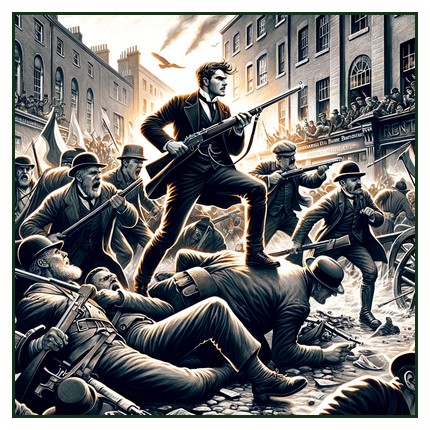
Throughout the 1870s, Daly remained steadfast in his pursuit of political reform and liberation for Ireland. His unwavering dedication to the cause saw him embroiled in various skirmishes and disturbances, including his arrest in 1876 for disrupting a home rule gathering. However, Daly’s resilience and determination prevailed, as he was acquitted of all charges, emboldening him to continue his fight for Irish freedom.
As Ireland grappled with the tumultuous events of the Land War, Daly’s influence within the Republican movement continued to grow. Serving on the Supreme Council of the IRB, he assumed the role of organiser for Connacht and Ulster, mobilising support and galvanising resistance against British rule. His leadership and organisational skills proved invaluable in navigating the complexities of the Land War, as he worked tirelessly to advance the cause of Irish independence.
In John Daly, Ireland found a steadfast champion of freedom and justice, whose unwavering commitment to the Republican cause served as a beacon of hope in the darkest of times. As the struggle for Irish independence entered a new chapter, Daly’s indomitable spirit and tireless advocacy ensured that the flame of liberty burned bright, lighting the way forward for future generations of Irish nationalists.
John Daly: Betrayal, Imprisonment, and Allegations of Poisoning
In the summer of 1883, John Daly’s life took a dramatic turn as he relocated to Birmingham, England, seeking refuge in the home of James Egan, an old friend and fellow member of the Irish Republican Brotherhood (IRB) from Limerick. Little did Daly know that his arrival in England would herald a period of betrayal, intrigue, and imprisonment that would shape the course of his life and legacy.
Upon Daly’s arrival in Birmingham, the wheels of surveillance were set in motion by E.G. Jenkinson, head of the Special Branch, who had received intelligence regarding Daly’s movements from America. Suspicions were aroused, and a plain-clothes detective was tasked with shadowing Daly’s every move, casting a pall of suspicion over his activities.
Unbeknownst to Daly, agents provocateurs lurked in the shadows, eager to ensnare him in a web of deceit and treachery. Among them was Dan O’Neill, a publican and local IRB member who succumbed to the persuasions of Jenkinson and Major Nicholas Gosselin, betraying Daly’s trust in exchange for leniency.
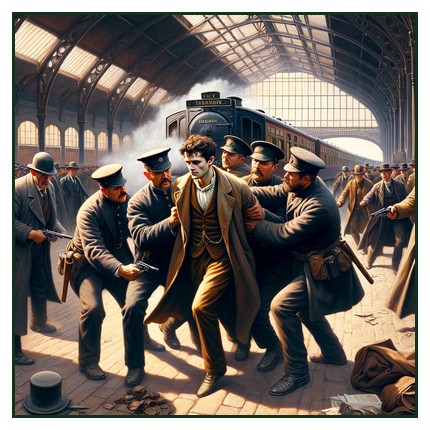
In a calculated ploy orchestrated by Jenkinson and Gosselin, O’Neill manipulated Daly into unwittingly transporting sealed cases purportedly containing explosives to associates in London. However, Daly’s plans were foiled on April 11th when he was apprehended by authorities just as he was about to board a train for London. Explosives were discovered in the case he was carrying, sealing his fate and marking the beginning of a harrowing ordeal.

A subsequent raid on James Egan’s home yielded further incriminating evidence, with explosives allegedly unearthed from Egan’s garden alongside damning documents. Daly found himself ensnared in a web of deceit and betrayal, his trust in fellow Republicans shattered by the treachery of those he once considered comrades.
Transferred to Chatham prison, Daly found solace in the unlikely friendship of Tom Clarke, a fellow prisoner who would later play a pivotal role in the 1916 Easter Rising and marry Daly’s niece, Kathleen Clarke. Yet, even behind bars, Daly’s ordeal was far from over, as he alleged that he was being poisoned with belladonna, prompting a commission of inquiry in 1890 that exposed the error as an act of negligence by a prison warder.
The spectre of imprisonment loomed large over Daly’s life, casting a shadow of uncertainty and despair. Yet, even amidst the darkness of his confinement, Daly refused to be silenced, granting an interview to the Daily Chronicle in 1896 that laid bare the injustices and hardships endured by Republican prisoners.
John Daly’s ordeal stands as a stark reminder of the sacrifices made by countless individuals in the pursuit of Irish independence. Betrayed, imprisoned, and subjected to allegations of poisoning, Daly’s resilience in the face of adversity serves as a testament to the indomitable spirit of the Irish people in their quest for freedom and justice.

Daly alongside fellow members of the Irish Republican Brotherhood Tom Clarke And Sean Mac Diarmada
John Daly: From Political Exile to Mayor of Limerick
John Daly’s journey from political exile to becoming the Mayor of Limerick City is a testament to his resilience, determination, and unwavering commitment to the cause of Irish independence. Despite facing numerous challenges and setbacks, Daly’s indomitable spirit propelled him forward, ultimately leading to his triumphant return to public life in his native city.
In the summer of 1883, Daly made the fateful decision to relocate to Birmingham, England, seeking refuge in the home of an old friend from Limerick, James Egan. However, his arrival did not go unnoticed by the authorities, as Special Branch agents closely monitored his movements, wary of his ties to the Irish Republican Brotherhood (IRB) and his potential to stir unrest.
Daly’s involvement in Republican activities soon caught the attention of the authorities, culminating in his arrest on charges of treason-felon after explosives were discovered in his possession. Despite facing imprisonment and allegations of poisoning while incarcerated, Daly remained steadfast in his convictions, emerging from his ordeal with renewed determination to continue the fight for Irish independence.
Following his release from prison, Daly’s political career reached new heights as he was elected as a Member of Parliament (MP) for Limerick City in the general election of July 1895. However, his tenure was short-lived, as he was swiftly disqualified due to his status as a treason-felon. Undeterred by this setback, Daly embarked on a series of lecture tours in England and America, further cementing his reputation as a formidable advocate for Irish nationalism.

In 1899, Daly achieved a significant milestone in his political career as he was elected Mayor of Limerick City, a position he would hold for three consecutive terms until 1901. His tenure as mayor was marked by a steadfast commitment to the welfare of his constituents and a dedication to advancing the cause of Irish freedom.
Daly’s legacy extended beyond his political career, as he played a pivotal role in financing the IRB newspaper Irish Freedom in 1910, demonstrating his ongoing commitment to the Republican cause. Additionally, his entrepreneurial acumen saw him establish a prosperous bakery business in Limerick, further solidifying his status as a prominent figure in the local community.
As Mayor of Limerick, Daly embodied the spirit of resilience and determination that defined the Irish struggle for independence. His leadership, marked by a deep sense of duty and integrity, endeared him to the people of Limerick, who fondly remember his contributions to the city’s development and prosperity.
John Daly’s journey from political exile to Mayor of Limerick City stands as a testament to the enduring spirit of the Irish people and their unwavering quest for freedom and justice. His legacy continues to inspire future generations, serving as a reminder of the indomitable human spirit in the face of adversity.
EMERALD CHRONICLE
.

