Membership is completely free, giving members unlimited access to all available resources, services, features, and benefits without any restrictions or fees.
Welcome back. Sign in to continue enjoying unlimited access to all available resources, services, features, and member benefits at no cost.
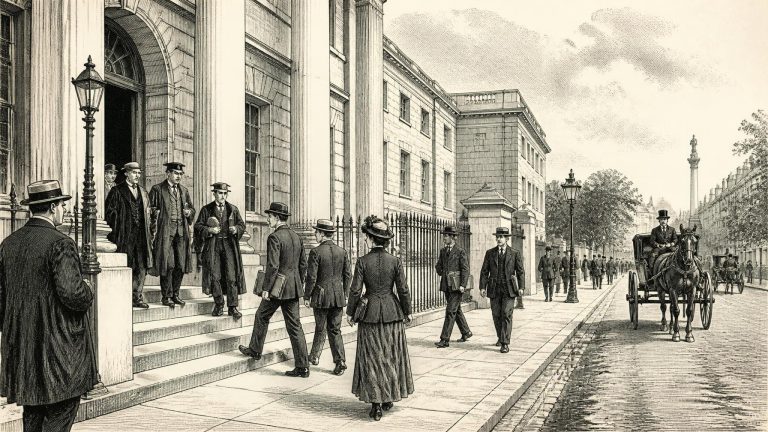
The central political achievement of the year was the Irish Universities Act 1908, dated 1 August. Its immediate legal effect was to provide for two new universities, one seated in Dublin and one in Belfast, and to dismantle the existing arrangement of the Royal University of Ireland and Queen’s College, Belfast. The Royal University had principally examined students and awarded degrees; it was widely criticised as an inadequate substitute for a properly endowed teaching university. The new legislation therefore answered an educational question that had frustrated governments, churchmen, academics and Irish politicians for decades.
On 1 January 1864, full civil registration of births, deaths and marriages commenced in Ireland. Registration of non-Catholic marriages had existed since 1845, but the new arrangement extended a legal duty to record births and deaths, as well as Roman Catholic marriages. It did not displace parish registers: Catholic clergy continued to create sacramental records of baptism and marriage, while the state compiled its own civil evidence. Nevertheless, the change was important. For families, it meant that birth, death and marriage increasingly became matters documented in standard forms, through local registrars and superintendent registrars, rather than events known chiefly through household, parish and community memory.
On 1 January, Edward Harland and Gustav Wilhelm Wolff formally entered partnership in Belfast. Harland, an English engineer and shipbuilder, had taken over the Queen’s Island yard only the year before; Wolff, born in Hamburg and established in Belfast after working in engineering, brought technical ability and commercial connections. The new concern, Harland and Wolff, was still a small enterprise beside the great industrial name it would become. Its significance in 1862 lay not in later-famous vessels but in its position within a growing port economy, where shipbuilding, engineering, linen manufacture, rope-making, warehousing and ocean trade increasingly reshaped the town and drew in labour from across Ulster.
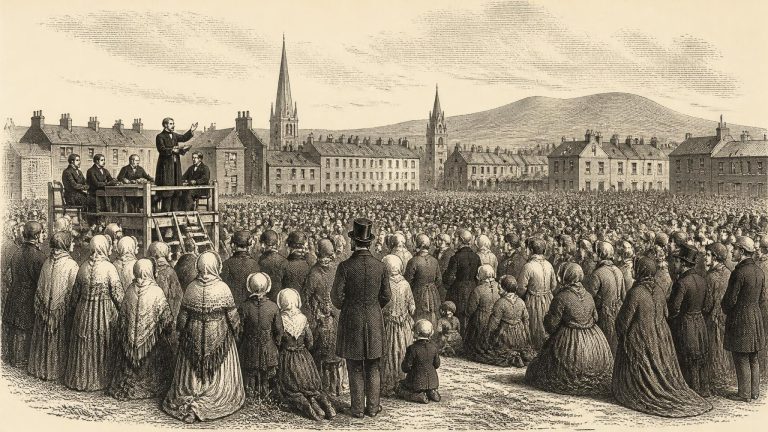
The most conspicuous development within Ireland during 1859 was the Evangelical Protestant revival in Ulster. Its immediate roots lay before the calendar year. Prayer meetings involving young converts had begun at Kells, County Antrim, in late 1857, encouraged by the Presbyterian minister John Hamilton Moore. During 1858 and, especially, 1859, reports of conversions, intense religious feeling, prayer gatherings and crowded services travelled rapidly through Presbyterian networks, newspapers and personal testimony. It was therefore not an event that can responsibly be assigned to one day, but 1859 was unmistakably its year of greatest public visibility.
The United Kingdom general election was held in Ireland between 27 March and 24 April 1857. Ireland returned 105 MPs to the House of Commons, but the electorate was narrow: voting remained tied principally to property qualifications, and many inhabitants had no parliamentary voice. Elections therefore displayed the influence of landlords, clergy, municipal interests and local alliances at least as clearly as they measured popular opinion.