

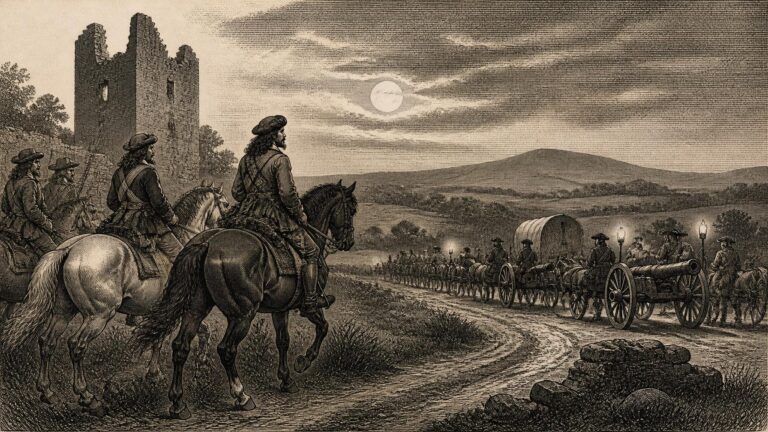
Patrick Sarsfield

Surrender Refused

Limerick formally entered a state of siege on 9 August 1690 when William III’s army moved from its camp near Cahirconlish and established itself before the city. William sent a summons demanding surrender to Alexandre de Rainier de Droué, Marquis de Boisseleau, the French officer entrusted with commanding the Jacobite infantry within Limerick. The decision placed the city’s inhabitants, soldiers and defences at the centre of the war following the Boyne. William expected the remaining Jacobite resistance to collapse, but Limerick’s position behind the Shannon and the presence of a substantial garrison offered the defenders a final opportunity to continue the campaign.

Shannon Retreat

Limerick became one of the principal centres of Jacobite resistance after William III’s victory at the Boyne on 1 July 1690 forced the Irish army to abandon the eastern approaches to Dublin. James II departed for France, but most of his surviving soldiers remained under arms and withdrew westwards towards the River Shannon. Some gathered around Athlone, which guarded an important crossing into Connacht, while the larger concentration developed around Limerick. The city’s walls, river position and access to the western counties offered the Jacobites a defensible base from which the war might continue despite the loss of Dublin.

Now Sharing: Articles (154) Images (306) Total Items Archived (460)
Our Mission: 100,000 Items Total Percentage Achieved (0.46%)