
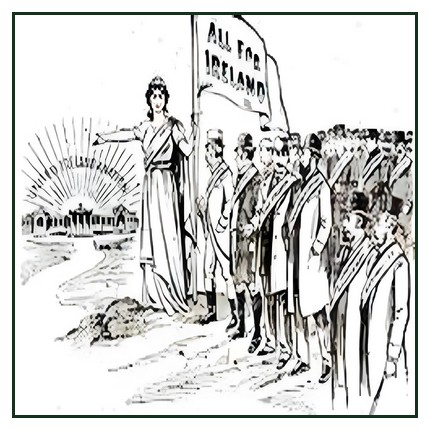
Ireland – Despite condemnations from prominent figures like the Archbishop of Tuam and Cardinal Logue, the United Irish League’s influence remains palpable, as illustrated by recent incidents that showcase the movement’s strength. Cattle driving, a practice criticized by clergy, continues to thrive, revealing the League’s significant impact and prompting questions about the effectiveness of existing laws.
A gathering organized by the local branch of the United Irish League in Greenane, County Wicklow, serves as a stark example. The meeting, designed to draw attention to a recent eviction, featured the Rev. J. Caffrey, P.P. of Aughrim, presiding. Attendees were informed that negotiations between the landlord and the tenant had taken place. Notably, Mr James O’Connor, MP.., emphasized the power of the organization, suggesting that the mere announcement of such a meeting exerted legitimate influence over the landlord. His remarks hinted at the League’s potential reliance on intimidation tactics.
Mr O’Connor went a step further, asserting that the advice to give Mr Birrell a chance, often associated with cattle driving, indicated the practice’s impact on political decisions. He argued that the people of Meath, Galway, and Roscommon knew what was best for their interests, refusing to condemn cattle driving and expressing willingness to participate if necessary. The lack of protest from the presiding clergyman suggested a concerning acceptance of such sentiments within the audience.
In legal proceedings related to the Ormond Hunt, a county court judge in Birr questioned whether the ordinary law or “mob law” was prevalent, highlighting the challenge of enforcing established legal norms. Despite the judge’s inquiry, judgments were rendered against United Irish Leaguers, emphasizing the need for adherence to existing laws.
The influence of the League also manifested in civil proceedings, where a tenant faced eviction for refusing to sign an eleven-month rent agreement. The petitioner, backed by the United Irish League, sought possession of the lands. In a bold move, the judge suggested that the tenant should have directed the League to mind their own business, emphasizing the importance of upholding ordinary law.
In another legal episode, individuals were charged with intimidating a landowner in Glencar, County Sligo. Despite attempts to secure warrants, the defendants eluded arrest, revealing a level of lawlessness in the West and parts of the South, where Nationalists openly boast about the dominance of the United Irish League’s law over the land.
As the League’s influence continues to clash with established legal frameworks, these incidents shed light on the complexities of enforcing law and order in Ireland. The pending by-elections further underscore the volatile political landscape, where competing ideologies and movements vie for control and influence, leaving both the legal system and local communities caught in the crossfire.
Daily Telegraph & Courier (London) – Monday 06 January 1908

