

Working Ireland
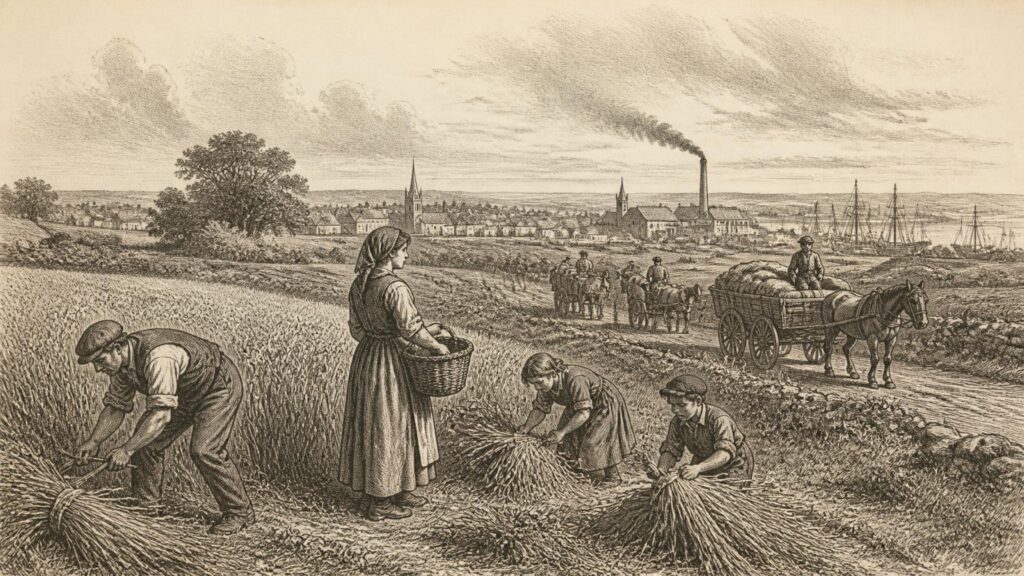
AI generated historical illustration, not a contemporary photograph.
At a Glance
Employment has never been merely an economic category in Ireland. It has shaped where people lived, whether they married, when they emigrated, how women’s work was valued or concealed, which communities prospered, and how political loyalties formed. The history of Irish work is therefore not a simple advance from farms to factories and offices. It is a history of uneven opportunity, of seasonal and insecure labour, of migration used as an escape from unemployment, and of determined collective action by workers seeking dignity, wages and control over their lives.
Rural Labour
For much of recorded Irish history, the principal setting of work was the countryside. Farming, herding, fishing, milling, turf cutting, craft production and domestic labour overlapped rather than existing as separate occupations in the modern sense. A household might cultivate a small holding, keep animals, make clothing, repair tools, gather fuel and take temporary work for a larger farmer or landlord. Such activity was economically vital even where no weekly wage changed hands. It is consequently difficult to impose modern ideas of employment upon earlier Ireland without losing much of what people actually did.
Evidence for the medieval and early modern periods is uneven. Legal texts, estate records, annals and archaeological findings reveal skilled craftspeople, tenant cultivators, servants, traders and people engaged in maritime work, but they do not provide a complete labour-force count. Nor is it sensible to attach exact prehistoric dates to occupations whose origins lie beyond written evidence. What can safely be said is that farming and livestock management long structured settlement, social status and subsistence. Control of land mattered because it controlled access to work, food and security.
The Irish countryside was never economically uniform. Better land supported grain, cattle, dairying and market production, while mountain, bog and marginal districts often depended on mixed small-scale cultivation and seasonal expedients. Coastal communities combined farming with fishing and sea traffic. Towns supplied markets for food, leather, cloth, timber and metalwork, while rural producers bought manufactured goods or sold surplus produce. The line between a farmer, labourer and craft worker could therefore be blurred.
Household labour was central. Women’s work included dairying, poultry keeping, spinning, food preparation, child care, washing, marketing and the management of domestic resources. Children also contributed according to age, household need and local custom. These activities were frequently absent from formal records because they were not recognised as separate paid occupations. Their absence should not be mistaken for idleness or economic insignificance. It demonstrates instead that official definitions of work were narrower than the labour required to sustain rural life.
Interpretations of pre-industrial Ireland must also avoid a romantic picture of a self-sufficient peasantry. Household production gave families practical resilience, but it could coexist with debt, poor housing, dependence upon landlords and merchants, and vulnerability to harvest failure. The capacity to work did not guarantee secure employment or an adequate livelihood. That distinction became tragically clear during the nineteenth century.
Land Dependence
By the eighteenth and early nineteenth centuries, landholding arrangements had made access to work acutely precarious for many rural families. Population growth, subdivision of holdings and dependence on the potato enabled large numbers of people to survive on very small plots, while also binding them to a fragile local economy. Cottiers and labourers could exchange labour for conacre ground, cash, food or other forms of payment. Work was often seasonal: digging, planting, harvesting, drainage, road making and turf cutting brought periods of intense demand, but not necessarily year-round employment.
Estate papers and contemporary observers show a hierarchy of rural work. At one end stood substantial farmers and graziers, who employed servants and labourers. At the other were men and women with little or no land, reliant on casual hiring, domestic service, spinning, seasonal migration or relief. Between them were smallholders whose own labour kept their farms viable but who might also hire out themselves or members of their households. The structure varied by province, soil, market access and local landlord practice.
The linen economy provided an important supplement in parts of Ulster and elsewhere. Spinning and weaving linked rural homes to merchants, bleachers and export markets. Yet cottage industry did not mean independence from commercial power. Producers could be exposed to fluctuations in prices, credit and demand. In some districts, the transition from hand production to mechanised factory processes later displaced or devalued work that had been carried out in homes.
Seasonal migration was another long-standing response to inadequate local opportunity. Irish workers travelled to Britain for harvests, construction and other temporary employment, while movement within Ireland connected poorer western districts with areas of stronger agricultural demand. Such mobility complicates the notion of a fixed rural population. Many households survived because one or more members could earn elsewhere for part of the year and bring money home.
Folklore and family memory often preserve an image of communal rural labour: neighbours helping at harvest, turf cutting or house building. Such cooperation was real, but it should not conceal unequal power. Mutual aid operated alongside hiring, rent, debt and dependency. A neighbourly exchange of labour could be a form of solidarity; it could also be the only way a household with little cash could manage essential work. The historical record asks that both possibilities be kept in view.
Famine Labour
The Great Famine transformed the relationship between work, relief and migration. When potato failure became prolonged after 1845, labour could no longer reliably secure food. For the poorest families, work on roads or estates was often insufficient, unavailable or paid in a currency that could not meet rapidly rising needs. The catastrophe exposed the weakness of an economy in which vast numbers depended on a single crop and possessed little protection against its collapse.
Public works were introduced as a relief measure, particularly during 1846 and early 1847. They employed people on roads, walls and other schemes, sometimes in severe weather and under gruelling conditions. Contemporary criticism centred on low wages, delayed payment, poor administration and the physical weakness of workers already suffering hunger. Historians debate the balance between administrative failure, ideology and the immense scale of need, but there is no serious doubt that relief labour was inadequate to the emergency. Employment schemes designed around notions of discipline and deservingness could not substitute for direct food relief when hunger was widespread.
The shift towards soup kitchens and, later, greater reliance on the Poor Law altered the relief system, but it also imposed hardship and stigma. Workhouses were not workplaces in the ordinary sense, although inmates performed tasks within them. They were institutions of last resort, separating families and governed by strict rules. Their place in the history of employment lies in the distinction between the availability of labour and the availability of paid work. People could be willing and able to work, yet have no viable labour market in which to sell that capacity.
Emigration became inseparable from employment history. Many people who left Ireland did so not simply because they sought adventure or because relatives had gone before, but because local work could not support life. University College Cork’s Emigre project notes the extraordinary scale of outward movement from nineteenth-century Ireland and emphasises the importance of employment prospects abroad. Migration networks reduced the practical risks of departure by providing information, loans, contacts and somewhere to stay. Nevertheless, leaving involved danger, bereavement and permanent separation as well as possibility.
The Famine also changed labour relations within Ireland. Population fell dramatically, holdings consolidated in some areas, and the demand for certain kinds of labour changed. It would be misleading to describe this as a straightforward improvement for surviving workers. Some gained bargaining power; many others entered a society marked by loss, depopulation and persistent emigration. The aftermath made clear that the question was not only how many jobs existed, but who had land, skills, mobility and the social resources necessary to obtain them.
Industrial Ulster
Nineteenth-century Belfast developed along a markedly different path from much of the island. Its growth rested upon trade, linen, engineering, shipbuilding, rope making, tobacco, food processing and associated commerce. The city drew workers from rural Ulster and beyond, becoming the most conspicuous Irish example of large-scale industrial employment. By 1901, according to research preserved by the CAIN archive at Ulster University, Belfast had expanded from a town of about 19,000 people in 1800 to a city of 349,000.
Industrialisation created new forms of regular wage employment, but it did not erase insecurity. Work was governed by business cycles, technological change, managerial authority and the unequal position of skilled and unskilled workers. Shipyard, engineering and machine work could provide relatively well-paid skilled employment for men, particularly where apprenticeships and union organisation offered entry. But recruitment frequently depended on kinship, neighbourhood and informal networks. These could protect established communities while excluding outsiders.
Textiles were equally important, and their history makes clear why employment must be understood through gender. The mechanisation of spinning, weaving and finishing generated factory work for large numbers of women and girls, frequently at lower wages and with less security than male skilled occupations. The CAIN study observes that 43 per cent of women and girls in Belfast were at work in 1901, compared with 32 per cent in England and Wales. That statistic does not mean that Belfast offered equal opportunity. It indicates the intensity of female wage labour within an industrial city whose employers often relied on it precisely because it was cheaper and more readily controlled.
Factory work altered daily rhythms. Bells, shifts, supervisors and machinery imposed a discipline different from seasonal agricultural labour or household production. Workers travelled to mills, yards and warehouses, bringing employment into densely settled urban districts. The industrial workplace could offer wages and collective sociability, but it also exposed people to accidents, dust, noise, long hours and dismissal. Belfast’s prosperity was therefore real, but it was neither evenly distributed nor socially neutral.
Industrial development in the north should not be allowed to stand for Ireland as a whole. A recent University College Cork study of industrial output argues that Ireland did not experience simple absolute deindustrialisation between 1800 and 1913, but that industrial growth was disappointing in comparative terms. Belfast’s exceptional concentration of heavy industry existed beside a predominantly agricultural island. The contrast mattered profoundly after partition, when economic systems that had developed within one island came to be governed through two states.
Urban Poverty
Dublin also contained significant manufacturing, transport, port, building and service employment, but it did not industrialise on Belfast’s scale. Its working population included dockers, carters, labourers, printers, railway workers, shop assistants, domestic servants, tailors, builders, food workers and many others. The city’s commercial and administrative importance created jobs, yet overcrowded tenements and irregular employment made poverty a defining feature of urban life for many families.
Work in the docks and on building sites was often casual. A worker might seek a day’s hire without any assurance of being selected. Casual labour shifted economic risk away from employers and on to households. When employment was interrupted by weather, illness, conflict or changes in trade, wages disappeared immediately. Families responded through pawnshops, credit, women’s earnings, lodgers, informal exchange and help from relatives. These strategies were resourceful, but they were signs of insecurity rather than prosperity.
The evidence available to historians is rich but partial. Census schedules, Poor Law records, city directories, trade-union papers and newspapers can identify occupations and disputes. They are less reliable as guides to the intermittent work that filled gaps between jobs. A man returned as a labourer might have worked at the docks, on roads, in a warehouse or wherever a day’s pay could be found. A woman described only through her husband’s occupation may have taken in washing, sewing, lodgers or food work without leaving a corresponding occupational entry.
Housing and employment were closely linked. Overcrowding was not merely a consequence of low wages; it could also affect health, family life, access to work and the ability to keep possessions or prepare food. The familiar historical image of Dublin tenements should therefore not be treated as scenery behind a labour story. It was part of the labour story. A worker’s capacity to arrive punctually, remain healthy, care for children or withstand unemployment depended upon domestic conditions as well as the wage offered at a gate or office.
Urban poverty was not confined to Dublin. Cork, Limerick, Waterford, Galway, Derry and many smaller towns contained their own distinctive combinations of trade, transport, service work and casual employment. Yet Dublin’s scale and the survival of records have made it especially prominent. The broader lesson is that employment figures alone cannot reveal the quality of work. A person counted as employed may have been poorly paid, intermittently hired and one accident away from destitution.
Women Workers
Women’s employment has often been underestimated because official records treated paid work, domestic responsibility and family status in restrictive ways. The instructions issued with the 1911 census return are revealing. They required regular work performed away from home, or business conducted at home, to be recorded; but no occupation was to be entered for women solely engaged in domestic duties at home. The rule did not deny that domestic labour existed. It denied it the status of an occupation.
Women worked in agriculture, domestic service, textiles, clothing, retail, education, nursing, clerical roles, food processing and many forms of home-based production. Their experience varied sharply by class and location. A farmer’s wife, a linen mill worker, a live-in servant, a dressmaker, a teacher and a shop assistant were all working women, but their income, autonomy and vulnerability were very different. Marriage could end a woman’s recorded employment even when household and farm work continued. Parenthood could intensify labour rather than remove it.
Domestic service was among the largest categories of female paid work. It offered food and accommodation as well as wages, which could make it attractive to young women from poor rural households. Yet it also involved long hours, limited privacy and dependence upon employers. Service helped sustain middle-class homes and urban households, while separating many young women from their own families and communities. Its prominence in census returns should not make it appear easy or uniformly desired.
Textile districts gave women access to wages outside domestic service, but not necessarily to equality. Mill labour brought collective workplaces, friendships and the possibility of union involvement. It also carried risks of low pay, managerial discipline and precarious employment during downturns. In the First World War, demand for particular goods and munitions briefly widened some opportunities. The National Museum of Ireland has documented women employed in munitions factories and the union campaigns that secured improved rates. Such gains were important, but they did not permanently overturn occupational segregation after the war.
Historical interpretation must resist two opposite errors. One is to imagine that Irish women entered work only in the late twentieth century. The other is to treat any wage job as liberation. Women had always worked, whether or not the census named their work. The major changes concerned visibility, access to education, legal rights, contraception, marriage patterns, public employment, trade-union representation and the ability to remain in paid work across adulthood.
Organised Labour
Trade unionism developed in Ireland within the wider framework of British and international labour movements, but it acquired distinctive Irish forms. Skilled workers had access to craft organisations before general labourers did. Many early unions were branches of British bodies, reflecting the integrated economy of the United Kingdom of Great Britain and Ireland. This offered resources and connections, while also raising questions about who controlled Irish workers’ representation.
General workers, casual labourers and women were harder to organise. Their bargaining position was weakened by poverty, high turnover and the availability of replacement workers. The educational material prepared by University College Cork on the Irish labour movement notes that three quarters of Dublin’s workforce in 1911 was unskilled and unorganised. The figure captures why calls for solidarity faced formidable obstacles. A worker who risked dismissal could quickly be replaced by someone desperate for wages.
James Larkin and James Connolly became enduring symbols of Irish labour radicalism because they insisted that workers’ conditions were not secondary to national politics. Larkin’s Irish Transport and General Workers’ Union sought to organise workers who had traditionally been neglected by craft unionism. Connolly joined socialist analysis to a powerful account of class, colonialism and national self-government. Their importance rests not upon legend alone, but upon the institutions, strikes, speeches and publications through which labour politics became visible.
The 1913 Dublin Lockout remains central because it exposed the confrontation between employer power and the effort to secure union recognition. It was not a simple contest between two united camps. Workers possessed differing skills, incomes and commitments; employers differed in interests; and public opinion was contested. But the lockout made insecurity plain. Families endured hunger because the struggle occurred in an economy where most had no savings to carry them through prolonged loss of wages.
Labour organisation also developed beyond Dublin. Railway workers, dockers, farm labourers, shop assistants, textile workers and others formed associations and pursued local disputes. Rural organising faced special difficulties, but agricultural workers were not politically passive. The history of strikes in counties such as Meath, Galway and Sligo shows that labour conflict existed within agriculture as well as factories. Work on the land involved wages, hours, housing and power, not simply inherited custom.
Revolutionary Years
The years from the First World War through the War of Independence and Civil War brought inflation, disruption, political mobilisation and labour conflict. Employment was shaped by wartime demand, military recruitment, shortages and the reorganisation of trade. Women entered some new roles, particularly where war production expanded, though Ireland’s experience differed from heavily industrialised areas of Britain. Existing sectors such as agriculture, domestic service, linen and shirt making remained important.
Labour activists participated in strikes, workplace committees, demonstrations and political campaigns. The period also witnessed soviets, especially in industrial and commercial disputes, in which workers sometimes assumed temporary control of premises or production. Such events have attracted later ideological interpretation. They should neither be inflated into evidence that Ireland was on the verge of a socialist revolution nor dismissed as irrelevant curiosities. They demonstrate that, amid political upheaval, workers could imagine direct control as a practical response to lockouts, closures and wage disputes.
National independence did not automatically answer labour questions. The new Irish Free State inherited a predominantly rural economy, limited industrial capacity and a society damaged by conflict. The Labour Party had stood aside from the 1918 general election in order not to divide the nationalist vote, a decision later remembered as a missed electoral opportunity. Yet labour issues continued to shape public policy and industrial relations. Workers wanted employment, housing and social protection; employers sought stability and competitiveness; governments had constrained resources and contested priorities.
Evidence from this era must be read with care. Political speeches often presented labour as either the authentic voice of the people or a disruptive threat to national order. Neither description wholly fits the varied experience of workers. A farm labourer, a Belfast shipyard worker, a Dublin tramway worker and a small-town shop assistant could share certain anxieties while occupying very different political worlds. The revolutionary period heightened these differences as well as creating moments of solidarity.
The enduring historical point is that national sovereignty and economic security were related but not identical. Independence created the possibility of domestic policy choices. It did not create jobs by itself. The difficulty of turning political autonomy into broad employment remained one of the central tests of the new state.
Partitioned Economies
Partition after 1921 created two jurisdictions with contrasting employment structures. Northern Ireland retained Belfast’s industrial base, including linen, engineering and shipbuilding, while the Irish Free State remained more dependent on agriculture and smaller-scale commerce. This contrast was substantial, but it should not be exaggerated into a story of industrial north and empty south. Both economies contained towns, services, farms, factories and unemployed people; both were affected by British markets and global conditions.
In Northern Ireland, work was entangled with religious and political identity. The CAIN study on employment, unemployment and religion documents patterns in which Protestants were disproportionately represented in manufacturing, shipbuilding and engineering, while Catholics were more concentrated in commercial occupations, shopkeeping, domestic service and general labouring. These were patterns rather than universal rules, and they changed over time. Nevertheless, they contributed to unequal access to better-paid skilled employment.
Claims of discrimination require careful language. Individual experiences cannot always be reconstructed, and labour markets are shaped by education, residence, family connections, industrial geography and employer decisions as well as overt prejudice. Yet historical research indicates that employment advantage and disadvantage were not distributed neutrally between communities. Informal recruitment through family and neighbourhood could preserve occupational dominance without the need for a written exclusionary rule. Sectarian hostility also made certain workplaces unsafe or unwelcoming for some workers.
In the south, the Free State’s economic policy was constrained by public finances, trade dependence and emigration. Agriculture remained the leading source of livelihood, while civil service, education, transport and local government provided important but limited employment. Protectionist policies from the 1930s encouraged domestic manufacturing in some sectors, though the gains did not remove underemployment or dependence upon migration. Economic nationalism promised self-sufficiency, but a small domestic market and limited capital restricted what it could achieve.
Partition also divided statistical systems, policy frameworks and labour politics. Yet people continued to move across the border for work, trade and family reasons. A history of Irish employment must therefore recognise the island-wide connections that survived political division, while refusing to erase the very real consequences of two states, two legal systems and increasingly divergent economic policies.
State Employment
The expansion of the modern state changed the meaning of secure employment. Teachers, postal workers, railway employees, civil servants, local authority staff, gardaí, nurses and other public servants formed a visible part of twentieth-century working life. Such jobs were often valued for regular wages, pensions and relative permanence. They also required education, examinations, patronage in some contexts and access to training. Security was more available to some groups than to others.
Education mattered increasingly because new occupations demanded literacy, qualifications and technical competence. The National Archives of Ireland holds school records that show why education history and employment history are inseparable: registers may record parents’ occupations, attendance, addresses and pupils’ progress. A child’s route through school could affect access to teaching, clerical work, apprenticeships or migration. Yet educational opportunity itself reflected family income, geography and gender.
Public employment could also reinforce conventional social expectations. Women gained access to teaching, clerical and nursing posts, but marriage bars and discriminatory practices limited careers in parts of the public and private sectors for much of the twentieth century. The removal of such barriers was not merely an administrative adjustment. It altered household incomes, women’s independence and the social expectation that paid work should end when a woman married.
In both jurisdictions, welfare provision gradually changed the experience of unemployment, illness and old age. Benefits did not remove hardship, but they reduced the absolute dependence on family charity, poor relief or emigration. The development of social insurance also made official employment status more consequential. Workers whose jobs were informal, intermittent or poorly recorded could remain less protected than those in regular insured occupations.
There is a temptation to describe state employment as an uncomplicated route out of insecurity. It was not. Public budgets could be cut, promotions could be unequal and wages could lag behind living costs. But the growth of public service work did widen the range of occupations available in a society long marked by small farms, domestic service, manual labour and departure abroad. It represented one aspect of a broader transition towards a more educated and administratively complex Ireland.
Emigration Safety
For generations, emigration functioned as an unofficial labour-market adjustment. When work was unavailable at home, people left for Britain, the United States, Canada, Australia and other destinations. The word “safety” requires qualification: migration could protect households from destitution through remittances and overseas wages, but it also separated families and transferred Irish labour to other economies. It was a coping mechanism, not evidence that the domestic employment problem had been solved.
Irish men found work abroad in construction, transport, docks, factories and public services. Irish women entered domestic service in very large numbers, particularly in Britain and North America. The resulting diaspora was sustained by letters, remittances, parish connections and chain migration. These networks were practical labour institutions even when they were not formally organised. A cousin’s address in London or New York could matter as much as a local vacancy at home.
The 1950s illustrate the severity of the relationship between employment and emigration in the Republic. University College Cork’s Emigre history describes a decade in which agricultural decline and insufficient new industry left little steady work for many young people. Roughly half a million people left the Republic during that decade, an extraordinary loss for a population then under three million. The experience left deep marks on family structures, local communities and cultural memory.
Popular memory often represents emigrants as those who were “forced” to leave. That phrase conveys an emotional and economic truth, but historians should recognise degrees of agency. Some migrants actively pursued higher wages, training, independence or city life. Others left because the alternatives were plainly worse. The decision could contain ambition and compulsion at once. A young person might welcome the prospect of London while knowing that no sustainable future existed in the home parish.
Emigration also affected those who remained. Remittances supported households and funded improvements, but the absence of young adults altered care arrangements, marriage patterns and community life. In this sense, the history of employment abroad belongs within Irish history. Jobs in British hospitals, building sites and homes were part of the economic survival of Irish families, even though the work was performed beyond the island.
European Change
Economic change from the late 1950s and Ireland’s entry to the European Economic Community in 1973 gradually widened the framework within which employment policy operated. The Republic moved away from the most restrictive forms of protectionism and sought foreign investment, export growth and closer participation in European markets. Agricultural modernisation altered rural employment, often reducing the number of people needed on farms while increasing output and specialisation.
The process was uneven. Industrial development agencies attracted manufacturing and later internationally traded services, but regional disparities remained. Rural areas could lose population even as national indicators improved. Women’s educational attainment and labour-force participation rose, changing the composition of paid work and family life. The Central Statistics Office records the scale of longer-term change: employment rose from about 1.07 million people in 1973 to approximately 2.55 million in 2022, although the series uses changing statistical definitions across its full span and should therefore be read cautiously.
The 1970s also brought economic pressure. Oil shocks, inflation and later fiscal difficulties constrained job creation. By 1988, the CSO records unemployment at 16.3 per cent under the principal economic status measure used for that period. The rate indicates a grave national problem, but it does not capture every form of underemployment, discouraged job seeking or emigration. As before, outward migration absorbed part of the labour surplus.
European integration did not simply create jobs. It reshaped standards, investment flows, training and mobility. It also made Irish workers more mobile within a wider labour market. For some, that mobility was an opportunity; for others, it repeated an old pattern in a new institutional setting. The historical continuity is striking: Irish policy increasingly sought to make migration a choice rather than an economic necessity, yet periods of recession repeatedly tested that ambition.
In Northern Ireland, European change intersected with political conflict, public-sector employment and the decline of traditional industries. The labour market could not be separated from the Troubles, fair-employment legislation or the concentration of unemployment in particular communities. Economic transformation was therefore inseparable from the pursuit of civil rights, equality and peace.
Celtic Expansion
The rapid growth of the 1990s and early 2000s, commonly labelled the Celtic Tiger, altered the employment landscape of the Republic more quickly than any earlier peacetime boom. Construction, finance, retail, information technology, pharmaceuticals, business services and foreign direct investment expanded. Employment rose sharply, unemployment fell, and Ireland shifted from a country defined by outward migration to one attracting returning emigrants and new migrants from Europe, Africa, Asia and elsewhere.
Such change should not be reduced to a celebratory national myth. The boom created real opportunities, including jobs for people who might earlier have emigrated. It increased women’s labour-force participation and diversified workplaces. It also depended heavily on construction and property development, sectors vulnerable to financial shocks. Income and wealth were not equally distributed, and the availability of work did not automatically solve problems of housing, childcare, low pay or insecure contracts.
Immigration changed the social history of employment. Workers from outside Ireland filled roles across health care, hospitality, construction, food processing, transport, domestic work and professional services. Their presence challenges any account that treats the Irish labour force as ethnically fixed. Modern Irish employment became increasingly international, while older Irish patterns of migration provided a powerful, if imperfect, context for understanding newcomers’ experiences.
The boom also transformed expectations. For a generation accustomed to stories of 1950s or 1980s departure, full employment appeared to signal a decisive break with the past. That belief was understandable but fragile. The property-centred nature of much growth meant that employment was exposed to the same speculative forces that were inflating house prices and expanding credit. When the financial crisis came, the vulnerability became clear.
Historians should distinguish the documented economic expansion from the retrospective folklore surrounding it. Stories of effortless wealth, universal prosperity and limitless jobs are memorable, but they flatten a more complicated reality. Many households gained significantly; others were already living with debt, low wages or insecure tenancy. The boom changed Ireland, but it did not abolish inequality or risk.
Crash Recovery
The financial and property crash after 2008 brought a dramatic reversal. Construction employment collapsed, businesses failed and unemployment rose rapidly. The CSO’s historical labour-market series records an unemployment rate of 15.9 per cent in 2012, following a low of 4.2 per cent in 2001. Those figures make the scale of reversal visible, although they cannot convey the anxiety experienced by households facing mortgage arrears, wage cuts, emigration or prolonged job searching.
Young adults were particularly affected. Some delayed leaving home, returned to education or accepted work below their qualifications. Others emigrated, often to Britain, Australia, Canada and elsewhere in Europe. The return of emigration demonstrated that the old relationship between employment shortage and outward movement had not disappeared. Yet the migrants of this period were not identical to those of the 1950s. Many possessed third-level education, professional skills and digital connections that made departure and return easier, even if emotionally difficult.
Recovery during the later 2010s and early 2020s restored employment, but the shape of work changed. Remote work, platform-mediated services, short-term contracts and multinational service industries complicated older distinctions between factory, office and home. The COVID-19 pandemic briefly disrupted employment on a massive scale while highlighting the importance of health workers, retail staff, delivery workers, cleaners, carers and others whose labour was sometimes described as essential only when it became impossible to ignore.
Long-run comparison is instructive. In 1926, the CSO records 1,307,662 people in gainful occupations in the Irish Free State, with 51 per cent working in agriculture. In Census 2022, 2,320,297 people were at work and almost 4 per cent were in agricultural occupations. The figures establish a profound structural change from an agrarian workforce towards services, professional work, administration and modern forms of manual employment. They do not prove that all contemporary work is secure or well paid.
Recovery must therefore be judged by more than the headline number employed. Hours, pay, housing costs, collective bargaining, care responsibilities, regional opportunity and workplace rights determine whether employment provides a stable life. Ireland’s history repeatedly shows that a job count is an essential measure, but never a complete social history.
Records Memory
The sources used to reconstruct Irish employment have their own histories and silences. Census returns classify people through official categories that changed over time. The 1911 instructions asked enumerators to distinguish particular branches of work and even to identify workers who were unemployed at the time of the census. This creates valuable detail, but it also reflects the administrative priorities of the state. People working in several jobs, helping family enterprises or undertaking unpaid domestic labour could be difficult to classify.
The 1926 census of the Irish Free State is especially important because it provides an early statistical portrait of the new state. Its recently digitised occupational tables reveal an overwhelmingly agrarian workforce, alongside a range of trades in transition. Coopers, saddlers, horse-vehicle drivers, milliners, lace workers, motor drivers, mechanics and electrical fitters appear within the same occupational landscape. Such lists make historical change visible, but they should not be read as a complete map of lived work.
Trade-union records, employment registers, company papers, school records, newspapers, memoirs and oral testimony supply different perspectives. An employer’s wage ledger may identify a worker but not explain a dismissal. A union minute may record a dispute but not the private hardship that produced it. An oral history can describe fear, pride or workplace culture that official documents omit, while also being shaped by later memory. Good historical practice does not choose one kind of evidence against another; it compares them.
Folklore is particularly valuable when used carefully. Stories about a grandfather in the shipyard, a grandmother in service, the annual journey to England for harvest work, or the mill whistle that ordered a neighbourhood’s day may preserve experience unavailable in formal archives. They become historical evidence when their nature is acknowledged: they are memories and traditions, not automatically precise records. They can guide questions, illuminate meaning and sometimes be checked against documentary evidence.
The history of employment is consequently also a history of recognition. Who was counted as working? Who was named only as a dependent? Whose skills were recorded? Whose labour left no written trace? Asking these questions broadens the subject beyond wages and occupations towards the social arrangements that made paid work possible.
Uneven Futures
Ireland’s employment history is not a march from poverty to prosperity. It is a succession of transformations in which new work replaced, reshaped or concealed older forms. Agriculture declined as a share of employment but remains essential. Heavy industry contracted in Belfast, leaving powerful social and political legacies. Domestic service lost its former dominance, while care work continues in new institutional and household forms. Migration changed from necessity for many to an option for some, though economic shocks have repeatedly revived the pressure to leave.
The island’s two jurisdictions retain different labour-market institutions and histories, yet they share enduring questions: how to distribute opportunity beyond major cities; how to value care; how to address insecure work; how to ensure fair access across communities; and how to reconcile economic growth with housing, public services and environmental limits. These are historical questions because they arise from patterns formed over generations.
Documented evidence supports a clear conclusion. Employment has been one of the main forces organising Irish society, not simply a consequence of it. Land systems shaped labour; industrialisation concentrated opportunity; gender determined what was paid and what was ignored; religion and politics influenced access in Northern Ireland; migration relieved unemployment while changing communities; and state and European policies altered the range of possible livelihoods.
Interpretation adds a further point. The most important change may not be the transfer of workers from fields to offices, but the slow and incomplete widening of who can expect secure, recognised and fairly rewarded work. That change has been real, yet it remains vulnerable. The historical record warns against complacency: prosperity can be regional, temporary and unequal, while the labour that sustains everyday life is often least visible when it is most necessary.
Working Ireland, then, is a story of endurance and adaptation, but not one that should be sentimentalised. People made lives through skill, movement, organisation and family support under conditions they did not wholly choose. Their history survives in censuses and archives, in union papers and school registers, and in remembered names and occupations. It remains indispensable to understanding Ireland’s past and the continuing meaning of work.