

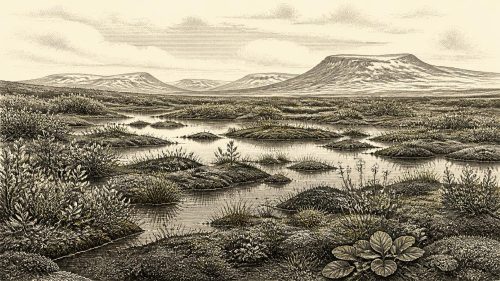
Fermanagh’s Bogbean Interval
Archived: 20 September 2026
At 31,106 BCE, a modern label within a broad radiocarbon range, Ireland experienced unstable late Marine Isotope Stage 3 conditions. Derryvree, County Fermanagh, preserves freshwater sediments between glacial tills, indicating an ice-free, treeless periglacial wetland of mosses, sedges, bogbean and tundra plants before later ice advance. Although ice sheets were expanding, glaciation remained uneven and sea-level change did not necessarily create accessible routes. Cave finds suggest cold-adapted mammals, including reindeer, mammoth and predators, but are time-averaged and fragmentary. Possible early human modification of a Castlepook bone remains unconfirmed; secure human evidence is far later. This is primarily regional environmental history.