

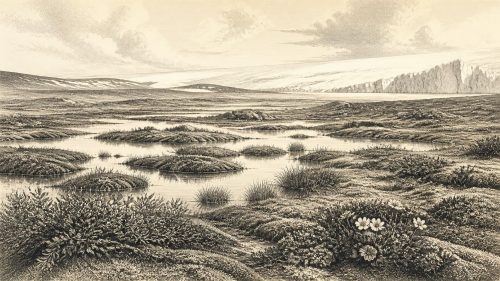
Derryvree’s Mountain-Avens Bed
Archived: 19 September 2026
At roughly 31,137 BCE, Ireland lay within the volatile Late Pleistocene, approaching but preceding the Last Glacial Maximum. Sediments beneath glacial tills at Derryvree, County Fermanagh, preserve evidence of a cold, locally ice-free freshwater wetland, dated broadly to 36,900–31,700 calibrated years BP. Mosses, sedges, mountain avens, dwarf willow, juniper, bogbean and insects indicate open, treeless, waterlogged tundra-like terrain. Elsewhere, Castlepook Cave fauna demonstrate intermittent connections with north-west Europe, including cold-adapted mammals and predators. A possibly butchered reindeer bone suggests, but cannot prove, occasional human visits. The evidence reveals changing ice, sea levels and habitats, not dated events, societies or settlements.