

Related Archive: County Cork

Mitchelstown’s September Dead
In 1887 Arthur Balfour’s Unionist administration combined coercion with limited land reform amid depressed farm incomes and organised tenant resistance. The Criminal Law and Procedure Act proclaimed districts and outlawed the Irish National League, while the Land Law Act revised protections, rents and purchase provisions. The Plan of Campaign mobilised tenants, notably on the Kingston estate near Mitchelstown. On 9 September, RIC police fired on a crowd, killing Michael Lonergan and mortally wounding John Shinnick and John Casey. The shootings intensified controversy over public meetings and policing. Meanwhile, The Times attacked Parnell, while antiquarian scholarship asserted Ireland’s distinct cultural heritage.
View Record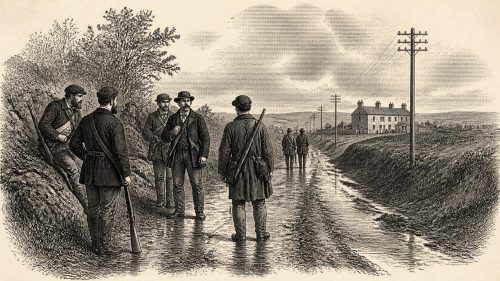
Bottle Hill Rising
In 1867 the Irish Republican Brotherhood launched a poorly coordinated Fenian rising seeking an independent republic and social reform. After alarms including the failed Chester Castle raid, authorities extended habeas corpus suspension, arrested suspects, and strengthened policing. On 5 March, insurgents attacked police and coastguard stations, disrupted telegraphs and railways, and assembled near Dublin and in Munster. Better-armed government forces, intelligence, poor communications, inadequate weapons, and absent mass support quickly defeated them. Peter O'Neill Crowley's later death fostered martyrdom. The year brought Fenian rescues and executions in Manchester, transportation to Western Australia, the Clerkenwell bombing, hardship, reform, and Orange mobilisation.
View Record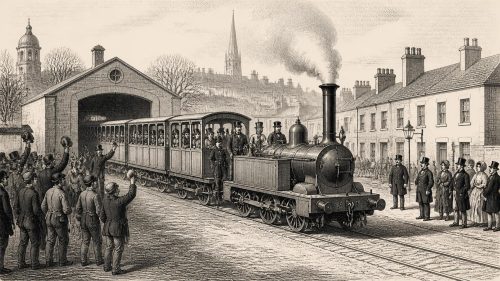
Westland Row, Gortroe
In 1834, Ireland’s contrasts were embodied by the opening of the Dublin and Kingstown Railway and the Rathcormac massacre at Gortroe, County Cork. The railway, Ireland’s first, linked Dublin’s commercial centre with its packet harbour, demonstrating private investment, engineering and growing passenger mobility. Next day, troops protecting tithe collection killed at least nine people resisting payments to the established Church of Ireland. The Tithe War exposed rural poverty, Catholic resentment and dependence on coercion. Westminster debated repeal, tithes and church reform amid ministerial instability. Population pressure, insecure labour, poor housing, disease and limited educational and health measures underscored persistent inequality.
View Record
Wellesley’s Bottle Riot
In 1822, Ireland endured agrarian unrest, food scarcity and emergency government. Lord Lieutenant Richard Wellesley inherited Rockite violence, chiefly in Munster, where the Insurrection Act, habeas corpus suspension, troops and special commissions produced prosecutions, transportation and executions. Poor harvests caused severe regional distress, especially in the west and south-west. Government coordinated charity and funded public works, employing labourers on roads, piers and harbours under engineers including Alexander Nimmo and Richard Griffith. Political divisions persisted over Catholic exclusion and the established Church. A new constabulary law encouraged organised policing. December's Bottle Riot, when a jar was thrown at Wellesley, symbolised conflict.
View Record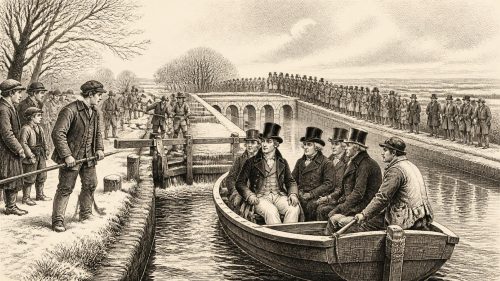
Lagan Waterway and Dublin Trials
In 1794, Ireland combined commercial development with intensifying political repression. The Lagan Canal’s completion linked Belfast to Lough Neagh, improving Ulster’s transport connections, while a gunpowder enterprise at Ballincollig reflected wartime industrial demand. Dublin’s United Irishmen publicly advocated parliamentary reform, but official alarm over French links led to raids and suppression; William Drennan’s acquittal for seditious libel nevertheless encouraged reformers. Rural violence involving Defenders, militia and local grievances demonstrated wider insecurity, though Defenders remained distinct from United Irishmen. Fitzwilliam’s appointment as Lord Lieutenant raised hopes of Catholic concessions. Mary Leadbeater’s educational publication also testified to continuing cultural and moral debate.
View Record
Carriganima’s Lament
In 1773, the killing of Art Ó Laoghaire near Carriganima exposed the unequal legal position of Catholics in Ireland. His feud with magistrate Abraham Morris, involving a horse and penal legislation, inspired Eibhlín Dubh Ní Chonaill’s enduring Irish-language lament. Morris’s acquittal and the disputed burial reinforced perceptions of unequal justice. Nationally, Lord Lieutenant Harcourt’s unsuccessful absentee-tax proposal revealed financial strain, landlord influence and limits on Dublin’s parliament. Linen, woollen promotion and trade sustained a diverse but dependent economy, while volunteer corps reflected Protestant local society. Goldsmith’s success and Leland’s contested history illustrated Ireland’s contribution to, and disputes within, British culture.
View Record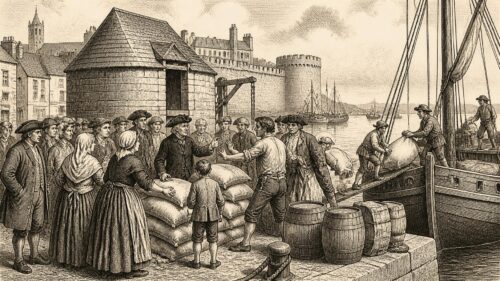
Youghal’s Grain Barrier
In 1727, Ireland experienced political continuity alongside acute social insecurity. George II succeeded George I, and a new Irish parliament assembled under a Protestant establishment managed through Dublin and London. Qualified Catholic freeholders still voted in the election, although legislation passed in 1728 subsequently disfranchised them. Harvest weakness and dear grain provoked resistance at Youghal and elsewhere to exports and interregional shipments, exposing conflict between commerce and subsistence. Linen exports did not ensure welfare. Swift criticised structural poverty, while Dublin’s workhouse expanded foundling provision amid uncertainty over dates. The year revealed unequal access to political rights, food, care and markets.
View Record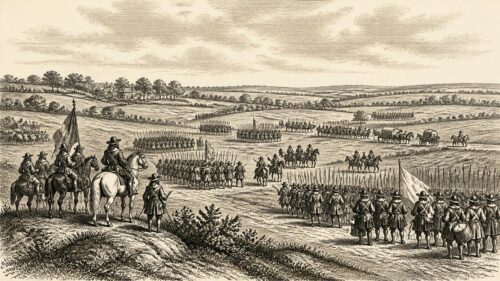
Dungan’s Hill and Cashel
In 1647, the Catholic Confederation’s position collapsed after political division, logistical weakness and military reverses. Parliament gained Dublin when Ormond transferred the city in June, providing a strategic base. Michael Jones destroyed Thomas Preston’s Leinster army at Dungan’s Hill in August, ending any prospect of taking Dublin. In Munster, Inchiquin’s forces devastated communities and stormed Cashel, killing defenders and civilians, plundering the religious complex and deepening Catholic fears. In November, Inchiquin defeated Taaffe’s army at Knocknanuss, killing Alasdair MacColla. Although Kilkenny and O’Neill’s Ulster army survived, these disasters encouraged royalist negotiation and transformed Confederate ambitions into a struggle for survival.
View Record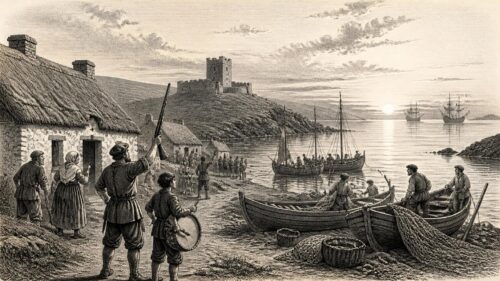
Baltimore’s Stolen Households
In 1631, Baltimore, a West Cork fishing settlement shaped by plantation, local rivalries and Atlantic commerce, suffered a corsair raid. Before dawn on 20 June, forces led by Murad Reis the Younger seized 107 inhabitants, chiefly women and children, after landing from vessels sailing from Algiers. The captives entered North African systems of sale, labour, ransom and household service; few are known to have returned. Suspicions of local collusion remain unproven. The raid exposed limited coastal protection. Elsewhere, royal honours reinforced hierarchy, Patrick Fleming founded a college in Prague and died in Bohemia, and Sir Henry Docwra died in Dublin.
View Record
Shifting Lordships
In 1219, Ireland’s power remained fragmented among Gaelic kings, Anglo-Norman lordships, churches and Henry III’s wider dominions. William Marshal died, prompting a managed succession in Leinster under Isabel de Clare’s continuing inheritance, supported by officials including seneschal Walter Purcell. In Munster, Diarmait Mac Carthaig captured Henry Butler’s Timoleague castle and its hostages, exposing colonial vulnerabilities. Domnall Mór Ó Domnaill secured submissions in northern borderlands, while Cathal Crobderg Ua Conchobair exercised authority in Connacht amid Richard de Burgh’s competing claims. Ecclesiastical deaths and succession, alongside papal involvement in the Ferns dispute, underscored church influence. Events revealed shifting, contested lordships throughout Ireland.
View Record
The Destruction of Kincora
In 1088, Muirchertach Ua Briain’s Munster faced renewed rivals after his father’s death. While he campaigned in Leinster, Connacht forces defeated Munster fleets, and his brother Diarmait’s coastal raid ended disastrously after relics were seized. Leinster’s attack on Waterford failed, while southern townsmen suffered defeat near Cork. Domnall Ua Lochlainn secured Connacht’s submission from Ruaidrí Ua Conchobair, then led a northern-Connacht invasion deep into Munster, devastating settlements and destroying Kincora, the Ua Briain stronghold. Raiding damaged cattle-based rural livelihoods, while ports supplied maritime power. Scholarly and dynastic deaths reflected Ireland’s fractured kingship and interlinked political, ecclesiastical, commercial and agricultural worlds.
View Record
Castlepook’s Mammal Passage
Ireland around 30,117 BCE lay within the climatically unstable Late Pleistocene, as the British–Irish Ice Sheet expanded unevenly and low sea levels reshaped coasts and possible dispersal routes. Derryvree, County Fermanagh, preserves freshwater organic deposits between glacial tills, indicating a treeless, wet tundra-like mosaic during a local ice-free interval. Castlepook Cave, County Cork, contains a time-spanning fauna including reindeer, mammoth, giant deer, predators and cold-adapted small mammals, demonstrating ecological richness but not a single contemporary assemblage. A cut-marked reindeer bone may suggest human carcass processing, yet no secure evidence proves settlement. Regional records reveal ice, water, vegetation and animal movements.
View Record
Elephant Hall’s Incised Femur
Labelled 30,118 BCE, this horizon represents an uncertain Late Pleistocene interval, not a precise Irish date. During Marine Isotope Stage 3, Ireland contained shifting ice, periglacial terrain, wetlands and open grazing country as the British–Irish Ice Sheet expanded towards its later maximum. Derryvree sediments indicate local ice-free freshwater environments, while Castlepook Cave preserves cold-adapted fauna including mammoth, reindeer, giant deer, hyaena and wolf. An incised reindeer femur may indicate early human butchery, but its insecure context and lack of associated tools prevent firm conclusions. Later glaciation destroyed much evidence, requiring cautious interpretations based on dated deposits, animal remains and landforms.
View Record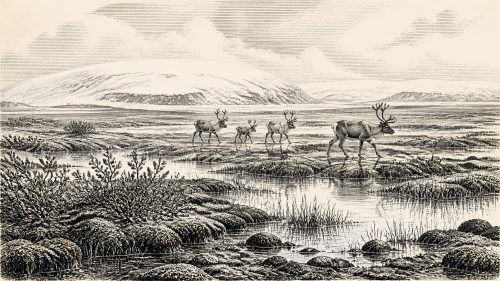
BIRM-166 Wetland Sample
At approximately 30,119 BCE, Ireland lay within the climatically unstable later Marine Isotope Stage 3, beyond precise calendar dating or historical record. At Derryvree, County Fermanagh, organic sediments between two glacial tills document an ice-free local landscape of shallow pools, mosses, sedges, herbs and tundra-like vegetation. They demonstrate regional climatic fluctuation, not an ice-free island. Lower seas and shifting ice altered coasts, while Crag Cave records intermittent conditions. Faunal remains at Castlepook Cave indicate open-country mammals. A marked reindeer bone suggests tentative Upper Palaeolithic human activity, but no secure settlement evidence exists. Environmental change and renewed glaciation define this period.
View Record
Derryvree’s Vanishing Tundra
Although 30,120 BCE lies within Derryvree’s calibrated radiocarbon range, no year-specific Irish history can be recovered. During unstable Marine Isotope Stage 3, Fermanagh’s Derryvree deposits record an ice-free interval between glacial advances: cold, treeless wetlands of pools, sedges, grasses, mosses, juniper and herbs. Later ice buried and preserved this evidence. Castlepook Cave in Cork contains remains of diverse Ice Age animals, but mixed deposits prevent a single contemporary reconstruction. A modified reindeer bone may indicate brief human butchery, not settlement. Ireland was periodically habitable amid shifting ice and sea conditions, yet lacks evidence for societies, economies, culture or enduring occupation.
View Record
Hyaenahall’s Mammoth Horizon
About 30,121 BCE, Ireland lay in a cold, unstable Late Ice Age landscape as the British–Irish Ice Sheet expanded. Open tundra-like habitats, altered coastlines and routes supported cold-adapted fauna, while glaciation later destroyed or buried much evidence. Castlepook Cave in County Cork preserves Ireland’s vertebrate archive for this period, though its mixed deposits span many millennia and were excavated. Bones of mammoth, reindeer, giant deer, hyaena, wolves and Arctic mammals demonstrate animal access. A possibly tool-marked reindeer bone may indicate human activity around 33,000 years ago, but cannot establish settlement, society or sustained occupation. The period remains an environmental history.
View Record
BIRM-166’s Periglacial Witness
30,122 BCE cannot be reconstructed as a precise year, but falls within a late-MIS-3 interval represented by the Derryvree BIRM-166 organic silt. Deposited between glacial tills in County Fermanagh, it records a locally ice-free freshwater tundra wetland with grasses, sedges, dwarf shrubs, mosses, insects and water plants. Ireland formed an unstable mosaic of ice, periglacial terrain and open habitats before later ice-sheet expansion. Castlepook Cave, County Cork, preserves diverse cold-stage fauna, including mammoth, reindeer and predators, though remains accumulated over time. A marked reindeer bone may indicate human butchery, but sustained occupation remains unproven. Evidence illuminates environmental change, not society.
View Record
Derryvree Bogbean Macrofossil
30,123 BCE is a modern label for an uncertain Late Pleistocene horizon, not a recorded Irish year. At Derryvree, County Fermanagh, organic freshwater sediments between glacial tills, radiocarbon-dated broadly to this period, preserve bogbean, pollen, mosses and insects. They indicate locally ice-free, treeless tundra wetland with pools, sedges, grasses, herbs and juniper. Ireland experienced changing ice margins before the later Last Glacial Maximum, while lower sea levels did not guarantee access routes. Castlepook Cave, County Cork, contains cold-climate fauna. A possibly tool-marked reindeer bone may indicate human carcass processing, but cannot demonstrate settlement. No evidence supports society, agriculture or institutions.
View Record
Derryvree’s Threeleaf Basin
About 32,000 calibrated years before AD 1950, Ireland lay within the climatically unstable Late Pleistocene. Derryvree, County Fermanagh, preserves freshwater organic sediments between glacial tills, demonstrating an interval of ice-free, treeless wetland amid advancing ice. Its plants indicate sedges, mosses and hardy herbs in tundra-like, periglacial conditions. Cave remains show that cold-adapted fauna, including reindeer, giant deer, mammoth and hyaena, reached Ireland during wider MIS 3, though not necessarily together. A potentially cut-marked Castlepook reindeer bone suggests, but does not establish, Upper Palaeolithic human presence. Evidence supports environmental change and episodic animal movement, not settlement, society, trade or recorded events.
View Record
Doneraile’s Mammoth-Steppe Borderland
About 32,000 years before present, Ireland was a cold, unstable Marine Isotope Stage 3 landscape, increasingly affected by the expanding British–Irish Ice Sheet. Open grassland, steppe and tundra-like habitats supported mobile large mammals, although coasts, ice margins and sea routes remained variable. Castlepook Cave in County Cork, Ireland’s richest pre-Last Glacial Maximum vertebrate archive, preserves time-mixed remains including mammoth, reindeer, giant deer, bear and hyena. Its disturbed deposits cannot prove simultaneous species or human hunting. A possibly cut-marked reindeer bone may indicate a brief human visit, but no secure settlement exists. Growing ice later reshaped terrain and obscured earlier evidence.
View Record
Maguirebridge’s Double-Till Record
Thirty-thousand years BCE is a modern chronological label, not a recoverable Irish year. Around this period, during MIS 3, Ireland experienced fluctuating climates and advancing, retreating ice. At Derryvree near Maguiresbridge, freshwater silts between two tills, broadly dated to 34,950–29,750 BCE, preserve cold treeless wetland plants and insects, demonstrating locally habitable refuges between glacial episodes. Castlepook Cave’s imperfectly recorded fauna, including mammoth, reindeer, giant deer and predators, indicates connections with wider mammoth-steppe ecosystems. A possible cut-marked reindeer bone may suggest human presence, but no secure evidence establishes settlement. Environmental instability, later glaciation and fragmented survival of evidence prevent conventional history.
View Record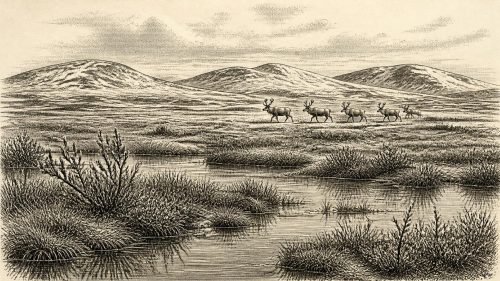
Cork’s Vanishing Cave Fauna
Rather than a precise historical year, 30,127 BCE denotes a Late Pleistocene, Marine Isotope Stage 3 interval of climatic instability before the Last Glacial Maximum. Ireland comprised shifting cold environments, with uncertain ice extent. Derryvree, County Fermanagh, preserves a buried freshwater wetland, dated broadly to this period, whose plants indicate treeless periglacial conditions and shallow water. Castlepook Cave, County Cork, contains a long, disturbed accumulation of mammal bones, including mammoth, reindeer and hyaena, demonstrating diverse Ice-Age fauna. A cut-marked reindeer femur may indicate human butchery, but cannot prove settlement. Evidence reveals ecological richness, not a historical chronicle for this island.
View Record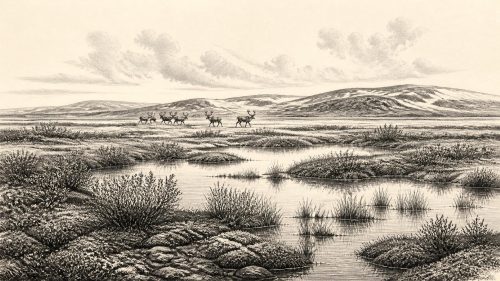
Maguirebridge’s Arctic Waterline
30,128 BCE is a modern label for a Late Pleistocene interval, not a recoverable Irish historical date. Environmental evidence from Derryvree, County Fermanagh, records a cold, treeless wetland between glacial advances, with sedges, grasses, mosses, aquatic plants and hardy shrubs. Castlepook Cave, County Cork, preserves MIS 3 fauna including mammoth, reindeer, giant deer, predators and scavengers, indicating productive open habitats. A possibly tool-marked reindeer bone suggests, but does not establish, early human presence. Lower sea levels altered routes, while later ice destroyed evidence. These fragile archives reveal changing ecosystems before extensive glaciation, not named communities, events or institutions in Ireland.
View Record
Derryvree’s Periglacial Beetles
Thirty thousand years BCE is not a precise recoverable Irish date, but falls within unstable late Marine Isotope Stage 3. At Derryvree, County Fermanagh, organic sediments between glacial tills, dated broadly to 36,900–31,700 calibrated years BP, preserve a cold, treeless freshwater wetland of mosses, sedges, hardy plants and periglacial insects. Ireland experienced shifting ice margins before the later glacial maximum, with fragmented evidence of changing environments. Castlepook Cave, County Cork, records cold-adapted mammals, including mammoth, reindeer and giant deer, across long periods. A possibly tool-marked reindeer bone may indicate a human visit, but no evidence demonstrates settlement, culture or institutions.
View Record
Castlepook’s Late MIS 3 Fauna
Labelled 30,130 BCE, this period falls in late Marine Isotope Stage 3, as Ireland moved towards, but had not reached, maximum glaciation. Conditions were cold, open and changing, with lower seas and unstable ice margins linking Ireland ecologically to north-west Europe. Castlepook Cave, County Cork, preserves Ireland’s principal pre-maximum vertebrate archive, including mammoth, giant deer, reindeer, bear, hyena, lemmings, Arctic fox and wolf. Its mixed, disturbed deposits cannot date all species together, though modern redating has revised ages older. The evidence indicates mobile Ice Age fauna in patchy tundra-like habitats, not human settlement. Secure human activity appears 12,800 years ago.
View Record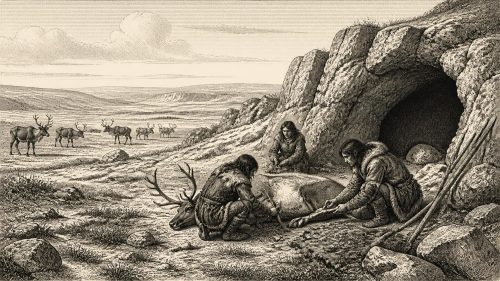
Castlepook’s Modified Femur
About 32,000 calibrated years BP, Ireland lay within an unstable Ice Age environment, as ice, sea levels and climates changed over periods. The British–Irish Ice Sheet's local extent remains uncertain, while open tundra-steppe supported reindeer, mammoth, horse and predators. Castlepook Cave, County Cork, produced a reindeer femur with a possible stone-tool cut or chop, tentatively indicating Palaeolithic human handling around 31,000 BC. However, disturbed deposits, antiquarian excavation and absence of associated tools or habitation evidence prevent claims of settlement or continuity. The record instead suggests possible brief hunter incursions amid ecological opportunity, reconstructed through fragmentary bones, sediments, landforms and dates.
View Record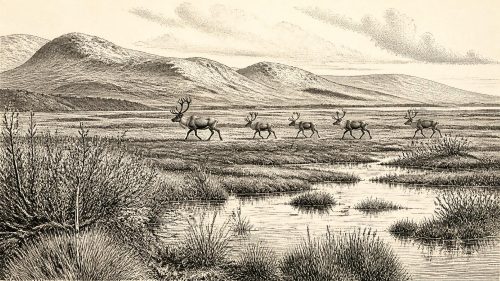
Derryvree’s Dryas Octopetala
At roughly 32,000 years before present, Ireland lay within the climatically unstable Marine Isotope Stage 3. Evidence from sediments, fossils, caves and glacial landforms permits environmental reconstruction but not precise history. At Derryvree, County Fermanagh, freshwater deposits between tills record tundra-like marsh vegetation, aquatic life and ice-free conditions during a broad calibrated interval encompassing 30,132 BCE. Castlepook Cave, County Cork, preserves remains of mammoth, reindeer, giant deer and predators, though its mixed deposits cannot establish contemporaneity. A cut-marked reindeer bone may indicate human activity, but no secure settlement evidence exists. Later glaciation erased much evidence, leaving a fragmentary environmental record.
View Record
Norwegian Lemmings at Castlepook
About 30,133 BCE, Ireland cannot be described through annual history, but Late Pleistocene evidence indicates a cold, changing MIS 3 environment. Derryvree, County Fermanagh, preserves freshwater deposits dated broadly to this period, showing treeless tundra-like wetlands with sedges, mosses and cold-adapted plants between glacial episodes. Castlepook Cave, County Cork, contains a mixed, complex fauna including mammoth, reindeer, giant deer, lemmings, Arctic fox, wolf and hyaena, demonstrating open cold habitats but not contemporaneity. A possibly tool-marked reindeer bone suggests human activity around 33,000 years ago, although no settlement is proven. Later ice and sea-level change destroyed or obscured much surviving evidence.
View Record
Doneraile’s Ice-Age Bone Archive
Around 30,134 BCE, Ireland was approaching the Last Glacial Maximum, although ice expansion varied regionally and no precise annual reconstruction is possible. Cave deposits, notably Castlepook near Doneraile, preserve a disturbed, long accumulated record of MIS 3 fauna, including mammoth, giant deer, reindeer, bears, wolves, foxes, hyaenas and lemmings. These remains indicate intermittent open, treeless cold habitats and connections with north-west Europe, not a uniform national fauna. Human occupation remains unproven: a possibly butchered reindeer bone suggests brief presence but lacks secure context. Growing ice fragmented habitats and obscured evidence, leaving ecological change rather than social or political history here.
View Record
Derryvree’s Frost-Shattered Wetland
Thirty thousand years BCE is not a precise recoverable Irish date but falls within Marine Isotope Stage 3. At Derryvree, County Fermanagh, radiocarbon-dated freshwater deposits, sealed between tills, record an ice-free interval before later glaciation. Their plants, insects and sediments reveal cold, treeless tundra wetlands with pools, mosses, sedges and short seasonal productivity. Castlepook Cave, County Cork, yielded diverse remains of reindeer, mammoth, horse, predators and other open-country fauna, though accumulation spans time. A cut-marked reindeer femur may indicate human activity, but proves neither settlement nor society. Together, the sites document severe yet habitable, climatically unstable Late Pleistocene Irish landscapes.
View Record