

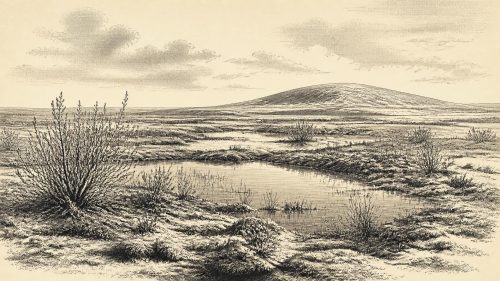
Maguiresbridge’s Organic Bed
Archived: 19 September 2026
Around 31,189 BCE, Ireland’s history is reconstructed from environmental evidence rather than events or people. At Derryvree near Maguiresbridge, Fermanagh, freshwater silts beneath glacial till reveal a cold, treeless wetland of mosses, sedges, dwarf shrubs and insects during Marine Isotope Stage 3, before renewed ice advance. The deposit demonstrates locally ice-free conditions, not nationwide deglaciation. Castlepook Cave, Cork, preserves Late Pleistocene fauna, showing intermittent ecological connections with Europe, though its remains are not contemporaneous. A marked reindeer bone may indicate early human activity, but cannot prove settlement. Climatic instability, low sea levels and shifting ice margins defined this periglacial landscape.