

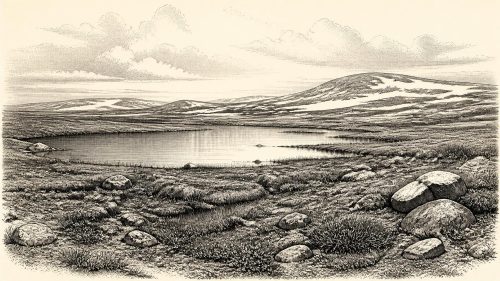
Derryvree Beneath the Till
Archived: 8 September 2026
Around 31,977 BCE, or c. 34,000 cal BP, Ireland was a climatically unstable Late Pleistocene landscape approaching expansion of the last Irish Ice Sheet. Organic lake and freshwater deposits beneath till at Derryvree and Greenagho, County Fermanagh, show that parts of north-central Ireland were ice-free, supporting open tundra and periglacial environments. Offshore evidence indicates later ice advances, chiefly after this period. No archaeological evidence demonstrates human occupation: Palaeolithic and Mesolithic finds cannot be projected backwards. Glacial erosion, redeposition and subsequent sea-level rise hinder preservation. Thus this date records environmental transformation, with advancing ice, water and sediments shaping the future landscape.