Explore every Emerald Archives article connected with
Leo Varadkar.
2020–2029 CE
On 8 March, voters rejected both proposed amendments to Bunreacht na hÉireann concerning family and care. The Family Amendment would have widened the Constitution’s understanding of the family beyond one founded on marriage, while the Care Amendment would have replaced language referring to women’s duties in the home with a recognition of family care. Both proposals emerged from the wider process of constitutional reflection on gender equality. Yet the campaign exposed disagreement over the wording, the legal consequences of recognising care, and whether the proposed replacement language gave sufficient practical value to carers and disabled people.
In 2023, Ireland confronted a revealing contrast: a prosperous, expanding State whose central public question was whether ordinary people could find a secure place within it. On 30 May the Central Statistics Office published the first headline results of Census 2022. The census had counted 5,149,139 people on 3 April 2022, the first population above five million since the nineteenth century. The statistic belonged to the preceding year, but its publication gave 2023 a powerful demographic landmark. Ireland had grown by 387,274 people, or 8.1 per cent, since 2016; net migration accounted for more of that increase than natural change.
The year began under the pressure of the Omicron wave. On 5 January, the Government described infection levels as exceptionally high, even as the booster campaign offered considerable protection against severe illness. The priority was to maintain schools, hospitals and essential services while daily routines remained constrained. That context makes the speed of the subsequent reopening more striking. From 6 a.m. on 22 January, capacity limits, early closing for hospitality, Covid passes for many venues and restrictions on nightclubs were removed. A phased return to workplaces followed. Mandatory mask rules in most remaining regulated settings ended on 28 February, although public-health advice continued to urge caution, especially around vulnerable people.
The general election of 8 February produced no commanding winner. Sinn Féin won the largest share of first-preference votes, while Fianna Fáil emerged with the largest number of Dáil seats, narrowly ahead of Fine Gael. The result reflected deep dissatisfaction with housing costs, homelessness and pressures on health services, as well as a striking appetite for political change. It also demonstrated the limits of a campaign: Sinn Féin’s unexpectedly strong vote came despite standing too few candidates to convert all its support into seats.
2010–2019 CE
In 2019 Ireland stood at an unusually charged intersection of memory, constitutional change and international uncertainty. The Republic’s economy was expanding and its population was growing, yet housing insecurity, pressure on public services and the prospect of Britain’s departure from the European Union qualified the language of recovery. For the whole island, Brexit made the border—largely unobtrusive in daily life since the Good Friday Agreement—an immediate practical and political question. The year also demonstrated that the constitutional and social histories of the two Irish jurisdictions remained intertwined, even while their laws and institutions differed sharply.
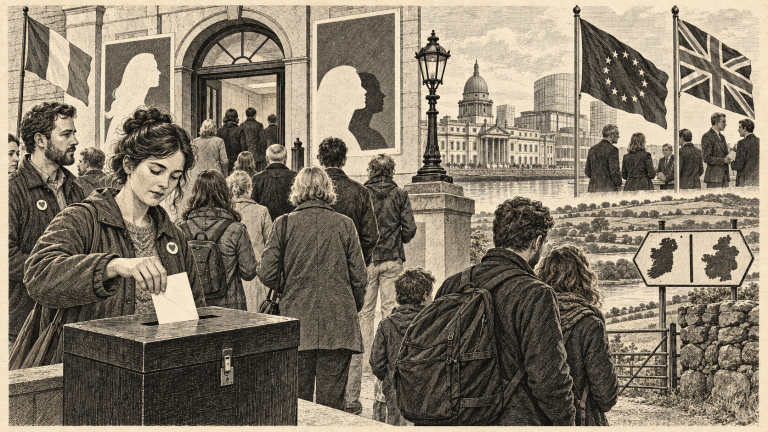
In 2018, Ireland confronted questions of bodily autonomy, national identity, borders and public provision with unusual intensity. The Republic was governed by Leo Varadkar’s Fine Gael-led minority administration, sustained by a confidence-and-supply arrangement with Fianna Fáil. Its agenda was dominated by Brexit and by the referendum on the Eighth Amendment, while the continuing housing emergency exposed the limits of recovery after the financial crash. In Northern Ireland, the absence of devolved ministers at Stormont deepened the political strain surrounding Brexit and public services. The year did not produce a single settled national mood. Rather, it showed a society capable of decisive constitutional change while remaining anxious about inequality, infrastructure and the island’s future relationship with Britain.

Enda Kenny resigned as Taoiseach on 13 June. The following day Dáil Éireann nominated Leo Varadkar, Fine Gael’s new leader, for appointment by President Michael D. Higgins. The nomination passed by 57 votes to 43, with 35 abstentions: a reminder that Varadkar led a minority administration dependent on the confidence-and-supply arrangement with Fianna Fáil. At thirty-eight, he was Ireland’s youngest Taoiseach to date and its first openly gay head of government. His appointment had a symbolic importance in a republic whose public culture had changed rapidly in the preceding decade.
