Membership is completely free, giving members unlimited access to all available resources, services, features, and benefits without any restrictions or fees.
Welcome back. Sign in to continue enjoying unlimited access to all available resources, services, features, and member benefits at no cost.
The potato was not Ireland’s only crop, nor was every Irish person dependent on it in the same way. Grain, livestock and dairy produce formed major commercial sectors, while townspeople, stronger farmers and many artisans had more varied diets. Yet for a vast rural population of labourers, cottiers and very small occupiers, potatoes supplied the essential daily food. A small plot, cultivated intensively, could sustain a family when wages were low, land access insecure and cash scarce. The same system left households exceptionally exposed when the crop failed. Potatoes also fed pigs and helped to support the small, interlocking economies of cabins, petty trade, rent payments and seasonal labour.
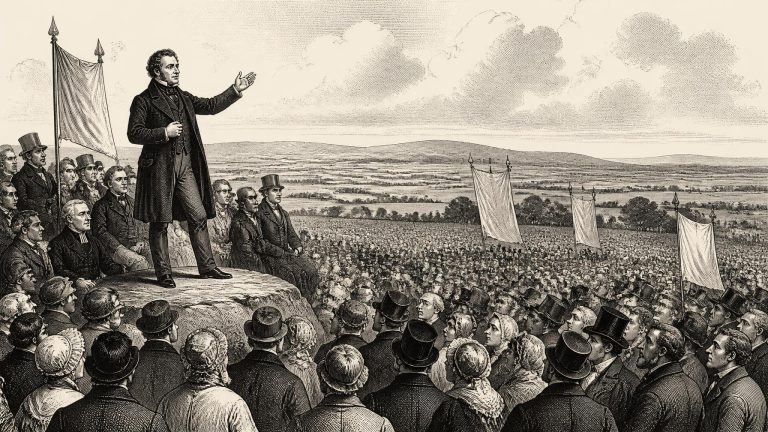
O’Connell was already the most formidable Irish popular politician of his age. His earlier mass campaign had helped secure Catholic Emancipation in 1829; now he argued that Ireland needed domestic self-government rather than piecemeal concessions from Westminster. Repeal, as he presented it, did not mean separation from the Crown. Ireland would share the monarch but recover a parliament in Dublin, capable of addressing Irish taxation, industry, land and social conditions.
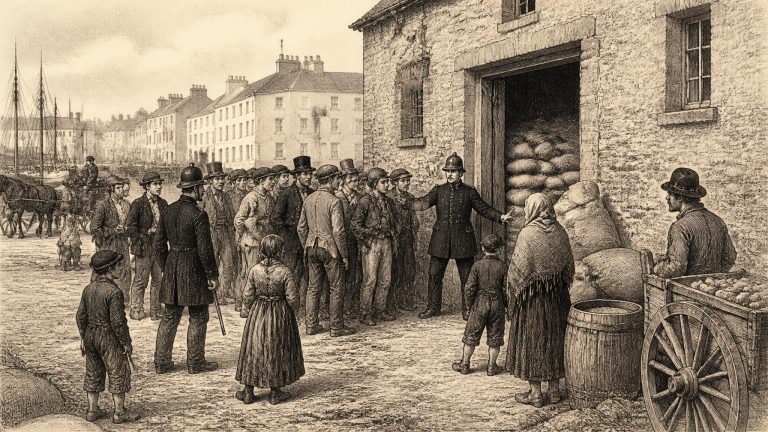
The crisis of 1842 arose from conditions familiar to many poor households rather than from the new potato disease that later became synonymous with famine. Much of rural Ireland depended on small holdings, casual labour and the potato as a cheap, productive staple. Families might supplement it with milk, oats or whatever wages could buy, but their margins were narrow. A shortfall in provisions, a rise in prices, or the seasonal gap between the exhaustion of stored food and the next harvest could quickly become dangerous. Those without land, savings or secure employment were especially exposed.
The immediate background belonged to the years before 1829, but it determined the shape of this one. Daniel O’Connell, a Kerry-born barrister and leader of the Catholic Association, had been elected for County Clare in July 1828. As a Catholic, he could not take the existing oath required of a member of parliament. His election nonetheless demonstrated that a Catholic candidate could defeat the nominee of major Protestant property and government influence through open, legal electoral mobilisation. The result placed the ministry of the Duke of Wellington and the home secretary, Robert Peel, under pressure to find a settlement which they had previously resisted.
In 1817 Ireland was caught in the sharpest phase of a crisis that had begun with the bad weather and poor harvest of 1816. Cold, wet conditions had damaged the potato crop in many districts; the wider post-war slump that followed the end of the Napoleonic Wars reduced employment and purchasing power. For labourers, cottiers and smallholders whose survival depended upon a narrow margin of food, fuel, seasonal earnings and informal credit, this combination was ruinous. The year is therefore often placed within the famine-and-fever emergency of 1816–19. Yet care is needed with the word “famine”. Recent scholarship has argued that Ireland did not experience a single island-wide collapse of food supply on the later, catastrophic scale of the Great Famine. What is beyond doubt is that severe scarcity, unemployment, rising prices and disease exposed profound insecurity in both town and countryside.
Ireland in 1814 was governed under the Union of 1801. Its parliament had disappeared, while Irish representatives sat at Westminster and executive authority was exercised through Dublin Castle in the name of the Lord Lieutenant, Charles Whitworth, Earl Whitworth. Robert Peel, Chief Secretary for Ireland since 1812, was the key minister responsible for daily Irish administration. He was only twenty-six when appointed, but in 1814 he drove measures which would have a long afterlife in the history of policing.
The Catholic cause had survived the Union, but its representative bodies faced a legal and political obstacle. The Convention Act of 1793 was intended to prevent representative assemblies from claiming a rival political authority. Catholic activists therefore had to devise forms of organisation that could petition, correspond and deliberate without giving the Dublin Castle administration an easy legal pretext to suppress them. In 1812, the Catholic Board became the principal vehicle for that work. It drew together members of the Catholic gentry, lawyers, merchants and clergy, while seeking links with county opinion beyond the capital.