
Nicholas Street
At a Glance
Street Setting
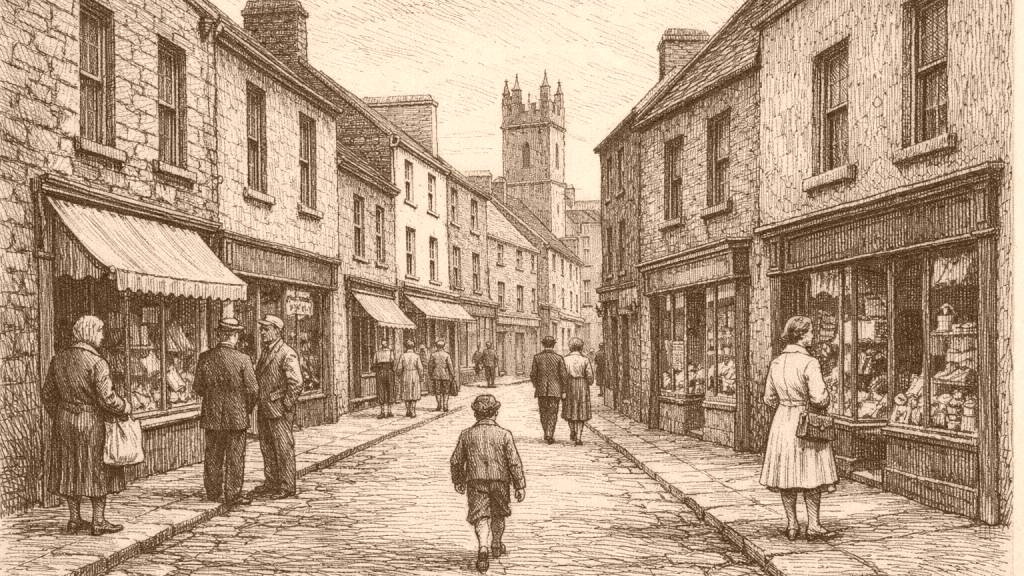
Nicholas Street is described in modern local material as Limerick’s oldest street and as a route tied to the city’s medieval core. One account places it in the heart of the walled city and links it to major landmarks. That matters for shop history because the street was not an isolated commercial strip but part of a long-lived urban corridor where buildings, plots, and uses changed over time while the street itself remained central.
Modern heritage notice also stresses that the street remains archaeologically layered. It identifies numbers 36 to 39 as the Fireplace site and says demolition in the 1990s revealed a party wall, fireplace, and corbels. The description does not document 1950s shop interiors, but it shows that later commercial and heritage readings of Nicholas Street rest on a dense built environment rather than on a cleared or uniform streetscape.
Shop Record
The clearest direct shop evidence is a photographic record for 41 Nicholas Street, identified as the Thomond Provision Company, Grocery Store. The item description names the premises, the address, and a boy at the entrance. It is a black-and-white image derived from a glass plate negative and dated to the 1930s, so it belongs before the 1950s; even so, it provides a concrete visual example of retail use on the street.
The metadata attached to that photograph also tags the item as a grocery store, shop front, and Nicholas Street scene. Those labels support the narrow conclusion that the street carried ordinary retail premises, not only landmark buildings, in the decades before the 1950s. The record does not identify every shop on the street, but it does show a recognisable commercial frontage in the historic city fabric.
Trader Memory
A later obituary in The Irish Times places an antique and collectibles shop on Nicholas Street and identifies the owner’s eventual base there under the banner Once Upon a Time. The account is much later than the 1950s, but it confirms that the street continued to host small-scale retail activity. It also shows a trader whose premises were visible to passers-by on Nicholas Street, reinforcing the street’s commercial identity across generations.
The same obituary describes the shop as charming but inconspicuous and says it stood in an unfashionable part of the city. That is a late retrospective view, not a 1950s description, so it should not be pressed too far. Its value lies in confirming that Nicholas Street remained a place where modest premises could still function as shops rather than as purely ceremonial or monumental buildings.
Urban Layer
An early nineteenth-century visitor to Limerick distinguished the newer English town from the older Irish town and noted that the newer streets were wide and regularly built. The same passage describes Limerick as divided into distinct parts and remarks on the old town’s cramped condition. Nicholas Street belonged to that older urban world, so the general setting for shops there was a historic street pattern rather than a planned modern commercial district.
The same account says the cathedral was squeezed among miserable buildings and hard to reach. That is not a description of Nicholas Street in the 1950s, and it should not be treated as one. It does, however, show how the older quarter of Limerick was already imagined as a dense, tightly built environment in which shops, houses, and civic structures stood close together.
Evidence Limits
The records gathered here remain uneven. There is a 1930s shop photograph, a much later obituary that names a Nicholas Street shop, and modern heritage notices about conservation and street renewal. What is not present is a direct 1950s directory page, photograph, or inventory for the whole street. That absence matters, because it prevents a shop-by-shop reconstruction of the decade.
Because the surviving material comes from different periods, the safest conclusion is limited continuity rather than precise detail. Nicholas Street can be shown as a place of retail occupation before the 1950s and after it, but the evidence does not justify naming specific 1950s shops beyond what is directly documented. Any fuller reconstruction would need additional period records from that decade itself.
Historical View
Taken together, the evidence presents Nicholas Street as an old Limerick street with enduring commercial use. A grocery shop in the 1930s, a later antique shop, and current heritage references to streetscape renewal all place trade within the same urban corridor. The records do not prove a single unbroken line of identical shops, but they do show that retail activity was part of the street’s long life.
For the 1950s specifically, the responsible historical summary is modest. Nicholas Street can be placed within a commercially active historic core, and surviving records show that shops belonged there in surrounding decades. Yet the decade itself remains thinly documented in the material assembled here, so the best answer is continuity of function, not a detailed reconstruction of every storefront or proprietor.
