
6 January 2026: Little Christmas, cold weather and a state testing its guardrails(c.2020s)
On 6 January 2026, Ireland’s public life mixed old seasonal ritual with urgent modern pressures. Nollaig na mBan, the final day of Christmas, was marked by renewed cultural celebration, while ice closed schools, Met Éireann framed 2025 as another near-record warm year, and food-safety alerts reached parents. Politics ranged from Micheál Martin’s China diplomacy to fiscal warnings, asylum-return figures and scrutiny of AI-generated sexual images. In the North, the fiftieth anniversary of Kingsmill kept legacy and justice in view. The day was historically significant less for one rupture than for revealing how tradition, risk and state capacity now meet publicly.
Dateline
Little Christmas in a changing Ireland
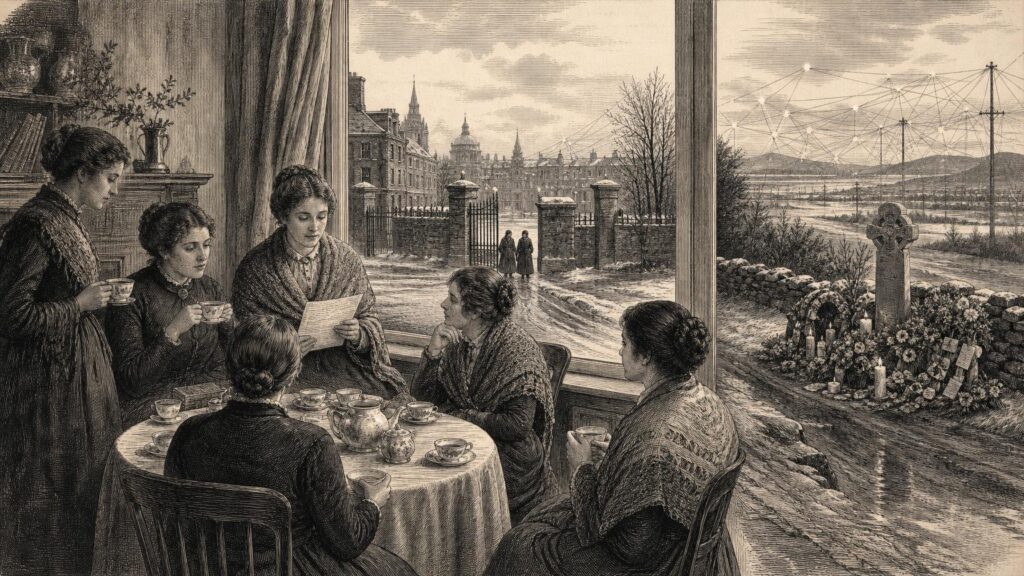
In Ireland, 6 January 2026 fell on a Tuesday, but its older meaning still mattered. Nollaig na mBan, Women’s Christmas or Little Christmas, marked the traditional end of the Christmas season and the Feast of the Epiphany. In the folk memory of many families, the date was a pause after weeks of domestic labour: women visited neighbours, rested, shared tea, or gathered socially while men were expected, at least symbolically, to take up the household work. By 2026, the custom was no longer a simple survival from rural Catholic Ireland. It had become a flexible cultural language for women’s creativity, friendship and public recognition.
That shift was visible in Dublin, where First Fortnight’s Nollaig na mBan event at Whelan’s brought together poet Vona Groarke, singer-songwriter Tolü Makay and poet Jan Brierton for an evening of music and poetry. The setting was modern and urban, but the structure echoed older practices: women’s voices, social gathering and the reworking of seasonal ritual. The event also showed how Irish traditions often endure by being reinterpreted rather than preserved unchanged. A day once tied to gendered labour in the home became a platform for art, mental-health awareness, performance and collective memory.
Weather, climate and the lived meaning of risk
The weather made the day feel more immediately historical than ceremonial. Northern Ireland remained under pressure from ice and low temperatures, with almost 200 schools closed and a fresh yellow warning issued into Wednesday morning. The disruption was concentrated in the west and north-east, while roads, bus services and daily routines were affected. In the Republic, consecutive yellow-level warnings covering every county had expired by 9am, the first time since the previous Friday that no county was under a cold-snap warning, though some Donegal schools remained closed.
At the same time, Met Éireann’s annual climate statement gave the cold spell a wider frame. It reported that 2025 had been Ireland’s second-warmest year on record since 1900, exceeded only by 2023, and that the most recent four years sat among the warmest in the national record. The contrast was striking but not contradictory. Climate history is not experienced as a smooth warming line; it arrives through sharp local episodes, damaged infrastructure, droughts, heat, cold snaps and arguments over preparedness. On 6 January, icy roads and climate statistics belonged to the same story: Ireland learning that weather is no longer merely background, but a central test of public systems.
Public health and domestic trust
Another practical anxiety entered Irish homes through the precautionary recall of specific SMA infant formula and follow-on formula batches. The Food Safety Authority of Ireland had advised parents, guardians and carers not to feed affected products to infants or young children because of the possible presence of cereulide, a toxin associated with some Bacillus cereus strains. No illness had been reported at the time of the initial Irish notice, and the recall was described as precautionary, but the issue touched a sensitive area of family life: the safety of infant feeding and the trust placed in regulators, retailers and multinational manufacturers.
Such recalls rarely become landmark events on their own, yet they form part of modern social history. They show how risk is communicated, how quickly households must interpret official advice, and how public-health systems depend on clarity. The matter also crossed jurisdictions, with the UK Food Standards Agency issuing its own alert relevant to consumers in Britain and Northern Ireland. On an island where food supply chains and family networks often run across borders, a technical safety notice could become a shared public concern.
Diplomacy, money and the argument over Ireland’s model
Beyond the home, 6 January brought several signals about Ireland’s place in the world. Taoiseach Micheál Martin was in China during an official visit from 4 to 8 January, following a meeting with President Xi Jinping in Beijing the previous day. Irish reports focused on trade, the EU-China relationship and higher-education links. Martin rejected the idea that Irish colleges teaching Chinese students was in itself a security risk, pointing to long-standing university engagement and joint programmes. The exchange captured a recurring Irish dilemma: a small, open economy seeking educational and commercial opportunity while navigating security, human-rights and geopolitical concerns.
The same day, the Department of Finance published end-year Exchequer returns describing robust tax revenues and sustained investment. Yet the Irish Fiscal Advisory Council warned that Government spending in 2025 had been about €4 billion higher than planned. This was not a dry accounting dispute. It went to the heart of the post-crash and post-pandemic Irish state: whether corporation-tax strength and employment growth were being converted into durable public capacity, or whether volatile receipts were normalising permanent spending commitments. Housing, health, infrastructure and climate adaptation all demanded investment; fiscal watchdogs warned that prosperity could still be mismanaged.
Migration, education and the digital frontier
Migration policy also featured in the day’s archive. Provisional figures reported a sharp rise in asylum seekers voluntarily leaving Ireland in 2025, though there was not a clear September surge despite increased financial incentives for some applicants to return before final decisions. The figures belonged to a wider European turn towards faster processing, returns and stricter enforcement. In Ireland, the debate carried particular weight because it intersected with housing shortages, far-right mobilisation, humanitarian obligations and the State’s capacity to administer protection fairly.
Education policy, meanwhile, showed change in quieter form. The ASTI urged teachers to engage with National Council for Curriculum and Assessment consultations connected to Senior Cycle redevelopment, including Leaving Certificate Music, Design and Communication Graphics, and Level 1 and Level 2 Learning Programme modules. Curriculum consultations are slow history: they reveal what a society thinks young people should know, make and value. On a day dominated by weather, finance and diplomacy, these consultations pointed to a different future-facing argument about creativity, inclusion and assessment.
The digital public sphere raised sharper questions. Irish reporting on 6 January said the Attorney General was examining whether existing laws were sufficiently robust to deal with AI-generated non-consensual intimate images and child sexual-abuse material, amid concern about Grok, the image-generating AI tool integrated with X. Coimisiún na Meán, Rape Crisis Ireland and civil-liberties advocates were among those raising alarms. The issue showed how Irish law, including the legacy of Coco’s Law, was being tested by technologies that could generate harm faster than legislation could define it.
Memory in the North
Finally, the day sat in the shadow of the fiftieth anniversary of the Kingsmill massacre and the associated sectarian killings of early January 1976. Commemorations around 5 January 2026 remembered the ten Protestant workmen murdered near Whitecross, Co Armagh, and also recalled the Reavey and O’Dowd families, whose Catholic relatives were killed in the same 24-hour cycle of violence. The anniversary did not belong to one community alone. It was a reminder of how remembrance in Northern Ireland remains morally necessary, politically charged and often incomplete where justice has not followed grief.
For that reason, 6 January 2026 was historically significant not because one single event transformed Ireland, but because many strands of Irish life were visible at once. A revived women’s tradition met contemporary arts; a cold snap met climate data; infant formula, AI and migration tested regulatory confidence; China and corporation tax exposed Ireland’s dependence on global systems; and Northern Ireland’s past remained present. The day’s archive is therefore one of continuity under pressure: an Ireland trying to honour memory while governing risks that are increasingly planetary, digital and interconnected.
Primary Sources
- The roots and traditions of Nollaig na mBan
- First Fortnight: Nollaig na mBan
- Further Northern Ireland school closures as new yellow warning for ice issued
- Annual Climate Statement for 2025
- 2025 second warmest year on record in Ireland, says Met Éireann
- SMA infant formula and follow-on formula recall
- Nestlé recalls several SMA Infant Formula and Follow-On Formula as a precaution because of the possible presence of cereulide (toxin)
- Tax revenues robust in 2025 and sustained investment in public services and infrastructure – Tánaiste Simon Harris & Minister Jack Chambers
- Government spending last year was €4bn higher than planned, Ifac warns
- Attorney General examining laws on sexualised AI images amid X backlash
- Visit of An Taoiseach Micheál Martin to China
- EU, China must engage to resolve trade friction – Martin
- Ongoing NCCA consultations
- Sharp rise in number of asylum seekers voluntarily leaving Ireland in 2025
- 'Time is not a healer' – 50th anniversary of NI attacks