

Shared Belonging
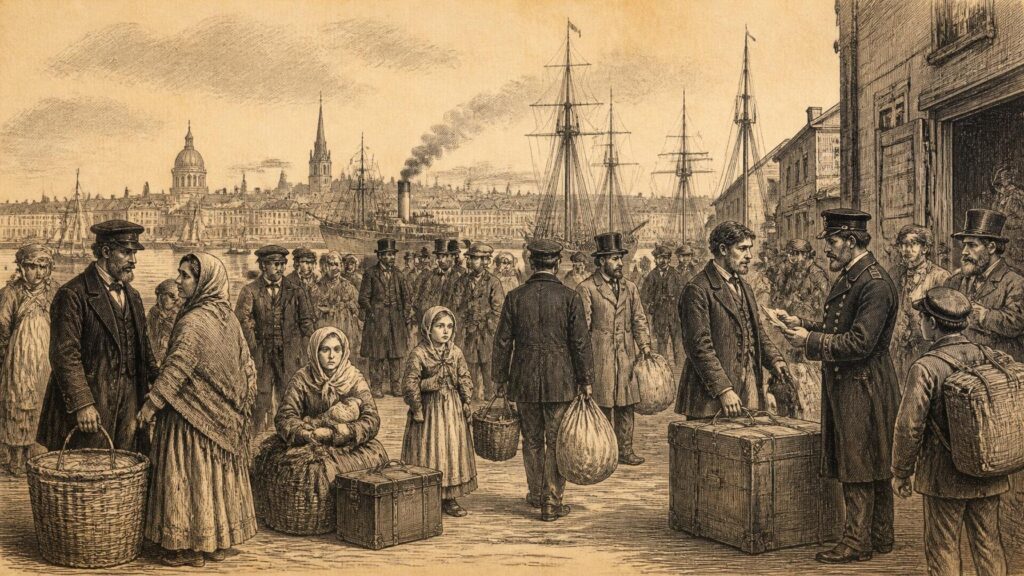
AI generated historical illustration, not a contemporary photograph.
At a Glance
Ireland’s history cannot adequately be told as the story of a people who only left. Emigration is undeniably central to Irish memory, family history and political imagination, but the island has also long received settlers, soldiers, artisans, refugees, students, labourers, spouses and returning descendants. Immigration has repeatedly tested, enlarged and sometimes hardened ideas of who could belong. The resulting history is neither a simple tale of tolerance nor one of permanent exclusion. It is a record of changing power, law, religion, language, class and race, in which Irish identity has been made and remade rather than inherited unchanged.
Historical Approach
“Immigration and Irish identity” contains two terms that need care. Immigration means the arrival of people to live for a time or permanently in a place, but historical records are uneven: they more readily preserve officials, merchants, clergy, property holders and persons regarded as troublesome than ordinary newcomers. “Irish identity” is even less stable. It can refer to residence on the island, kinship, language, religious affiliation, political loyalty, citizenship, cultural practice or a claimed emotional inheritance. These meanings have overlapped, but they have not always agreed. A Protestant loyalist in Belfast, an Irish-speaking Catholic in Connemara, a Jewish shopkeeper in Cork, a Dublin-born child of Nigerian parents and a returned emigrant may each have had distinct grounds for describing themselves as Irish, British, both, neither, or differently Irish.
This article therefore avoids treating identity as a biological essence. It considers documented movements of people alongside the institutions and stories through which communities recognised, limited or denied belonging. Census returns, parish registers, legislation, departmental files, newspapers and personal testimony can establish particular presences and official categories. They cannot, by themselves, reveal every private attachment. Nor should later national categories be projected backwards without qualification. A person entering early modern Ireland did not encounter the passport, visa, nationality law or census ethnicity question familiar today. Conversely, modern citizenship does not settle every question of social acceptance.
There is a further methodological danger. Ireland’s powerful history of famine and departure has encouraged a consoling assumption that a people once excluded abroad must naturally welcome newcomers at home. That is an interpretation, not a historical law. Irish migrants experienced prejudice in Britain, North America and elsewhere, yet Irish society has also contained anti-Jewish, anti-Traveller, sectarian and racial exclusions. The historical comparison can encourage empathy, but it should not turn the suffering of emigrants into evidence that later Irish responses were automatically generous. Recent scholarship specifically challenges the older image of a racially uncomplicated and uniformly homogeneous twentieth-century Ireland.
Island Movements
Long before a modern Irish state existed, the Irish Sea connected rather than separated communities. People moved through trade, marriage, religious travel, war and service in the households of rulers. The archaeological and linguistic record establishes extensive contact among Ireland, Britain and continental Europe, but it does not justify neat modern claims about a single timeless people. It is safer to say that communities on the island were formed through both continuity and connection. Medieval political identities were often local, dynastic, linguistic and ecclesiastical rather than national in the later sense.
The arrival of Viking groups from the late eighth century and the establishment of coastal towns are an important example. Norse settlement and commercial networks affected places such as Dublin, Waterford, Wexford, Cork and Limerick. Yet “Viking” is not an explanation for all later urban life, nor did newcomers remain an untouched foreign bloc. Intermarriage, trade, conversion and political alliance altered the identities of both residents and arrivals. The later Norman invasion likewise brought lords, soldiers, clergy, administrators and settlers from Wales, England and continental Europe. Its consequences were coercive and unequal, involving conquest, landholding and a changing political order. Still, the people described as Anglo-Norman did not form a single unchanging population either. Over generations, some families adopted Irish language, law and kinship ties while others retained or renewed links to England.
These cases are sometimes reduced to a cheerful folklore of “everyone came from somewhere”. That phrase captures the obvious fact of movement but can obscure unequal circumstances. A merchant, a dispossessed farmer, a military colonist and a refugee did not arrive with comparable freedom or power. It also risks suggesting that later national and sectarian conflicts were unreal because ancestry was mixed. Historical evidence supports neither pure descent nor effortless harmony. The more useful conclusion is that ancestry has always been a poor guide to political loyalty and cultural belonging.
Colonial Transformations
The sixteenth and seventeenth centuries made migration inseparable from colonisation. Tudor and Stuart governments sought to extend English authority through military conquest, plantation, land transfer and the settlement of people deemed politically reliable. English and Scottish Protestant settlers arrived in several regions; the Plantation of Ulster, begun after the Flight of the Earls and the confiscation of land, had especially lasting consequences. Indigenous Irish Catholic communities were displaced, subordinated or incorporated under harsh terms. To present those settlers merely as immigrants would conceal the state force and dispossession central to the process.
At the same time, “settler” was not a timeless or exhaustive identity. People born in Ireland could identify as English, Scottish, British, Protestant, Irish, Ulster-Scots, unionist or some combination. The categories developed in particular political circumstances. The Act of Union of 1800, the expansion of the British state, religious reform, industrialisation and the later partition of the island gave them new importance. For many Irish nationalists, colonial settlement became evidence of an alien presence; for unionists, British connection and Protestant political traditions formed a legitimate inheritance. Neither account can be understood apart from the history of power.
The enduring difficulty is visible in the language used about belonging. Nationalist discourse could contrast a native Gaelic Catholic population with newcomers or planters; unionist discourse could emphasise civil, constitutional and British loyalties. Each language selected a different historical starting point. Scholarship on early modern identities cautions that communal labels, ancestry and political allegiance did not line up consistently. Identity was constructed through religion, status, locality and imagined descent as much as through demonstrable genealogy. That does not diminish the material realities of confiscation and sectarian inequality; rather, it warns against imagining fixed ethnic blocs existing unchanged across centuries.
Migration into Ireland was therefore embedded in an asymmetrical colonial order. It shaped the island’s demography, ownership, town life and religious map, especially in Ulster. Modern discussions of immigration should acknowledge this background, but they should not use it to make present-day newcomers responsible for historic colonial relationships. The historical analogy has limits. A twenty-first-century nurse recruited to a hospital, an EU worker exercising free movement or a person seeking international protection enters a state governed by wholly different legal structures. The past explains sensitivities; it does not provide ready-made verdicts.
Refugee Communities
Some of the clearest documented early modern arrivals were Protestant refugees from continental Europe. French Huguenots, and smaller related groups, reached Ireland before and after the revocation of the Edict of Nantes in 1685. They settled in Dublin and in towns including Portarlington, Cork, Waterford, Lisburn, Carlow and Kilkenny. Surviving registers, congregational records and family papers make their presence unusually visible, though losses of records mean that the history remains incomplete. The Representative Church Body Library holds important Irish Huguenot material, while the wider documentary record shows communities linked to weaving, trade, skilled crafts and military service.
The familiar story depicts Huguenots as industrious refugees warmly absorbed into Ireland and bringing useful skills. There is evidence for economic contribution and for social mobility, but the formula needs qualification. They arrived in a Protestant-dominated political order in which shared Reformed religion could open avenues unavailable to Catholics. Some maintained French worship, language and associational life for generations; others conformed to the Established Church or married into local families. Assimilation was neither immediate nor total. The very survival of distinct congregational records demonstrates that incorporation could coexist with a consciously preserved difference. A later national story that remembers only successful blending may flatten this complexity.
Palatine refugees from German-speaking territories are another instructive case. Many were displaced amid war, insecurity and hardship in the early eighteenth century. A number were directed to Ireland through schemes associated with landlords, Protestant networks and imperial policy, with settlements particularly associated with Limerick, Wexford and Carlow. Their arrival was shaped by patronage and economic calculation as well as humanitarian concern. Recent research on European migrants in eighteenth-century Ireland finds that Palatine households did not remain confined to the best-known colonies; some entered other Protestant networks and were absorbed into Huguenot communities or local society. The archival trail makes clear that identity could be adapted pragmatically.
These histories matter because they undermine the notion that pre-independence Ireland was simply closed to outsiders. Yet they should not be turned into evidence that Ireland offered equal refuge to all. Reception was conditional. Religion, useful skills, sponsorship, wealth and imperial politics mattered. Protestant refugees could be welcomed partly because they were seen as assets within a confessional state, while Catholics and poorer migrants faced different restrictions. The appropriate historical lesson is not that Ireland has always been a sanctuary, but that admission and acceptance have long been selective.
Urban Diversity
Dublin, Belfast, Cork, Limerick and other towns were contact zones. Their ports connected the island to Britain, continental Europe, the Atlantic world and imperial routes. Sailors, domestic servants, students, artisans and traders passed through; some remained. The nineteenth- and early twentieth-century city was not ethnically uniform, despite later memories that portray it as such. The National Archives’ census exhibition on Dublin notes that around a quarter of migrants to the city were born outside Ireland, while industrial firms sometimes recruited specialist workers from Britain and elsewhere. This did not make Dublin a cosmopolitan equality, but it does correct the picture of an entirely isolated capital.
Jewish migration is especially important to this urban history. Sephardi families had earlier connections with Ireland, while Ashkenazi migrants from eastern Europe formed more visible communities from the late nineteenth century. In Dublin, the area around the South Circular Road became associated with the “Little Jerusalem” community. Jewish residents established religious, commercial, cultural and charitable institutions, participated in civic life and raised families whose descendants included public figures. Their history is documented through synagogue records, press coverage, community archives and municipal sources. It challenges the assumption that Irishness was naturally synonymous with Catholicism.
That challenge did not mean prejudice was absent. Jewish people in Ireland encountered stereotypes, discrimination and, at times, open hostility. The scale and character of Irish antisemitism differed from that in some European states, but a comparative claim of relative moderation is not a claim of innocence. The experience of Jewish refugees during the Nazi era is particularly sobering. Ireland admitted some refugees but maintained restrictive policies, and the number granted refuge remained small. Historians continue to debate motives, institutional responsibility and the weight given to neutrality, economic capacity, Catholic culture and bureaucratic caution. The surviving evidence does not sustain a romantic image of an unqualified welcome.
Black people and people of mixed heritage were also present in Ireland long before the late twentieth century, though the sources often render them difficult to trace. Records may identify birthplace, occupation or a racialised description, but many do not record ethnicity at all. Research drawing on parish, poor-law, military and other archival materials has found evidence of Black residents and people of African descent in eighteenth- and nineteenth-century Ireland. Such evidence is fragmentary, and historians should resist inflating a small number of recoverable lives into firm population totals. Still, invisibility in conventional narratives reflects archival practices and historical selection, not necessarily absence.
Urban diversity was matched by internal migration. Famine, agricultural distress, employment and family networks drew rural people into towns, above all Dublin. Residents sometimes described country migrants as outsiders competing for work or housing. The language is revealing: “foreigner” could be deployed flexibly, even against people from elsewhere in Ireland. Belonging was therefore not only a question of international borders. Accent, parish, class, religion and access to employment could determine whether a person was treated as local. This older urban experience helps explain why the social boundary between “us” and “them” is historically mobile.
National Definitions
Nineteenth-century nationalism changed the terms in which Irish identity was discussed. Cultural revivalists elevated the Irish language, Gaelic games, folklore and a distinct historical tradition as evidence of nationhood. Such work was often an answer to colonial denigration and cultural loss. It gave many people a language through which to oppose British rule. But national movements also created boundaries. A nationalism that equated authentic Irishness with Gaelic ancestry, Catholicism or cultural practice could make Protestants, English-born residents, Jews and other minorities appear conditional members of the nation, even when they were active in public life.
The record of the revolutionary period demonstrates that nationalist ideas were not uniform. Some republicans and cultural nationalists used exclusive language; others asserted a civic conception of the nation. Arthur Griffith argued that allegiance to an Irish nation, rather than descent, should be the decisive test. The historical examples often cited in this connection are real: Michael Noyk and Robert Briscoe, both from Jewish immigrant backgrounds, played important roles in nationalist politics, while people of various origins participated in labour, cultural and republican movements. Their involvement does not prove that all barriers disappeared. It does show that the revolutionary nation could be imagined more broadly than a racial lineage.
The 1916 Proclamation’s promise to cherish all the children of the nation equally became a foundational ideal, but an ideal is not a social description. It was issued in a divided society, and the state that emerged after revolution and civil war inherited religious, class and regional tensions. The new Free State contained a significant Protestant minority, Jewish citizens and longstanding Traveller communities, as well as people born abroad. State-building, schooling, public ritual and legislation increasingly promoted a version of national culture rooted in Catholic and Gaelic revival assumptions. That version could be powerful without being universally shared.
Partition made the question still more complicated. In Northern Ireland, many unionists understood their identity as British and often Protestant, while nationalists understood theirs as Irish and often Catholic. These descriptions were never complete accounts of individual belief, but they became politically consequential under a devolved unionist regime and during the conflict that followed. It is misleading to speak of a single Irish identity operating uniformly across the island. The Good Friday Agreement later recognised the birthright of people in Northern Ireland to identify and be accepted as Irish or British or both, subject to law. That constitutional recognition is itself the outcome of a long history of contested belonging.
State Boundaries
Independence did not instantly produce a settled answer to who was Irish. The Irish Free State had to administer borders, naturalisation, passports and relations with Britain while its constitutional position evolved. National Archives holdings include departmental files on “aliens” from 1918 to 1954 and naturalisation and citizenship applications from 1923 onwards. Such records are valuable because they show the state categorising residents, assessing applications and applying administrative discretion. They also remind us that the bureaucratic word “alien” was once a routine legal term, though it now carries a sharper sense of exclusion.
The Irish Nationality and Citizenship Act 1956 provided a major legislative framework for citizenship, subsequently amended on several occasions. Citizenship law is not identical to identity, but it gives legal force to membership and determines rights of entry, residence and political participation. The changing law reflects wider transformations: the relationship with Britain, the constitutional status of Northern Ireland, European integration, changing patterns of migration and public debate about birthright citizenship. The statute should be read carefully rather than treated as a single permanent rule, because its provisions have been revised and their effects depend on the date and circumstances of a birth or application.
The 1998 constitutional settlement was a watershed. In the context of the Good Friday Agreement, constitutional amendments removed the territorial claim in the former Articles 2 and 3 and articulated the entitlement and birthright of every person born on the island of Ireland to be part of the Irish nation, subject to qualifications in law. This placed plural identities in Northern Ireland within the constitutional imagination of the state. It also offered a language of affiliation that was not reducible to one religion or ancestry. However, constitutional language cannot itself erase political division or unequal social power.
The citizenship referendum of 2004 and the Irish Nationality and Citizenship Act 2004 then altered the rules governing citizenship by birth. The change followed a heated public debate in which asylum, maternity services, EU law and fears of abuse were frequently intertwined. It is important historically to distinguish the referendum result from claims about migrants as a whole. The legal change concerned citizenship conditions for children born in Ireland to non-national parents; it did not define the worth or cultural belonging of all migrants. Nevertheless, the campaign demonstrated how quickly immigration could become a site on which national identity, welfare, sovereignty and demographic anxiety were argued together.
Emigrant Memory
Why has Ireland so often imagined itself as a land without immigrants? The scale and emotional force of emigration provide much of the answer. Departure after the Great Famine, and continued migration to Britain, North America, Australia and elsewhere, affected almost every county and many families. Letters, remittances, wakes, absences and return visits embedded migration in private life. The diaspora also shaped politics, culture and finance. Irish identity was fashioned not only in Ireland but in Liverpool, Glasgow, New York, Boston, Melbourne and innumerable other places.
Yet the emigrant past has two contrary uses. It can produce a humane recognition that migrants are not abstractions but people with families, skills, fears and hopes. It can also become sentimental shorthand, where the phrase “we were all immigrants once” avoids the differences between famine exile, seasonal labour, colonial settlement, free movement, professional recruitment and forced displacement. It may also conceal that Irish emigrants themselves could be divided by religion, gender, class and politics, and that some achieved acceptance at the expense of other marginalised groups. Historical analogy is ethically useful only when it remains specific.
Irish migration was never a one-way farewell. There was recurring movement between Ireland and Britain, return migration from the United States and the wider empire, and the arrival of children, spouses and descendants with Irish connections. People who returned could be treated as local, exotic or suspect depending on their wealth, accent, religion and political outlook. This complicates any hard separation between emigrant and immigrant. A person born in Ireland who spent decades abroad might return as a stranger; a person born elsewhere might become deeply embedded in a locality through work, marriage, language and public service.
The diaspora also altered the meaning of Irishness. By the late twentieth century, official and cultural institutions increasingly described Irish identity as extending beyond the territory of the state. That development had political value, but it raises a question: if Irishness can persist across generations and continents for people of Irish descent, on what grounds should people who make their lives in Ireland be denied a comparable place in the national story? The question does not compel one policy answer. It does expose a tension between descent-based and residence-based understandings of the nation.
Changing Republic
From the later twentieth century, inward migration became more visible in the Republic of Ireland. Students from Africa and Asia, workers from Britain and continental Europe, returning Irish emigrants, spouses and families, and people seeking asylum all formed part of this change before the Celtic Tiger years. A recent study of mid-twentieth-century Ireland notes the presence of Jewish, eastern European, Italian, African, Chinese and South Asian communities, while also showing how the national self-image of exceptional tolerance could coexist with racialised treatment and exclusion. The point is not that Ireland suddenly became diverse in the 1990s; it is that older diversity became more visible and new migration rose markedly.
Economic growth and Ireland’s membership of the European Union changed the scale and character of migration from the 1990s and especially after the enlargement of the EU in 2004. Workers from Poland, Lithuania, Latvia and other European states became prominent in workplaces, schools and towns. Migrants also arrived from Nigeria, China, India, Brazil, Romania and many other countries, through routes shaped by employment, family reunification, study, free movement and international protection. Their experiences varied sharply. A highly skilled worker, a care worker, an agricultural labourer, a student and an asylum seeker may share a country of origin yet encounter very different constraints.
The evidence of the census is particularly useful because it supplies categories that can be checked, while also revealing the limits of those categories. The Central Statistics Office recorded 631,785 non-Irish citizens among the usually resident population in Census 2022, amounting to 12 per cent. It also found that nearly 3.9 million people, or 77 per cent, identified their ethnic group or background as White Irish. These figures should not be misread as rival measures of belonging. Citizenship, birthplace, nationality and ethnic self-description answer different questions. A person may be Irish by citizenship and identify as Black Irish, Asian Irish, Traveller, mixed, White Irish or in another way; dual citizenship is increasingly common.
Comparison over time is instructive. The CSO’s examination of the 1926 and 2022 censuses reports that 96.6 per cent of residents in the new state in 1926 were born in Ireland, compared with 80 per cent in 2022. In 1926, fewer than one per cent were born outside Ireland, Northern Ireland and Great Britain; in 2022, the equivalent share was 13.7 per cent. Those figures document a major demographic change, but not a replacement of one national population by another. They record a larger and more internationally connected society in which most residents remained Irish-born. They also show why an older national narrative, formed during high emigration and low inward migration, has become less adequate to social reality.
Social Frictions
Demographic change does not distribute benefits evenly. Housing shortages, insecure work, unequal access to services and local pressure can become occasions for blaming migrants, even where the causes are state policy, market failure or long-standing inequality. Historical writing should not reproduce claims that newcomers simply caused such problems without evidence. Equally, it should not romanticise integration. Racist abuse, anti-migrant mobilisation, workplace exploitation and discrimination in housing or public life are documented features of contemporary Ireland. Their existence matters precisely because celebratory accounts of a naturally welcoming people can make them harder to acknowledge.
The history of Irish Travellers is essential here. Travellers are not immigrants in the ordinary sense; they are an indigenous ethnic minority whose presence exposes the inadequacy of defining diversity only through recent arrival. For decades, state policy often approached nomadism as a social problem to be settled, managed or eliminated rather than as a legitimate cultural life. The marginalisation of Travellers demonstrates that exclusion can operate within a population regarded as native. It also shows why a historical account of belonging must attend to class, housing, mobility and institutional power, not only colour or country of birth.
Religion has likewise changed without disappearing. The Catholic Church once had exceptional influence within the Republic’s social and educational order, while Protestant and Jewish minorities negotiated their place within a state commonly imagined as Catholic. Census evidence now records a much more varied religious landscape, including substantial numbers who report no religion and communities of Muslims, Orthodox Christians, Hindus and others. Religious diversity should not be equated mechanically with immigration: Irish-born people may belong to any of these traditions, and migrants may be Catholic, secular or of many faiths. But new patterns of settlement have made older assumptions about the nation’s religious uniformity less plausible.
Language provides another test. Irish remains a constitutional and cultural symbol, while English is the dominant everyday language for most residents. Newcomers and their children have added Polish, Romanian, Arabic, Portuguese, Chinese languages, Ukrainian, Yoruba and many others to schools and neighbourhoods. This need not make Irish language revival irrelevant; indeed, some migrants have become Irish-language learners and speakers. The more difficult issue is whether linguistic competence is used as an invitation to participate or as an impossible gatekeeping test. History suggests that Irish people themselves have repeatedly navigated language shift, bilingualism and the adoption of English under unequal conditions. That experience can inform discussion, but it should not erase the particular challenges facing new residents.
Future Histories
There is no single historical answer to the question “who is Irish?” The evidence instead shows successive answers. In some periods, residence, loyalty to a lord, parish membership or religious conformity carried greatest weight. In others, language, descent, constitutional allegiance, citizenship or national culture became more important. These criteria have often overlapped and have often been contested. The history of immigration does not dissolve Irish identity into vagueness; it demonstrates that identity has always been an argument about relationship, obligation and recognition.
A defensible interpretation is that Irishness has been strongest when understood as a layered civic and cultural belonging rather than as a test of unbroken ancestry. That interpretation is grounded in the island’s mixed historical experience, the diaspora’s role in extending Irish identity beyond territory, the participation of minorities in public life, and constitutional recognition of plural affiliations in Northern Ireland. It should nevertheless be presented as an interpretation. Other people continue to attach special importance to language, local inheritance, religion or family descent. Historical evidence cannot dictate which attachment an individual should feel; it can show the costs of turning one attachment into the sole measure of legitimacy.
Folklore and family tradition have their place in this history. Stories of Viking blood, Norman names, French ancestors or a relative “coming home” from America may express genuine affection for place, but they are not proof without records. Genealogy can illuminate family movement, yet surnames are unreliable markers of ethnicity and genetic testing cannot by itself establish cultural identity or political belonging. The historian’s task is not to mock inherited stories but to distinguish what documentation can establish from what tradition remembers. That distinction is especially important where ancestry is used to claim superior authenticity.
Ireland’s history of arrivals makes clear that belonging has never been a finished inheritance handed down without alteration. Communities have formed through settlement and displacement, conversion and resistance, departure and return, marriage and labour, law and imagination. The future will add further chapters, shaped by economic conditions, climate displacement, international conflict, European mobility, local institutions and the choices of residents themselves. Historical knowledge does not promise that inclusion will occur automatically. It offers something more demanding: a record showing that identities made to appear ancient and natural have repeatedly been negotiated, and can therefore be negotiated again.
Source Notes
Key documentary and scholarly evidence consulted includes the National Archives of Ireland census exhibition on migration in Dublin; the National Archives annual report describing immigration and naturalisation files; the Irish Nationality and Citizenship Act 1956 and the Irish Nationality and Citizenship Act 2004; the CSO’s Census 2022 migration and diversity results and its comparison of 1926 and 2022 birthplace data; Claire McCormick’s Cambridge research on Palatine migration; Eugenio Biagini’s chapter on minorities in modern Ireland; and the scholarly study “No race hate here?”. Useful contextual work on Huguenot records, Black and mixed-heritage lives, and immigrant participation in the revolutionary era was also consulted through History Ireland, alongside University College Dublin research on the history of immigration and nation-building.