European Passage
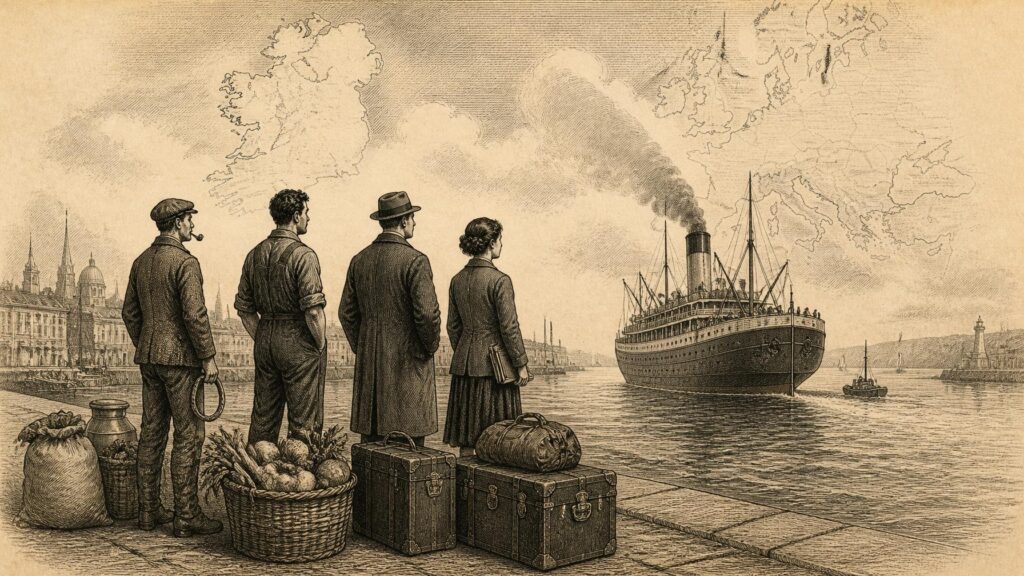
AI generated historical illustration, not a contemporary photograph.
At a Glance
Ireland’s relationship with the European Union is among the decisive stories of the modern State. It cannot be reduced to grants, motorways or Brussels regulations, although all became visible features of membership. It is the history of a country seeking room for independent action while tied economically to Britain; of voters repeatedly asked to authorise international commitments; of farmers, workers, officials and students whose opportunities changed; and of an island whose border acquired a new significance after the United Kingdom chose to leave the Union.
Island Economy
When Ireland entered the European Economic Community on 1 January 1973, it joined an organisation that had been created by six continental states in the aftermath of the Second World War. The EEC was not then the European Union of later decades: it had no single currency, no directly elected European Parliament, and a more limited range of policy responsibilities. Yet its central promise was already considerable. By lowering internal barriers and establishing common policies, especially in agriculture, it sought to bind participating economies together. For Ireland, that prospect had a particular meaning. The State stood geographically at Europe’s western edge, but its trade and economic assumptions remained closely connected to the United Kingdom.
This dependence had deep historical roots. Partition, the creation of the Free State, the preservation of the Common Travel Area and the scale of Britain’s market all ensured that London mattered more to Dublin than any continental capital. In the decades after independence, protectionism was intended to foster domestic industry, but it coincided with weak growth, unemployment and sustained emigration. The shift away from that model during the late 1950s and early 1960s was therefore not merely a technical alteration of tariff policy. It was an attempt to revise the economic setting in which the independent State operated. The European Commission’s historical account notes both the predominance of agriculture and the exceptional reliance on British markets in the period before membership; it also records the doubts among the original EEC members about Irish economic capacity and neutrality.
Sean Lemass’s governments encouraged export-led development and foreign investment, while the 1958 Programme for Economic Expansion marked the public abandonment of older economic habits. European integration became relevant because British entry into the EEC could have transformed the conditions under which Ireland sold cattle, dairy products and manufactured goods. The Irish calculation was not simply that continental Europe offered a larger market. It was also that remaining outside a Community which included Britain might leave the State subject to decisions taken elsewhere, with few means of influence.
That is an important distinction. Later celebratory accounts sometimes describe EEC membership as the moment Ireland escaped Britain economically. The evidence supports a more careful formulation. Membership widened Irish options and, over time, reduced the overwhelming proportion of trade conducted with Britain. It did not erase geography, the Common Travel Area, commercial links or the political importance of Anglo-Irish relations. In 1973, Ireland and the United Kingdom entered together, and Ireland’s route to accession was closely constrained by British applications and French vetoes. The new European relationship was thus built partly through, rather than wholly against, the older British connection.
Continental Choice
Ireland first applied to join the EEC in 1961, only days after the United Kingdom submitted its own application. A second Irish application followed the British reapplication in 1967. On both occasions President Charles de Gaulle’s opposition to British membership prevented enlargement. Ireland was not legally bound to move in Britain’s wake, but the commercial facts of the time made a wholly separate strategy difficult. The historical record therefore shows both agency and constraint: Irish ministers and civil servants made an affirmative European choice, while doing so in circumstances shaped by dependence on the British market.
The political discussion was broader than an argument over export figures. Membership involved the sharing of decision-making powers and the acceptance that Community law could have domestic effect. The Government’s White Paper, Membership of the European Communities: Implications for Ireland, published in 1970, considered agriculture, industry, movement, taxation and policy. The document itself is evidence that accession was understood as a constitutional and social question as well as a commercial one. The Oireachtas Library’s account of the period preserves the context of that White Paper and the later negotiations.
Negotiations began in earnest after de Gaulle’s resignation in 1969 and the willingness of the Six to reconsider enlargement. Ireland signed the Treaty of Accession at Brussels on 22 January 1972. Taoiseach Jack Lynch and Minister for Foreign Affairs Patrick Hillery signed for the State. Hillery’s later appointment as Ireland’s first European Commissioner gave the moment an additional symbolic importance: membership required not merely access to European markets but a permanent Irish presence within the institutions that made common rules.
It is tempting to present accession as inevitable because it later appeared successful. That would flatten the uncertainty of the time. Agriculture expected gains from the Common Agricultural Policy, but industrial firms faced greater competition. Fishery interests feared unequal access to waters. Critics questioned the implications for neutrality, independence and democratic control. The Labour Party favoured association rather than full membership in the earlier phase, and Sinn Féin opposed accession. Supporters ranged from those convinced by European political cooperation to those who saw practical economic necessity. The campaign was thus neither a simple elite manoeuvre nor a unanimous national awakening.
What can be documented is that the principal parties of government and opposition—Fianna Fáil and Fine Gael—backed a Yes vote, while opponents warned that the Community could narrow national autonomy. What belongs to interpretation is the weight given to each motive among individual voters. Most citizens did not leave a detailed explanation of their ballot. Contemporary campaigns, parliamentary debates and later scholarship show that prosperity, farm prices, employment, national independence and the United Kingdom all mattered, but they cannot yield a single motive for an entire electorate.
Constitutional Gate
Irish membership required popular authorisation because accession altered the constitutional position of the State. The Third Amendment of the Constitution permitted the State to become a member of the European Communities and made clear that measures necessitated by membership, including acts of Community institutions, could have force in the State. It was a notable constitutional innovation. Ireland did not merely make an external treaty; it adapted its fundamental law to accommodate a legal order beyond the Oireachtas and the domestic courts. The enacted text and date are preserved in the Irish Statute Book’s ‘Third Amendment of the Constitution Act, 1972’.
The referendum took place on 10 May 1972. The proposal passed with 83.09 per cent voting Yes on a turnout of 70.3 per cent. Ireland entered the Communities on 1 January 1973, alongside Denmark and the United Kingdom. Those figures are not folklore; they are official historical results, repeated in the Oireachtas chronology and in the State’s later commemoration of accession.
The magnitude of the vote is sometimes used to imply that Irish European policy thereafter enjoyed uncomplicated consent. It did not. The 1972 result established a durable presumption in favour of membership, but later treaty debates showed that consent was conditional, informed by particular texts and political circumstances. The constitutional route mattered because it gave citizens a recurring role in decisions about the scope of European integration. Ireland became unusual among member states in the number of European treaty questions submitted to referendum.
The European Communities Act 1972 supplied the domestic statutory machinery for membership. Its importance was practical as well as symbolic: European obligations and legal acts could be incorporated and implemented within Irish law. This did not make the Irish legislature irrelevant. Rather, it created an interlocking system in which the Oireachtas legislated within fields increasingly affected by European treaties, regulations, directives and judicial decisions. The Act remains a central archival starting point for tracing that relationship.
In historical terms, the referendum also complicates any crude contrast between national sovereignty and European membership. The people authorised membership through the Constitution, an exercise of sovereignty under Irish constitutional practice. But that authorisation allowed shared rule-making and accepted limits on unilateral action in agreed fields. The tension did not disappear. It became one of the defining features of Irish European politics.
Rural Change
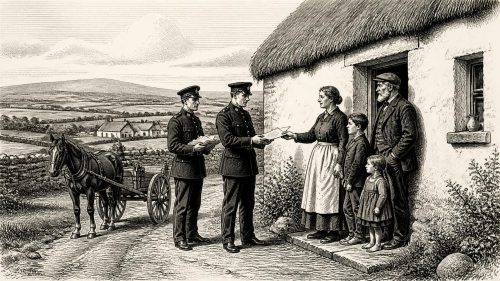
The Common Agricultural Policy, or CAP, was the most immediate and tangible European policy for much of rural Ireland. Agriculture carried a far greater weight in employment, exports and public life in the early 1970s than it would in the twenty-first century. Access to common price supports and a larger market could raise farm incomes; it could also expose producers to the disciplines and controversies of a system designed across several states. For families in cattle, dairying and tillage, ‘Europe’ often meant milk quotas, intervention prices, payments, veterinary rules, environmental requirements and the changing economics of small farms.
The gains were real but uneven. The CAP helped increase returns and brought large flows of support into rural areas. The Commission estimates that between 1973 and 2020 CAP investment in Ireland totalled €64.7 billion, including support for farmers and rural communities. Such retrospective figures should be used cautiously: they are expressed in current euros across many decades and do not alone measure social benefit. Nonetheless, they demonstrate the scale of the policy’s fiscal importance.
CAP support did not preserve every rural livelihood. Ireland, like other member states, experienced continuing farm consolidation, mechanisation and demographic change. The idea that European membership simply saved a timeless countryside is better understood as political memory than as precise history. Villages continued to lose services; younger people continued to leave some areas; and farm households often depended on off-farm work. European funds could support adaptation, but they could not halt all the economic forces remaking rural society.
Fisheries revealed another difficult side of accession. Ireland possessed extensive maritime waters but entered a Common Fisheries Policy in which access, quotas and enforcement were negotiated collectively. The subject acquired particular political force because fishing communities frequently believed that the State had exchanged a resource of exceptional value for wider gains concentrated in farming and industry. That belief contains an arguable interpretation of bargaining outcomes, not an easily settled fact. What is well documented is that fisheries became a durable source of contention in Irish debates about membership and national interest. The European Commission’s account records the historic difficulties of patrolling waters and the later dependence of Irish seafood exports on European as well as British and global markets.
The wider lesson is that Ireland’s European experience was never socially uniform. A dairy farmer, a trawler owner, a factory worker, a civil servant and an emigrant returned through freedom of movement did not encounter the Community in the same way. Historical accounts that focus only on national income conceal those differences. Equally, accounts that emphasise one harmed sector can fail to explain why membership maintained broad public support. The subject requires both scales: national transformation and local experience.
Public Works
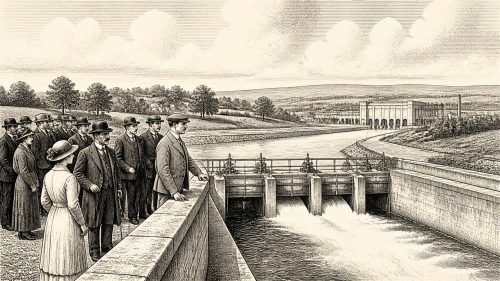
European regional and structural funding became another visible element of membership. Ireland joined at a time when it was among the poorer Community states, and the European Regional Development Fund, created in 1975, addressed disparities between regions. Roads, water schemes, training, urban renewal, environmental projects and transport infrastructure later bore the plaques and signboards that made European funding publicly recognisable. Ireland’s first Council Presidency in 1975 coincided with the establishment of the fund; Dublin Castle hosted the first formal meeting of the European Council in March of that year.
There is ample evidence that European transfers mattered, especially before Ireland’s economic convergence. The Commission states that Ireland was a net recipient of more than €40 billion in EU funds from 1973 to 2018, although it later became a net contributor as national income grew. This is a useful indicator, but it should not be made to carry an implausible causal burden. Economic development also reflected domestic policy, demographic change, educational expansion, globalisation, foreign direct investment and decisions by multinational companies.
It is more historically defensible to say that membership supplied resources, policy frameworks and market access which interacted with Irish choices. The late twentieth-century expansion of education and infrastructure, for example, cannot be attributed solely to Brussels. But European co-financing helped governments undertake projects that would otherwise have imposed greater demands on domestic budgets. The effects were especially significant when Irish public resources were constrained.
The visible works also shaped political culture. A European flag at a building site did not necessarily generate affection for supranational institutions, but it placed Europe within everyday landscapes. Rural roads, motorways, the DART, the Luas Red Line and regional facilities provided concrete examples in arguments that might otherwise have seemed remote. The Commission lists major transport projects and visitor amenities which received European support, including the Dublin Port Tunnel, portions of the inter-urban road network and the Luas Red Line.
Folklore developed around these projects. One common story treats every major road as ‘paid for by Europe’; another treats funding boards as proof that projects would not have existed without them. Neither formula is reliable without examining the particular programme, rate of co-financing and domestic contribution. The boards are evidence of European participation, not by themselves a complete account of causation. For historians, the distinction matters because public memory often turns a complex budgetary partnership into a simple tale of gift or dependency.
Legal Horizons
The legal consequences of membership were as important as its financial ones. European law entered Irish public administration through regulations, directives, court decisions and transposition measures. Employment equality, consumer standards, environmental protection, public procurement and competition policy all became fields in which domestic law was affected by European obligations. The influence varied by subject and period, but its cumulative result was to add a European dimension to legislative and administrative life.
That process sometimes advanced rights that Irish governments had been slow to recognise. European equality law is frequently associated with challenges to unequal treatment of women in employment and with the gradual dismantling of assumptions embedded in public and private workplaces. It would be misleading to claim that all social liberalisation came from Europe; domestic movements, litigants, trade unions, political parties and changing public attitudes were essential. Yet European legal standards created additional routes through which discrimination could be challenged. The Commission’s historical overview identifies equal-pay and equal-treatment rules among the ways membership altered employment rights.
The constitutional boundary was tested decisively in Crotty v An Taoiseach in 1987. Raymond Crotty challenged the proposed ratification of the Single European Act. The Supreme Court held, by majority, that the provisions on European Political Cooperation required constitutional approval because they involved a transfer of sovereignty not already authorised by the Constitution. The ruling did not reject European integration. It distinguished elements of the treaty and required a referendum for the political-cooperation title. A later Supreme Court judgment summarises the holding and its constitutional significance.
The referendum on the Single European Act took place on 26 May 1987 and passed with roughly 70 per cent support. More enduring than the particular vote was the constitutional practice that followed. Major amendments to the founding treaties came to require a referendum where they went beyond existing constitutional permission. This gave Irish voters an unusually direct place in the ratification of Maastricht, Amsterdam, Nice and Lisbon. The official referendum archive lists these polls and the constitutional amendments associated with them.
Crotty is sometimes portrayed as a simple nationalist veto on Europe. That is too narrow. The judgment affirmed that international cooperation could be constitutionally authorised, while insisting that the people—not government alone—must approve an additional transfer of constitutional authority. Its legacy was democratic as much as restrictive: successive governments had to explain European treaties in public campaigns, and opponents could make their cases before an electorate rather than only in parliamentary debate.
Treaty Democracy
The Maastricht referendum of 18 June 1992 was a major threshold. The Treaty on European Union created the EU as a wider political framework, prepared the path toward Economic and Monetary Union and expanded cooperation in areas beyond the older Community market. Ireland approved the Eleventh Amendment with 69.1 per cent voting Yes. The constitutional text formally allowed the State to ratify the Treaty on European Union and become a member of that Union.
Maastricht showed that support for membership could coexist with unease about its direction. Debates encompassed the single currency, neutrality, subsidiarity and the social dimension of Europe. The Amsterdam Treaty was approved in 1998, but the pattern changed at Nice. In June 2001, voters rejected the Nice Treaty by 53.9 per cent to 46.1 per cent, on a turnout of 34.8 per cent. Concerns about Irish neutrality, enlargement, institutional representation and the character of the campaign all featured in contemporary analysis. The vote did not amount to a rejection of membership; it was a rejection of a particular treaty proposal at a particular moment.
The Government sought declarations and assurances, including on neutrality, and returned to the electorate in October 2002. Nice then passed with 62.89 per cent voting Yes. The two ballots are often simplified into a lesson that Irish voters vote Yes when asked twice. Such a phrase is rhetorically useful but historically inadequate. Between the polls there were changes in turnout, campaigning, public information, international context and the commitments offered by the other member states. The Oireachtas chronology records both results and the concerns associated with the first vote.
Lisbon repeated this pattern in a more dramatic setting. On 12 June 2008, Ireland rejected the Treaty of Lisbon, the only member state required to hold a referendum. It approved the treaty on 2 October 2009 after the Government obtained legally significant guarantees and political commitments concerning matters including neutrality, taxation, family policy and a continuing Commissioner for each member state. The first vote produced a 53.4 per cent No; the second a 67.1 per cent Yes. These results are official facts. The explanation for the change remains a matter for analysis, involving the altered campaign, the economic crisis, greater public attention and the assurances secured.
This sequence demonstrates that Irish European history is not a story of passive compliance. Referendums made European policy vulnerable to public distrust, but they also made it more accountable. They forced governments to translate treaty language into questions about daily life: military neutrality, the number of commissioners, abortion law, taxation, workers’ rights and the national capacity to decide. Claims made during campaigns were often contested, sometimes exaggerated and occasionally speculative. The historian’s task is not to reproduce every warning as prediction or every reassurance as certainty, but to recognise that the arguments reveal what voters and campaigners believed was at stake.
Currency Union
Ireland joined the European Monetary System at its creation in 1979, ending the formal link between the Irish pound and sterling. That decision carried both economic and symbolic weight. It did not make Ireland immune from British economic influence, but it marked a deliberate monetary differentiation from the United Kingdom. The euro later extended that separation: Ireland joined the first group of participating states in 1999, and euro notes and coins entered circulation in 2002.
The euro was presented as an instrument of stability, lower transaction costs and deeper integration with European markets. For a small, open economy, those were substantial attractions. Ireland’s 1996 Council Presidency helped broker the Stability and Growth Pact and took decisions associated with the practical design and launch of the currency. The Irish Presidency’s role is part of a broader record in which the State, though small, chaired negotiations and supplied administrative leadership.
Membership of monetary union also created constraints. During the financial crisis that began in 2008, Ireland could not restore competitiveness through an independent currency devaluation. The banking collapse, the State guarantee, the EU–IMF programme and subsequent austerity exposed the political costs of economic interdependence. It would be inaccurate to describe the crisis as simply caused by the euro: domestic banking policy, property speculation, regulatory failures and international capital flows were all central. Conversely, it would be inaccurate to treat the euro as irrelevant. The crisis renewed argument about fiscal sovereignty, the design of monetary union and the balance between solidarity and discipline.
Irish voters approved the Treaty on Stability, Coordination and Governance in 2012, commonly called the Fiscal Stability Treaty, by referendum. The vote came after the most severe period of the bailout and demonstrated again that support for European membership was not unconditional endorsement of every policy. Ireland’s relationship with the Union had become materially deeper than the 1972 market-access debate. It now touched currency, budgetary rules, banking supervision and the management of a national emergency.
Peace Context
The European dimension of the Northern Ireland peace process should be described with care. The European Union did not make the Good Friday Agreement of 10 April 1998. The agreement emerged from complex negotiations among the British and Irish governments, Northern Ireland parties and other actors, supported by the United States and shaped above all by local political courage, exhaustion with violence and sustained civic work. To credit Europe alone would diminish those participants.
Yet common EEC and EU membership changed the setting in which British-Irish relations operated. Irish and British ministers met routinely in European institutions; officials acquired habits of cooperation; and the shared framework reduced the symbolic sharpness of an interstate frontier that remained politically contested. European funding through programmes including PEACE supported cross-community and cross-border activity. The Commission describes the EU as having offered support and a neutral forum that facilitated progress, while the more precise historical claim is that European institutions and funding formed one useful part of a wider architecture for cooperation.
The Good Friday Agreement itself created institutions for North-South and British-Irish cooperation. Those arrangements developed while both Ireland and the United Kingdom were EU members, with common rules for goods, people and services making practical cross-border activity easier. This context should not be romanticised. The border did not vanish from political consciousness, and the legacy of conflict remained. But its physical and economic salience lessened under the combined influence of the peace settlement, the Common Travel Area and shared EU membership.
Brexit made the importance of that context unmistakable. The United Kingdom voted to leave the EU on 23 June 2016 and formally withdrew on 31 January 2020. Negotiations then confronted a problem largely absent from public imagination before the referendum: how could the EU protect its Single Market while avoiding a hard border on the island and preserving the Good Friday Agreement’s institutions and assumptions? The Protocol on Ireland and Northern Ireland, subsequently adjusted by the Windsor Framework, was designed around that problem. The European Commission states explicitly that the arrangements seek to protect North-South cooperation, avoid a hard border and safeguard the Agreement in all its dimensions.
Brexit also altered Ireland’s wider position. The State remained an English-speaking EU member with close cultural and economic ties to Britain, while the United Kingdom became a neighbouring non-member. Irish diplomacy had to defend the all-island economy and the peace settlement without treating Northern Ireland merely as an external trade problem. The episode confirmed that Europe was no longer an optional foreign-policy arena for Ireland. It had become integral to the constitutional, commercial and social geography of the island.
Language Presence
European membership affected culture as well as law and trade. Irish became an official language of the EU in 2007, initially subject to a derogation that limited the quantity of material translated and published. On 1 January 2022 that derogation ended, giving Irish full status as an official and working language of the institutions. The achievement matters because it placed the language within a multilingual European legal and administrative order, creating employment, translation and terminological work while affirming its formal equality with other official languages.
It would be fanciful to suggest that institutional status alone can reverse language decline in Gaeltacht communities or resolve questions of transmission in families and schools. It cannot. But official recognition has practical and symbolic effects, demonstrating that Irish citizenship need not be framed solely through English-language access to international institutions. It also complicates the old image of Europe as a force of homogenisation. The Union has promoted economic integration, but it also operates through a system of official languages and has supplied a platform for minority-language claims.
Freedom of movement likewise changed Irish experience. For earlier generations, departure for Britain, the United States, Canada or Australia often meant a severe and sometimes permanent rupture. Membership did not end emigration, particularly during recessions, but it expanded the legal ease with which Irish citizens could work, study and live across participating states. Erasmus and related programmes brought a European dimension to education and personal mobility. Such experiences are difficult to quantify as historical change, yet they help explain why European identity could coexist with, rather than displace, Irish identity.
Continuing Argument
Fifty years after accession, Ireland’s relationship with the European Union cannot be understood through either triumphalism or nostalgia. The evidence strongly supports the view that membership helped transform the State’s external economic orientation, supplied extensive agricultural and regional funding, widened opportunities for mobility, enhanced diplomatic reach and embedded Ireland in a larger legal and political community. It also shows that outcomes were uneven, that domestic decisions remained decisive, and that membership produced genuine disputes about fisheries, neutrality, democratic authority, taxation, social policy and monetary governance.
The change from net recipient to net contributor is itself historically revealing. It illustrates economic convergence but should not be read as proof that membership has ceased to matter. Ireland continues to participate in the Single Market, the euro area, common legislation and shared programmes; it also retains a strong interest in European decisions affecting trade, climate policy, agriculture, technology and the island’s border. Modern figures may be useful for context, but they should not obscure the historical point: the relationship evolved from one in which Ireland sought entry partly to overcome relative poverty and isolation into one in which it seeks influence within an interdependent Union.
Irish presidencies of the Council demonstrate that small states can shape agendas when they hold institutional responsibility. The 1975, 1979, 1984, 1990, 1996, 2004 and 2013 presidencies included moments of consequence, from the first formal European Council meeting in Dublin to work on German unification, the Stability and Growth Pact, eastern enlargement and banking supervision. The record does not mean Ireland controlled outcomes; presidencies broker rather than command. It does, however, refute the notion that membership made the State merely a recipient of rules devised by larger powers.
The most enduring feature of this history may be the negotiated character of Irish Europeanism. Ireland did not dissolve into Europe, nor did it preserve an untouched sovereignty outside collective obligations. It used constitutional referendums to authorise successive steps, sometimes approving and sometimes refusing them. It gained access to institutions in which national preferences could be voiced, while accepting that other states possessed the same right. Its citizens benefited from common rules and sometimes protested against them. Its governments used Europe to diversify external relations, while repeatedly having to explain why that choice served national interests.
That is why the story belongs securely in Irish history. It is not an imported institutional narrative imposed upon a self-contained island. European membership reshaped the Irish State’s economy, Constitution, law, infrastructure, diplomacy and understanding of the border. The consequences remain open to argument, and no historical account should pretend that all were beneficial or all were intended. But the documentary record leaves little doubt that the European passage, begun with applications in the early 1960s and confirmed by voters in 1972, became one of the principal routes by which modern Ireland was made.