Learning Republic
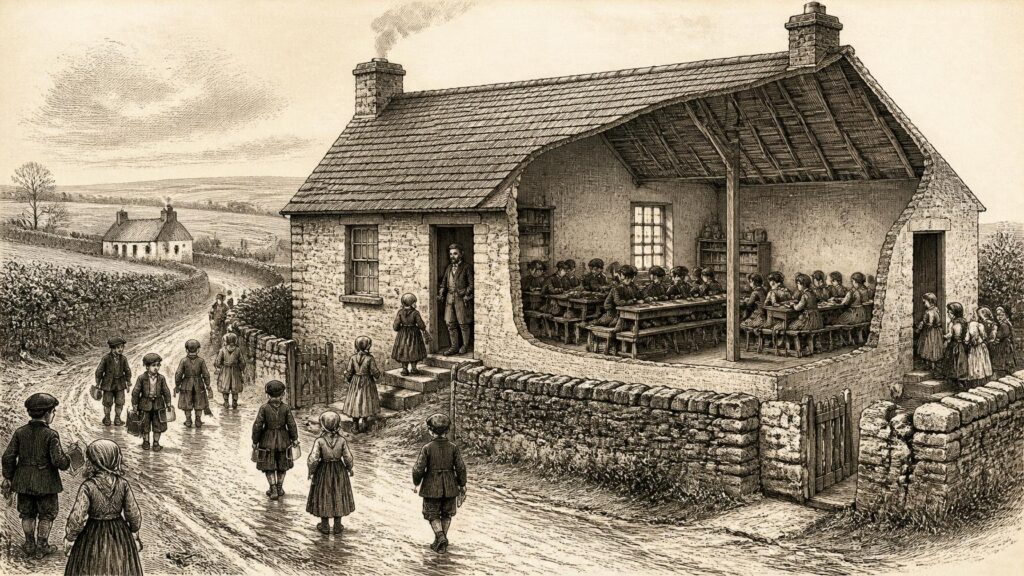
AI generated historical illustration, not a contemporary photograph.
At a Glance
Education reform in Ireland has been a recurrent attempt to decide who should learn, what they should learn, who should pay, and which moral or national authority should shape the school. Its history is not a smooth ascent from ignorance to enlightenment. It is a contested history in which widening access coexisted with denominational division, gendered expectations, linguistic loss, social inequality and unusually durable local control over schools.
Before Systems
Long before the State established a national school network, education in Ireland was supplied through a shifting mixture of family teaching, parish provision, fee-paying schools, charitable institutions and private masters. The surviving evidence does not support a simple picture of an unlettered population suddenly rescued by nineteenth-century government. Research based on the 1824 educational inquiry has shown a wide, if uneven, network of schools before the national system. These establishments differed greatly in accommodation, fees, curriculum and quality. Some met in purpose-built rooms; others occupied cabins, barns or rooms attached to homes. Attendance was often irregular because children’s labour remained important to household survival.
The term ‘hedge school’ has become one of the most evocative phrases in Irish historical memory. It properly refers to a diverse group of informal or private schools, rather than a single coordinated system. Some were associated with the era of the Penal Laws, when Catholic education was restricted; many later schools continued after restrictions had eased, charged fees and operated in buildings rather than literally beside hedges. The romantic image of a learned schoolmaster instructing barefoot children in Latin under a hedge is therefore partly folklore. Yet the evidence for substantial popular demand for literacy and numeracy is strong. Hedge and pay schools helped create it, especially among Catholic families excluded from secure access to formal institutions.
Such schooling was never politically neutral. In the eighteenth and early nineteenth centuries, education intersected with religious establishment, Protestant missions, Catholic emancipation, social discipline and the spread of English. Charter schools, founded in the eighteenth century, aimed in part at converting Catholic children; their record made them deeply suspect among many Catholic families. The Kildare Place Society, established in 1811 to promote the education of the poor, received public funding and trained teachers, but its non-denominational claims also met resistance where Bible reading and the authority of Protestant patrons seemed inseparable.
There was also no uniform language of instruction. English was increasingly valuable for employment, administration, migration and trade. Irish remained the first language of many people, particularly in rural districts, but its place in formal schooling was insecure. The growing attraction of English cannot be explained solely as coercion. It was also an understandable family response to a changing economy and to the prospect of emigration. This difficult mixture of compulsion, aspiration and adaptation would remain central to educational debate throughout the nineteenth century.
By the 1820s, reformers and officials could see both an extensive existing educational culture and its serious limitations. Provision was fragmented; schools often depended on precarious local resources; teacher preparation varied; girls’ attendance lagged behind boys’ in many places; and schooling was not consistently free. The question facing government was therefore not whether Irish people valued education. It was whether a state-supported system could be created without provoking sectarian conflict and without removing local religious influence. The answer shaped the institutional structure that has endured, in altered form, into the present.
National Foundations
The Commissioners of National Education were established in 1831 under British rule. The new arrangement is often called the national school system, though ‘national’ then meant a state-supported system for Ireland within the United Kingdom, not an institution of an independent Irish nation. Its stated ambition was ambitious: schools would provide elementary education for children of different religious backgrounds, with secular instruction shared and religious teaching arranged separately. In theory, this was intended to reduce sectarian antagonism while extending public provision.
In practice, the system expanded rapidly but moved away from its original mixed-denominational aspiration. Local clergy and communities were indispensable because they supplied sites, influence and financial support. Catholic bishops, Protestant clergy and religious orders consequently acquired major roles in management. The pattern was not imposed in one decisive moment; it emerged through thousands of local decisions about school buildings, teachers, patrons and enrolments. By the later nineteenth century, most national schools were effectively denominational, even though they were publicly funded and centrally inspected.
The national school was an important institutional achievement. It supplied grants, a central inspectorate, teacher training and an increasingly standardised curriculum. It reached places where formal schooling had been uncertain and helped make primary education more routine. But it did not simply displace older provision overnight. Hedge schools and private schools persisted, especially where communities preferred familiar masters or distrusted new arrangements. Nor did the school system erase economic constraints. Poor families could need children’s wages or farm labour, and the nominal availability of school did not guarantee regular attendance.
Curriculum revealed the priorities of the new order. Reading, writing, arithmetic, needlework and practical subjects occupied central places. The model encouraged discipline, punctuality and basic literacy, qualities valued by administrators as well as parents. Instruction in English was fundamental. The system contributed to the broad nineteenth-century language shift, although it was only one force among many: famine, death, migration, labour markets, urbanisation and family choices all mattered. It would be historically misleading to treat national schools as the sole cause of Irish-language decline; equally, it would be misleading to deny that schooling gave English institutional power.
The school building itself became a familiar feature of Irish landscapes. Many were modest, often with separate entrances, rooms or playgrounds for boys and girls. The architecture embodied assumptions about gender, religion and authority. Girls were educated in increasing numbers, but their curriculum commonly reflected expectations of domestic labour and motherhood. Religious congregations became especially influential in girls’ education, establishing convent schools that combined academic work with moral and religious formation. The scale of their contribution was considerable, but it also ensured that access and ethos were strongly shaped by denomination.
Compulsory attendance legislation in the late nineteenth century increased the State’s formal expectation that children would attend school. Its enforcement, however, was uneven. Rural distance, inadequate transport, poverty and seasonal work limited compliance. Reform thus involved more than passing laws: it required teachers, buildings, rates of attendance, public confidence and money. The national system expanded educational opportunity, but it also established a defining Irish compromise: public financing and central regulation combined with local, predominantly church-based patronage.
Religious Settlement
That compromise has sometimes been described as the State surrendering education to the churches. It is more accurate to say that a weak and fiscally constrained State relied on religious and local institutions while retaining important powers over recognition, inspection, salaries and curriculum. The balance was unequal and changed across regions. Catholic authorities gained a dominant position in much of the island, while Protestant institutions remained especially significant in parts of Ulster and in particular communities elsewhere. Parents often chose schools that reflected their faith, not merely because clergy directed them to do so but because schooling was bound tightly to communal identity.
The arrangement gave Ireland a dense school network, but it created enduring difficulties. A school might be publicly supported yet controlled by a patron whose religious ethos shaped enrolment, staffing and daily life. Minority families could find local choice constrained. Teachers frequently worked under demanding conditions, with modest pay and close inspection. Their professional organisations, notably the Irish National Teachers’ Organisation, became important advocates for better salaries, pensions, training and a broader curriculum. Teacher activism is a vital part of reform history because many changes presented as governmental initiatives were also won through sustained professional pressure.
The nineteenth-century secondary system developed differently. It remained largely fee-paying and was supplied by private schools, diocesan colleges and institutions run by religious orders. The Intermediate Education Act of 1878 introduced examinations and grants linked to pupils’ results. This widened incentives for schools to prepare students for public examinations, but it also fostered an examination-centred culture. Academic success in set subjects could bring status, funding and routes to professional careers. The legacy of that system can still be seen in the cultural authority later attached to the Leaving Certificate.
Technical and vocational education developed more slowly and often carried lower social prestige than classical or academic schooling. The technical instruction legislation of the closing nineteenth century and the vocational education structures of the twentieth attempted to remedy this. Yet the hierarchy between academic secondary schooling and vocational preparation proved stubborn. It reflected social class, institutional tradition and the high value placed on university entrance. Reformers repeatedly argued that an economy undergoing industrial and technological change needed more than an elite examination system, but institutional habits were difficult to dislodge.
Language Nation
The revolutionary and early independence periods made education a principal arena for national reconstruction. After the establishment of the Irish Free State in 1922, governments inherited the buildings, teachers, denominational patronage and administrative habits of the national system. They did not build a wholly new secular state school structure. Instead, they sought to reshape inherited institutions through curriculum, examinations, teacher preparation and language policy. The most conspicuous aim was the restoration of Irish.
Irish was introduced more fully into primary schooling soon after independence, and policies increasingly sought to make it both a subject and a medium of instruction. The intention was cultural as well as educational: schools would assist in rebuilding a distinct national identity after centuries of political subordination. Supporters believed that the classroom could reconnect children with a language marginalised by nineteenth-century economic and social change. Critics worried about overburdened teachers, inadequate materials, uneven linguistic competence and the effect on other subjects. Both positions had force. National revival was a sincere public project, but schools alone could not reverse broad changes in the language’s social use.
The reform had a paradoxical quality. It tried to use the administrative machinery inherited from British rule to cultivate an Irish-speaking nation. Teachers were asked to carry a burden far beyond ordinary instruction. In many English-speaking districts they had to teach Irish to children who rarely encountered it outside school; in Irish-speaking areas, policies could fail to respect the linguistic realities of pupils. The result was not simple failure or success. Irish became a compulsory and symbolically important part of schooling, helped sustain language knowledge across generations and supported the later growth of Irish-medium education. But it did not restore Irish as the everyday majority language.
Curricular nationalism extended beyond language. History, geography, literature, music and physical culture were expected to cultivate civic attachment and cultural confidence. Such subjects mattered deeply in a new State seeking legitimacy. Yet priorities could conflict. The severe economic conditions of the 1920s and 1930s limited expenditure, while many rural schools remained small, poorly resourced and dependent on teachers handling multiple age groups. The rhetoric of national renewal could be powerful, but daily educational experience was often marked by material scarcity.
Education also remained closely connected to Catholic moral authority. The new State did not dismantle denominational patronage. Catholic religious orders continued to provide a large share of secondary education and training institutions, while the State focused on curricula, examinations and grants. This produced a system that was national in aspiration but plural in management, with a dominant Catholic character in most areas. Protestant schools maintained their own traditions and protections. It is essential not to flatten these different experiences into a single story, yet the overall result was that religious identity remained a central organising principle.
The 1937 Constitution confirmed the importance of family rights in education. Article 42 recognises the family as the primary and natural educator, protects parents’ freedom to provide education in homes, private schools or recognised schools, and requires the State to provide free primary education. It also requires a minimum moral, intellectual and social education. These clauses institutionalised a view in which state provision was necessary but parental conscience and voluntary initiative were strongly protected. In later disputes over school ethos, admissions, home education and curriculum, Article 42 became a continuing point of reference.
Economic Turning
By the 1950s, the limitations of the inherited settlement were increasingly evident. Many young people left school early; post-primary education was beyond the financial reach of numerous families; and emigration remained a defining experience. The State’s economic strategy began to change from protectionism towards a more outward-looking model. That shift made education appear not only as cultural formation but as economic infrastructure. Industrial development, scientific training, technical competence and a larger skilled workforce became matters of national urgency.
The Programme for Economic Expansion, initiated in 1958, formed part of this changing context. Education was not the sole cause of economic transformation, but policy-makers increasingly treated it as essential to development. The landmark Investment in Education report, prepared by a survey team appointed in 1962 and published in 1965, supplied influential evidence and recommendations. It examined participation, staffing, buildings, teacher education and the relationship between schooling and economic needs. Its importance lay not simply in particular proposals but in its use of planning, data and projected manpower needs to make the case for much greater public investment.
The report helped recast educational disadvantage as an economic and social waste, rather than merely an unfortunate private circumstance. It showed how fees, distance and family resources restricted progression beyond primary school. This language of human capital can sound narrow to modern ears, but it had a politically powerful consequence: it made expenditure on education appear productive rather than charitable. Reform came to be linked to national prosperity, regional development and social mobility.
Several institutional changes preceded and accompanied the most celebrated reform. Comprehensive schools, community schools and expanded vocational provision challenged the sharp divide between academic secondary schools and technical education. New regional colleges widened opportunities after school. School building expanded. Teacher education adapted slowly to new demands. The changes did not abolish the old secondary schools, many of which continued under religious patronage, but they broadened the range of post-primary pathways available to families.
Free Access
The announcement by Minister for Education Donogh O’Malley in September 1966 that free post-primary education would be introduced was a decisive moment in Irish social history. The scheme began in 1967, with free tuition and a school transport system designed to make attendance possible for pupils living at a distance from suitable schools. It did not create universal equality, nor did it instantly remove all costs. Families could still face expenses for uniforms, books, meals and activities. Nevertheless, it removed the formal fee barrier that had excluded large numbers from secondary education.
The initiative is often told as the achievement of one bold minister, and O’Malley’s role was undeniably important. He was Minister for Education from 1966 until his death in 1968, and his public commitment accelerated a change that parts of the civil service and wider policy environment had been preparing. But the lone-hero narrative is incomplete. The reform rested on the research behind Investment in Education, demographic pressures, teacher and parental expectations, school construction, transport arrangements and an emerging consensus that early school leaving damaged both society and economy. O’Malley made a politically memorable intervention; he did not act in an institutional vacuum.
The practical consequences were profound. Post-primary participation expanded, rural pupils could travel to larger schools, and the expectation that children would continue beyond primary education became much more widespread. For many families, particularly those without a previous tradition of secondary schooling, the reform altered what was imaginable. It opened routes to apprenticeships, teacher training, clerical employment, colleges and universities. It also changed family decisions: children who might formerly have entered work early could remain in education through adolescence.
Yet free education should not be mistaken for a complete social revolution. Selective patterns survived. Some schools retained higher status, some families could better manage indirect costs, and social advantage continued to influence subject choice, examination outcomes and progression to higher education. The system’s denominational character also remained largely intact. Free access expanded within existing school structures rather than replacing them with a unified publicly managed network. This is why the reform was simultaneously radical in effect and conservative in institutional form.
The new transport scheme mattered as much as tuition in many rural areas. Geography had long shaped opportunity: a child living far from a town school might be technically eligible to enrol but practically unable to attend. Transport connected dispersed populations to larger post-primary centres and helped make a national promise real. It also contributed to the closure or decline of some very small local arrangements, reinforcing a wider trend towards larger schools and longer journeys. Reform always has spatial consequences: accessibility improved for many, while community attachment to local provision could weaken.
Expansion in the late 1960s and 1970s placed pressure on buildings, teachers and curricula. The traditional academic model could not easily meet the needs of a much larger and more socially diverse student body. Comprehensive and community schools offered broader combinations of academic, practical and vocational subjects. The vocational sector, administered through committees that later evolved into Education and Training Boards, gained a more prominent place. The ideal was not merely to keep more pupils in school but to give them meaningful choices there.
Economic Turning
The long-term effects of free post-primary education were intertwined with wider economic change. It contributed to a population better equipped for expanding public services, professional employment and foreign investment. However, claims that one reform alone created modern Ireland are interpretative rather than demonstrable fact. Economic openness, European integration, demographic shifts, women’s rising labour-market participation and later investment patterns were also crucial. Education was a necessary part of transformation, but historical explanation should resist turning it into a single master key.
Women’s educational participation offers one of the clearest examples of change. Girls had long attended primary school, and religious orders had provided extensive girls’ secondary education. Yet social expectations and employment structures limited many women’s opportunities. As post-primary participation broadened and third-level access increased, women’s qualifications and occupational choices expanded significantly. The gains were neither automatic nor evenly distributed, but education became a major route through which women could claim greater independence and public presence.
The period also intensified the authority of public examinations. The Intermediate Certificate, later replaced by the Junior Certificate and then the Junior Cycle framework, and the Leaving Certificate continued to organise pupils’ lives and family expectations. Examinations offered a standardised means of selection and could appear fairer than patronage or private recommendation. At the same time, they rewarded familiarity with academic conventions, access to support and the capacity to endure high-stakes assessment. The tension between certification and education has therefore been a persistent theme of reform.
Curriculum Change
Primary education experienced a major curricular reorientation with the Primary School Curriculum introduced in 1971. It followed long criticism of crowded, prescriptive programmes and the limited space given to children’s developmental needs. The new curriculum sought a broader, child-centred approach, placing greater value on activity, discovery, creativity and the whole child. It represented a meaningful change in educational language, although implementation varied greatly according to class size, school resources, teacher preparation and local culture.
The distinction between written curriculum and lived curriculum is especially important. A curriculum can promise child-centred learning, but a teacher facing a multi-grade rural class, limited materials and pressure from parents or inspectors may adapt it substantially. Historians should therefore avoid treating official documents as direct descriptions of classroom reality. Teachers translated policy into daily practice, sometimes enthusiastically and sometimes cautiously. Their judgement was not a failure of reform; it was the mechanism by which reform became real, partial or resisted.
The 1999 Primary School Curriculum built on the 1971 reforms and followed extended consultation. It stressed the child’s development across cognitive, emotional, social, physical, creative and spiritual dimensions. Its six broad areas embraced language, mathematics, social environmental and scientific education, arts, physical education, and social personal and health education. The curricular emphasis on active learning, integration and differentiated approaches reflected both Irish experience and wider international ideas about childhood. It also acknowledged more explicitly the educational role of parents.
At post-primary level, reform proceeded in phases. The Junior Certificate, introduced in the late 1980s, replaced older examinations and aimed to provide a broader common curriculum for the first years of secondary education. The later Framework for Junior Cycle, published in 2015, sought to shift attention towards key skills, wellbeing, varied assessment and statements of learning. These reforms generated debate about workload, standards, teacher autonomy and the relationship between classroom assessment and national examinations. Such controversy is not evidence that reform failed. It demonstrates the real stakes involved when assessment practices change.
Changes in curriculum also reflected altered understandings of citizenship. Earlier systems emphasised religious formation, national identity and basic literacy; later frameworks made room for environmental awareness, digital capability, wellbeing, critical thinking and diversity. These additions do not simply replace older purposes. Schools remain expected to transmit knowledge, prepare young people for work, support personal development and sustain communities. The difficulty is that each purpose competes for limited time. Curriculum reform is therefore an argument about priorities as much as a technical redesign.
Rights Diversity
The Education Act 1998 was a major legislative consolidation. It stated that education should serve the common good, provide for people with disabilities and special educational needs, respect the diversity of values, beliefs, languages and traditions in Irish society, and operate in partnership among schools, parents, pupils, staff, communities and the State. It also placed the National Council for Curriculum and Assessment on a statutory footing and set out arrangements for boards of management, school planning and inspection. The Act did not end disagreement, but it changed the legal vocabulary of education towards rights, accountability and partnership.
Special education underwent particularly important change. For much of the twentieth century, children with disabilities were often excluded from ordinary schools or placed in segregated settings with limited provision. Reform gradually moved towards recognition of special educational needs, individual support and inclusion in mainstream education where appropriate. Progress has been substantial, but practice remains dependent on assessment, staffing, specialist expertise, accessible buildings and sustained funding. The history warns against celebrating legislation without examining the support available to families and schools.
Diversity has also changed the context in which the old denominational settlement operates. Ireland is more religiously and culturally diverse than the State imagined in the 1920s or 1930s. Families may seek Catholic, Church of Ireland, Muslim, Jewish, interdenominational, multi-denominational, Irish-medium or non-denominational settings. The growth of Educate Together schools and other alternatives has widened choice, while debates about patronage, school admissions and religious instruction have become more prominent. The historical issue remains familiar: how can a publicly funded system respect parental conviction while serving a population that does not share a single religious or cultural identity?
Irish-medium education offers another instructive case. Gaelscoileanna and Irish-medium post-primary schools grew from voluntary activism as well as state recognition. They demonstrate that language revival can find durable institutional forms when parents, teachers and communities actively choose them. Their growth should not be taken as proof that earlier compulsory language policies succeeded, nor as evidence that all families want the same linguistic pathway. Rather, it shows how educational reform can create space for voluntary cultural renewal alongside a predominantly English-speaking society.
Unequal Chances
Access expanded dramatically after the 1960s, but inequality did not disappear. Research and policy reports have repeatedly found that family income, parental education, housing, health, disability, local services and school composition affect educational experience. A formally free school system cannot neutralise every difference in resources. Books, transport, digital access, quiet study space, private tuition, confidence in dealing with institutions and knowledge of progression routes can all shape outcomes. The history of reform is therefore also the history of recognising that equal admission is not identical with equal opportunity.
The State developed several targeted responses. The Disadvantaged Areas Scheme of the 1980s, home-school-community liaison, Breaking the Cycle, Giving Children an Even Break and the School Completion Programme addressed different dimensions of disadvantage. In 2006 these strands were brought together under DEIS, Delivering Equality of Opportunity in Schools. DEIS combined supports such as reduced class sizes in designated settings, literacy and numeracy assistance, book grants, planning, home-school liaison and measures intended to prevent early leaving.
The establishment of DEIS is significant because it represented a move away from treating poverty as an individual failure or a matter solely for charitable intervention. It recognised that schools in areas of concentrated disadvantage require different levels of support. Yet designation also raises difficult questions. Disadvantage can exist outside officially designated schools, and school communities change over time. Current policy continues to revise the allocation of resources, demonstrating that no static list can fully capture social need. Reform must be responsive, but constant adjustment can itself create uncertainty for schools and families.
The history of Traveller education deserves particular care. Travellers experienced exclusion, prejudice, interrupted attendance and inappropriate provision. Separate classes and schools, once defended as practical responses, often reinforced segregation and lower expectations. Later policy moved towards inclusion in mainstream settings, supported by recognition of Traveller culture and rights. Outcomes remain affected by discrimination, accommodation insecurity and barriers extending beyond school. This is a reminder that educational reform cannot solve wider social injustice alone, though schools can either reproduce or challenge it.
Migration has added further complexity. Pupils arriving with languages other than English or Irish may require language support while also bringing valuable knowledge and experience into classrooms. The development of English as an additional language supports, intercultural guidance and more diverse curricula reflects a changing Ireland. The central historical lesson is that the ‘normal’ pupil imagined by previous systems was often too narrow. A modern public education system must be capable of adapting to children rather than requiring every child to fit an inherited template.
Northern Context
Any history of education reform in Ireland must distinguish the six counties of Northern Ireland after partition. From 1921, Northern Ireland developed under a separate government and legal framework. Schooling there was shaped by the political division of the island, the position of Protestant and Catholic communities, and later the United Kingdom’s welfare-state reforms. Similarities with the South persisted, especially denominational schooling and the importance of examinations, but institutional histories diverged.
The Education Act for Northern Ireland in 1947 introduced reforms associated with the wider post-war settlement, including free secondary education and a system organised around selection. The transfer test and grammar-school system became deeply consequential. Supporters argued that academic selection enabled able working-class children to reach grammar schools. Critics pointed to the effects of testing at a young age, social advantage and the division of pupils into different educational tracks. The later abolition of the official transfer test did not end controversy because selection continued in other forms.
Integrated education emerged in the late twentieth century as a response to division. The first integrated school opened in 1981, and the movement sought to educate Protestant and Catholic children together in a shared environment. Its growth has been historically important, though most pupils still attend schools broadly associated with one community or the other. Irish-medium education also developed in Northern Ireland, often amid political disagreement as well as cultural enthusiasm. These developments show that education can become a site of reconciliation, but cannot by itself overcome the structures that separate communities.
The North’s experience clarifies a broader point. Denominational provision is not merely an administrative question. In societies marked by contested identity, school choice may express language, memory, safety and belonging. Calls for structural reform therefore need to account for genuine parental trust as well as public ideals of integration. The contrast between North and South does not produce an easy model for either jurisdiction; it illuminates the different historical conditions under which education systems evolve.
Lasting Questions
The most enduring feature of Irish education reform is the persistence of compromise. Since 1831, successive governments have enlarged state finance, inspection, curriculum-making and legal responsibility while preserving substantial roles for patrons, families, churches, voluntary bodies and local communities. This has produced flexibility and a strong tradition of civic participation. It has also complicated efforts to create a system that is equally accessible, inclusive and representative of a changing public.
Historical progress is unmistakable. Primary education became broadly available; post-primary fees were removed; participation in secondary and higher education expanded; girls and women gained wider opportunities; special educational provision gained legal and professional recognition; and targeted programmes acknowledged the effects of poverty. These achievements should not be minimised. For many individuals and families, they altered life chances in concrete and lasting ways.
But progress did not erase older questions. Who governs a publicly funded school? How should religious and non-religious convictions be accommodated? Is an examination system an impartial measure of learning or a mechanism that reproduces advantage? How should rural access be balanced against the benefits of larger schools? What support is necessary for disability, poverty, language difference and mental wellbeing? Each question has historical roots, and none can be answered simply by invoking a golden age of national schools, hedge schools or free education.
Folklore has often simplified this history. Hedge schools are remembered as heroic resistance; the national school as either benevolent enlightenment or cultural oppression; independence as immediate educational liberation; and the 1960s as a sudden democratic breakthrough. Each image contains an element of truth, but none is sufficient. Documentary evidence points instead to gradual, uneven change produced by families, teachers, civil servants, religious organisations, politicians and pupils. Reform worked best when institutional promises were matched by resources and when policy recognised the realities of daily life.
The historical significance of education in Ireland lies precisely in this combination of aspiration and argument. Schools have been expected to preserve faith, revive language, build a nation, prepare workers, cultivate citizens, protect children and reduce inequality. No institution can fulfil all those tasks without tension. The record of reform suggests not a finished national achievement, but an ongoing public negotiation over what children are owed and what kind of society education might help to create.