
Colby’s Measuring Ireland1825 CE
In 1825, government suppressed the Catholic Association through the Unlawful Societies Act, but Daniel O’Connell quickly reorganised constitutional agitation for emancipation, while a relief bill failed in the Lords. Thomas Colby’s Ordnance Survey began mapping Ireland for taxation and administration, incorporating local knowledge into state records. Government-assisted migration sent 2,024 people from Cork to Upper Canada. The Provincial Bank, Portlaw’s cotton venture, revised excise licences and packet steamers reflected economic change. Educational inquiry documented extensive yet fragmented schooling, while Croker’s Fairy Legends promoted Irish oral traditions. These developments linked politics, administration, migration, commerce and culture in an unequal, changing Ireland.
Dateline
In 1825 Ireland was being measured, regulated and politically mobilised with unusual intensity. The year brought no settlement of the Catholic question, but it showed how far Daniel O’Connell’s campaign had altered public life. Westminster tried to contain the Catholic Association through legislation; O’Connell adapted rather than retreated. Meanwhile surveyors began the immense task of mapping Ireland in unprecedented detail, emigrants departed Cork under a state-assisted scheme for Upper Canada, and new commercial institutions and industrial ventures registered both opportunity and insecurity in the post-war economy.
Suppressing the Association
The central political event was the Unlawful Societies (Ireland) Act, which received royal assent on 9 March. It extended earlier restrictions on bodies claiming to represent the people or to seek redress of grievances in church or state. Its immediate political target was widely understood to be the Catholic Association, founded in 1823 by O’Connell, Richard Lalor Sheil and others to press for Catholic Emancipation. Its provisions also bore upon Orange organisation. The law did not grant Catholics the parliamentary and office-holding rights they sought; instead, it attempted to remove the national political machinery that had made those demands so powerful.
The Association had acquired its reach through the “Catholic rent”, a small regular subscription that enabled people far beyond the Catholic elite to participate financially in a national campaign. Priests, lawyers, merchants, smallholders and labourers could now be connected, however unevenly, through parish collections, meetings, newspapers and petitions. Such activity alarmed a government already concerned about political association, religious tension and the capacity of organised public opinion to outpace official authority.
The existing Catholic Association formally dissolved on 28 March. That was a real disruption, but not a defeat. O’Connell had gone to London with a delegation to oppose the bill and, once it became law, used his legal expertise to find room within it for continued organisation. By July a New Catholic Association was operating in Dublin. It presented itself in forms intended to avoid the statute’s restrictions, including short-lived meetings and charitable purposes, while the wider emancipation cause and its fundraising networks continued. The episode was an important lesson in constitutional agitation: law could constrain an organisation’s name and structure, but it could not easily dissolve the public commitments and local relationships behind it.
A Bill That Failed
Suppression and concession were debated together in 1825. A Roman Catholic relief bill passed its third reading in the House of Commons on 10 May, only to be rejected in the House of Lords on 17 May. The failure mattered especially because the proposed settlement carried difficult conditions. It was linked to state provision for the Catholic clergy and to raising the county franchise, a change that would disfranchise many Irish forty-shilling freeholders. O’Connell’s willingness to support a measure carrying such terms exposed divisions among Catholics as well as the limits of support in Britain.
Nothing in 1825 therefore amounted to emancipation. Catholics remained excluded from parliament, and the political structure created by the Union still located decisive authority at Westminster. But the year made the issue harder to return to the margins. The government had treated the Association as a national political force requiring a special statute. O’Connell’s rapid response demonstrated that a peaceful, subscription-funded and legally alert movement could survive official pressure. The eventual relief act of 1829 lay in the future, but 1825 was a formative trial of the methods that would help bring it about.
Surveyors on the Ground
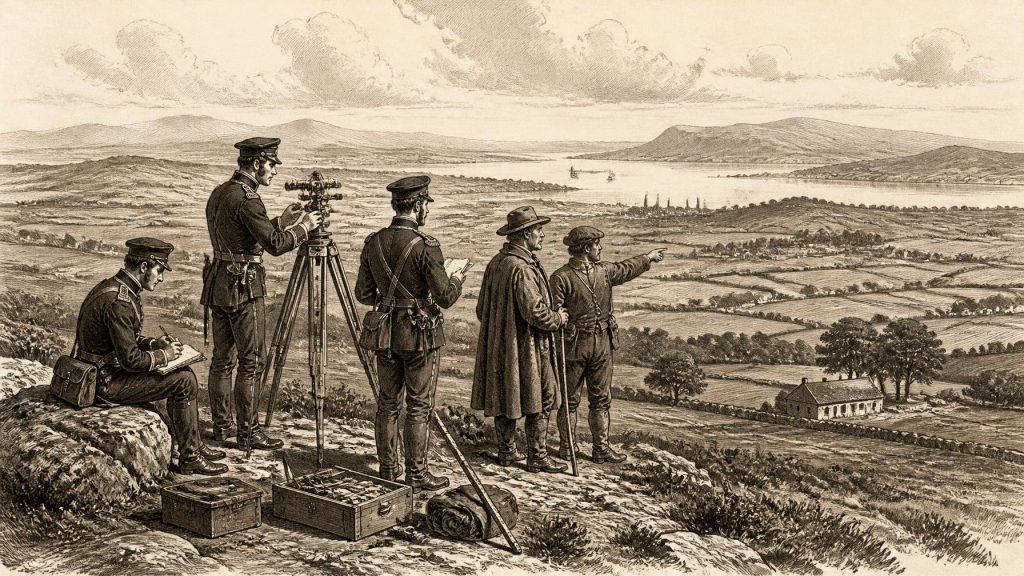
Another undertaking begun in 1825 would leave a different but equally enduring mark. The Ordnance Survey’s work in Ireland commenced under the direction of Thomas Colby. The project grew from concern that existing knowledge of land, townlands and local valuation was inadequate for fairer county taxation and administration. It would become far more than a fiscal exercise. Surveyors, many of them Royal Engineers and sappers, set about establishing an accurate national framework of triangulation and detailed measurement.
For people living in the districts being surveyed, the enterprise could be conspicuous and intrusive: men entered land, erected signals on heights and sought the names and limits of townlands from local knowledge. Its later six-inch maps would record fields, roads, houses, bogs, streams, ruins and settlements with a precision previously unavailable across the island. That finished cartographic archive belongs chiefly to later years, and the famous baseline beside Lough Foyle was measured in 1827–28, not 1825. Yet the beginning of the survey in this year was decisive. Ireland was becoming legible to the state in a new way, while local place-names and boundaries were being drawn into a national documentary system.
Leaving Cork for Upper Canada
Emigration gave 1825 an Atlantic dimension. In May, nine ships departed Cork carrying 415 families—2,024 people in all—in the Peter Robinson assisted-emigration scheme. The emigrants were intended for settlement in Upper Canada, in the area now associated with Peterborough, Ontario. Many were drawn from north County Cork, including districts around the Blackwater valley. The scheme followed a smaller experiment of 1823 and was backed by the British government, which saw organised migration as one possible response to hardship and underemployment in southern Ireland.
These were not the first Irish people to cross the Atlantic, nor was emigration a simple remedy for poverty. Families faced separation, an ocean passage and a demanding start in a colonial landscape. Nonetheless, the scale and administration of the Robinson migration made it distinctive. Surviving records include lists of settlers, ships’ medical reports, accounts and material concerning supplies of tools, clothing and livestock. They preserve unusual evidence of people who otherwise appear only faintly in official Irish records. In 1825, departure from Cork was not merely an individual choice: it was also a government-managed experiment in moving Irish rural families, labour and expectations overseas.
Capital, Cotton and Communications
Economic change was visible in institutions as well as migration. The Provincial Bank of Ireland was established in 1825, part of the emergence of joint-stock branch banking after legislation had made such ventures more practical. With substantial Scottish backing and a London head office, it pointed to a commercial network that would connect provincial towns more closely to credit, deposits and bills of exchange. Its foundation did not transform the lives of the rural poor, but it signalled increasing competition with older private banking arrangements and with the Dublin-centred Bank of Ireland.
At Portlaw in County Waterford, David Malcomson’s family began the development of what would become one of Ireland’s notable nineteenth-century industrial villages. The attraction was practical: water-power from the Clodiagh, access to labour, and proximity to the Suir and the port of Waterford. The cotton mill and planned settlement that followed should not be projected backwards as a finished model village in 1825. Rather, this was the year in which an industrial experiment took root in a place that had previously been a very small settlement. It offered work and housing under employer direction, an arrangement that could bring stability while also tying local life closely to one family and one industry.
Government legislation also altered the commercial framework of daily life. The Excise Licences Act received royal assent on 27 June and took effect from 5 July, repealing earlier licence duties in Great Britain and Ireland and imposing a new schedule. Licensing touched numerous occupations connected with the sale and manufacture of excisable goods, so changes made in London could be felt in Irish towns, shops, distilleries and public houses. On the shorter sea crossing between Donaghadee and Portpatrick, the paddle steamers Arrow and Dasher entered Post Office packet service in 1825. They made the Irish Sea route more closely tied to steam-age timetables, mail and passenger movement, even if sail remained dominant on longer routes such as the Cork–Quebec migration.
Learning, Reading and Tradition
The year also produced evidence of a society in which education was expanding but fragmented. The First Report of the Commissioners of Irish Education Inquiry appeared in 1825, drawing on extensive returns about schools of many kinds. The inquiry counted 11,823 schools in 1824, with more than half a million pupils enrolled. Such figures should not be mistaken for regular attendance, uniform standards or a national school system: none yet existed. Schooling came through hedge schools, fee-paying establishments, parish ventures, charitable societies and denominational institutions. Religious instruction and fears of proselytism were persistent difficulties, especially where Catholic parents encountered Protestant-sponsored education.
The report nevertheless reveals an Ireland in which reading, writing and arithmetic were sought by families across the country. This demand mattered politically as well as socially. A population increasingly reached by print could follow petitions, controversies and newspapers, while education itself became a question about the relation between religion, social improvement and state responsibility.
In literary culture, Thomas Crofton Croker’s Fairy Legends and Traditions of the South of Ireland first appeared anonymously in 1825. The Cork-born antiquary presented tales of fairies, banshees, merrows and enchanted places to a wide reading public. The book helped make Irish oral tradition visible within British and European literary culture; it was soon translated by the Brothers Grimm. It must not be treated as a transparent transcript of unaltered popular belief, since Croker and his collaborators selected, shaped and published material for readers. Even so, its appearance is a useful marker of a growing antiquarian interest in local story, language, landscape and custom.
Thus 1825 joined apparently separate developments: an act intended to curb collective politics, a new campaign devised around that restriction, surveying that converted local ground into official knowledge, and movement of people, capital and stories across wider networks. Ireland was still overwhelmingly rural and deeply unequal, with much of the population vulnerable to insecure work and small holdings. But it was not static. In this year, national politics, state administration, commercial enterprise and popular culture all acquired new means of circulation—and new consequences.
Primary Sources
- An Act to amend certain Acts relating to unlawful Societies in Ireland
- Unlawful Societies in Ireland Bill, 14 February 1825
- O'Connell, Daniel
- The Registered Papers of the Chief Secretary's Office: Catholic Association
- Roman Catholic Relief Bill, 10 May 1825
- Roman Catholic Relief Bill, 17 May 1825
- Thomas Colby’s ‘Instructions for the Interior Survey of Ireland’, 1825, and the first all-Ireland mapping survey
- The Boundary Survey, 1825 to 1837
- John W. Pringle (c. 1793–1861) and Ordnance Survey geological mapping in Ireland
- Peter Robinson fonds
- Research and Publications
- Westward Cork Migration by Sail 1815–1860
- Journal of the Statistical and Social Inquiry Society of Ireland, Vol. XXVI, Part I
- List of proprietors of the Society or Copartnership called the Provincial Bank
- Portlaw: A Nineteenth-Century Industrial Village
- Explore Portlaw
- Excise Licences Act 1825
- Post Office Packet Steamers: Dasher
- First Report of the Commissioners of Irish Education Inquiry
- Irish Education Inquiry: Commissioners Reports, 1825–1837
- Fairy Legends and Traditions of the South of Ireland
- Croker Papers, 1798–1858
- Why Was the Potato So Important?
- The Office of the Chief Secretary of Ireland: Chronology