

Parish Pressure
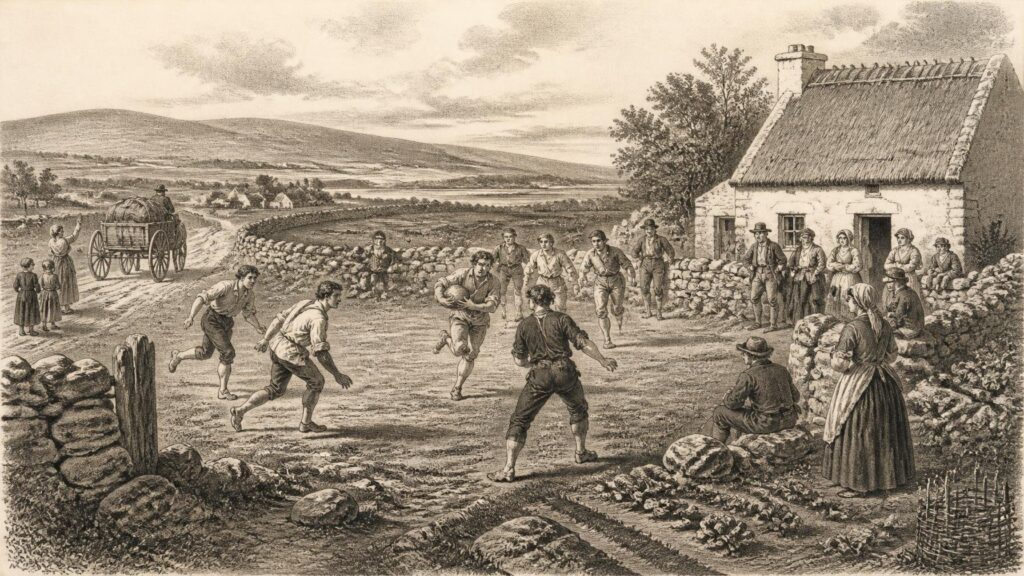
AI generated historical illustration, not a contemporary photograph.
At a Glance
For more than a century, the fortunes of Gaelic Athletic Association clubs have been closely bound to the distribution of people across Ireland. A parish capable of sustaining juvenile teams, adult panels, officers, fundraising and a pitch was also, usually, a place with enough homes, families, work and continuity to keep communal institutions alive. The connection was never mechanical: clubs have survived extraordinary population loss, while large settlements have sometimes lacked strong sporting organisation. Yet the history of rural depopulation and housing makes clear why the modern GAA speaks about planning as well as playing fields. Its concern is not simply that a small club may lose a team. It is that a pattern of settlement can weaken the local relationships from which voluntary associations draw their members, labour and purpose.
Rural Measure
The phrase “rural depopulation” can suggest a single, steady retreat from the countryside. Irish history offers no such simple line. Population change has varied sharply by region, period, sex, age, occupation and household type. It has involved death, delayed marriage, emigration, seasonal movement, internal migration, return migration and, more recently, immigration. It has also involved changing definitions of town and country. A village may be socially rural, functionally tied to farming families and treated by its inhabitants as a parish centre, while appearing in official statistics as an urban settlement. Conversely, dispersed housing can raise a rural district’s population without necessarily restoring the dense social life once associated with a village street, school or shop.
The historical record nevertheless establishes the scale of the transformation. Central Statistics Office summaries place the population of the territory now comprising the Republic at more than 6.5 million in 1841. Famine mortality and migration were followed by decades of further loss, leaving a population of about 3.1 million in 1911. The lowest post-independence total came in 1961, when the State’s population was approximately 2.8 million. These figures do not tell every local story, but they provide the essential frame: the Irish countryside in which the GAA was founded had already been reshaped by catastrophe, and the rural Ireland through which the Association expanded continued to lose people for generations.
Housing belongs at the centre of that frame. A home is not merely shelter counted by a census. It can determine whether a young couple establishes a household in a home parish, whether grandparents and grandchildren live within daily reach, whether school enrolments are sustained, and whether enough adults remain to organise a club. It can also reveal inequality. The difference between a secure cottage with an allotment, an overcrowded dwelling, a farm household divided by inheritance, a rented room in a city, and a new estate far from established facilities has mattered to the shape of community life.
The GAA did not cause those changes, nor could it control them. It was, however, built on unusually local units. Its club is a voluntary institution rooted in place, often carrying a parish or townland identity more vividly than an administrative boundary does. That makes its archive of fixtures, affiliations, amalgamations, grounds, committee work and memberships historically valuable. It also makes clubs vulnerable to the same pressures that affect schools, post offices, shops, transport and local services. To read club difficulty simply as sporting failure is therefore to miss the wider history. To read it as proof that one policy alone has emptied rural Ireland would be equally misleading.
Famine Aftermath
The catastrophe of the Great Famine remains indispensable to any history of Irish depopulation, but it should not be used as a catch-all explanation for every subsequent rural difficulty. The Famine was a watershed in mortality, eviction, family strategies and migration. It accelerated the destruction of a highly precarious social order in which innumerable small occupiers depended heavily on the potato and on access to minute parcels of land. But emigration, seasonal labour and movement from poorer districts were not inventions of the 1840s. Nor did the population decline cease once the immediate famine years had passed.
In the decades afterwards, the rural household changed. Later marriage and a more restrictive pattern of inheritance reduced the subdivision of holdings. The remittances sent from emigrant children altered family survival and aspiration. Young women as well as young men left, a fact that is crucial when considering the long-term reproduction of local communities. Some rural districts were connected to Britain, North America and other destinations by durable family networks. The decision to depart was not always a desperate individual rupture; it could be a calculated response to wages, labour demand, land prospects and information supplied by earlier migrants. That does not make it painless, or less consequential for the people left behind.
The 1911 Census General Report offers unusually plain evidence of the broad direction of travel. Between 1901 and 1911, Ireland’s total population fell again, even though the decline was less severe than in earlier decades. Meanwhile the population of towns rose and the rural population fell from more than 3.46 million in 1891 to about 2.92 million in 1911. The report also records changes in housing: the number of inhabited houses edged upwards between 1901 and 1911 while the average number of persons per house declined. Such figures demonstrate that fewer people did not always mean fewer dwellings. Household size, building quality, tenure and location complicate the picture.
This distinction matters for the later history of clubs. A rural parish could retain houses yet lose young adults. It could have better housing conditions but fewer children. It could possess a fine playing field but lack the age cohort to fill a minor panel. Population totals alone do not measure social capacity. Age structure, gender balance, commuting, incomes and the availability of voluntary time are all relevant. Historical analysis must be careful not to project today’s concerns onto a nineteenth-century community, but it can recognise a continuity: migration altered not just the number of inhabitants but the composition of households and the practical capacity of local institutions.
The popular image of a deserted Irish landscape sometimes turns this history into elegy. Empty cottages, ruined cabins and abandoned fields are powerful objects, but they can encourage the false belief that rural Ireland was once uniformly crowded, prosperous in sociability and stable in residence. The nineteenth-century countryside included poverty, seasonal absence, class division and profound insecurity. Many people who left did so because remaining offered little prospect. The loss of population was traumatic, but it cannot responsibly be treated as evidence that every earlier settlement pattern should have been preserved unchanged.
Club Foundations
The GAA was founded in 1884, at a time when demographic loss, agrarian reorganisation and political nationalism were already shaping everyday life. Its founders and early organisers promoted Irish games, but the Association was never separable from the society in which those games were played. Athletic meetings, football matches and hurling contests required open ground, local organisers, transport, subscriptions and audiences. They also depended on a generation of young people whose lives were often marked by precarious employment, agricultural work, migration and political mobilisation.
The rapid early spread of the Association is one reason later decline can be misunderstood. Clubs formed in great numbers, often with unstable resources and shifting rules. Their names, boundaries and allegiances changed. Some were short-lived; some existed as much on paper as on a reliable fixture list; some revived after a gap. This was not unique to Gaelic games. Voluntary associations commonly ebbed and flowed with personal leadership, local disputes, finance, religious tensions and political events. Yet the GAA’s early weakness in the 1890s was aggravated by the economic downturn and renewed emigration. Historical work on the period has cautioned against explaining the Association’s near-collapse only through high politics or internal faction.
The loss was especially significant because emigrants were often young adults: the people most likely to play, travel, officiate and organise. A club could be deprived of its strongest players, but it might also lose its secretary, collector, trainer or convenor. One should not assume that all emigrants abandoned Gaelic games. Irish communities abroad formed clubs and carried sporting loyalties with them. The diaspora helped to preserve and remake forms of Irish identity. But an active club in London, New York or elsewhere did not replace the particular social role of an active club in the originating parish.
Local attachment gave the GAA resilience as well as vulnerability. A club could survive difficult years because members considered it an inheritance owed to their place. Land, kinship, chapel district, school catchment and remembered rivalries supplied a framework for continuity. In many areas, the organisation became one of the principal settings in which young people encountered public responsibility. The committee meeting, gate collection, pitch work and championship journey were ordinary acts, but they created habits of collective action. It is reasonable to interpret the GAA as part of the social infrastructure of rural Ireland, provided this is not mistaken for a claim that every parish was united or that sport transcended all class and political divisions.
The emotional language of parish loyalty belongs partly to memory and folklore. Stories of men walking extraordinary distances to matches, of teams assembled at the last minute, or of a single player carrying a club through lean seasons often contain a kernel of experience but are rarely complete demographic evidence. They should not be discarded. Oral tradition conveys what people believed a club represented. Yet historians must distinguish such narratives from recorded affiliations, census data, contemporary newspapers and minute books. The former illuminate meaning; the latter more securely establish scale and sequence.
Housing Reform
Housing policy entered rural Irish life long before the contemporary language of planning targets and viability assessments. In the nineteenth and early twentieth centuries, the condition of labourers’ dwellings was recognised as a public question. The legislation was uneven and its effects depended on local authorities, landlords, finance and administration, but it marked an important shift: the quality and availability of working-class housing could no longer be treated solely as a private matter.
The Labourers Acts, developed from the 1880s onward, enabled rural local authorities to provide cottages and plots for agricultural labourers. The cottages became a distinctive feature of parts of the Irish countryside. They were neither an all-purpose solution to rural poverty nor a uniform architectural type. Their condition, setting, rent and allotment varied. Still, they represented a material intervention in the lives of families who had often lived with poor accommodation and insecure access to land. A cottage with a garden or allotment could improve domestic security and make a small but meaningful difference to subsistence.
The Housing of the Working Classes Act 1890 and later legislation formed part of the larger legal context. The Housing of the Working Classes Act 1903 amended the law again. The Office of Public Works archive guide records that earlier legislation had enabled loans for dwellings and that housing loans could be made where accommodation for the working classes was required. This legal history should not be romanticised as a benevolent, seamless march of reform. Administration was constrained by money, authority and local priorities, and many poor families remained badly housed. But the laws show that the connection between housing conditions and public welfare was already acknowledged in institutional form.
Housing also interacted with land reform. The transfer of land from landlords to occupiers altered the tenure landscape and strengthened the ideal of the family farm. It did not create unlimited places for new households. Indeed, a system centred on maintaining viable holdings could discourage subdivision. The result was a tension with long consequences. Landholding families might value continuity on the farm, while sons and daughters without an inheritable holding required other work, other homes or migration. A rural society of owner-occupiers could be more secure in some respects and still be unable to accommodate all those born within it.
That tension is relevant to the GAA because clubs drew their identity from precisely the localities shaped by land and household patterns. An agricultural labourer’s cottage, a farmhouse, a village terrace and a town lodging house did not produce identical rhythms of work, travel or recreation. A player’s participation depended on time, money, transport and family permission as much as enthusiasm. The club’s place in a community should therefore be seen against the material circumstances of members rather than as an abstract expression of national culture.
State Building
The establishment of the Irish Free State did not end the demographic problems inherited from the nineteenth century. The population continued to decline between 1911 and the first census of the new State in 1926, and emigration remained central to the explanation. The new state faced the difficult task of building institutions with limited resources, an uneven economy and a population dispersed across a large rural territory. Housing, roads, health, education and agricultural policy all had to be addressed amid competing priorities.
For much of the twentieth century, the social weight of rural Ireland remained considerable. Yet the countryside was not static. Mechanisation, changing farm practices, industrial employment, education and improved mobility transformed the relationship between home and work. The post-war decades brought another powerful phase of emigration. The national population fell during the 1950s and reached its modern low point in 1961. This was not simply a rural event: cities and towns also experienced loss. But sparsely populated districts and small communities often had fewer alternative institutions or employers with which to absorb the effect.
The GAA’s own experience of the 1950s and 1960s belongs in this context. Clubs did not vanish everywhere, and sporting success could still arise from small places. But migration created absences in age groups that clubs depended upon. It also created transnational circuits. Players joined teams in Britain and elsewhere; families followed fixtures through newspapers, letters and holiday returns; migrants came home for weddings, funerals and sometimes championships. The idea that emigration meant a clean break from parish life is therefore too crude. At the same time, periodic return could not compensate for the loss of people present every week to train children, maintain grounds and sit on committees.
Housing policy after independence had a similarly mixed record. New local-authority estates relieved bad conditions for many households and altered the physical shape of towns. Rural housing expanded in some places, often through individual houses rather than concentrated village development. The distribution of homes mattered. Housing located near work, school, services and recreation could reinforce settlement; housing scattered without corresponding infrastructure could place new burdens on transport and service provision. The historical issue was not whether rural building was intrinsically good or urban building intrinsically bad. It was whether development patterns enabled ordinary family and community life.
The State’s changing relationship with voluntary bodies is also significant. In rural areas, clubs often supplied facilities through local fundraising and voluntary labour. This tradition created impressive grounds and clubhouses, but it could make the GAA appear self-sufficient to public authorities. A community able to build a pitch through subscriptions might still lack sewerage, transport, childcare, affordable housing or a viable school. The capacity to fundraise should not be treated as proof that a locality needs no public investment.
Migration Patterns
By the later twentieth century, the old association between Irish identity and departure remained powerful, but migration had become more varied. People left rural areas for Dublin, Cork, Galway, Limerick and regional towns as well as for Britain, North America and further destinations. Education widened horizons; employment became more specialised; women’s work patterns changed; commuting expanded. Rural youth migration research has rightly warned against treating departure as a single cultural reflex. Decisions emerge from individual biography, family expectations, housing opportunities, work, relationships and ambition.
That caution matters when interpreting local decline. It is tempting to say that young people leave because they cannot get a house, or that they leave because they prefer city life. Both propositions may be true for particular people, but neither explains every case. A home may be available while secure employment is not. Work may be nearby while suitable accommodation is unaffordable. A couple may want to remain in a parish but be unable to find a serviced site, a rental dwelling or a house appropriate to their income. Others may choose urban life for reasons unrelated to constraint. Historical explanation must preserve that range of agency.
The later return of some emigrants and the arrival of new residents also complicate the narrative of irreversible disappearance. Rural Ireland has attracted return migrants, newcomers from elsewhere in Ireland and people born abroad. Some counties that long exported population have experienced renewal. Yet return and in-migration do not automatically reproduce the age structure, local networks or volunteering habits of an earlier period. A place can gain residents while retaining a shortage of affordable homes for younger local households. It can acquire commuters who are deeply involved in community life, or commuters whose working hours limit participation. The outcome cannot be assumed from a headcount.
Housing is therefore an issue of timing as well as number. Clubs require continuity across childhood, adolescence and adulthood. A surge of young children may create immediate pressure on pitches and coaches. If those children later move away because homes and employment are inaccessible, the same locality may struggle at adult level. Conversely, a rural club may lack underage numbers today but benefit later from settled families if housing and services support them. Historical demographics show why simple annual membership figures need to be read across decades.
There is an additional gendered dimension. Rural community histories often focus on male players and senior teams, especially in accounts of earlier generations. Yet household formation, migration and sport have never been exclusively male questions. Women’s departure, employment and educational opportunities altered local population patterns profoundly. The growth of ladies’ Gaelic football and camogie has made the relationship between demographic change and participation even clearer: a parish’s sporting future depends on the opportunities available to all its young people, not on an imagined male succession alone.
Planning Consequences
In recent years the GAA has articulated a direct argument about settlement, housing and club survival. Its demographic work describes a country in which population growth is concentrated in cities, towns and parts of the east, while many rural clubs face declining numbers. The Association’s public statements emphasise the double pressure: rural clubs can struggle to field teams, while urban clubs may be overwhelmed by demand for pitches, training space and volunteers. This is a useful corrective to the assumption that demographic growth is automatically easy for sport. Growth without land, facilities and organisation can be as difficult to manage as decline.
The evidence provided by the GAA is important but should be interpreted accurately. It establishes that the Association has gathered information, mapped demographic pressures and heard repeated concerns from counties and clubs. It does not establish that every weakened club has been damaged principally by housing policy, or that every planning restriction produces emigration. Club viability can also be affected by competition from other sports, changing work patterns, coaching standards, travel distances, local conflict, school arrangements and changing attitudes to volunteering. A serious historical account should take the GAA’s warning seriously without converting an institutional advocacy case into a universal law.
The Oireachtas committee discussion in January 2026 made the present connection unusually explicit. GAA representatives argued that housing, planning, employment and community sustainability now affect the future of Gaelic games. They described villages perceived as closed to development, young people moving to towns, rural clubs losing population and urban clubs lacking enough facilities. These are contemporary political claims, not neutral census categories. They should be understood as part of a campaign for more balanced development. But they are grounded in a long historical recognition that where people can live shapes whether local institutions can endure.
Planning disputes can expose competing public goods. Restrictions on dispersed rural housing may be defended on environmental, infrastructural, road-safety or settlement-planning grounds. Calls for more rural building may be framed in terms of local continuity, family connection and demographic balance. Neither side can be settled by invoking the GAA alone. The Association is a powerful witness to lived consequences, but it is not an environmental regulator, housing authority or demographic census office. Its intervention is most valuable when it insists that decisions about homes cannot be detached from schools, transport, facilities and the social life of places.
Historically, the strongest lesson is not that every parish must preserve its past population pattern. Such a goal would be neither possible nor necessarily desirable. The lesson is that public policy creates spatial consequences. Roads, water systems, zoning, employment location, public transport, broadband, school provision and housing tenure influence where people can build lives. If these decisions repeatedly concentrate young households in a narrow range of expanding centres, then rural clubs will feel one result while urban clubs will feel another.
Club Evidence
How, then, should historians use the GAA as evidence for rural change? First, club records can reveal local continuity. A surviving minute book may show who performed unpaid work, when a ground was acquired, whether a club relied on emigrant subscriptions or how it responded to falling numbers. Fixture lists can indicate the practical geography of travel. County-board correspondence may record disputes about boundaries, eligibility and amalgamation. Newspaper reports, though often celebratory, can preserve the names of small clubs that later disappeared from formal memory.
Second, club history can illuminate change in the meaning of locality. An amalgamation is not always evidence of failure. It may allow players from neighbouring areas to continue participating, preserve a tradition under a new name or respond sensibly to altered age cohorts. Equally, a new urban club can represent successful adaptation rather than the loss of an older sporting culture. The historical significance lies in the decision itself: which places were asked to combine, which identities were retained, and what resources were shared or surrendered.
Third, club evidence needs to be compared with independent records. Census returns, civil registration, valuation material, local-authority housing files, school rolls and electoral registers can test whether a story of decline reflects a real population movement, a particular age imbalance or an organisational problem. Oral testimony adds the texture that official records lack, especially on housing searches, commuting, volunteer fatigue and family choices. But memory may telescope dates, elevate exceptional matches and interpret a long process through a single memorable closure or defeat. It should be respected and corroborated.
There is also a risk of retrospective certainty. A club that prospers today may appear destined to have done so; a club that merged may be described as inevitably doomed. Historical evidence seldom supports such inevitability. Small changes in local leadership, a new employer, a school bus route, a housing scheme or a successful underage cohort can alter an organisation’s course. The GAA’s importance is precisely that it has often made such interventions visible. Clubs are not passive indicators. They recruit, welcome newcomers, share facilities, establish juvenile structures and maintain links across migration routes.
Historical Limits
The relationship between rural depopulation, housing and Gaelic games is therefore real, but it must be described with discipline. The census confirms long population decline after the Famine, continuing rural loss into the early twentieth century and a national low point in the early 1960s. Housing legislation and public records confirm a long-standing concern with the quality, finance and provision of working-class dwellings. GAA records and modern demographic statements demonstrate that clubs experience the effects of uneven settlement. These are documented foundations.
Interpretation begins when those foundations are connected. It is reasonable to argue that secure, attainable homes near work and services can help sustain the age groups on which clubs depend. It is reasonable to see a club as part of local social infrastructure. It is also reasonable to conclude that urban growth without sufficient playing space creates a different form of exclusion. But it is not supportable to claim that housing alone explains rural decline, that every planning rule is hostile to community, or that a particular club’s fate can be read directly from national trends.
Folklore and nostalgia have their place, though not as substitutes for evidence. The remembered golden age of the parish team may express real grief for lost neighbours, a closed school or fewer children on the road. It may also conceal old hardships, limited opportunities and the departures that made education, work or independence possible. The most humane history holds both truths together. It recognises the genuine value of local belonging while refusing to make immobility the measure of a successful life.
The modern GAA’s intervention in housing debate is best understood as the latest chapter in a much older story. From labourers’ cottages to local-authority estates, from farm inheritance to suburban expansion, the geography of home has helped determine the geography of association. Gaelic games cannot solve the housing crisis or reverse every demographic imbalance. Yet clubs can make visible what aggregate statistics sometimes obscure: whether children have a place to play, whether volunteers have the time and numbers to organise, and whether people can remain connected to the communities they call home.
That is why the subject belongs in Irish history rather than merely in sport policy. The GAA is not an accidental observer of rural change. It has been woven into the social life of parishes through the era of mass emigration, the formation of the State, mid-century decline, suburban growth and contemporary arguments about planning. Its clubs record a continuing negotiation between attachment to place and the necessity of movement. The question raised by rural housing is not simply whether a team can be fielded next season. It is what forms of settlement will allow communities, old and new, to remain socially capable in the decades ahead.
Parish Pressure
The most useful way to understand parish pressure is not as a simple contest between rural survival and urban growth. It is a question of whether the places in which people live can sustain the routines on which voluntary life depends. A club needs more than a numerical population. It needs children arriving in roughly continuous age groups, adults with time to coach and administer, households able to travel, and enough durable attachment for people to accept work that brings no wage. Those conditions can be weakened by population loss, but they can also be strained by rapid growth. The GAA’s recent demographic work identifies both outcomes: rural clubs may find it harder to field teams, while expanding urban clubs face pressure on volunteers and access to playing and training space.
That distinction should guard against treating a parish as a fixed container. Parish identity can survive changes in employment, migration and residence; it can also be altered by them. A family may retain strong ties to an ancestral club while living elsewhere, returning for funerals, holidays or important matches. New residents may become committed members, officers and supporters. Yet neither diaspora loyalty nor welcome alone removes practical constraints. A juvenile section cannot be organised only through sentiment, and a growing town cannot absorb new players indefinitely without pitches, changing facilities, transport and people prepared to undertake regular work.
Housing statistics show why counting dwellings is insufficient. By 2011, occupied rural detached houses with individual sewerage treatment systems accounted for more than a quarter of all private occupied dwellings in the State. Most of these houses lay outside the towns and settlements identified by the census, and a substantial share stood more than a kilometre from the nearest settlement. This pattern cannot be reduced to a verdict for or against one-off housing. For some households, such homes made continued residence near family land or local networks possible. But dispersion also shapes the ordinary logistics of participation: lifts to training, the cost of running cars, the distance to schools and shops, and the time required of parents and volunteers.
The importance of transport is especially clear in a society where rural households have historically depended more heavily on cars than urban households. A pitch may be geographically within a parish but functionally distant for a child whose parents work late, for an older volunteer without easy mobility, or for a household managing several competing journeys. The consequence is not necessarily withdrawal from sport. It may instead be a more fragile form of participation, dependent on a small number of drivers, coaches or grandparents. Clubs often overcome that fragility through informal cooperation, but it remains a form of pressure that membership totals alone cannot reveal.
Longer historical comparisons require equal care. The census record confirms the enormous decline from the population recorded in 1841 to the low point reached in 1961, but it does not permit an easy story in which every later difficulty flows directly from the Famine. The geography of population also changed. By 2016, Leinster contained a much larger share of the population of the Republic than it had in 1841, while the shares in Munster and Connacht had fallen. For a club, such national and provincial shifts matter only when they become local realities: an absent age cohort, an estate without sufficient facilities, a school roll changing faster than teams can be organised, or a village that has homes but too few opportunities for younger adults to remain.
The older housing archive offers a further warning against narrow explanations. Records associated with the Office of Public Works include material on labourers’ housing as well as schools, railways, harbours and other local works. Their value lies partly in showing that housing was never an isolated policy field. Decisions about a cottage, a road, a school or a source of employment could together affect the prospects of a household and the viability of a locality. The Housing of the Working Classes legislation belongs to that wider history of public intervention, not to a separate architectural story. A secure dwelling could matter greatly, but security also depended on income, access, services and the ability to remain connected to other people.
For historians, parish pressure is therefore best investigated through converging evidence. Census tables can establish broad movement; housing data can reveal tenure, location and household form; local records can show how policy was administered; and club minutes, fixtures and oral testimony can reveal what these changes meant in practice. No single source can prove that a planning decision caused a team to disappear, or that a new housing scheme restored a club. What the evidence can show is the chain of conditions through which settlement becomes social capacity. Gaelic games are not merely a measure of that capacity, but their intensely local organisation makes them one of its most revealing expressions.
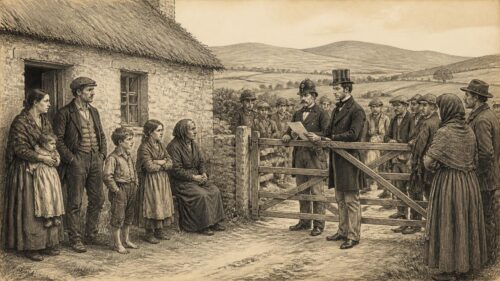
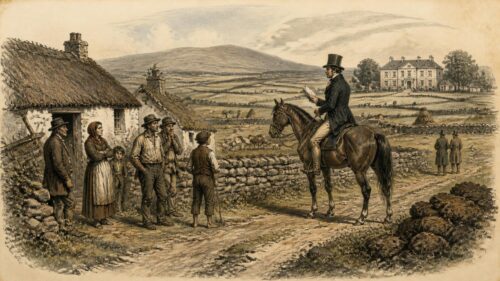
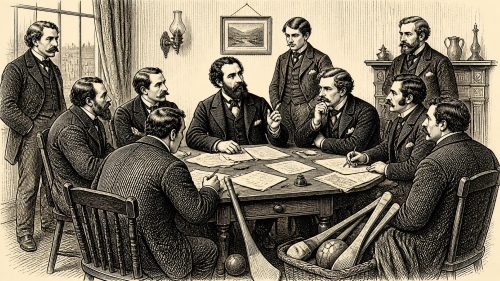
Most striking is the article’s insistence that a GAA club’s fortunes cannot be read as a straightforward census of parish vitality. Housing location, age structure, migration, commuting and voluntary time may all shape whether teams and committees endure, while clubs themselves preserve valuable local evidence of these changes. This complicates contemporary claims that housing provision alone can revive rural communities: homes may increase population without rebuilding everyday social capacity, especially where services and work remain distant. How should policymakers and communities weigh club records alongside census data, housing patterns and service access when judging whether development can sustain parish life?