
Hayes Hotel’s New Association1884 CE
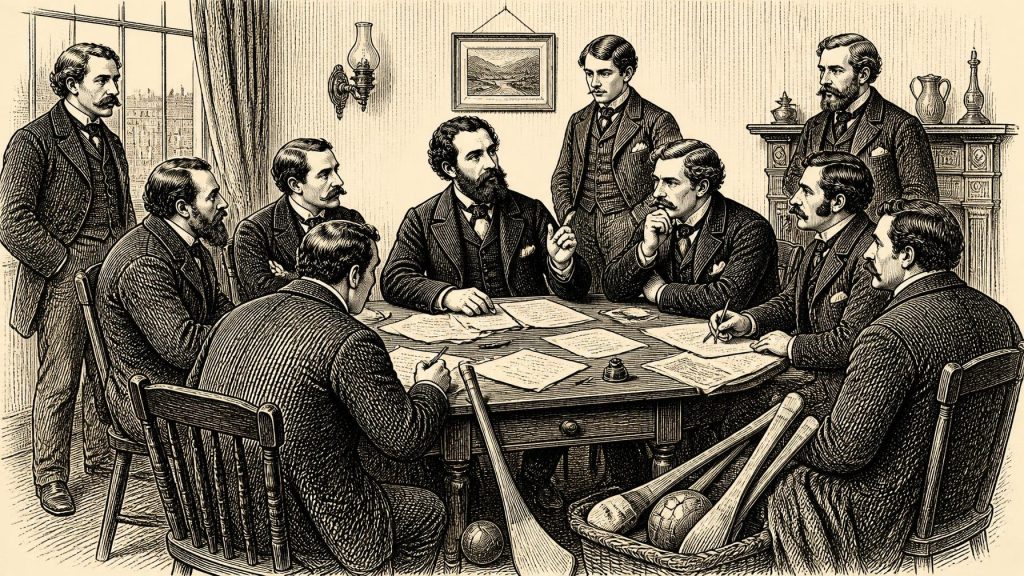
In 1884, Michael Cusack, Maurice Davin and others founded the Gaelic Athletic Association at Hayes’s Commercial Hotel, Thurles, to organise and promote Irish games and athletics. Supported by patrons including Charles Stewart Parnell, Michael Davitt and Archbishop Croke, it linked recreation with nationalist cultural confidence, though formal rules followed in 1885. Meanwhile, franchise reform widened male voting rights without enfranchising women or all men, intensifying Home Rule politics and land concerns. Emigration exceeded natural population growth, while disease and infant mortality remained high. Nine women received Royal University degrees, signalling limited educational progress amid persistent social, economic and religious inequalities.
Dateline
In 1884, Ireland’s most consequential new national institution was founded not in a parliament chamber, a landlord’s office or a government department, but in a hotel in Thurles. On 1 November, Michael Cusack, Maurice Davin and fellow enthusiasts established the Gaelic Athletic Association for the preservation and cultivation of national pastimes. The meeting was small, but its purpose was large: to give Irish athletics and traditional field games a national organisation of their own. In a year shaped by the extension of the parliamentary franchise, continuing emigration and the long aftermath of the Land War, the new association offered another way of imagining public life in Ireland: organised locally, connected nationally, and consciously Irish.
A Meeting in Thurles
The founding meeting took place at Hayes’s Commercial Hotel, Thurles, County Tipperary, on Saturday 1 November. The surviving record is not wholly uniform about how many men were in the room: later institutional accounts commonly name seven, while contemporary newspaper reporting suggests a somewhat wider attendance. The essentials, however, are firm. Maurice Davin, the celebrated athlete and farmer from Carrick-on-Suir, was elected president. Michael Cusack, the Clare-born schoolmaster and journalist, became one of three honorary secretaries, alongside John Wyse Power and John McKay. Charles Stewart Parnell, Michael Davitt and Archbishop Thomas William Croke were invited to act as patrons.
The choice of these patrons showed that the association was never merely a sports club. Parnell was the commanding figure in constitutional Irish nationalism; Davitt remained closely associated with land agitation and tenant right; Croke was the Catholic archbishop of Cashel and Emly, based close to Thurles. Their names connected the GAA to the leading political, social and religious currents of nationalist Ireland. Yet the association’s stated task was practical as well as symbolic: it aimed to cultivate games, athletics and recreations for people’s leisure hours. Its founders wanted rules, meetings, clubs and a framework through which competitions could be run on Irish rather than English governing terms.
Cusack had spent the autumn making the case in print. In October, writing in United Ireland, he attacked the prevailing athletic culture of foot-racing, betting and poorly regulated meetings, and argued for an organisation that would foster games regarded as distinctively Irish. Davin brought something equally necessary: sporting authority. He was already widely known through athletics, including throwing and jumping events, and had experience of how competitions were managed. The partnership of the combative publicist and the respected athlete made the proposal more credible than either man acting alone.
Games, Rules and Cultural Confidence
The GAA did not create hurling, football, wrestling or rural athletic gatherings from nothing. Such games survived in varied local forms, and their rules could differ from place to place. What was new in 1884 was the decision to build a national association that could organise and standardise them. The initial meeting did not yet produce the familiar formal codes of Gaelic football and hurling; committees would work on rules in the following winter and publish them in 1885. It is important not to read later championships, county structures or stadium crowds back into the first November meeting. At the close of 1884, the GAA was a promising new body whose reach still depended on voluntary organisers, newspaper publicity and local support.
Its cultural message nevertheless became clearer before the year ended. On 18 December, Archbishop Croke accepted the invitation to become a patron. His letter, subsequently printed in Dublin newspapers, lamented what he regarded as the importation of English fashions, entertainments and games at the expense of older Irish recreations. He listed activities from hurling and football to wrestling, rounders and children’s games. Croke’s language was strongly nationalist, but it also captured a wider anxiety about cultural dependence in an Ireland tied economically and politically to Britain. His endorsement gave a new voluntary association exceptional public standing, especially among Catholic nationalists in Munster and beyond.
The GAA’s birth therefore belonged to a larger cultural turn, although the Gaelic League, often treated as its linguistic counterpart, would not be founded until 1893. In 1884 the revival of games was ahead of the later organised revival of the Irish language. The association’s founders saw physical recreation as part of social health, local fellowship and national self-respect. That vision was not shared by every Irish person, nor did it erase the popularity of cricket, rugby, association football, horse racing and other pursuits. But the founding meeting made the promotion of Irish games an organised public cause.
The Household Vote
Political Ireland in 1884 was also being reshaped at Westminster. Parnell’s Irish Parliamentary Party sought Home Rule: an Irish legislature in Dublin while remaining within the United Kingdom. No Home Rule bill was introduced in this year; that lay ahead. But the Representation of the People Act, passed in December 1884 after a prolonged dispute between the Commons and Lords, was immediately important to Irish political calculation. It extended the household and occupation franchise into Irish counties, bringing the county electorate closer to the borough qualification.
The measure did not establish democratic equality. Women remained excluded from parliamentary voting, as did many adult men without the required household, lodger or occupation qualifications. Registration procedures, rate books and the practical tests of residence still mattered. Nevertheless, the Act substantially widened the male electorate. It meant that the political loyalties of small farmers, householders and other occupiers would carry more weight in future elections. Unionists feared that the enlarged electorate would strengthen Parnell and Home Rule; nationalists saw a chance to convert broad popular support into parliamentary power. The arguments during the bill’s passage openly revealed how closely constitutional reform, religion, property and the future of the Union had become intertwined.
For rural voters, political questions were inseparable from land. The most intense phase of the Land War had receded after 1882, but the structure of rural life still rested heavily on tenancy. The Land Law (Ireland) Act 1881 had recognised the tenant’s interest through fair rents, fixity of tenure while rent was paid, and free sale of the tenant interest. In 1884 this legislation was not an abstract settlement: it shaped relations between landlords, agents and tenants, and framed expectations that further change might follow. The National League continued to connect the land question with Parnell’s parliamentary strategy, while emigration and the need for secure livelihoods remained central facts of family life.
Population, Work and Departure
The Registrar-General’s return for 1884 gives a sober measure of the country’s demographic condition. Ireland’s estimated mid-year population was 4,962,693. During the year, 118,875 births and 87,154 deaths were registered, a natural increase of 31,721. But recorded emigration reached 75,863, more than cancelling that gain. The report estimated an apparent population decrease of 44,142, while cautioning that immigration could not be fully measured. Emigration was therefore not simply a memory of the Famine years; it remained a living calculation for households across the island, separating relatives and redirecting young adults towards Britain, North America and elsewhere.
Those figures also show uneven conditions. Registered mortality was highest in Dublin, at 25.9 deaths per thousand, and much lower in several western counties, including Roscommon, Leitrim, Sligo and Donegal. Such contrasts cannot by themselves explain health, poverty or age structure in each place, but they underline the difference between crowded urban life and the varied populations of rural counties. Infectious illness remained a serious danger: 8,498 deaths were attributed to diseases then classified as zymotic, while childhood mortality was severe. More than 10,000 infants died before their first birthday. Everyday life was thus marked by family labour, parish and neighbourhood ties, but also by risks of illness that modern sanitation and medicine had not yet overcome.
Agriculture remained the principal livelihood for much of the population. Official livestock figures for 1884 recorded about 3.38 million cattle, 3.06 million sheep and 1.07 million pigs. These numbers point to the importance of cattle raising, dairying, sheep farming and pigs kept or sold by smallholders, though they do not tell us how income was distributed between large graziers, farmers and labourers. The countryside contained very different worlds: prosperous commercial farms, small mixed holdings, seasonal labourers and households dependent on earnings sent from emigrant kin. The relative easing of overt agrarian conflict did not remove those inequalities.
Education and Religious Society
Another firmly dated landmark came on 22 October, when the Royal University of Ireland conferred degrees on nine women. They were among the first women in Britain and Ireland to receive university degrees. Isabella Mulvany, headmistress of Alexandra College, was one of the graduates. The occasion was an important advance in women’s higher education, although it did not mean that women had gained equal access to every institution or to political citizenship. Trinity College Dublin, for example, would not admit women students until much later. Still, the Royal University ceremony demonstrated that educational barriers could be breached within the existing system.
The year’s civil registration also suggests the continued centrality of religious institutions. Of the 22,585 marriages registered, the great majority were celebrated according to Roman Catholic, Church of Ireland or Presbyterian rites; only a small minority were civil marriages. At the same time, 75.3 per cent of grooms and 71.9 per cent of brides signed rather than marked the register, one limited but useful indication of literacy. Ireland in 1884 was neither culturally uniform nor socially static. Catholic nationalism was increasingly influential, Protestant and Presbyterian communities retained substantial regional importance, and educational opportunity was expanding unevenly.
By December, then, the year’s defining developments had not resolved Ireland’s great questions. The franchise reform had altered the terms on which those questions would be fought electorally. Demographic returns showed that departure overseas still outweighed natural increase. Women graduates marked a real, if restricted, widening of intellectual opportunity. Above all, the meeting at Hayes’s Hotel had created an institution that joined recreation to collective identity. In 1884 the GAA was only beginning; its durable importance lay precisely in the local clubs, contests and loyalties that supporters would now have to build.
Primary Sources
- Timeline 1884–1945
- 1 November, 1884: The Birth of a Sporting Revolution
- A Treasure Trove of GAA and Irish History
- Letter from Archbishop Croke to Michael Cusack on the GAA
- Cusack, Michael
- Davin, Maurice
- McKay, John
- Representation of the People Act 1884
- Representation Of The People Bill—Bill 119
- Representation Of The People Bill — Redistribution
- The Law and Practice Relating to Franchise and Registration in Ireland
- University Education for Women
- First Women Graduates of the Royal University of Ireland 1884
- Mulvany, Isabella Marion Jane
- Twenty-First Annual Report of the Registrar-General of Marriages, Births, and Deaths in Ireland, 1884
- Agriculture Statistical Yearbook of Ireland 2014: Crops and Livestock
- Rural Ireland, 1850–1950: Timeline of Events
- Irish Statute Book: British Public Statutes 1884
- Public Health (Ireland) Act 1878
- The Foundation of the GAA
- GAA Museum Secondary School Resource Pack
- Exhibition: Gaelic Athletic Association Oral History Project