

Institutional Memory
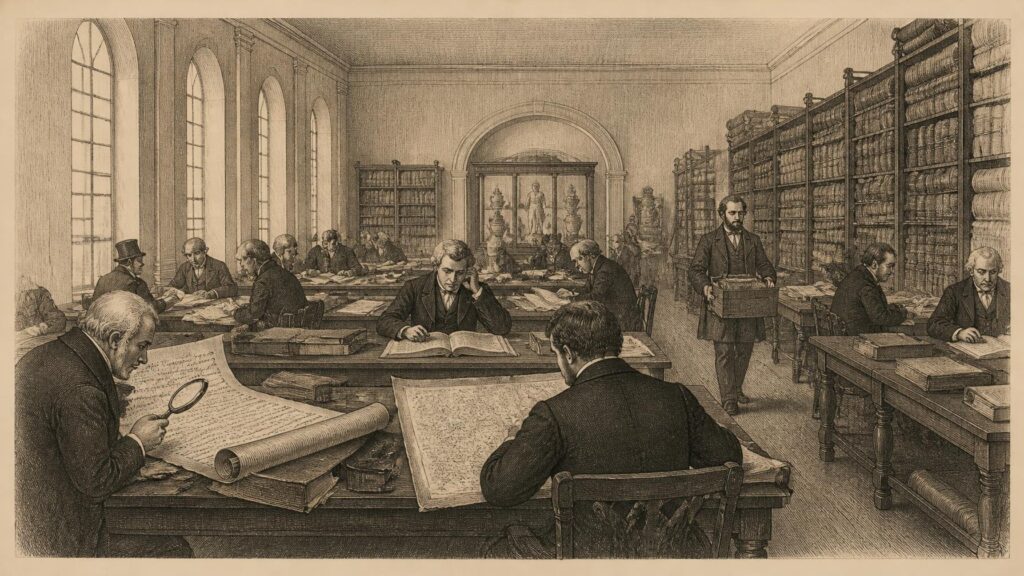
AI generated historical illustration, not a contemporary photograph.
At a Glance
Public memory in Ireland has never been held in one place or spoken in one voice. It has been made in record offices and museums, classrooms and churches, at gravesides and parades, in official ceremonies and family kitchens. Institutions have given some pasts durable form through documents, monuments, collections and curricula; they have also, at times, imposed silence, restricted access or preserved records without making their human meaning readily visible. The history of Irish public memory is therefore also a history of authority: of who could collect, classify, commemorate, disclose and be believed.
Memory Made
Public memory differs from private recollection. A person may remember a parent’s account of the War of Independence, a difficult childhood in an industrial school, a relative lost at the Somme, or a frightening night during the Troubles. Such memories can be precise, partial, inherited or altered by retelling. Public memory begins when recollections, objects and stories enter shared forms: a named grave, a local monument, a parish history, a television documentary, an archive catalogue, a school lesson, a national ceremony or a public inquiry. Institutions do not create all memory, but they strongly influence which memories endure beyond the lifetime of those who experienced events.
In Ireland this influence has been unusually visible because history has repeatedly been bound to political legitimacy. The island’s past includes conquest and colonisation, religious change, plantation, famine, emigration, constitutional struggle, revolution, partition, civil war, conflict in Northern Ireland and the exposure of grave failures in church and state institutions. Each subject has produced competing accounts. A commemoration that seems honourable to one community may seem exclusionary to another; a monument may signify liberation, loss, sacrifice or domination according to the observer’s historical position.
That does not mean that every interpretation is equally supported by evidence. Records can establish dates, decisions, ownership, administrative responsibility and, sometimes, individual experience. Archaeological objects can demonstrate material practices and long continuities. Oral testimony can preserve experience that official paperwork omitted or distorted. Folklore can reveal what communities wished to remember, fear or explain, even where it cannot securely prove an event as narrated. Good public history makes such distinctions plain. It does not dismiss lived memory merely because it is personal, nor does it treat a repeated story as documentary fact simply because it is moving.
Irish institutions have had to work within this tension. Their task has not only been to keep the past safe. It has been to decide what counts as a record, how it is described, when it can be seen and how it may be interpreted. The result is not a settled national memory but an evolving public field in which evidence, ceremony, scholarship, activism and family remembrance meet.
Colonial Foundations
Many of the institutions through which Ireland remembers were formed under British rule. This origin matters. Nineteenth-century collecting, surveying and record keeping were linked to administration as well as learning. Governments required maps, valuations, censuses, court files, property records and correspondence in order to tax, govern, police and regulate. Learned bodies gathered manuscripts, antiquities and natural specimens partly from scholarly curiosity, but their collections also reflected the assumptions and hierarchies of their age.
The Royal Irish Academy and the Royal Dublin Society were central to the development of antiquarian and archaeological collecting. The National Museum of Ireland traces important parts of its archaeological holdings to collections assembled by those bodies during the eighteenth and nineteenth centuries. The resulting national collection contains material from prehistoric and medieval Ireland as well as later periods, including objects now familiar as cultural touchstones, such as the Tara Brooch and Ardagh Chalice. These treasures have helped make the ancient past visible to generations who could never read a medieval manuscript or excavate a site themselves.
Yet museum collections are not transparent windows onto the past. An object reaches a museum through choices: excavation, purchase, donation, excavation law, curatorial judgement and available resources. Display introduces further choices. One gallery can make a chalice appear chiefly as devotional art, another as skilled metalwork, another as evidence for political power, trade, mobility or patronage. None of these readings is necessarily false, but each directs attention differently. The institutional setting gives an artefact public authority while also framing its meaning.
The same is true of documentary archives. The nineteenth-century state produced immense quantities of paperwork. But state records mainly preserve the concerns of governing institutions: land, revenue, law, security, official appointments and social administration. The poor, women, Irish speakers, itinerant people, children and migrants often appear only when they encountered official power. Their absence from a particular series does not demonstrate an absence from history. It may show the limits of the institution that created the record.
This is a crucial interpretative point. Colonial archives are neither simple propaganda nor complete social portraits. They are evidence shaped by the purposes of their creators. They may record coercion in bureaucratic language, describe communities through official categories or leave private motives unspoken. Historians use them critically, comparing them with newspapers, letters, local records, material culture, oral tradition and records created by other institutions. The archive becomes most useful not when it is treated as neutral, but when its procedures and silences are understood.
Cultural Custody
By the late nineteenth century, cultural preservation had become a public concern in its own right. Archaeological protection, manuscript collecting, library development and the preservation of historic buildings all expressed a belief that Ireland possessed an inherited cultural wealth worth conserving. That conviction was shared across political differences, though people disagreed about what heritage meant and who should control it.
The institutionalisation of heritage offered major benefits. Fragile manuscripts, coins, metalwork, vernacular objects and archaeological finds could be conserved rather than dispersed or destroyed. Professional cataloguing made collections intelligible to researchers. Public exhibitions turned specialist knowledge into something accessible to visitors and schools. National institutions gave physical form to the idea that the island’s past belonged to more than elite collectors.
At the same time, cultural custody involved selection. The word “national” could encourage a broad understanding of inheritance, but it could also compress diversity into a single story. Gaelic manuscripts, Celtic ornament and early Christian metalwork became especially powerful symbols in cultural revival movements. Their importance was real, but an exclusive focus on them could make other inheritances appear peripheral: Viking towns, Norman lordships, Protestant traditions, industrial labour, urban poverty, Ulster Scots culture, Jewish communities, Traveller heritage and the experiences of later migrants.
The most durable institutions have gradually had to widen their frames. This does not require abandoning established treasures or pretending that all traditions have occupied identical positions in public life. It requires acknowledging that an island’s history cannot be represented only through a canon of celebrated objects. A museum’s collecting policy, exhibition labels and educational work can show that the past contains overlapping communities rather than a single uninterrupted lineage.
Folklore occupies a related but distinct place. The collection of songs, place lore, tales and customary practices preserved cultural knowledge that written state archives often ignored. Folklore can be exceptionally valuable evidence of language, performance, social values and local memory. It is less reliable when used as untested proof of remote events. A story explaining the origin of a ringfort, holy well or battlefield may preserve a later community’s relationship with a place rather than an account contemporary with the site’s creation. Institutions that present folklore responsibly retain its imaginative and cultural force without confusing tradition with corroborated chronology.
Archive Ruin
No episode better demonstrates the vulnerability of institutional memory than the destruction of the Public Record Office of Ireland at the Four Courts in Dublin in June 1922. The loss occurred during the opening phase of the Civil War. Anti-Treaty forces had occupied the Four Courts complex, including the Record Treasury, and an explosion followed by fire devastated the repository. The event destroyed a vast body of records accumulated over centuries.
The loss was not merely a professional disaster for archivists. The Public Record Office held records that touched ordinary lives as well as constitutional history: census material, wills, court and estate records, parish material, maps, town records and other administrative papers. The National Archives of Ireland notes that the destroyed collections documented both the development of the state and many aspects of life across the island. Their disappearance made family research, local history and the reconstruction of institutional practice much more difficult.
Popular accounts sometimes compress the event into a simple statement that “all Irish records were burned”. That is folklore in the broad sense of a widely repeated simplification, not a correct description. Important records survived because they were held elsewhere, copied, printed, calendared, abstracted, dispersed among other repositories or later reconstructed from related materials. The surviving 1901 and 1911 census returns, for example, have become indispensable sources precisely because so much other demographic material was lost. Some damaged documents were recovered from the ruins, while copies and transcripts made before 1922 preserve fragments of otherwise vanished series.
Nevertheless, the scale of destruction altered what could be known. It created unevenness in the historical record. Certain families, localities and legal questions can be investigated in rich detail; others encounter abrupt archival silence. The absence of a document after 1922 cannot automatically be interpreted as evidence that the transaction, person or institution never existed. It may indicate that the relevant record perished. This distinction is especially important where descendants seek to establish kinship, property history or the experiences of marginalised relatives.
The destruction also acquired symbolic force. It represented a rupture in the material inheritance of the island at the moment of political upheaval. Yet it is misleading to turn the loss into a national parable of complete amnesia. Archivists, librarians, scholars and local researchers continued to preserve what remained. Their work was often painstaking and unglamorous: retrieving fragments, identifying copies, conserving scorched parchment, creating finding aids and persuading other repositories to share material.
The contemporary Virtual Record Treasury of Ireland is an important expression of this longer recovery. Working with the National Archives and many partner institutions, it uses digital methods to reunite surviving fragments, copies and related material in a publicly accessible reconstruction of lost archives. It cannot recreate every destroyed original or remove uncertainty from damaged evidence. What it can do is change the practical experience of loss, allowing users to encounter dispersed traces together and to see the 1922 destruction as a challenge to research rather than a final prohibition on knowledge.
State Narratives
The creation of the Irish Free State gave public commemoration new urgency. States use anniversaries, monuments, ceremonies and school programmes to tell citizens what deserves collective attention. In the decades after independence, public remembrance often concentrated on national revival, the Easter Rising, republican sacrifice and the struggle for self-government. These themes had obvious emotional and political force. They also provided a language through which the new state could establish historical continuity and honour those associated with its foundation.
Such commemoration was never wholly uniform. The revolutionary period itself involved constitutional nationalists, republicans, labour activists, unionists, soldiers in British forces, women’s organisations, civilians, police and many people whose political views shifted as circumstances changed. The Civil War made any uncomplicated narrative still harder to sustain. Commemorating a revolution that had led quickly to conflict among former comrades required choices about emphasis, language and ceremonial restraint.
Institutions played a central role in turning these choices into public habit. Schools transmitted national history and civic symbolism. Museums and libraries mounted exhibitions. Government departments organised ceremonies. Local authorities named streets, maintained memorials and supported local events. Newspapers and broadcasters supplied recurring images and narratives. Veterans’ organisations and families guarded their own claims to recognition. Together they created what might be called a commemorative infrastructure: not one official doctrine, but a network through which certain anniversaries became expected and certain absences became noticeable.
There is documentary evidence for the state’s continuing commitment to commemoration. The official Decade of Centenaries programme, running from 2012 to 2023, was structured as a cross-government effort to encourage reflection on the series of events that culminated in the foundation of the state. Its stated approach stressed authenticity, inclusivity and partnership. These terms did not solve historical disagreement, but they marked a significant change from older forms of commemoration that could assume a narrower national audience.
Interpretation is needed here. The language of inclusion is partly an ethical aspiration and partly a practical response to Ireland’s changed political culture: the peace process, stronger North–South relationships, more diverse communities, new scholarship and a public accustomed to questioning official accounts. It should not be treated as proof that commemorative practice has become free of tension. Rather, it signals an institutional recognition that memory is contested and that ceremony must make room for complexity.
The National Famine Commemoration, the annual Easter Rising remembrance, Somme commemorations and the National Day of Commemoration show this wider landscape. Their coexistence does not erase disagreement, but it weakens the idea that public remembrance must choose between mutually exclusive Irish and British histories. A mature commemorative culture can recognise that different communities inherited different griefs, loyalties and political languages while still insisting on careful evidence and human dignity.
School Lessons
Schools are among the most influential memory institutions because they introduce historical language, sequence and evidence to children. A classroom cannot teach every topic in equal depth. Its curriculum necessarily selects periods, themes and source materials. That selection influences which events later seem central, familiar or neglected.
Education does more than pass on facts. It can teach pupils how history is made: how to examine a photograph, distinguish a primary source from a later interpretation, compare testimony with official correspondence and recognise when an image was produced for propaganda or commemoration. These habits are particularly important in Irish history, where emotionally powerful stories circulate within families and communities. Critical inquiry need not diminish attachment. It can make attachment more responsible by separating what is documented from what is inferred.
The Decade of Centenaries showed education operating as a bridge between national institutions and local learning. The Department of Education reported projects involving the delivery of national flags to schools, resources based on the Military Pensions Archive, material prepared with the National Archives and an all-island schools history competition undertaken with University College Cork. Such initiatives demonstrate how institutional memory becomes everyday memory: not only through major state ceremonies but through pupil research, family conversations and local projects.
There are risks in this process. A flag presentation or commemorative project can become a ritual of affirmation if it is detached from historical enquiry. Conversely, an insistence that all commemoration is merely political can make young people cynical about legitimate remembrance. The most valuable educational work allows both civic significance and evidential challenge. Pupils can learn why the Proclamation matters to many people while also investigating its context, its limitations and the experiences of people who did not share its aspirations.
School history also provides an opportunity to recover quieter subjects. The history of work, migration, disability, medicine, housing, women’s lives and local environments can reveal how national events were experienced unevenly. Such topics are not secondary additions to “real” history. They show how policy, economy and social custom shaped ordinary life. When institutions provide digitised records, local studies resources and accessible collections, they enable schools to move beyond a history made only of leaders and crises.
Northern Records
Public memory on the island cannot be understood solely through institutions of the Irish state. Northern Ireland developed within a different constitutional framework after partition, and its public institutions worked within a society marked by competing national identities, religious divisions, political conflict and unequal experiences of state power. The Public Record Office of Northern Ireland, established under the Public Records Act of Northern Ireland 1923, has a statutory responsibility to preserve public records and also holds significant private deposits.
Archives in Northern Ireland carry a particular burden because records can be both historical evidence and active elements in debates about justice, responsibility and loss. Files concerning policing, prisons, security policy, public order and government decision-making may contain material of profound importance to victims, families and researchers. Access is therefore shaped by legal restrictions, personal privacy, security questions and the rights of those affected. Closure is not automatically evidence of concealment, but neither should administrative restriction prevent public scrutiny indefinitely where accountability requires it.
PRONI’s conflict archives show a changing approach to this inheritance. Its digitised resources include records relating to the Troubles and oral-history projects that preserve testimony from people whose experiences would not be captured fully in official files. The Prisons Memory Archive, for example, includes filmed accounts from people connected with Armagh Gaol and the Maze and Long Kesh Prison, among them former prisoners, staff, relatives, tutors, chaplains, lawyers, doctors and maintenance workers. The range matters. A prison is not remembered only by those who controlled it or those confined within it.
Oral testimony is indispensable in this context, but it must be handled with care. A witness may remember fear, routine, violence, compassion or humiliation with great clarity while misremembering sequence or attribution decades later. Trauma can affect memory; so can later political language, public debate and the knowledge that an interview will be archived. These cautions do not make testimony weak evidence. They explain why it should be read alongside other material where possible and presented with attention to context.
The wider lesson is that no single archive can deliver reconciliation. Opening records may clarify decisions and preserve testimony, but it cannot compel agreement about meaning. Nor can it undo bereavement or repair every institutional failure. What archives can provide is a more durable ground for argument: records that can be inspected, challenged, compared and revisited rather than claims left wholly to partisan repetition.
Difficult Pasts
For much of the twentieth century, some of the most painful experiences in Irish institutional life were poorly represented in public memory. Survivors of industrial schools, reformatories, Magdalene laundries, county homes and mother and baby homes often encountered stigma, disbelief, fragmented documentation and barriers to information about their own lives. Their stories were not absent from families and communities, but they were frequently absent from official commemoration and from the respectable national narratives presented in public.
The emergence of these histories into public view illustrates that institutions can be challenged from outside. Survivors, adoptees, relatives, journalists, researchers, advocates and local campaigners pressed for acknowledgement. Their work transformed private pain into public evidence. Catherine Corless’s research into the Tuam Mother and Baby Home, for instance, became an important catalyst for broader investigation. The subsequent Commission of Investigation into Mother and Baby Homes was established in 2015 to examine named institutions and a representative sample of county homes over the period from 1922 to 1998.
The commission’s existence was itself an institutional act of memory, but it was not the beginning of the story. Survivors had already made claims, preserved documents, sought tracing information and asked difficult questions about burial, separation and neglect. Official investigations can supply resources and legal authority; they can also define a remit, set categories and decide how testimony is summarised. Their findings therefore require reading both as evidence and as products of a particular process.
The State’s 2021 response to the commission’s report acknowledged serious failures in the treatment of mothers and children and committed itself to recognition, remembrance, records and restorative measures. Official statements noted that the historical record was incomplete in places, including in relation to some burial arrangements. This is a painful reminder that archival absence is not abstract. Missing records can obstruct a person’s attempt to know a parent, child, sibling or place of burial.
Public memory in such cases should not become a substitute for justice, information or care. A monument may express respect, but it cannot by itself answer a survivor’s question about identity or remedy the loss caused by withheld records. Equally, the absence of complete documentation should not be used to cast unwarranted doubt on all survivor testimony. Responsible institutions must state what the evidence proves, what it strongly suggests and what remains unknown. They must preserve records sensitively, provide lawful access and ensure that memorialisation does not speak over the people whose experience it claims to honour.
This area also demonstrates why historical context must be used carefully. It is true that poverty, poor public health, limited welfare provision and social stigma shaped earlier decades. Such context can explain conditions. It cannot excuse preventable cruelty, discrimination or institutional indifference. To understand the past is not to distribute blame indiscriminately across all individuals who lived in it; nor is it to treat structures of power as morally neutral because they were common. The strongest public history holds both propositions together.
Living Witnesses
Institutions preserve records, but communities preserve memory through people. Family stories frequently carry information omitted from official files: a migration that was never formally recorded, a hidden adoption, a workplace injury, a local eviction, an act of neighbourly help or a political allegiance kept quiet for safety. Oral history projects make space for such memories, particularly where communities have not traditionally deposited papers in archives.
The value of oral history is not confined to factual supplementation. It captures tone, emotion, language, pauses and patterns of meaning. A person recalling a childhood school may remember the cold of a classroom, the sound of a teacher’s voice, the route walked each morning or the fear attached to a particular rule. Such details can illuminate how institutions were experienced rather than merely how they described themselves.
Yet public institutions must not treat oral history as raw material to be extracted. Ethical practice requires informed consent, clarity about future access, sensitivity to trauma and respect for a narrator’s right to withdraw or restrict material in defined circumstances. PRONI’s prison-memory holdings acknowledge that some participants later withdrew recordings. That fact is instructive. Participation in public memory remains a continuing relationship, not a one-time transfer of ownership from speaker to archive.
Living witnesses also complicate official anniversaries. A centenary can create an expectation of closure: an event is placed safely one hundred years in the past, framed by banners, lectures and ceremonial language. But memory is not evenly distributed by calendar. For descendants and communities, consequences may remain immediate. The loss of a relative in revolutionary violence, the displacement caused by conflict, or the lifelong effects of institutionalisation do not become neutral merely because a round anniversary arrives.
The best institutions understand commemoration as an invitation to inquiry rather than a final verdict. They make room for grief without prescribing identical emotions. They allow historical disagreement but resist falsification. They recognise survivors and descendants as participants in memory, not merely audiences for an official script.
Digital Returns
Digitisation has altered the practical geography of Irish public memory. A researcher once needed to travel to a reading room, understand specialist catalogues and request documents through formal procedures. Those practices remain essential for many records, but online access has brought census returns, photographs, maps, archival descriptions, museum collections and digitised documents to a far wider public. It has helped families separated by migration to participate in Irish historical research from abroad.
The benefits are considerable. Digitised catalogues allow a person to discover that a record exists before planning a visit. High-quality images protect fragile originals from repeated handling. Search functions can connect names and places across vast collections. Online exhibitions can introduce non-specialists to records that might otherwise remain known only to researchers. Digital projects can also reunite dispersed material, as the Virtual Record Treasury attempts to do for archives shattered in 1922.
However, digital visibility is not the same as full access. A searchable record may be only a catalogue entry. Optical character recognition can misread names, particularly in handwritten sources. A database may reproduce the categories of the original institution, including old terminology that is now offensive or misleading. Online popularity can direct attention towards material that is easily searchable while leaving unscanned collections obscure. The digital archive therefore has its own silences.
There are also questions of power. Who has broadband, archival literacy, time and confidence to use online collections? Whose names can be safely made searchable? Personal records can involve privacy, adoption, medical information, allegations and sensitive details about living people. Institutions must balance openness with care, rather than treating digitisation as an automatic public good.
For historians, digital abundance increases rather than eliminates the need for judgement. A scanned document remains a historical object created for a purpose. Its online presentation may omit the surrounding file, the reverse side, physical scale or cataloguing history. Users need contextual notes, clear metadata and guidance about uncertainty. Digital tools are most democratic when they are paired with explanation rather than simply releasing images into an unstructured stream.
Civic Futures
The future of Irish public memory will depend less on finding a single agreed story than on improving the institutions through which stories are tested and shared. Archives require sustained funding for conservation, cataloguing and access. Museums need resources to research provenance, refresh interpretation and work with communities. Schools need time and materials for source-based history. Broadcasters and publishers need to resist the temptation to turn complexity into spectacle. Commemorative bodies must be alert to those whose losses have been overlooked.
There is an important distinction between consensus and civic trust. Consensus suggests that people should reach the same conclusion about difficult events. Civic trust asks something more achievable and more valuable: that institutions should explain their methods, preserve evidence honestly, correct errors, acknowledge uncertainty and permit scrutiny. A person may continue to disagree with an exhibition or ceremony while trusting that its evidence has not been fabricated and that alternative evidence can be examined.
This principle is especially important across the island of Ireland. Different traditions have their own calendars, heroes, injuries and inherited languages. Shared history does not require forced emotional uniformity. It requires recognition that another community’s memory is not made illegitimate simply because it is unfamiliar or uncomfortable. It also requires a refusal to flatten real asymmetries of power, violence and exclusion into vague calls for everyone to “move on”.
Institutions can make this possible by showing their work. An archive can explain why a file is closed and when it will be reviewed. A museum can distinguish between archaeological evidence and later legend. A school resource can place conflicting sources side by side. A commemoration can name civilian as well as combatant suffering. An inquiry can explain both the limits of its documentation and the importance of testimony. Such practices may appear procedural, but they are ethical acts. They determine whether public memory becomes a possession of authority or a shared means of understanding.
Ireland’s historical institutions are not outside history. They were formed by particular political orders, inherited particular collections and sometimes participated in the exclusions they now seek to address. Their significance lies not in an impossible claim to neutrality, but in their capacity for self-criticism, preservation and renewal. Records destroyed at the Four Courts, objects acquired under older collecting practices, testimonies of conflict, and survivor accounts of institutional abuse all demonstrate the same truth: memory is fragile when it depends on silence, but it gains strength when evidence can be recovered, questioned and placed in public view.
The enduring task is therefore not to manufacture a usable past. It is to build public institutions capable of holding difficult evidence with accuracy and care. In doing so, they help Ireland remember not only its celebrated achievements, but also its divisions, omissions and obligations.
The article’s account of the 1922 destruction of the Public Record Office is thought-provoking because it distinguishes irreversible loss from the recovery of dispersed fragments through projects such as the Virtual Record Treasury. This suggests that digital reconstruction can make archival absence more visible as well as make surviving evidence easier to use. Yet bringing copies, calendars and damaged records together may also encourage users to experience a reconstructed archive as more complete than it truly is. How should archives present both the possibilities of digital reunification and the uncertainties created by missing records, particularly for families researching marginalised ancestors?