

Sallins Reckoning
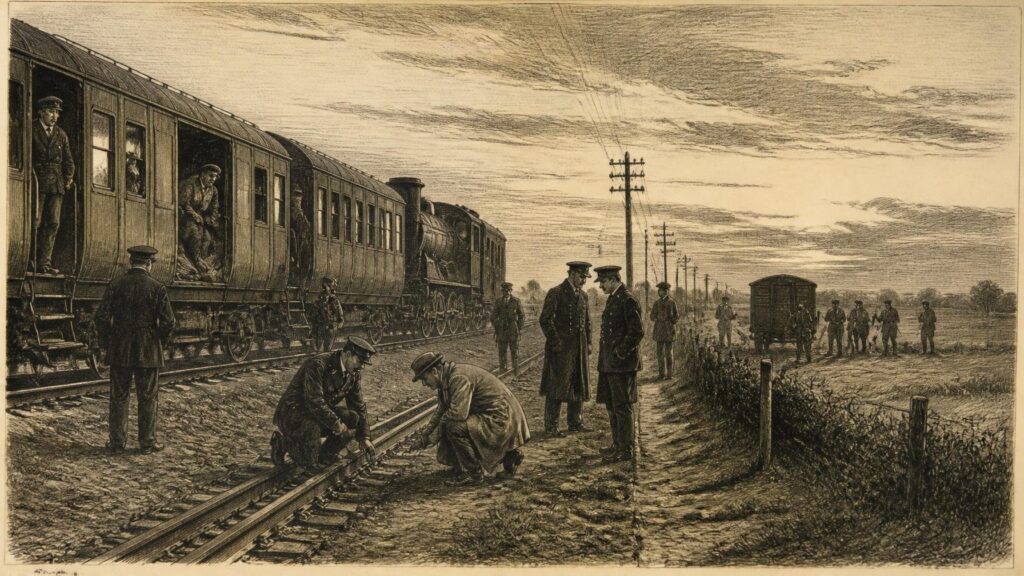
AI generated historical illustration, not a contemporary photograph.
At a Glance
The Sallins case is not simply the history of a spectacular railway robbery. It is the history of what followed: the arrest and interrogation of political suspects, convictions resting upon contested statements, the release of men whose convictions could not stand, and a public argument about policing and justice that endured for half a century. In July 2026, the Court of Appeal formally certified Osgur Breatnach’s conviction as a miscarriage of justice. That ruling did not answer every question raised by the case, but it gave unusually clear legal recognition to a wrong which campaigners had described for decades.
The Robbery
On 31 March 1976, the Cork to Dublin mail train was stopped near Sallins, County Kildare, and robbed by an armed gang. Contemporary accounts put the sum taken at approximately £200,000, a very large amount in the Irish economy of the time. The operation had an obvious theatrical quality: a mail train, a planned stoppage, armed men, a substantial haul and a rapid escape. Yet it was not a romantic adventure. It was an organised armed crime occurring in a State already strained by the violence and political divisions associated with the Northern conflict.
The robbery was soon known as the Sallins train robbery, though the crime took place in the railway landscape around the town rather than in a neat, bounded public arena. Its name joined the event to a place whose residents had not chosen the association. More importantly, the name became shorthand for the legal and moral controversy that developed afterwards. In later memory, “Sallins” often referred less to the theft itself than to allegations of ill-treatment in Garda custody, non-jury trial, disputed confessions and the apparent inability of the State to deliver a full account of what had happened.
There is an essential distinction to maintain. The robbery occurred. A substantial quantity of money was stolen. The historical dispute concerns who carried it out, how the investigation was conducted, whether the suspects were treated lawfully and whether convictions based on their alleged statements could be sustained. Conflating those questions has repeatedly obscured the case. The innocence or guilt of particular arrested men was not settled by the fact that a robbery had undeniably been committed; equally, public revulsion at an armed robbery could not excuse unlawful treatment of suspects.
Political Weather
Ireland in 1976 was living through the worst years of the Troubles. Although most violence was concentrated in Northern Ireland, the Republic was not insulated from armed republican activity, loyalist violence, security anxiety or the political consequences of the conflict. Emergency measures, including the Special Criminal Court, reflected the belief that ordinary criminal procedures could be inadequate in cases connected to paramilitary organisations. That atmosphere shaped public language and official priorities.
The men later caught up in the Sallins investigation were associated with the Irish Republican Socialist Party, or IRSP. The party had emerged from a republican socialist tradition and was linked politically, though not identically in every individual case, with the Irish National Liberation Army. This background made its members conspicuous to police and security authorities. It also made it easy for some observers to treat political affiliation as a substitute for proof. Historical writing must resist that temptation. Membership of, or sympathy for, a radical republican organisation was neither evidence that a person had robbed a train nor a licence to disregard legal safeguards.
That does not mean politics were irrelevant. They were central to the investigative setting. The robbery occurred in a period when government and Gardaí feared armed groups capable of violent action in the Republic. A successful theft of this scale appeared likely to finance political violence. In such a climate, pressure to identify perpetrators could be intense. Pressure is not proof of misconduct, but it helps explain why speedy results carried institutional value and why suspects with known political identities could become the focus of an investigation.
Early Arrests
In the days after the robbery, Gardaí arrested a number of IRSP members. The names most closely associated with the subsequent case are Osgur Breatnach, Nicky Kelly, Brian McNally, John Fitzpatrick, Michael Plunkett and Michael Barrett. The exact procedural path was not identical for every man. Charges changed, some prosecutions did not proceed in the same fashion, and the long aftermath involved court appeals, imprisonment, civil actions, campaigning and political representations. The cases should not be compressed into one undifferentiated story.
What connected them was the allegation that the arrests were followed by oppressive interrogation. Several of the men bore injuries and said they had been assaulted or otherwise ill-treated while held in custody. Garda witnesses rejected those accusations. The conflict between these accounts became one of the central evidential and moral issues in the entire affair. It was not a later embellishment created by campaigners: allegations of abuse were raised early, were aired in court and drew the attention of Amnesty International.
At the time, people detained for serious offences did not have the protections now commonly expected in police custody. Audio or video recording of questioning was not the standard safeguard it would later become. Access to legal advice was far more restricted in practical effect. A written statement could acquire immense importance, particularly in an investigation where other direct evidence was thin or disputed. The vulnerability created by long, unrecorded questioning was one of the larger lessons of Sallins, even where the law had not yet fully absorbed that lesson.
Custody Claims
The men alleged that they were beaten, deprived of rest and subjected to threatening or coercive methods intended to obtain admissions. The Garda group accused in public discussion came to be known as the “Heavy Gang”, a label used widely in journalism, political debate and human-rights commentary. It should be used carefully. It was not the name of a formally acknowledged Garda unit with a published membership list or an agreed institutional history. Rather, it described a group or culture alleged to have operated within serious-crime policing and to have used oppressive methods against detainees.
Amnesty International examined allegations of ill-treatment in Irish custody during this period. Its concern was not confined to Sallins, though the case became a major illustration of its wider warning. Amnesty reported allegations involving a core group of detectives and urged an independent inquiry. Its later publications continued to question whether the injuries sustained by those detained after the Sallins robbery had been satisfactorily explained. Such interventions matter historically because they show that concerns were being voiced by an international human-rights organisation while the events were still relatively recent, rather than being imposed retrospectively on a settled past.
The State’s position was different. Garda evidence denied improper conduct. In the Special Criminal Court, the prosecution relied upon alleged confessions and challenged the detainees’ explanations of injury. The court initially accepted that the statements were voluntary. This finding became devastating for the accused: once a court accepted the statements as voluntary and reliable, the prosecution’s case appeared far stronger. Yet the later appellate outcome showed why the distinction between a trial court’s conclusion and a final historical assessment is vital. A judicial finding can be authoritative at the moment it is delivered and still later be overturned.
Confession Evidence
The Sallins prosecutions revealed the risks of confession-centred cases. Confessions can be compelling evidence where freely made, accurately recorded and independently corroborated. They can also be deeply unreliable where fear, exhaustion, violence, threats or suggestion have influenced the person questioned. The difficulty is not merely philosophical. Once an alleged confession exists on paper, it may dominate a trial, shape investigators’ understanding of the facts and make other evidence seem secondary.
Osgur Breatnach, Brian McNally and Nicky Kelly were tried in the non-jury Special Criminal Court. The prosecution case rested substantially upon alleged admissions. The defendants denied involvement in the robbery and challenged the circumstances in which statements had been obtained. The trial was prolonged and difficult. An earlier hearing had collapsed after the death of one of the judges, requiring a fresh trial. This procedural history increased the duration, cost and psychological burden of the affair, but it did not resolve the underlying question: whether statements attributed to the accused were voluntary.
It is tempting to describe every contested statement as a “forced confession”. That phrase captures the men’s case and the view of many supporters, but historians should describe legal findings precisely. The Court of Criminal Appeal later held that the confessions of Breatnach and McNally had been obtained under oppression and were involuntary. That was a decisive judicial conclusion. It did not establish every individual allegation made about every hour in custody, nor did it amount to a complete public inquiry into Garda conduct. Nevertheless, it went much further than mere doubt: the legal basis for the convictions of those two men had failed.
Special Tribunal
The Special Criminal Court was a central feature of the Sallins story. It sat without a jury and was designed for cases in which the ordinary courts were considered inadequate to secure the effective administration of justice and preservation of public peace and order. Its supporters considered it a necessary response to paramilitary intimidation and political violence. Its critics argued that non-jury procedure gave exceptional power to the State at precisely the point when a defendant required the fullest protections.
The Sallins trial showed how that institutional debate could become personal. Three judges, rather than twelve jurors, had to assess the conduct of interrogations, the provenance of written statements, medical evidence of injuries and the credibility of Garda witnesses and defendants. No historical account can responsibly claim that the absence of a jury itself caused the miscarriage. The later appellate decision turned on the voluntary nature of confessions, not on a general verdict that all non-jury courts were incapable of justice. But the case undeniably became part of the larger argument about emergency law, political cases and the public confidence required by criminal justice.
The court convicted Breatnach, McNally and Kelly in December 1978. Breatnach and Kelly received sentences of twelve years; McNally received nine. To families and supporters, the verdict was a catastrophe after years of fear, arrests and hostile public attention. To those who trusted the prosecution, it seemed to close a grave crime. The two reactions existed simultaneously, and they help explain the bitterness that followed. A conviction does not end a controversy where the methods used to obtain the evidence remain contested.
Broken Verdicts
In May 1980, the Court of Criminal Appeal quashed the convictions of Osgur Breatnach and Brian McNally. The court ruled that their alleged confessions were involuntary, having been obtained under oppression. Both men had already spent about eighteen months in prison. Their release was recorded by RTÉ, whose archive footage preserves the immediate public significance of the decision. In legal terms, the appeal was a reversal of convictions. In human terms, it was an acknowledgement that two men had been imprisoned upon evidence which should not have supported conviction.
The decision did not settle the position of Nicky Kelly. He had absconded during the early proceedings and later returned to Ireland. His case developed differently, including imprisonment and a hunger strike. That divergence is important because it complicates the simplified statement that “the Sallins men were freed together”. They were not. Their experiences were connected but unequal, and their legal routes were distinct. Kelly’s continued imprisonment became a powerful symbol of what supporters regarded as a system unable or unwilling to correct an injustice consistently.
Kelly received a presidential pardon in 1992. A pardon is a significant constitutional act, but it is not identical to a judicial acquittal after a retrial or a court declaration that a conviction was unsafe. This legal distinction has mattered in later campaigns. A pardon can remove or mitigate the effects of a conviction without giving the recipient the full explanatory judgment he may seek. For Kelly, and for those who campaigned with him, the question was not only release or clemency. It was recognition of innocence, an account of what occurred in custody and institutional responsibility for the consequences.
Public Campaign
The Sallins case survived in public memory because the men, their families, lawyers, journalists, artists and civil-liberties advocates refused to let it disappear. Campaigning was sustained over decades, often when official appetite for revisiting the matter appeared limited. The families lived with the consequences of arrest and imprisonment: damaged reputations, lost years, financial pressure and the exhausting requirement to repeat a story that many listeners preferred to regard as closed.
Osgur Breatnach’s family became especially prominent in maintaining the issue in public view. His brother, the musician Cormac Breatnach, later helped bring the family’s experience into cultural work. Theatre, radio and documentary treatment did not replace legal evidence, but they widened the historical archive. They showed the domestic effect of a miscarriage of justice: waiting outside courts, visits to prison, children hearing rumours, parents attempting to protect their families while confronting authority. Such testimony is not automatically conclusive proof of every disputed fact; it is, however, evidence of lived consequence and of the prolonged nature of state error.
Journalistic investigation also mattered. Reporters revisited the robbery, the interrogation allegations and the strange procedural history at intervals over many years. Their work did not produce a statutory inquiry, but it preserved contested evidence and challenged official amnesia. The Irish Times and RTÉ have both played substantial roles in keeping the case accessible to new audiences. The later RTÉ series Crimes & Confessions situated Sallins alongside other Irish cases involving allegations of coercive policing and unreliable confession evidence.
Human Rights
Amnesty International’s engagement gives Sallins a place in the history of Irish human rights as well as Irish criminal law. The organisation was concerned in 1977 about reports of systematic maltreatment by detectives alleged to specialise in oppressive interrogation methods. It later returned to the cases of Breatnach, McNally and Kelly, calling for independent investigation. The value of Amnesty’s intervention was not that it could itself determine criminal guilt or conduct judicial appeals. Rather, it supplied an external standard: allegations of abuse in custody required credible and independent scrutiny.
The Irish Council for Civil Liberties and other organisations later continued this work. In 2023, the ICCL, the Committee on the Administration of Justice, Fair Trials and the Pat Finucane Centre called for a statutory inquiry. They described Sallins as one of the most consequential miscarriages of justice in modern Irish history. Their argument was broader than compensation or individual exoneration. They sought an investigation capable of examining how the arrests, interrogations, prosecutions and subsequent official responses had occurred.
Advocates of inquiry make a persuasive historical point: individual remedies do not necessarily explain systemic failure. An overturned conviction addresses one person’s legal position. A pardon can recognise exceptional circumstances. A damages settlement may compensate loss. None automatically establishes which officials knew what, whether misconduct was isolated or patterned, why safeguards failed, or what lessons were actually learned. Opponents of reopening old cases may point to elapsed time, dead witnesses and competing demands on public resources. Those practical obstacles are real. They do not remove the underlying question of whether the State owes an account where its institutions have contributed to a proven injustice.
Official Silence
For many years the State’s response was piecemeal. The convictions of Breatnach and McNally were quashed; Kelly was pardoned; financial settlements followed. These outcomes were important, yet they did not produce the comprehensive inquiry which the men and their supporters sought. In parliamentary exchanges, governments have acknowledged aspects of the history while resisting a dedicated public inquiry. This has left a gap between legal correction and public explanation.
That gap is at the heart of the word “reckoning”. A miscarriage of justice is not only a defective verdict. It may include the chain of events which made the verdict possible: investigative assumptions, custody conditions, evidential practices, emergency procedures, legal representation, judicial evaluation and political reluctance to revisit official wrongdoing. The Sallins case became a test of whether the Irish State could investigate itself where the alleged failure involved policing, prosecution and courts rather than an easily isolated rogue act.
There is a danger, however, in treating the absence of a public inquiry as proof of a single coordinated conspiracy. The documentary record available publicly does not support easy certainty about every official motive or every individual participant. What is established is grave enough without embellishment: men were convicted, two convictions were quashed because confessions were found involuntary, Kelly was later pardoned, and Breatnach’s conviction was subsequently certified a miscarriage of justice. The unanswered questions concern the full institutional story behind those facts.
Later Evidence
In July 2026, the Court of Appeal granted Osgur Breatnach a certificate under the miscarriage-of-justice procedure. The decision rested upon a newly discovered fact concerning alibi evidence relating to John Fitzpatrick. The Director of Public Prosecutions did not dispute that the material constituted a newly discovered fact for the statutory test. The court was satisfied that the threshold had been met. Breatnach’s conviction, already quashed in 1980, was thereby formally declared a miscarriage of justice.
The ruling was important for several reasons. First, it gave a formal judicial designation which had long been sought. A quashed conviction can leave ambiguity in public understanding: it may be interpreted as a procedural failure rather than recognition of substantive injustice. The 2026 certificate removed much of that ambiguity in Breatnach’s case. Secondly, it placed alibi material beside the history of oppressive confessions. The case was no longer understood only through what happened in custody, but also through evidence which bore on whether those accused had participated at all.
Thirdly, the judgment demonstrated that historical cases can retain legal life. Nearly fifty years had passed since the robbery. Witness memories had faded, institutions had changed and many participants were no longer available. Yet the discovery and assessment of significant evidence remained possible. This should not be mistaken for a complete factual adjudication of every part of the 1976 robbery. The Court of Appeal’s function was to decide the application before it. Still, its conclusion has considerable historical weight: a conviction once upheld by the State’s courts was officially recognised as a miscarriage of justice.
Alibi Question
The alibi issue requires particular care. Public accounts of the 2026 decision indicate that newly available information concerning John Fitzpatrick’s alibi formed the relevant new fact. The significance for Breatnach lay in the relationship between that evidence and the earlier prosecution narrative. It was not simply an abstract technicality. Alibi evidence can expose the fragility of a case constructed through interconnected statements, especially where one alleged participant’s presence has been assumed or asserted by others.
Historical readers should avoid pretending that a later report provides every detail that a full trial transcript, judicial judgment or statutory inquiry might supply. The public reporting makes clear the court’s outcome and the DPP’s position on the statutory threshold. It does not, by itself, create a complete evidential history of every person arrested after the robbery. Responsible interpretation therefore has limits. Breatnach’s certificate is a definite legal fact. Wider conclusions about all suspects, all officers and every stage of the original investigation must be stated with proportionate caution.
That caution is not evasiveness. It is the discipline required by a case in which certainty has often been claimed too easily by opposing sides. The original investigation was conducted in a charged political environment. Later campaigning understandably used powerful moral language. Official defences were often categorical. Yet historical understanding progresses by distinguishing what a court determined, what witnesses alleged, what contemporary organisations reported, what later evidence established and what remains unresolved.
Memory Politics
Sallins occupies an uneasy position in Irish collective memory. It is sometimes recalled within a sequence of cases that raised disturbing questions about Garda interrogation methods in the 1970s and 1980s. Such comparisons can be illuminating because they reveal repeated concerns about custody, vulnerable suspects and confession evidence. They can also flatten differences. Each case has its own victims, records, charges, legal decisions and social setting. Sallins should be connected to, but not dissolved into, a general story of Irish policing.
Its relationship to the Troubles is also complicated. The alleged political affiliation of the arrested men made the case intensely controversial. For some, any criticism of the investigation seemed to minimise the threat posed by republican violence. For others, the case became evidence that emergency powers inevitably corrupted justice. Neither reflex is adequate. A democratic state can and must investigate armed crime. It must do so by methods which can withstand scrutiny. The more serious the offence and the greater the security pressure, the stronger the argument for reliable safeguards rather than weaker ones.
Folklore has grown around Sallins, as it does around many unresolved public scandals. Stories about individual detectives, hidden political decisions, lost files and secret knowledge circulate easily. Some may contain fragments of truth; some may be distorted by repetition; some cannot now be verified. The responsible historian does not dismiss oral memory simply because it is inconvenient, but neither does he convert rumour into fact. The enduring power of such stories is itself revealing. They flourish where official explanation has been sparse and where affected people feel that formal institutions have not listened.
Legal Lessons
The most durable lesson of Sallins concerns confession evidence. Modern legal systems increasingly recognise that a confession should not be treated as self-validating. Its reliability depends on context: how it was obtained, recorded, tested, corroborated and presented. Safeguards such as access to legal advice, custody records, medical examination and recording of interviews are not bureaucratic inconveniences. They protect suspects from coercion, protect investigators from false allegations and help courts assess what actually occurred.
The case also underlines the importance of independent scrutiny. Internal denials, however sincerely made, are not always sufficient where serious allegations concern those who hold coercive power. An independent inquiry can have defects of its own, but its value lies in distance from the institution under examination. Amnesty International’s early calls, and the later calls by Irish and international civil-liberties groups, rested on this principle. They were asking not for a predetermined verdict but for a process capable of examining contested evidence with public credibility.
There is a further lesson about remedies. Justice delayed is not merely justice postponed. Time changes the remedy. A man released after eighteen months has still lost eighteen months. A pardon after years does not restore the years before it. A formal miscarriage-of-justice certificate half a century later can provide profound recognition, but it cannot recreate careers, family life, health or trust. The law may correct its record; it cannot wholly repair a life shaped by the original error.
Unfinished Account
The Sallins story therefore has no simple ending. The 1976 robbery has never ceased to be a real crime requiring explanation. The legal collapse of key convictions, however, means that the original prosecutions cannot be treated as a reliable resolution of that crime. The 1980 appeal judgment, Kelly’s later pardon and Breatnach’s 2026 miscarriage-of-justice certificate transformed the historical meaning of the affair. They established that the State’s first answer was gravely flawed.
What remains unfinished is accountability in the broad sense. Who made the crucial investigative decisions? What precisely occurred during interrogations? Why did the system initially accept statements later held to be involuntary? How were injuries assessed and disputed? What did officials know when later calls for inquiry were made? These questions may be harder to answer with every passing year, but difficulty is not the same as irrelevance. The passage of time can make transparency more necessary, not less, because those directly affected have carried uncertainty for so long.
For Irish history, Sallins is a warning against narratives of automatic institutional progress. The Republic developed stronger legal safeguards and a more self-critical public culture over subsequent decades. Yet progress is not a reason to minimise older failure. It is a reason to study failure honestly. Sallins endures because it forces a fundamental question upon any democracy: what happens when the machinery created to establish guilt instead helps manufacture it? The answer cannot rest only in the past. It lies in the safeguards, candour and willingness to be accountable that public institutions practise now.
Evidential Afterlife
One reason Sallins has remained historically unsettled is that its evidential life did not end with the original proceedings. The case moved through several different kinds of record: statements attributed to detainees, medical evidence, court findings, appeals, television investigation, human-rights reporting, family memory and later legal applications. These records do not all carry the same authority, and they do not answer the same questions. Their coexistence is nevertheless important. It shows that the public understanding of Sallins was never based solely on a single verdict, nor solely on the claims of those who challenged it. It developed through repeated encounters between official findings and material that called those findings into question.
The 1980 appeal judgment concerning Osgur Breatnach and Brian McNally was the crucial legal break in the original narrative. Its significance lay not merely in their release, but in the appellate court’s conclusion that the alleged confessions had been involuntary. That decision obliged anyone examining the case to reconsider the status of the statements on which the prosecution had depended. Yet the appeal did not provide a full reconstruction of every interrogation, identify every cause of every injury, or determine all questions surrounding the robbery. This incompleteness helps explain why the case continued to generate investigation and argument. A successful appeal corrected a conviction; it did not create a complete public account.
For Nicky Kelly, the gap between correction and explanation was particularly acute. His release in 1984 on humanitarian grounds and his presidential pardon in 1992 were major events, but neither was a judicial retrial of the original allegation. The distinction mattered because Kelly’s concern was not confined to the fact of imprisonment. He sought an answer to how the case had been constructed and why the allegations made by him and others about their treatment in custody had not produced a more searching official response. That demand was shared, in different forms, by those who regarded Sallins as evidence of a wider failure in the administration of justice.
Amnesty International’s intervention illustrates the importance of records created outside the Irish State. In 1991, the organisation renewed its call for an independent inquiry into allegations of ill-treatment connected with the robbery. It named Breatnach, Kelly, McNally and John Fitzpatrick in connection with injuries sustained while in custody, noted the quashing of the first two men’s convictions, and observed that the charge against Fitzpatrick had been dismissed. Amnesty was not acting as an appellate court, and its reports cannot substitute for judicial findings. But its continued concern demonstrates that questions about custody had not been answered to the satisfaction of a significant international human-rights body.
The same Amnesty publication drew attention to a 1991 RTÉ documentary on Kelly’s case, Though the Heavens May Fall. The programme commissioned a linguistic examination of Kelly’s alleged confession. The expert involved concluded that the language could not have originated with Kelly alone and suggested that more than one person had been involved in producing it. Such analysis should be treated with care. A linguistic opinion is not a final legal determination, and the reliability and limits of any expert method require scrutiny. Its historical value lies elsewhere: it showed that the disputed statement could still be examined by means other than simply accepting or rejecting the accounts of Gardaí and detainees.
This was an important shift in the case’s afterlife. The question was no longer only whether physical coercion had occurred. It also became a question about authorship, language and the making of a document that had been presented as an accused man’s own words. In confession cases, wording can matter as much as the signature at the end of a statement. A text may appear orderly, detailed and persuasive because it has been shaped through questioning, suggestion or composition by others. That possibility does not automatically establish fabrication in any particular case. It does, however, explain why an unrecorded statement requires careful testing before it is treated as reliable proof.
Broadcasting played a related role in preserving the dispute. RTÉ archive material of Breatnach and McNally leaving prison after their convictions were quashed supplies something that later commentary cannot: a contemporaneous public image of the result of the appeal. The footage does not settle the reasons for the original arrests or identify responsibility for the failure. It does, however, resist the tendency to reduce the affair to an abstract legal citation. It records the human reality of men emerging from imprisonment after a court had ruled that the confessions used against them were involuntary. Television documentary and archive material also carried the case to audiences who had not followed the trial in the late 1970s.
That public afterlife had consequences for the meaning of authority. At the original trial, official witnesses and formal statements possessed obvious institutional weight. Later reporting and documentary work did not erase that weight, but they made it possible to revisit the apparent finality of the proceedings. In this respect Sallins belongs to a broader history in which miscarriages of justice were exposed not by one dramatic revelation alone, but by the slow accumulation of doubts: a contested injury, a failed appeal ground, an overlooked piece of evidence, an expert opinion, archival footage, or the persistence of a family unwilling to accept silence as an answer.
The 2026 miscarriage-of-justice certificate granted to Breatnach gave this long process a new legal form. It was not simply a symbolic endorsement of a campaign, because it arose through the statutory procedure and the court’s assessment of newly discovered material relating to an alibi issue. At the same time, the ruling cannot be detached from the older evidential history. It arrived after decades in which the reliability of the original case had already been challenged through appeals, human-rights advocacy and public investigation. The certificate did not transform every allegation surrounding Sallins into an established fact. What it did establish was that the State’s earlier conviction of Breatnach now bore the formal legal designation of a miscarriage of justice.
For historians, the case therefore demands both attention and restraint. It is wrong to treat later evidence as though it had been available and conclusively accepted in 1978. It is equally wrong to treat the original convictions as permanently authoritative after the courts and the State itself had taken steps that undermined them. The historical task is to hold the different stages together: the armed robbery; the political pressures surrounding the investigation; the contested statements; the quashed convictions; Kelly’s exceptional route through imprisonment, release and pardon; and the later recognition afforded to Breatnach. Sallins remains significant because each stage changed the meaning of the one before it.
Its evidential afterlife also identifies what remains absent. No public process has fully joined the legal, medical, investigative and personal strands into a single authoritative narrative. As a result, the case continues to be remembered through fragments: court decisions, campaigns, documentary reconstructions and the testimony of those who lived through it. That fragmentation is not a reason to dismiss the story as unknowable. It is a reason to distinguish carefully between what has been judicially established, what has been credibly alleged, what has been independently questioned and what still awaits explanation. In that distinction lies the continuing reckoning of Sallins.









The article highlights a persistent gap between correcting individual convictions and explaining institutional failure. Breatnach’s 2026 certification, the earlier quashing of confessions obtained under oppression, and Kelly’s pardon offered important remedies, yet none appears to provide a complete account of interrogation practices, oversight or decision-making. This distinction matters beyond Sallins: legal redress may acknowledge harm while leaving families and public without a shared understanding of how safeguards failed during an emergency period. Given the practical difficulties of investigating events decades later, what form of independent inquiry, evidence-gathering or public acknowledgement could meaningfully address the unresolved questions surrounding the Sallins case?