

State Wages
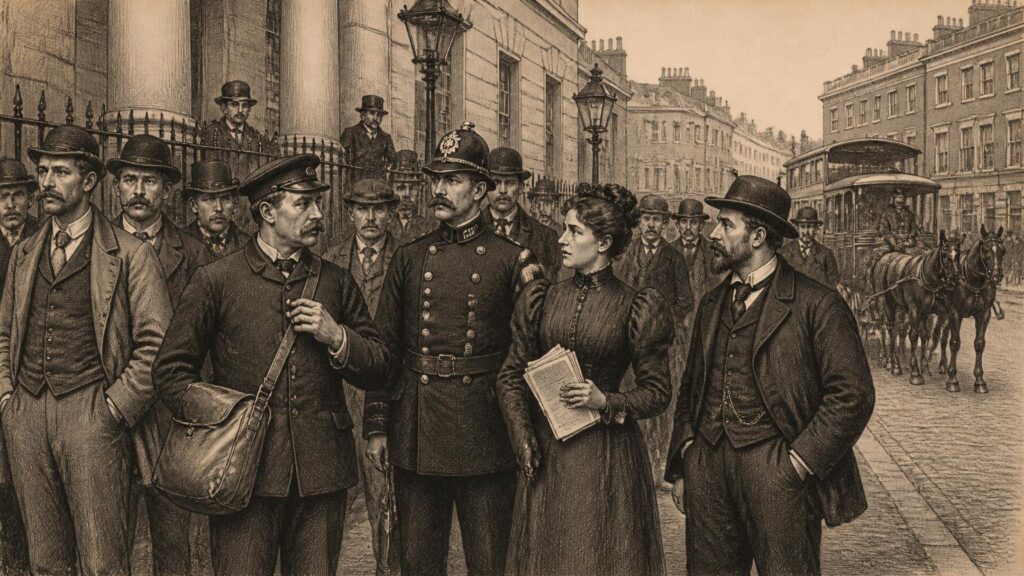
AI generated historical illustration, not a contemporary photograph.
At a Glance
Public sector pay disputes have repeatedly exposed a central tension in modern Irish history: the State is at once an employer, a guardian of essential services and the institution expected to protect the public purse. Arguments over wages therefore became arguments about authority, citizenship, equality, service and survival. From police agitation under British rule to postal stoppages during the Civil War, from teachers’ strikes in the era of educational expansion to the emergency pay measures after 2008, remuneration was never merely an administrative detail.
Public Employment
“Public sector” is a modern umbrella term, and it should not be projected too casually backwards. In nineteenth-century Ireland, people employed by government included civil servants, police constables, postal staff, teachers supported by public grants, poor-law officials, prison staff and workers in state-supervised services. After independence, the range widened through the institutions of the Free State and later Republic: departments, local authorities, schools, hospitals, transport bodies, communications services and commercial or semi-state organisations. Their employment arrangements were varied. Some were directly appointed by the State; some worked for bodies funded, regulated or closely controlled by it; some had mixed contractual relationships inherited from church, local or imperial structures.
That variety matters because disputes about public pay were rarely settled by a single rule. A civil servant’s case might be decided through departmental machinery, an arbitration arrangement or direct ministerial decision. A teacher’s salary could involve school management, denominational authority, departmental grant and national policy. A worker in posts, telecommunications, transport or electricity might bargain with a formally separate employer while knowing that ministers and the Department of Finance retained decisive influence. The question was not simply who signed the payslip. It was who possessed the power to approve expenditure, define grades, recognise unions and decide whether a service could be interrupted.
Irish public-sector disputes also occupied a distinctive political space. Workers performed services which citizens encountered every day: letters stopped arriving, schools closed, telephones went unanswered, court business was delayed, transport was curtailed or hospital routines altered. Governments could therefore portray restraint as a responsibility owed to taxpayers and service users. Unions could answer that dependable public services required adequately paid and respected staff. Neither claim was automatically insincere. Their collision explains why wage disputes so often acquired a public moral language absent from many private-sector negotiations.
The historical record is uneven. Official papers usually preserve ministerial calculations, legislation, formal agreements and departmental correspondence. Union archives retain resolutions, circulars, strike notices and the vocabulary of collective grievance. Newspapers record immediate controversy but also reproduce the assumptions of their editors, owners and readerships. Later recollections add texture, though memory may compress events or turn a complicated settlement into a simpler tale of victory or betrayal. The history that follows accordingly distinguishes documented events from interpretation. It does not treat every contemporary accusation, later anecdote or union tradition as settled fact.
Imperial Foundations
Before 1922, Irish public employment was shaped by the structures of the United Kingdom. The civil service and postal system operated within imperial administration; the Royal Irish Constabulary and Dublin Metropolitan Police served the state’s coercive and municipal needs; education was increasingly dependent on public finance while retaining denominational and local features. This did not mean that Irish workers were passive recipients of salaries fixed in London. Their conditions were affected by local living costs, political upheaval, Irish trade union organisation and the growing expectation that employment by government should carry particular obligations.
Police pay illustrates the contradiction. Constables were expected to enforce order, often in tense political circumstances, yet they were also wage earners subject to rising prices, long hours and rigid discipline. Their ability to organise was constrained by the nature of policing and by official suspicion of collective action among armed or uniformed servants. The same State that relied on them for authority was reluctant to acknowledge that they might bargain collectively in a manner resembling other workers.
The First World War intensified these pressures. Inflation made nominal wages less meaningful, while emergency duties enlarged workloads and sharpened awareness of comparisons with other occupations. Wartime bonuses, intended to offset increased living costs, became politically charged because their adequacy depended upon the rate at which prices rose and upon perceptions of fairness between grades. In this period, as in later Irish disputes, a supposedly technical calculation became a judgement about dignity and social standing.
Police Agitation
The Dublin Metropolitan Police agitation of 1916 is one of the clearest early examples. The force, responsible for policing Dublin until the mid-1920s, had a comparatively low-paid rank-and-file. During the 1913 Lockout, labour leader Jim Larkin had publicly drawn attention to the difficult conditions faced by Dublin policemen, particularly the extra pressures caused by the dispute. A modest increase awarded in 1914 did not settle the question. By 1916, the combined effects of wartime inflation, additional duties after the Easter Rising and new firearms training had deepened discontent.
Contemporary reporting and subsequent historical work show that constables sought both a general increase and a war bonus. Their complaint was not confined to a single headline rate. They pointed to the expense of travelling to training and to ancillary costs associated with new duties. Such details are important. Public pay disputes often turn on apparently minor allowances because those payments reveal who bears the practical cost of organisational change. When an employer imposes a new duty but leaves workers to absorb its incidental expense, the grievance becomes broader than the sum involved.
The authorities responded as much to the form of the agitation as to its substance. Meetings were viewed as potentially subversive; the use of a hall connected with nationalist organisation heightened official anxiety. When constables publicly processed through Dublin with their belongings, a gesture intended to dramatise their readiness to leave, management and government treated the episode as a challenge to discipline. Five men were dismissed. Subsequent legislation improved pay and provided a bonus, while arrears gave many members a useful Christmas payment. Yet the dismissals demonstrated the narrow limits within which police could press their case.
It would be too simple to call the outcome either a defeat or a victory. Material concessions followed, but the men most visibly associated with the protest were punished. The episode reveals an enduring pattern: governments may concede that pay is inadequate while refusing to concede that workers in strategically sensitive services possess an unrestricted right to collective pressure. Later Irish governments, confronting garda, prison, health, transport and communications disputes, would repeatedly navigate the same divide between negotiation and control.
Revolutionary State
The years surrounding independence did not suspend economic conflict. They made it more acute. The revolutionary decade and Civil War disrupted administration, trade and public finance while giving new importance to the legitimacy of the emerging State. Workers who had supported national self-determination could reasonably ask what independence would mean for wages and employment rights. Ministers, meanwhile, faced depleted resources, fractured authority and a determination to establish that the new government could maintain essential services.
Inflation was a major background condition. During the Great War, civil servants in Britain and Ireland had received cost-of-living allowances. These were not simply bonuses in the casual sense; they were an attempt to prevent established salary scales from being eroded by exceptional price increases. After the war, the issue did not disappear, because prices and household pressures remained high. The provisional government’s decision in 1922 to reduce the cost-of-living bonus for public employees therefore touched an already sensitive nerve.
Postal Strike
The postal strike of 1922 is especially revealing because it occurred while the Irish Free State was being forged amid armed conflict. Postal workers occupied an indispensable position in communications, administration and everyday social life. Their unions argued that the proposed reduction in the cost-of-living payment threatened workers whose underlying rates had long lagged behind living costs. The dispute involved the Irish Postal Union, Irish Postal Workers’ Union and Irish Post Office Engineering Union, which created a temporary United Postal Union to coordinate their response.
The government’s stance was uncompromising. The Postmaster General, James J. Walsh, issued a notice warning that an officer who withdrew labour would automatically forfeit his position and that reinstatement, if granted, would not necessarily restore pension or continuous-service rights. The wording made the stakes unmistakable. This was not merely an invitation to settle a claim through ordinary machinery. It asserted that a public servant’s employment could be treated as forfeited through strike action.
Union representatives described the notice as intimidation and as an attack on the right of government workers to use normal trade-union methods. Their language should be read as advocacy, but the underlying constitutional and political issue was real. Could employees of the new State organise as citizens and workers, or did their duty to the State outweigh those claims? The answer delivered in practice was restrictive. The government placed continuity and authority above collective action, and the dispute ended with substantial consequences for workers.
This episode has sometimes been treated as a minor footnote to the Civil War. That is misleading. It exposed a formative choice in state-building. The Free State did not simply inherit offices and payrolls; it inherited a problem familiar to modern governments: how to reconcile public employment with labour rights when the employer is itself the political community. The postal dispute also undermines any romantic assumption that national independence automatically produced harmony between government and organised labour. State formation created new opportunities for representation, but it also created a new employer capable of enforcing discipline in the name of national necessity.
There is a temptation to use the 1922 strike as proof that all later public-sector settlements were predetermined by authoritarian origins. The evidence does not justify that deterministic conclusion. Industrial relations institutions changed significantly over subsequent decades, and unions won recognition and influence. Nonetheless, the dispute established a durable political reflex: during moments of perceived emergency, Irish governments could present wage restraint and restrictions on action as measures necessary to preserve the State itself.
Institutional Bargaining
The middle decades of the twentieth century brought a more settled but not conflict-free framework. The Industrial Relations Act 1946 created the Labour Court, an institution intended to encourage voluntary resolution of disputes through investigation, recommendation and conciliation rather than compulsory wage fixing. It did not abolish conflict. Its importance lay in providing a recognised public forum in which claims could be framed, evidence considered and compromise proposed.
The postwar system was voluntarist in a specific sense. Bargaining remained principally a matter for employers and unions, while the State supplied institutions and, in public employment, frequently acted as the employer or controlling authority. The distinction could be blurred. Departments of Finance and Public Service were not detached observers of public-sector settlements; they guarded expenditure and set broad policy. Yet the presence of procedures gave disputes a language other than raw confrontation. Claims could be referred, comparisons could be made and recommendations could carry moral or political weight even where they were not legally enforceable.
Academic work on Irish pay determination identifies the 1950s and 1960s as a period in which informal wage leadership and relatively regular wage rounds operated alongside fragmented union representation. Craft workers and powerful groups could influence the norms against which others judged their claims. The Labour Court played a role, particularly where disputes required an authoritative comparison, but no perfectly coherent national structure existed. The arrangement became increasingly strained as economic development accelerated, public services expanded and workers demanded that pay reflect changing skills, qualifications and responsibilities.
For public employees, comparison was always troublesome. A clerical officer might be compared with a private office worker, but pension security, increments, promotion prospects and job tenure complicated the calculation. A teacher, nurse, garda or prison officer had no exact private-sector equivalent. Claims therefore relied on analogies: qualifications, responsibility, unsocial hours, exposure to risk, recruitment difficulties or the pay of supposedly comparable grades. Such comparisons were never wholly objective. They were arguments about what society valued.
Educational Expansion
Teachers’ pay disputes in the 1960s and 1970s show how administrative reform and remuneration became inseparable. Educational expansion transformed the scale and expectations of Irish schooling. The introduction of free second-level education, changing patterns of attendance and a growing emphasis on qualifications made teachers central to national development. At the same time, the profession was divided among primary, secondary and vocational sectors with different traditions, contractual arrangements and salary expectations.
The Ryan Tribunal on teachers’ salaries proposed a common basic scale. Common scales can appear administratively rational: they promise clarity, consistency and a means of coordinating expenditure. But they also redistribute status. Secondary teachers feared that a common scale would diminish a differential they regarded as justified by qualifications, professional responsibilities and established conditions. The dispute was therefore not simply resistance to reform. It was an argument over whether equalisation meant fairness or levelling down.
Teacher Militancy
In February 1969, members of the Association of Secondary Teachers, Ireland began an all-out strike after rejecting the Ryan recommendations. The stoppage closed nearly all second-level schools. It was an unusually visible form of public-sector industrial action because its immediate effects were felt by pupils, parents, school managers and communities throughout the country. Contemporary accounts record the wider anxieties surrounding the dispute: not only the amount of pay, but fears about direct State payment of salaries and the possible alteration of long-standing relationships between teachers and religious school managers.
The dispute continued in altered forms into 1970. Agreements, tribunal recommendations and allowances became entangled with the positions of other teacher unions. The episode demonstrates a recurrent problem of public pay policy: a concession to one group can create claims from another group whose relative position changes as a result. Governments often imagine that a settlement closes a file. In a graded public service, it may instead open several more.
Teachers’ action also invited public commentary about professional duty. Critics argued that school closures imposed costs on children and families. Supporters countered that teachers had been driven to action after ordinary channels failed, and that professional status could not be maintained on inadequate terms. These arguments belong to the history of the dispute, but neither should be confused with neutral fact. They express rival ethical interpretations of public work. The same ethical contest would recur in disputes involving health care, policing and transport: does the special importance of a service increase workers’ bargaining responsibility, or strengthen their claim to fair treatment?
By the mid-1980s, teacher pay was again a prominent national controversy. Independent arbitration recommendations and government resistance generated regional stoppages, a national day of action and threats affecting examinations. The form of action had changed, but the core issue remained relative pay and the authority of review or arbitration mechanisms. The State could not easily invoke neutral expertise when it declined to implement an award that teachers considered legitimate. Once a government creates or accepts a mechanism for evaluating pay, its political difficulty is not removed; it is relocated to the question of whether the mechanism will be honoured.
Inflationary Conflict
The 1970s placed Irish industrial relations under exceptional pressure. International inflation, oil shocks, economic uncertainty and changing expectations of wage growth unsettled established pay norms. Ireland experienced frequent strikes, unofficial actions and disputes within essential services. The public sector was not isolated from this turbulence. Indeed, because the State was responsible for schools, communications, transport, utilities and other services, many of the most disruptive conflicts had a public or semi-public dimension.
The move towards national wage agreements was partly an attempt to restore order. Formal national agreements sought to coordinate pay increases, taxation, employment policy and other elements of economic management. Their attraction was obvious: if employers, unions and government could agree an overall framework, individual claims might be contained within it. Yet public employees often had reasons to pursue claims outside general rounds. Their work could change rapidly; an occupational group might believe that national increases ignored a particular historical anomaly; shortages in a specialised service might create leverage; or one settlement might disturb an established relationship between grades.
In this setting, “comparability” became a powerful but unstable concept. Pay was rarely debated solely in terms of subsistence. Workers asked whether their position had fallen behind analogous occupations, whether women were being paid fairly, whether technical skill had been recognised and whether public service should mean perpetual restraint while private wages rose faster. Governments asked whether each claim, if conceded, would be replicated across thousands of employees. Both sides were responding to the architecture of public employment, in which a decision for one group can have large and cumulative consequences.
Telephone Equality
The Dublin telephonists’ dispute illustrates the intersection of pay and gender. Women telephonists challenged unequal rates and the assumptions embedded in a departmental hierarchy. Their campaign occurred in an era when equal-pay principles were gaining force across Europe, but formal commitments did not automatically alter payroll practice. Dublin City Council’s historical account of the dispute records that the Department of Posts and Telegraphs reached an equal-pay settlement in February 1979.
The timing mattered. A wider postal and telecommunications dispute soon followed, and there was contemporary suspicion that management had underestimated women workers’ willingness to support male colleagues in lower grades. That suspicion is evidence of a contemporary perception, not a fact that can be conclusively established from it. What is clear is that women telephonists were not peripheral to industrial relations. Their action challenged both a pay structure and a gendered expectation of workplace loyalty.
The equal-pay story should not be reduced to a tidy narrative of progress. A settlement can remove one explicit differential while leaving occupational segregation, promotion barriers and unequal caring burdens intact. Still, the dispute marked an important shift. It showed that public-sector remuneration was increasingly judged not only by traditional craft or grade comparisons but also by principles of sex equality. In later decades, equality claims would remain central to arguments over new entrants, part-time workers, allowances and the valuation of work traditionally performed by women.
Postal Stoppage
The 1979 postal and telecommunications strike was among the most consequential Irish public-service disputes of the period. It lasted eighteen weeks and had effects far beyond the immediate workforce. Postal delivery and telephone services were central to commerce, personal communication and the operation of institutions. The Labour Court’s history records that the strike caused major disruption to the Court’s own work and accounted for approximately 1.2 million of the 1.465 million working days lost in Ireland that year.
Those figures establish the scale of the stoppage, but figures alone cannot explain its significance. The dispute became a test of whether the State could permit an essential communications service to remain out of operation while maintaining a commitment to collective bargaining. The eventual settlement brought a more modest increase than workers had initially sought. As with many long disputes, participants could reasonably disagree about its meaning. Government could claim fiscal discipline and continuity of authority; union members could emphasise solidarity, endurance and the pressure that made a settlement unavoidable. The documentary record supports the disruption and the eventual compromise, but it cannot reduce diverse lived experiences to one verdict.
The strike also reveals why public-sector action has such political resonance. A stoppage in a private firm can be economically damaging, but a stoppage in communications may make the ordinary workings of social life visibly difficult. Public anger can therefore become an indirect instrument in negotiation. Governments may appeal to it; unions may seek to retain sympathy by explaining their case and organising exemptions where possible. The public is not a passive audience. It is a contested constituency whose inconvenience, support or frustration affects the bargaining environment.
Fiscal Retrenchment
The economic crises of the early 1980s again changed the balance between pay claims and public finance. Successive governments faced budgetary pressure, high unemployment and growing concern about borrowing. Public-service pay became a prominent target because it was a large, visible and controllable element of current expenditure. Yet reductions or freezes were politically hazardous. Public servants were not an abstract spending category; they were organised employees whose earnings supported households and local economies.
A pay freeze introduced in 1982 and the resistance it generated must be understood in this context. The dispute was not merely over whether a particular percentage should be awarded. It concerned whether the fiscal crisis justified government departure from previously expected patterns of increase and bargaining. Trade union leaders had to balance the immediate anger of members with the risks of prolonged confrontation during a period of unemployment and economic weakness. Governments, for their part, had to decide how far to rely on restraint, legislation and institutional negotiation.
Public-sector bargaining in this era was complicated by the boundary between direct State employment and semi-state bodies. Organisations such as transport, peat, electricity and communications enterprises could have commercial responsibilities, distinctive workforces and separate managements. Nonetheless, ministerial departments frequently exercised close control over their finances and industrial relations. Workers often regarded this as proof that their ultimate employer was the State; ministers could argue that separate management and financial constraints mattered. The ambiguity itself could become a cause of dispute.
By the later 1980s, the limitations of repeated confrontation were evident. Neither governments nor unions had discovered a stable answer to the distributional conflicts produced by inflation, recession and fragmented bargaining. The emergence of social partnership after 1987 should therefore be seen not as a sudden conversion to consensus, but as a response to accumulated institutional fatigue. It offered a means of linking wages, tax changes, public expenditure and economic strategy within longer agreements.
Social Partnership
Social partnership became one of the defining frameworks of late twentieth-century Irish economic governance. National agreements brought together government, employer representatives, trade unions and, in time, other social interests. For public servants, partnership promised a more predictable route to pay increases and a forum in which issues of taxation, reform and public-service change could be negotiated rather than imposed. For government, it offered industrial peace and a mechanism for connecting pay policy to wider economic aims.
Its success should not be exaggerated into a story of permanent harmony. Partnership depended upon economic growth, political trust and the belief that negotiated gains were preferable to unilateral action. It also contained internal tensions. Public-sector unions had different memberships and priorities; private-sector workers did not always share the same concerns; lower-paid workers could judge percentage increases differently from higher-paid professionals; and reform measures could redistribute burdens unevenly. Nevertheless, the system altered expectations. Bargaining moved from episodic crisis towards structured multi-year agreements.
Public-service benchmarking in the early 2000s exposed both the appeal and the danger of this approach. Benchmarking attempted to compare public-service salaries with comparable work in the private sector and to make adjustments where public servants were judged to have fallen behind. Supporters regarded it as a serious effort to settle longstanding anomalies using evidence rather than industrial muscle. Critics questioned the comparisons, the cost and the capacity of the Exchequer to absorb awards. The public debate often focused on headline sums, but the deeper question was whether technical evaluation could command political legitimacy when it required large spending commitments.
The answer was mixed. Benchmarking could provide a language of objectivity, yet it could not remove judgement from the process. Decisions about comparator groups, pensions, security, working time and responsibility involved assumptions. Nor could a report guarantee acceptance once economic conditions changed. Public-sector pay is particularly exposed to this problem because an award may be negotiated during prosperity but paid during downturn. What appears to be a contractual obligation to workers can appear to be an unaffordable legacy to a government facing falling revenues.
Financial Emergency
The financial crash after 2008 brought that conflict into its sharpest modern form. Ireland’s fiscal crisis was severe, and public-service payroll became a major focus of emergency policy. In 2009, the State introduced the pension-related deduction, commonly known as the pension levy, and further reductions in remuneration followed. The official legal framework described these measures as financial emergency measures in the public interest. The language was deliberate: it sought to establish that extraordinary intervention in public pay was justified by exceptional national circumstances.
The measures were controversial because they cut across previous expectations of collective bargaining and security. Public servants argued that they were being asked to bear a disproportionate cost for a crisis they had not caused. Government argued that collapsing revenues, fiscal commitments and the need to preserve services left little alternative. Both claims shaped the politics of the period. The issue was not only the level of pay but whether the State could unilaterally alter remuneration, increments and pension-related arrangements through legislation.
The Public Service Agreement of 2010, widely known as the Croke Park Agreement, marked an attempt to move from unilateral emergency action back towards a negotiated framework. The agreement linked public-service reform, reduced staffing, redeployment and efficiency measures to commitments that there would be no further cuts to basic pay rates beyond those already imposed and no compulsory redundancies where they did not already apply, subject to flexibility and the delivery of savings. It was not a conventional pay-rise agreement. It was an exchange in which job security and protection against further cuts were traded for major changes in work organisation.
Reform Bargain
The Croke Park Agreement is often remembered through the phrase “Croke Park hours”, especially in education, but that shorthand obscures its breadth. The agreement concerned redeployment, mobility, altered work practices, staffing reductions and the maintenance of services with fewer employees. Its political significance lay in restoring negotiation as a means of administering austerity. Instead of presenting public servants solely as a cost to be cut, it treated them as participants in a reform bargain, albeit one made under intense fiscal pressure.
Interpretations of the agreement differ. Supporters argue that it avoided compulsory redundancies, protected basic pay from further reduction and secured changes necessary to sustain services. Critics contend that it embedded concessions, increased workloads and transferred too much of the burden of adjustment onto staff. These are interpretive judgements. The documented terms confirm that protection was conditional and that reform obligations were substantial. They do not compel a single conclusion about whether the exchange was fair.
The agreement also showed that public-sector pay cannot be separated from the organisation of labour. A nominal salary may remain unchanged while working time, duties, location, staffing levels and pension deductions alter materially. Workers understandably judge their position through the total employment relationship. Governments, however, may classify many of these changes as management reform rather than pay. This difference in classification can itself fuel dispute: what ministers describe as efficiency, employees may experience as an unpaid intensification of work.
Renewed Austerity
Economic recovery did not arrive quickly enough to prevent further conflict. The Haddington Road Agreement and associated legislation in 2013 extended the period of restraint and introduced additional measures, including changes affecting increments, working hours and higher earners. The Financial Emergency Measures in the Public Interest Act 2013 provided for reductions in remuneration for public servants earning above specified thresholds and situated those provisions within the wider emergency programme agreed with international lenders.
These arrangements tested unity within the trade-union movement. Some unions accepted negotiated terms as the least damaging available outcome; others rejected them, believing the concessions excessive or the distribution unfair. This division was not evidence that one side misunderstood the facts. It reflected genuine differences in membership composition, occupational pressures and assessments of bargaining power. A union representing workers close to the lower end of the scale might prioritise relief from deductions; a professional group affected by altered hours or specialist allowances might assess the bargain differently.
Later agreements, including the Lansdowne Road Agreement, began a phased unwinding of emergency reductions and pension-related deductions. The sequencing mattered. Restoration was not instantaneous and did not affect every group in the same way. Newer entrants, whose terms could differ from those of established staff, became a particularly sensitive issue. Their position showed that “public servants” were not a homogeneous body. The history of pay disputes is also a history of divisions by generation, grade, gender, profession, pension status and date of entry.
Historical Meanings
Across more than a century, several themes recur. First, inflation repeatedly transformed disputes. Workers did not experience salary as a figure on a scale alone; they experienced its purchasing power. Wartime bonuses, cost-of-living payments, national wage rounds and emergency cuts all arose from the gap between formal remuneration and household reality. Governments could cite budgetary arithmetic, but workers measured rent, food, transport and family obligations.
Second, relativity mattered as much as absolute pay. A settlement could be welcomed by one group and condemned by another if it disturbed an established differential. Teachers and telephonists, police and postal staff, clerical grades and professionals all framed claims through comparison. Such arguments were not necessarily selfish or merely symbolic. Relative pay could influence recruitment, retention, hierarchy and the perceived worth of skills. But relativity also made comprehensive settlement difficult, since each adjustment created new reference points.
Third, public service carried an ambiguous moral weight. Governments invoked service users, taxpayers and national necessity. Unions invoked the quality of service, the dedication of staff and the injustice of expecting workers to subsidise public provision through poor pay. The historical evidence demonstrates that these arguments were made repeatedly; it cannot objectively decide every ethical claim. What it does show is that public-sector disputes were never only bilateral contests between employer and employee. The public formed an unavoidable third presence.
Finally, institutions mattered. The Labour Court, arbitration, national agreements, review bodies and formal public-service agreements did not eliminate conflict, but they gave it channels. They enabled workers and governments to argue through reports, recommendations and negotiated texts rather than through stoppages alone. Their authority, however, depended on confidence that their outcomes would be respected. When governments departed from awards or imposed emergency measures, the institutional memory of broken expectations became part of later bargaining.
Continuing Arguments
There is no single Irish tradition of public-sector pay disputes. The DMP agitation of 1916, the postal strike of 1922, teachers’ stoppages, the telephonists’ equality campaign, the 1979 communications strike and the post-2008 agreements arose in different constitutional, economic and social worlds. To collapse them into one story would erase the specific pressures of war, independence, educational reform, gender equality, inflation and financial crisis.
Yet they share a durable question: what does a State owe those who carry out its work, and what may it require of them in return? The answer has changed with political circumstance. At times the State has disciplined and legislated; at times it has negotiated, benchmarked, restored and reformed. Workers have struck, petitioned, referred claims, accepted difficult bargains and challenged the definitions of fairness imposed upon them. Public-sector pay disputes therefore belong not at the margins of Irish history but near its centre. They reveal how governments understood fiscal responsibility, how employees understood citizenship and how ordinary people encountered the consequences when the work of the State became contested.
Folklore surrounding major disputes often offers satisfying lessons: that one determined strike won everything, that a government never yields, that one agreement solved a generation’s problems or that public servants were either uniquely privileged or uniquely mistreated. The archival record is less tidy. Settlements were partial; concessions could be followed by new claims; reforms generated unanticipated burdens; and public opinion shifted with circumstances. The more useful historical conclusion is not that conflict was avoidable, but that it was structured by choices about authority, evidence, distribution and trust.
That conclusion remains valuable because public pay will always involve a collective decision about resources. Wages in public service are funded through public systems, but public systems also depend upon people willing and able to perform demanding work. Irish history shows that durable settlements have generally required more than a percentage figure. They have required recognition of changing duties, credible procedures, attention to equality, and some shared belief that neither public service nor public finance is being treated as an afterthought.
The article’s account of teachers’ disputes suggests that a common salary scale can represent either fairness or a loss of professional recognition, depending on which comparisons are considered legitimate. This ambiguity seems especially significant in public services, where qualifications, responsibility, continuity of service and historical differentials cannot be measured as straightforwardly as a market wage. The 1969 secondary teachers’ strike also shows how a settlement for one group may reshape claims by others across a graded system. When governments seek consistent public-sector pay structures, how should they weigh equal treatment against distinct skills, responsibilities and established professional expectations over time?