

Private Losses
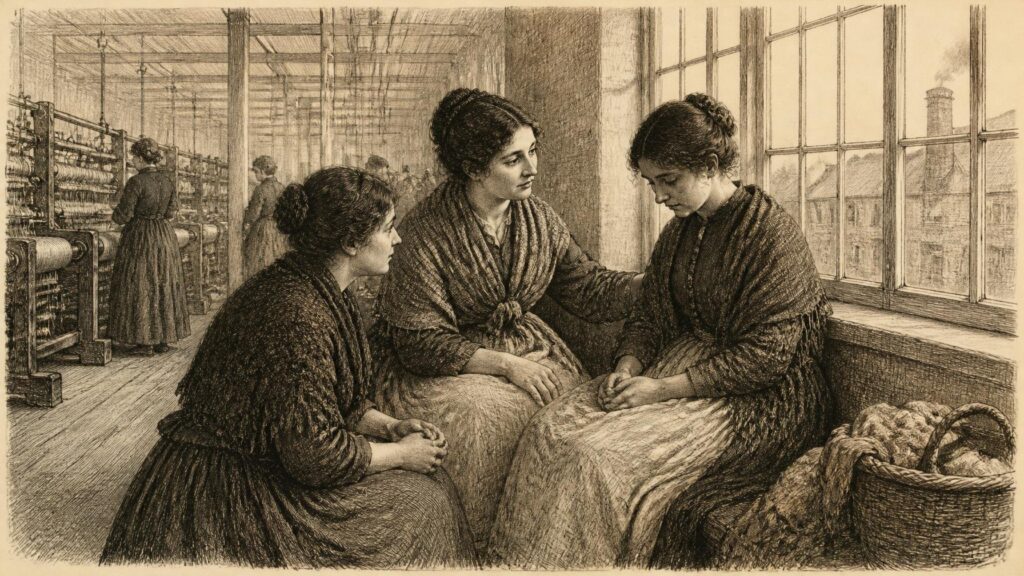
AI generated historical illustration, not a contemporary photograph.
At a Glance
For much of Irish labour history, miscarriage was present in working lives but largely absent from employment law. A worker might be bleeding, receiving medical treatment, grieving a hoped-for child or supporting a partner, yet the available official categories were usually illness, annual leave, informal managerial discretion or no leave at all. The recent movement for miscarriage leave therefore belongs to a longer Irish story: the gradual admission of women’s bodily experience, reproductive autonomy and family loss into the legal language of paid work.
Hidden Experience
Miscarriage is neither a new occurrence nor a newly felt bereavement. What is new is its emergence as a defined subject of employment rights. That distinction matters. Historical records are much better at preserving laws, hospital rules, parliamentary speeches and trade-union resolutions than they are at preserving private losses. A woman who miscarried in a nineteenth-century household, a factory worker who concealed a pregnancy from an employer, or a public servant who returned to work before she had physically recovered may appear only indirectly in surviving documents, if at all. Silence in the archive should not be mistaken for absence in life.
Irish social history has long been shaped by sharp divisions between public and private life. Pregnancy, childbirth, infertility, menstruation and miscarriage were commonly treated as intimate matters, often mediated by family, church, doctor or midwife rather than workplace institutions. This did not mean that employment was unaffected. Women’s work was organised around bodies that could become pregnant, around workplaces that might be unsafe, and around wages that could not easily be forgone. But the terms in which employers, lawmakers and unions recognised these facts developed slowly and unevenly.
Miscarriage in particular resisted simple official classification. It could entail pain, haemorrhage, surgery, infection risk, anaesthesia, follow-up appointments and a period of physical recovery. It could also entail grief, shock, fear about future pregnancies or the resurfacing of earlier losses. Yet an early pregnancy may not have been disclosed to relatives, colleagues or managers. This meant that the practical need for time away from work was often accompanied by a need for privacy. A worker might need leave precisely while wishing not to explain why.
That tension explains why the history of miscarriage leave cannot be told only as a history of benevolence. Informal kindness from a manager could be valuable, but it was conditional: dependent on workplace culture, job security, personal disclosure and the discretion of someone in authority. A legal entitlement operates differently. It creates a recognised category, a procedure, a right to return and, potentially, a remedy where an employer refuses. The question in Ireland has therefore been not simply whether people deserve sympathy after pregnancy loss, but whether sympathy should be translated into enforceable labour protection.
Industrial Change
The background to that question lies in the changing place of women in paid employment. Ireland’s economy was never a world in which women did not work. Women worked in agriculture, domestic service, textiles, shops, laundries, family businesses, teaching, nursing and many forms of informal or poorly recorded labour. However, access to secure, pensionable and publicly recognised employment was shaped by gender, marital status and family expectation. The ideal of the male breadwinner, although never a complete description of Irish life, influenced law and administration for generations.
The twentieth-century State inherited social assumptions that treated married women’s employment as secondary or problematic. The marriage bar in parts of the public service and teaching system, which required many women to leave work upon marriage, was one powerful example. It made the relationship between paid work and family formation an explicitly political matter. Its eventual removal was significant not merely because it allowed women to remain employed after marriage, but because it helped establish the principle that women should not be forced to choose between adulthood, family life and an occupational future.
That change did not automatically create maternity rights. An employee could retain her job in theory while facing pregnancy discrimination, dangerous duties, loss of income or inadequate leave in practice. Nor did it settle the status of a pregnancy that ended before birth. Labour law traditionally organised rights around events that were legible to the employer and the State: work performed, illness certified, a child born, a death registered. Early miscarriage could fall between these categories. It was medically real, but sometimes not visible. It was emotionally consequential, but not always treated as bereavement. It interrupted work, but did not necessarily fit established leave schemes.
European equality and health-and-safety law became an important force in changing this framework. Ireland’s accession to the European Economic Community in 1973 brought the country into a developing legal order that increasingly addressed equal treatment, workplace safety and maternity protection. These measures did not originate in Ireland alone, and they did not use the later language of pregnancy-loss leave. Nevertheless, they helped move pregnancy from the realm of private inconvenience towards the realm of employment protection.
It would be misleading to portray this as a simple march from exclusion to inclusion. Rights were often achieved after pressure from workers, unions, equality campaigners and legislators, and their value depended on enforcement. Moreover, the workplace was not a single place. A permanent public-sector worker, a teacher, a nurse, a retail employee, a migrant worker, a person on a short contract and a self-employed person could encounter very different levels of security. The history of miscarriage leave is consequently also a history of unequal access to time, money, privacy and institutional support.
Legal Foundations
The Maternity Protection Act 1994 was a major landmark in Irish employment law. Enacted in December 1994 and commenced in January 1995, it implemented European requirements concerning the safety and health of pregnant workers and workers who had recently given birth or were breastfeeding. It also re-enacted and altered earlier maternity-protection provisions. Its basic architecture was recognisable: a period of maternity leave, safeguards for employment rights, protections around dismissal, time for maternity-related medical care and duties upon employers concerning health and safety.
The 1994 Act is important to the history of miscarriage leave partly because of what it did and partly because of the boundary it created. It framed pregnancy and maternity as conditions calling for labour protection, rather than as purely private matters. It required employers to confront risk, absence and return to work. It recognised that an employee remained connected to her job while away on statutory leave. In this respect, maternity protection offered an institutional model later campaigners could invoke: if pregnancy and birth could generate specific rights, why should pregnancy loss be addressed only through generic sick leave?
At the same time, maternity law was principally constructed around confinement and birth. Its original leave arrangements were more limited than those now familiar. Statutory maternity leave was extended over time: from fourteen weeks in the 1994 framework to eighteen weeks in the early 2000s and then, from 2007, to the twenty-six weeks that became the current standard, accompanied by an additional unpaid period. These extensions show that the statutory meaning of maternity was not fixed. It was repeatedly revised in response to changing norms, policy choices and the practical realities of family life.
Protection against dismissal was especially significant. An entitlement without security of employment can be hollow. The law’s concern with preserving a worker’s job during maternity leave reflected a recognition that pregnancy can expose employees to disadvantage. Yet the framework was designed for a continuing pregnancy and a birth. It did not amount to a broad legal recognition that every reproductive event, including miscarriage before the statutory threshold, should have its own protected absence.
This distinction should not be read as indifference by every individual employer or colleague. Many workplaces made informal arrangements, permitted sick leave or acted compassionately. But historical analysis must separate voluntary practice from legal right. A manager’s generosity could not guarantee equal treatment across sectors, and it might be unavailable to workers who feared disclosure, had exhausted leave, worked irregular hours or lacked confidence that their contract would be renewed. In the absence of a dedicated entitlement, the quality of support could depend on luck.
The law’s language also carried consequences. Maternity protection linked rights to a recognised legal status: pregnant worker, worker who has recently given birth, worker who is breastfeeding, employee on leave. Early pregnancy loss could interrupt entry into those statuses. A person may have been pregnant in the ordinary sense, may have required treatment and may have suffered a profound loss, but still have found that the employment system did not supply a distinct route for absence. The later campaign for miscarriage leave emerged from that gap.
Threshold Rules
The most consequential gap concerned gestational thresholds. Irish maternity law has long afforded substantial protections after stillbirth, while earlier pregnancy loss was treated differently. The exact statutory definition of stillbirth has changed. Under current arrangements, reflected in the Civil Registration changes of 2024, a stillborn child is defined by a birth without signs of life at a gestational age of at least twenty-three weeks or a birth weight of at least 400 grammes. A person who experiences a qualifying stillbirth may access maternity leave, and a qualifying parent may also access related paternity provision.
Before the 2024 change, the better-known threshold in this area was twenty-four weeks and a birth weight of 500 grammes. The change is legally meaningful, but it does not remove the wider historical problem. Any bright line creates cases just on either side of it. For a worker, a loss at twenty-two weeks and six days may involve medical intervention, physical recovery and grief that do not neatly differ from a loss a short time later. The law, however, needs administrable definitions. The resulting tension between lived experience and legal classification has been central to the Irish debate.
Thresholds were not invented to deny grief. They served functions in civil registration, maternity entitlement, public-health record keeping and social welfare administration. Still, they shaped whose loss was institutionally visible. Where a loss met the definition of stillbirth, it could activate maternity leave and maternity benefit, subject to the relevant conditions. Where it did not, a worker before the proposed new legislation generally had no dedicated statutory pregnancy-loss leave. She might seek certified sick leave, annual leave, unpaid leave or an employer’s discretionary compassionate provision.
That contrast is the source of what policymakers and campaigners have called a cliff edge. The phrase is an interpretation, not a technical legal term, but it captures a real structure. On one side of a gestational boundary there was a specific protected leave regime tied to maternity; on the other, there was no equivalent statutory category. The line did not measure the intensity of a person’s attachment to a pregnancy, the complexity of medical care, the number of previous losses or the demands of a particular job.
Irish public debate has often treated miscarriage and stillbirth as discrete experiences, while bereaved parents and researchers have stressed continuities as well as differences. There are good reasons to preserve careful medical and legal terminology. Different forms of loss can require different clinical responses and registration rules. Yet the workplace question is not identical to the clinical question. It asks whether an employee needs protected time and whether the law should compel an employer to provide it. That question can be asked across gestational stages without denying the distinct character of each loss.
The distinction between leave and pay is equally important. Maternity leave is a statutory absence from work; maternity benefit is a social-insurance payment, and some employers provide contractual top-ups. Sick leave carries its own rules and evidential demands. A proposed pregnancy-loss scheme could therefore create a right to be absent but attach payment conditions, or it could make an employer responsible for pay. These technical choices determine who can actually use an entitlement. Historical progress in labour rights has repeatedly shown that a right which is unpaid, poorly protected or difficult to claim is least usable by workers with the least economic security.
Union Pressure
The modern Irish campaign for reproductive leave developed partly through organised workers rather than solely through government initiative. The Irish National Teachers’ Organisation played a notable role. Its members reported difficulty obtaining time away from work for fertility treatment and after early pregnancy loss. Teaching made the problem especially visible: classrooms are demanding, timetabled and public workplaces; a teacher who is physically unwell or emotionally distressed may be expected to continue supervising pupils unless a formal absence can be arranged.
In 2019 the INTO surveyed members about reproductive-health difficulties at work. The survey and subsequent union discussion gave collective expression to experiences often managed individually. It is important to treat such surveys with care. They report the responses of those who took part, not a complete statistical portrait of every worker in Ireland. But historically their value is considerable. They document that what might be dismissed as an isolated personal difficulty was recognised by workers themselves as a workplace issue requiring representation and policy.
Trade-union advocacy did more than request sympathy. It reframed the problem. If a worker had to consume annual leave, take unpaid time, rely on sick certification or conceal the reason for absence, the issue was not merely a matter of individual resilience. It concerned whether existing leave structures accurately described the event. Calling miscarriage “sickness” could make short-term absence possible, but it could also fail to acknowledge bereavement and could require a person to present a loss in medicalised terms. Calling it annual leave was more plainly mismatched: annual leave was intended for rest and leisure, not recovery from a pregnancy ending.
This reframing also widened the discussion beyond the person who was pregnant. Partners could experience grief and could be essential practical support during medical care. Fertility treatment raised related questions because appointments, procedures and uncertainty did not always fit standard working hours. The connection should not be overstated: miscarriage leave, fertility-treatment leave and general reproductive-health leave are distinct policy choices. Yet the campaign history shows why they appeared together. Each exposed the inadequacy of an employment system built around a narrow picture of the worker as detached from reproductive care.
Union pressure also mattered because it brought private testimony into public institutions. Individual accounts are not folklore merely because they are personal. When recorded in surveys, research interviews or parliamentary proceedings, they become evidence of experience, though not necessarily evidence of prevalence. The history of this movement contains both kinds of source: quantified data about workplace patterns and testimony about pain, concealment, unsympathetic management or generous colleagues. Neither should be used carelessly. Statistics do not fully convey grief; moving testimony cannot, by itself, establish the best technical design of legislation.
The labour movement’s contribution was therefore political as well as evidential. It asserted that decent work includes the capacity to encounter bodily vulnerability without forfeiting dignity or security. This was consistent with longer trade-union traditions concerning sick pay, health and safety, equality, predictable hours and protection from arbitrary treatment. In the case of pregnancy loss, the demand was for a new named right because the old categories had proved unreliable.
Parliamentary Claims
The Organisation of Working Time (Reproductive Health Related Leave) Bill 2021 brought this argument directly into the Oireachtas. Promoted by Labour Party legislators, the Bill proposed paid leave for early miscarriage and for reproductive-health care. Its supporters did not claim that the measure alone would solve every difficulty surrounding fertility, pregnancy or loss. Rather, they argued that it would establish formal recognition where workers had been compelled to improvise.
The parliamentary record is particularly useful because it reveals both agreement and disagreement. Speakers described workers returning while still physically affected by miscarriage, using sick days or annual leave, and feeling unable to disclose the true reason for absence. They also acknowledged legal design problems: the appropriate statutory vehicle, the scope of any definition, medical certification, employment protections, funding and the relationship between a new entitlement and existing maternity or sick-leave law.
Those details complicate any simple account of delay. Governments can use consultation and further research to postpone reform, and campaigners reasonably criticised delays where need was already evident. Yet it is also true that a durable entitlement requires choices that cannot be made by sentiment alone. Should leave cover all pregnancy losses regardless of cause? Should it extend to partners? Should it be available from the first day of employment? Must a doctor certify the loss? How many days are appropriate? Should payment be borne by employers, social insurance or a combination? Each answer distributes cost, privacy and risk differently.
In January 2024, a Dáil debate on the 2021 Bill preserved the origins of the proposal in teacher-union advocacy and documented legislators’ arguments that early loss was not properly recognised at work. It also recorded government concerns that a stand-alone statute or an amendment to family-leave legislation might provide a sounder legal basis than the Organisation of Working Time Act. This was a dispute about legislative route, but it was also about symbolism. Locating the right within working-time law, maternity law, equality law or a separate Act would each tell a somewhat different story about what pregnancy loss is.
A separate Act can state that pregnancy loss is a distinct event deserving dedicated recognition. Placement in maternity law could emphasise continuity with pregnancy protection and reproductive health. Placement in sick-leave law could simplify administration but risk implying that grief and pregnancy loss are reducible to illness. None of these readings is inevitable, and legislation often has more than one purpose. Still, classifications shape public understanding. Labour law does not merely respond to social meaning; it helps make social meaning.
Parliamentary language should also be read critically. Elected representatives frequently spoke of compassion, dignity and an “unspoken” grief. Such language helped make the case for change, but it should not obscure material questions. A low rate of pay can limit use of leave; a lengthy service requirement can exclude newer workers; certification rules can create unwanted disclosure; and a short statutory period may be insufficient for some people while being more than others need. A history of rights must ask not only whether a law was proposed but whom it would practically protect.
Research Evidence
The strongest recent body of Irish evidence is the PLACES project: Pregnancy Loss under 24 weeks in Workplaces: Informing policymakers on support mechanisms. Commissioned by the Department responsible for equality policy and conducted by researchers associated with University College Cork and the University of Galway, the project was published in January 2024. It examined the workplace experience of pregnancy loss before twenty-four weeks, a period selected because those experiencing later qualifying loss already had access to maternity and paternity entitlements.
PLACES was important not only because it described a problem but because it used several forms of investigation. The researchers reviewed international literature, relevant law and employer policies; conducted a national mixed-methods survey; and interviewed people who had experienced pregnancy loss while working in Ireland. The survey included 913 responses, while the qualitative interview component involved thirteen participants. These methods cannot answer every question. A voluntary survey cannot establish a precise national rate of every experience, and thirteen interviews cannot stand for all bereaved people. But the combination provides a substantial evidence base for identifying recurring workplace obstacles.
The project found that many participants took some form of leave after loss, while others did not, often because they did not wish to disclose what had happened. It reported workplace pressures, concerns about management response and anxieties about career consequences. The research also highlighted a crucial inequity: employees with less income or security may be less able to forgo wages or negotiate informal flexibility. The consequence is that a supposedly private event can become an issue of class, employment status and bargaining power.
PLACES did not argue that every person will want the same response. That is one of its most useful implications. Some people may wish to return to work quickly, valuing routine and privacy; others may need time for physical treatment, grief or both. A statutory entitlement need not prescribe a universal emotional timetable. Properly designed, it supplies an option and protects workers who need it. The historical significance of this approach lies in moving away from assumptions that silence means absence of need or that a single model of grieving is appropriate.
The report recommended a statutory right to paid leave for pre-viability pregnancy loss, without restricting eligibility by gestational stage or reason for loss, and suggested medical certification. It also emphasised workplace policies, informed managers and supportive cultures. This broader approach matters because leave alone cannot prevent clumsy disclosures, discriminatory assumptions or insensitive returns to work. Conversely, training and voluntary guidance cannot substitute for a right where a worker needs time immediately and cannot safely negotiate for it.
The report’s evidence should be placed in historical perspective. In earlier decades, researchers and policymakers often treated miscarriage primarily as a clinical matter. PLACES treated it as a workplace phenomenon without denying its medical dimension. That conceptual shift is significant. It recognises that an event can be intimate yet socially structured; that an individual loss can expose institutional weakness; and that employment policy can influence recovery without claiming authority over grief itself.
Private Policies
Before any general statutory scheme, some Irish employers adopted their own pregnancy-loss, bereavement or reproductive-health policies. These were important experiments. They showed that dedicated leave could be administered in workplaces and that employers could recognise both physical recovery and grief. They also offered immediate help to some employees. Yet voluntary policies have an obvious historical limitation: they create a patchwork. A worker’s treatment depends on where she works, what contract she has, whether she knows the policy exists and whether her manager applies it properly.
Patchwork provision can deepen inequality. Larger organisations may have human-resources teams, staff-representative structures and the financial capacity to provide paid leave. Small employers may have fewer resources and fewer formal procedures. Workers in casual, temporary or insecure employment may be least likely to seek an accommodation if they fear not being offered further work. A statutory floor does not abolish differences between workplaces, but it can prevent basic support from becoming an employment perk available chiefly to those already well placed.
There is, however, a legitimate historical caution about policy language. A workplace may describe a scheme as compassionate leave, bereavement leave, miscarriage leave, pregnancy-loss leave or reproductive-health leave. The terms overlap but are not identical. “Bereavement” affirms loss but may not capture medical treatment. “Sickness” can secure payment but can misdescribe the event. “Pregnancy loss” is broad and may include circumstances that differ substantially in law and personal meaning. The struggle over names is not pedantic. It concerns recognition, confidentiality, eligibility and how workers understand their own rights.
Policy design also raises difficult questions about evidence. Employers commonly want enough information to administer leave fairly; employees may seek the minimum disclosure necessary. Medical certification offers one route, but it can impose cost, delay and exposure at a distressing time. A law that requires an employee to provide extensive details risks recreating the very silence it intends to address. On the other hand, a scheme with no clear verification mechanism may be politically vulnerable. These are practical matters, not reasons to deny the underlying need.
Return-to-work arrangements matter as much as the initial absence. A person may need altered duties, remote working where feasible, a phased return, privacy from workplace gossip, time for follow-up appointments or simply a manager who does not demand emotional explanation. Historic maternity protection already established the principle that risk assessments and adjusted work can be required during pregnancy. The broader lesson is that equality at work often requires more than permission to be absent; it requires conditions that make return possible.
Changing Language
The growth of public language about miscarriage represents a cultural change as well as a legal one. Earlier generations did speak about pregnancy loss, but often within restricted circles and with vocabulary shaped by medical authority, religion or family convention. The claim that miscarriage was entirely unspeakable is therefore too sweeping. What can be supported is narrower: it was often difficult to discuss openly at work, and the absence of a specific leave right reinforced the sense that it was not an event the workplace was obliged to recognise.
Contemporary advocates frequently use the language of stigma. That word should be used carefully, for experiences vary. Some people receive abundant support; others prefer privacy without experiencing shame. Nevertheless, research and parliamentary testimony document fears about disclosure, career progression and managerial misunderstanding. These fears are historically intelligible. Pregnancy has long affected employers’ assumptions about reliability, commitment and future availability. A worker who has not told colleagues she was pregnant may face the additional burden of explaining an absence without revealing a loss.
Language also affects partners. Older labour-law models commonly treated maternity as a matter between pregnant employee and employer. The expansion of paternity and parents’ leave has complicated that model, recognising that care is not solely maternal. Pregnancy loss has brought a related question to the foreground: whether a partner’s grief and caring role should generate a direct workplace right. The answer remains a policy choice, but the question itself marks a change from the older assumption that reproductive events were exclusively women’s employment issues.
Care is needed not to universalise the language of parenthood. Not every pregnancy is planned, wanted or disclosed; not every person experiencing loss identifies with the same terms; and not every relationship is the same. A historical article should resist imposing one emotional narrative. The strongest case for labour protection is not that all workers will feel identically, but that employment law should accommodate a range of real needs without forcing people into public disclosure or a prescribed form of grief.
Folklore has a limited place in this history. Families and communities retain stories of mothers, grandmothers and neighbours who worked through miscarriages because there was “no choice”, returned quickly or received help from women colleagues while formal institutions remained silent. Such accounts can illuminate social memory, but they cannot be treated as representative evidence without corroboration. The documented record is stronger for the late twentieth and early twenty-first centuries, when law, union archives, official debates and research began to record the matter directly.
Proposed Reform
On 14 July 2026, the Irish Government approved the drafting of a Pregnancy Loss Leave Bill. As of 30 October 2026, this was a proposal rather than enacted law. The announced general scheme would introduce, for the first time, statutory leave for pregnancy loss before twenty-three weeks’ gestation. It proposed five days of leave in a year, medical certification, a right to leave from the first day of employment, and a payment entitlement after thirteen weeks’ continuous service. Payment was proposed at seventy per cent of normal daily pay, capped at €110 a day, following the structure of statutory sick leave.
The proposal would mark a clear break with the older position in which pre-threshold loss had no dedicated statutory leave. It would also formalise the State’s acceptance that pregnancy loss affects employment and cannot be left wholly to annual leave, sick leave or managerial goodwill. The scheme was expressly informed by PLACES and by earlier Private Members’ Bills. In that sense, it belongs to a recognisable legislative sequence: worker testimony, union mobilisation, parliamentary proposal, commissioned research and government drafting.
It would nevertheless leave significant questions. Five days may provide meaningful immediate space for some employees, while others may require longer medical recovery or emotional support. The distinction between a day-one right to absence and a thirteen-week qualification for payment may matter sharply for recently hired workers, especially those on lower incomes. A cap on payment controls employer cost but means that employees on higher earnings may lose income. Medical certification may give the entitlement administrative clarity while raising concerns about privacy and access to care.
These are not arguments against reform; they are the ordinary substance of labour politics. Employment rights are negotiated compromises between need, cost, enforceability and social principle. What matters historically is that the terms of discussion have changed. The issue is no longer whether a miscarriage is simply a private matter outside labour law. The debate concerns the scope and adequacy of a recognised entitlement.
The proposed Bill also illustrates the continuing force of thresholds. Its planned coverage before twenty-three weeks was designed to meet the gap left by statutory maternity arrangements from twenty-three weeks onwards. This offers a more continuous legal landscape than the earlier system, but continuity will depend on precise drafting and administration. It will also be important to distinguish a pregnancy-loss leave scheme from wider reforms concerning fertility treatment, bereavement, discrimination and workplace flexibility. Connected problems are not always solved by one statutory instrument.
Historical Meaning
The history of miscarriage leave in Ireland is not only about a new category of absence. It reveals how labour law decides which parts of life count as work-related. For much of the twentieth century, the worker imagined by policy was implicitly available, uninterrupted and unencumbered. Maternity protection challenged that ideal by acknowledging pregnancy, birth and infant care. The movement for miscarriage leave extends the challenge, insisting that reproductive reality cannot be reduced to successful birth or medically certified incapacity.
This does not mean that Irish law has ignored pregnancy loss until the present. Stillbirth provisions, maternity benefit rules, clinical services, voluntary support organisations and individual employers all formed part of the landscape. Nor should past workers be presented only as victims of indifferent institutions. People supported one another, unions organised, doctors certified absence and some managers acted with real humanity. The point is that these supports were uneven. Their existence did not create a universal, secure and named employment right for earlier pregnancy loss.
The documentary record is strongest where institutions spoke: in the Maternity Protection Acts, government guidance, Oireachtas debates, trade-union advocacy and the PLACES research. It is weaker for the everyday experience of earlier generations, particularly workers whose employment was informal, precarious or poorly archived. Interpretation is therefore necessary, but it must remain modest. It is reasonable to infer that many workers faced a conflict between recovery and earning a living; it is not reasonable to claim that every workplace reacted in the same way or that silence proves universal hostility.
What can be said with confidence is that recent Irish reform efforts have made visible a problem previously handled through ill-fitting categories. The emerging right is historically significant because it joins bodily health, grief, gender equality and economic security in one field of policy. It acknowledges that a worker should not have to disguise pregnancy loss as a holiday, negotiate it as a favour or risk employment by explaining it.
The story remains unfinished. A proposed Bill can be amended, delayed, enacted or replaced, and its real effect will depend on the final law, workplace knowledge and access to redress. But the direction of travel is clear. Miscarriage leave has moved from the margins of private sorrow into the centre of Irish debate about what fair work requires. That movement is itself an archival event: a once largely hidden experience has become a subject on which workers can claim not only understanding, but rights.
Private losses becoming legal categories is the article’s most striking theme. Irish maternity law offers protection after a stillbirth, yet earlier miscarriage has been channelled through sick leave, annual leave or discretion. The article suggests that this threshold-based structure can make medically and emotionally similar experiences institutionally unequal, while acknowledging administrative purposes of definitions. Its discussion of union advocacy and the proposed Pregnancy Loss Leave Bill raises a question about whether named rights can protect privacy as well as provide time away from work. How should Irish legislation balance administrable thresholds, payment, confidentiality and recognition of experiences of pregnancy loss?