

Defiant Province
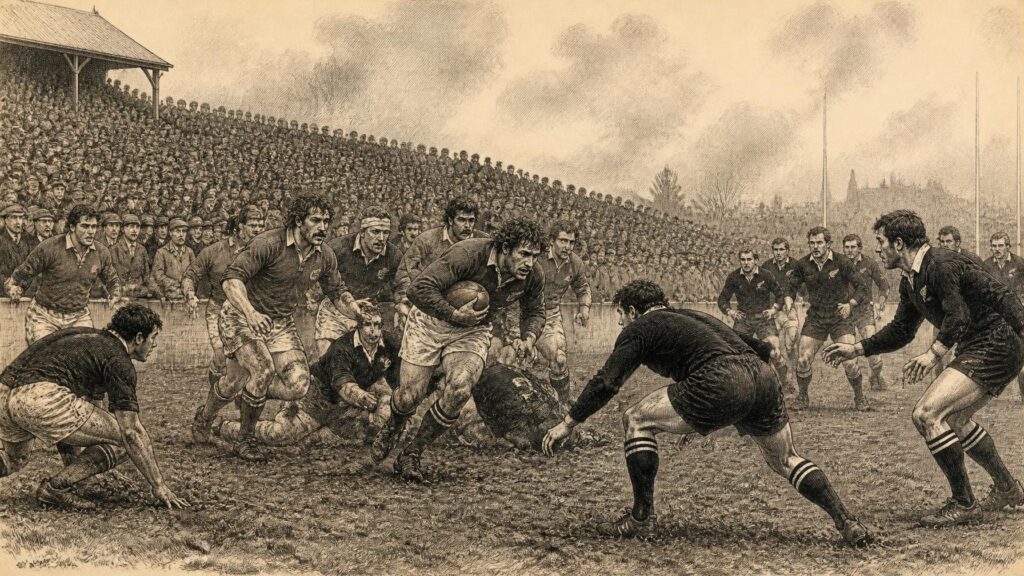
AI generated historical illustration, not a contemporary photograph.
At a Glance
On Tuesday 31 October 1978, Munster defeated the touring New Zealand All Blacks by 12 points to nil at Thomond Park, Limerick. It was the first victory by an Irish side over New Zealand, and for decades it stood alone in Irish rugby history. The score has become an emblem of provincial pride, but its force lies not simply in a celebrated upset. It arose from the particular world of amateur Irish rugby, from Munster’s long experience of meeting touring sides, and from a performance which contemporary evidence shows was composed, physical and tactically intelligent.
Touring Culture
To understand why the result acquired such force, it is necessary to recall the importance of touring teams in rugby before the modern professional age. International rugby did not possess today’s dense annual calendar, global television audience or club competitions structured around regular elite fixtures. Visits by southern-hemisphere teams were exceptional occasions. A New Zealand tour brought the most formidable name in the game to grounds which, for much of the year, hosted club and interprovincial fixtures. The visitors did not meet only national sides. They also played counties, cities, universities, invitation teams and provinces. Such matches were not exhibition fixtures in the casual modern sense. They were tests of local standing, occasions on which players who were teachers, students, civil servants, doctors, farmers and tradesmen could measure themselves against world-famous opponents.
For Munster, the touring match carried a special resonance. The province had an established rugby culture extending through Cork, Limerick and many smaller towns, rooted in schools, clubs and a strong inter-club rivalry. Yet provincial representation was not an automatic expression of a single, uniform public identity. Its players came from competing clubs and, in some cases, from institutions outside the province. A Munster selection had to be assembled and made coherent in a short space of time. That made the best touring performances feel less like routine victories and more like rare moments of collective concentration.
New Zealand’s name intensified every aspect of the occasion. The All Blacks were already rugby’s pre-eminent touring side, identified with pace, skill, fitness and an uncompromising expectation of victory. Irish rugby had known honourable defeats and close calls against them, but no Irish team had beaten them. The prospect of a provincial side doing so seemed remote. That distance between expectation and result is central to the later legend, but it should not obscure the fact that Munster’s players did not enter the match as passive witnesses to a famous visiting team. They entered it with a tradition of challenging visitors and with a coach who prepared them to make the game as uncomfortable as possible.
Provincial Foundations
Munster’s 1978 achievement had a history. The province had long regarded fixtures against touring teams as opportunities to demonstrate a rugby character distinct from, though connected to, the Ireland side. The tradition included fierce club competition, particularly between Limerick and Cork, and the conviction that a provincial jersey demanded unusual effort. Thomond Park itself was more than a convenient venue. It was a ground associated with Limerick rugby and with a crowd capable of making an afternoon fixture feel like an event of regional consequence.
The official history published by the Irish Rugby Football Union records a succession of narrow encounters with major visitors. Munster drew 3–3 with Australia in 1958, lost narrowly to New Zealand in 1963, and finally overcame Australia 11–8 at Musgrave Park in 1967 under the captaincy of Tom Kiernan. That 1967 victory made Munster the first Irish province to defeat a major touring side. A further encounter with the All Blacks at Musgrave Park in 1973 ended 3–3 after New Zealand secured a late penalty. The scoreline later acquired the quality of an almost-story: victory appeared within reach, then receded at the last moment.
These earlier matches matter because they correct the idea that 1978 emerged from nowhere. Munster had developed habits suited to tour rugby: a willingness to defend for long periods, an awareness that set pieces and kicking could compress a difference in individual talent, and an appetite for the occasion. The province had also learned that visitors could be pressed. The narrow loss to New Zealand in 1963 and the draw of 1973 were evidence of competitive possibility, not guarantees of what would follow.
There was another foundation: the playing network from which the team was drawn. The 1978 side included players associated with Garryowen, Shannon, Cork Constitution, Lansdowne, St Mary’s, Trinity and University College Cork. Such a list demonstrates the composite nature of provincial rugby. Munster was not a club team in enlarged form. It was a selection drawing strength from rival traditions, and its success depended upon players accepting a common plan quickly. The victory later fed a powerful image of provincial unity; at the time, that unity had to be created on the training field and sustained under pressure.
Autumn Challenge
The All Blacks arrived in Britain and Ireland in the autumn of 1978 on a demanding tour. Their itinerary eventually contained eighteen matches. They won seventeen. Munster was the sole defeat. That record gives the Limerick result its proper sporting scale. It was not a victory over an obscure or experimental travelling party at the end of a weary campaign. The New Zealand side was captained by Graham Mourie and contained established international figures including Bryan Williams, Bruce Robertson, Stu Wilson, Andy Haden and Frank Oliver.
Touring sides nevertheless faced pressures unfamiliar to modern national squads. Matches came close together, travel was extensive, pitches varied and local opponents treated the visitors’ arrival as the season’s defining date. The All Blacks had already beaten the Irish national side’s leading rivals on the tour schedule and were approaching a run of international fixtures against Ireland, Wales, England and Scotland. It would be mistaken to say that the match against Munster did not matter to them. The intensity of the team selected and the later testimony of New Zealand participants indicate that it mattered greatly. But it is equally fair to recognise that provincial tour matches created an asymmetry of emotional investment: for Munster, there could be no more important fixture.
The date, Halloween, helped later retellings. It supplied a dramatic frame that newspapers, players and theatre-makers have repeatedly used. Yet the historical core is plainer. On the afternoon of 31 October, some 12,000 people were officially accommodated at Thomond Park. Many more have subsequently claimed attendance. This inflation is part of the match’s folklore, usually expressed with affectionate exaggeration rather than deceit. The number of remembered spectators has become a way of saying that those who were not physically present nevertheless inherited the memory through family, club and city.
Contemporary accounts make clear that the crowd was loud and partisan. Noise at Thomond Park did not score points, but it formed part of the pressure in which every New Zealand mistake acquired consequence and every Munster tackle drew a response. The atmosphere should be treated as an important condition, not a mystical explanation. The decisive work was done by fifteen players who defended their territory and used their chances.
Careful Preparation
Tom Kiernan was central to the match. By 1978 he was already a celebrated figure in Irish rugby: a former Ireland and British and Irish Lions captain and the leader of the Munster side that had beaten Australia in 1967. His status gave authority, but the most significant feature of his role was preparation. Accounts of the occasion consistently describe a coach who studied New Zealand closely and gave his players a direct tactical brief. Munster would not try to outplay the All Blacks in every open-field exchange. They would meet them physically, restrict room, compete at set piece, kick intelligently and demand that New Zealand earn every yard.
Such an approach may sound unsurprising now, but it was tailored to the balance of the contest. New Zealand’s backs carried international pace and invention; allowing them clean, quick ball in open country would have played to their strengths. Munster therefore sought to slow the game and to turn the match into a contest of pressure. The task required discipline. A side cannot defend its own half for an afternoon through emotion alone. It needs line integrity, controlled aggression and players ready to make repeated tackles without conceding easy penalties.
The team was captained by Donal Canniffe of Lansdowne. Tony Ward, then a rapidly emerging Irish out-half, supplied direction and points. Christy Cantillon, Brendan Foley, Moss Keane, Seamus Dennison, Gerry McLoughlin, Pat Whelan, Larry Moloney and their colleagues formed a team remembered collectively, though later memory has sometimes concentrated on a handful of emblematic moments. That concentration is understandable, but it risks understating the supporting labour of the forwards, the chase after kicks, the covering defence and the unglamorous work that made a clean sheet possible.
The fact that several players had international experience did not make Munster an Ireland team under another name. It did, however, provide the selection with enough experience to understand what awaited them. The players knew the standards required. Kiernan’s contribution was to turn knowledge into a credible match plan and to persuade his side that it could be executed.
Opening Exchanges
Munster began with the requisite intensity. Later recollection has often fixed upon Seamus Dennison’s tackle on Stu Wilson as an early declaration. The tackle is documented in reports and remembered as one of the match’s most vivid incidents. Its exact dramatic colouring has inevitably deepened with repetition, as famous sporting collisions do, but the larger point is secure: Munster tackled with unusual force from the outset and made clear that New Zealand would not be permitted an easy rhythm.
The All Blacks possessed the ball-playing capacity to recover from such a start, and much of the match involved them probing for a way through. Their forwards were not overwhelmed; contemporary reporting acknowledged their work and their ability to secure possession. But possession is not the same as control. Munster’s line speed and tackle pressure narrowed options, while their kicking game made New Zealand turn and play from less favourable positions. The contest was shaped by a repeated refusal to let the visitors establish the expansive pattern for which they were feared.
Ward’s role was crucial. As an out-half, he combined distribution with the tactical obligation to judge when territory mattered more than ambition. The kick was not a surrender of possession but an instrument of pressure. A well-directed kick, chased hard, could put an opponent under a decision-making strain that open play did not. Munster’s forwards then had to sustain that pressure at the breakdown and in the set piece. This was rugby suited to the weathered, demanding conditions of provincial grounds and to the limitations of amateur preparation; it was also rugby intelligently designed for the opponent.
The match did not become a simple siege in one direction. Munster had moments when they attacked, and the score would come from one. What distinguished the performance was its balance. The home side did not chase a spectacular result at every opportunity. It remained committed to a structure which accepted that a narrow lead, if defended without panic, could be enough.
Decisive Try
The key attacking moment came when Christy Cantillon crossed for Munster’s try. In the scoring system of 1978 a try was worth four points. Ward converted it for a six-point lead. Contemporary reporting credited a movement in which Ward was brought down but supplied Cantillon, who finished the chance. Later descriptions naturally make the passage appear fated, as though the ball had travelled towards a prewritten conclusion. In reality, it was the product of a fleeting opening, individual awareness and a finishing touch taken under immense pressure.
The try mattered beyond its arithmetic. Until then, the match had been a confrontation in which Munster’s defensive intent was evident but victory remained an abstraction. Six points gave the plan a tangible reward. It forced New Zealand to consider not merely how to impose themselves, but how to retrieve a deficit against a team now convinced that its discipline was working. The crowd’s belief increased, and belief in a ground can affect the temperature of every subsequent phase.
Ward added a drop goal in each half. Under the points values of the period, each drop goal brought three points, producing the final score of 12–0. These kicks were not decorative additions. They were acts of judgement which rewarded territorial position and extended the pressure on New Zealand. A six-point lead could still be erased quickly by a converted try; a twelve-point lead, in a match where Munster’s defence was holding, created a different psychological landscape. The All Blacks needed two scores and found no route to even one.
It is tempting to narrate the score as an uninterrupted ascent towards certainty. That is not how close rugby matches work. Munster still had to absorb attacks, win restarts and resist the natural fear that accompanies a lead against a side of New Zealand’s stature. The achievement of the scoring sequence was that it provided a margin without inviting recklessness. Munster had points on the board, but did not abandon the methods that had put them there.
Territorial Battle
The nil was as important as the twelve. New Zealand teams were accustomed to finding a score, even in difficult matches. For Munster to prevent that required a full-team defensive effort. The back line had to stop breaks and cover kicks; the forwards had to contest possession and make their close-range defence count. A clean sheet against the All Blacks could not rest on one famous tackle, one refereeing decision or one fortunate bounce.
There was, inevitably, a physical edge. Rugby in 1978 was played under laws and expectations different from those of the contemporary game, and accounts from both sides describe a fiercely abrasive contest. Historical care requires avoiding two opposite errors. The first is to sanitise the match into a polite tactical exercise. The second is to treat unverified tales of mayhem as literal explanation. The evidence supports a hard, confrontational Munster display. It does not require every later anecdote to be accepted without qualification.
New Zealand created pressure, but their preferred attacking rhythm was repeatedly disrupted. The Irish Examiner’s preserved match report praised the collective defence and noted that New Zealand’s prominent backs were denied the space needed to become decisive. Such observations are valuable because they were made close to the event, before the result had accumulated decades of myth. They support the conclusion that Munster won as a team: not by a single improbable break, but by ensuring that the visitors’ individual excellence could not settle into a pattern.
One later comment attributed to Stu Wilson, that New Zealand were fortunate to finish scoreless, has become part of the story. It conveys the severity of the pressure more effectively than a statistical summary might. Whether repeated in precisely the same words on every occasion is less significant than the underlying acknowledgement, shared by former All Blacks, that Munster had made the defeat unavoidable through its performance.
Final Whistle
When the whistle ended the match, Munster had won 12–0. The immediate historical fact is uncomplicated: a provincial selection from Ireland had beaten New Zealand. The broader importance became clear almost at once. New Zealand completed the remainder of the tour with victories, including the celebrated sweep of the home unions often described as a Grand Slam. Munster remained their only conqueror in eighteen matches.
The result also stood in contrast to the subsequent Ireland–New Zealand international at Lansdowne Road. Ireland lost 10–6 on 4 November. That did not diminish Munster’s accomplishment. If anything, it reinforced the extraordinary nature of the Limerick afternoon. The national side, despite a close contest, could not reproduce it days later. Munster’s success had been shaped by its own blend of preparation, selection, ground and occasion.
For many years, the match was accurately described as the only occasion on which an Irish team had defeated the All Blacks. That statement needs dating. Ireland’s men’s national team beat New Zealand in Chicago on 5 November 2016. Munster’s 1978 success therefore no longer stands alone as an Irish victory over the All Blacks, though it remains the only such victory by an Irish provincial men’s side. Precision matters here, because historical phrases can outlive the circumstances that originally made them true.
At the moment of victory, however, no such qualification was necessary. The score represented a breach in a sporting order that had seemed immovable. It provided proof that Irish rugby, and provincial rugby specifically, could defeat the game’s most imposing opposition. That proof was invaluable in an era when rugby reputations travelled chiefly by word of mouth, newspapers, radio and the memories of those who had stood at the touchline.
Contemporary Record
The event is unusually well supported by a combination of official rugby histories, contemporary reporting and later player testimony. Munster Rugby’s historical timeline records the score tersely: “Munster 12 New Zealand 0.” The brevity is appropriate to a result which needs little embellishment. The Irish Rugby Football Union has placed it within the longer story of Munster’s encounters with touring sides, while the Irish Times and Irish Examiner have preserved detailed retrospective and contemporary-informed accounts of the players, scoring and atmosphere.
These sources establish the principal facts: the date, venue, score, coaching, captaincy, scoring sequence and the identities of the teams. They also support the wider point that New Zealand were defeated only once on their 1978 tour. They are less decisive about every colourful element repeated in later public memory. The exact words of dressing-room speeches, the precise force of every tackle, the number of supporters who claim to have attended and the dramatic timing of individual exchanges have all passed through decades of retelling.
That does not make the folklore worthless. Folklore reveals how communities use an event. The claim that vastly more people were present than Thomond Park could contain is plainly not a literal attendance figure; it is an expression of ownership. The famous stories of pre-match inspiration, of New Zealanders stunned by noise, and of a province discovering its full voice belong to the cultural history of the match. They should be presented as remembered tradition unless firmly anchored in evidence, not discarded as though only a scorebook mattered.
The distinction is especially useful in sport, where memory is both archive and performance. Players recount the same afternoon for different reasons: to honour colleagues, entertain an audience, explain a tactical choice or transmit standards to younger generations. The historian’s task is not to drain such accounts of life. It is to identify what can be documented, acknowledge interpretative judgement, and mark the boundary at which an anecdote becomes legend.
Public Memory
The public memory of 1978 has been maintained through reunions, anniversary events, books, broadcasts, memorabilia and oral retelling. The names of the players became touchstones in Munster rugby culture. For supporters, the match offered a usable past: a story of local people defeating a global sporting power through preparation, courage and solidarity. Its appeal extended beyond dedicated rugby followers because it could be told as a Limerick story and, more broadly, as an Irish story.
That process of remembrance has sometimes smoothed over tensions within the social history of rugby. Munster rugby was not socially uniform, and the province’s club structures carried differences of class, education, geography and institutional affiliation. Scholarship on Irish sporting culture has cautioned against treating Munster as naturally or universally classless. The 1978 team’s mixture of clubs is meaningful, but it should not be converted into a simplistic claim that rugby erased all social distinctions.
What can be said is that the victory supplied an unusually powerful occasion for identification across those distinctions. The team represented a province in a conspicuous international encounter, and the result made that representation feel earned rather than ceremonial. In later decades, as Munster developed into a major force in European professional rugby, 1978 became a foundational reference point. It offered precedent: the conviction that a side from the province could confront opponents who appeared richer, more celebrated or more technically favoured.
The danger of any foundational story is that it becomes too neat. Munster’s later successes arose in different conditions, with professional contracts, enlarged stadiums, European competitions and global media. They cannot be explained as simple descendants of one amateur-era afternoon. Yet the earlier victory supplied a language of resistance and expectation which later generations could invoke. In that sense its influence was cultural rather than mechanically causal.
Cultural Afterlife
The match entered the arts most conspicuously through John Breen’s stage comedy Alone It Stands. The title itself captures the mythic status of the result: one scoreline, one afternoon and one achievement apparently isolated in the landscape of Irish rugby. The play did not function as a documentary transcript. It used humour, caricature and collective memory to celebrate the event, demonstrating that sporting history can be remade for audiences who may never have seen a minute of the original contest.
Its popularity is historically revealing. Audiences were not drawn only by a technical interest in line-outs or drop goals. They recognised a drama in which local confidence confronts external authority. The All Blacks were formidable precisely because they were famous; Munster’s victory was satisfying precisely because it seemed, beforehand, beyond ordinary expectation. Theatre made room for exaggeration, but it also preserved the central truth that an amateur provincial side had won through a startlingly disciplined performance.
Books and documentaries have performed a related role. They have recorded players’ voices and retained details which newspapers alone might not preserve. At the same time, commemorative forms naturally privilege a coherent narrative. They look for a defining tackle, a decisive speech and a symbolic hero. The historian should appreciate that process without confusing it with complete explanation. A famous match becomes memorable because people continue to find meanings in it; the meaning is not exhausted by the final score, but neither should it obscure the score’s documented foundations.
The enduring phrase “Munster 12, All Blacks 0” works almost like a place-name or a date. It can be said without further explanation in rugby circles. That shorthand is the mark of a successful communal memory. It compresses a detailed sporting event into a shared reference while leaving room for each listener’s inherited version of what it meant.
Historical Meaning
The historical significance of the match lies in three connected areas. First, it was a sporting achievement of exceptional rarity: the only defeat suffered by New Zealand on an eighteen-match tour, delivered by a provincial side in Limerick. Second, it crystallised a tradition of Munster competitiveness against touring teams, converting earlier near-successes into an unambiguous victory. Third, it became a durable story through which the province could describe itself.
Interpretation should not turn that story into inevitability. Munster were not destined to beat the All Blacks because of geography, crowd noise or inherited toughness. They won because a particular group of players, coached by Kiernan, carried out a coherent plan on a particular afternoon and took the chances available to them. New Zealand’s failure to score was as much an achievement of organisation as of passion. Ward’s twelve-point contribution, Cantillon’s try, the forward effort and the defensive discipline each belong in any serious account.
Nor should the victory be used to diminish the quality of the All Blacks. Its value depends on the strength of the opposition. New Zealand went on to defeat every other opponent on the tour and to complete victories over the four home unions. The fact that such a side lost at Thomond Park is what made the result astonishing; the fact that it lost 12–0 is what made the performance unforgettable.
Sporting history is sometimes dismissed as a succession of results with no wider importance. That is too narrow. Matches can reveal how communities organise memory, status and belonging. The 1978 victory illuminates amateur rugby culture in Ireland, the continuing importance of the province, the relationship between local ground and international spectacle, and the manner in which performance becomes legend. It is a small event in world political history, but a major one in the historical life of Munster.
Enduring Legacy
Nearly half a century after the final whistle, the result remains both historical record and living inheritance. It is recalled at Thomond Park, in clubhouses, at reunions and whenever Munster face a supposedly superior opponent. Its survival is not based solely on nostalgia. The match has endured because the basic facts remain remarkable and because the story continues to reward retelling without requiring invention.
For Emerald Archives, the proper conclusion is not that Munster somehow performed the impossible. In sport, improbable outcomes happen when preparation, opportunity and composure coincide. Munster’s players met an outstanding New Zealand side, denied it rhythm, scored efficiently and defended their lead with resolve. Their victory was extraordinary, but it was made rather than bestowed.
The folklore should be cherished as folklore: the impossible attendance, the thunderous ground, the speeches repeated in ever finer form, and the claim that every household in Munster had a witness. The documented event is strong enough without them. On 31 October 1978, at Thomond Park, an amateur provincial team defeated the All Blacks 12–0. The score remains a compact statement of one of the most resonant achievements in Irish sporting history.

Munster’s 12–0 victory is compelling not only because it upset New Zealand, but because the article presents it as a carefully constructed performance later enlarged into civic memory. The tension between documented discipline—defence, kicking, preparation and collective labour—and memorable anecdotes raises questions about how sporting communities preserve meaning without losing historical texture. Earlier narrow contests and the 2016 Irish win also place the match within a longer story of changing possibility. How should supporters and historians balance tactical evidence, personal recollection and provincial identity when interpreting why this amateur Munster selection’s victory continues to matter so powerfully across Ireland today?