

Sallins Memory
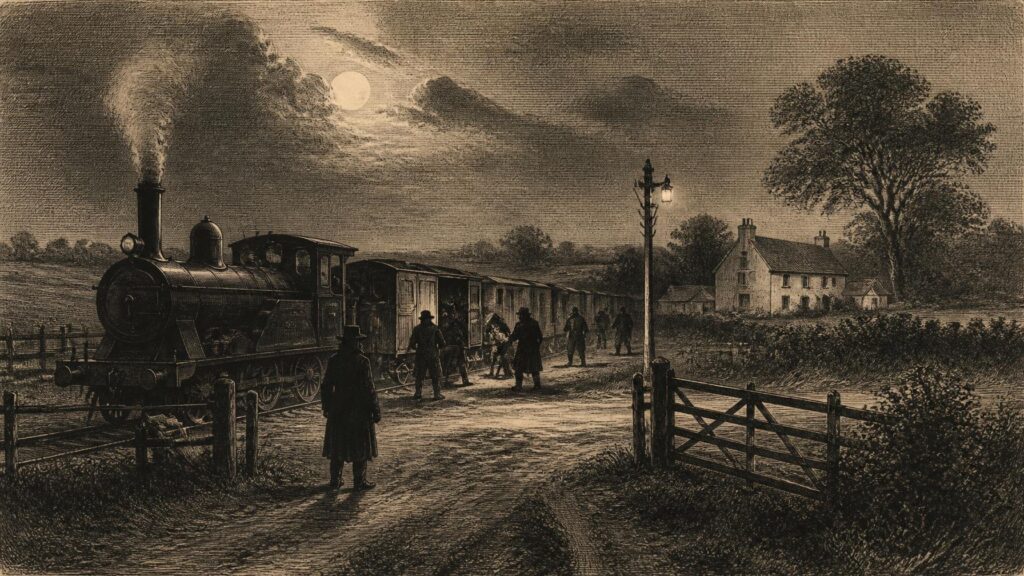
AI generated historical illustration, not a contemporary photograph.
At a Glance
The Sallins train robbery remains in Irish memory not merely because armed men stopped a night mail train and took a remarkable sum of money, but because the investigation that followed became inseparable from a long argument about policing, confession, courts and the limits of State power. The robbery was real; the money was stolen; yet the convictions of men associated in public memory with the crime did not endure in the same way. That distinction is the beginning, rather than the end, of its history.
The Robbery
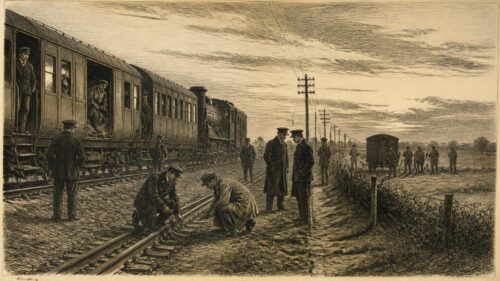
In the early hours of 31 March 1976, a Cork-to-Dublin mail train was stopped in the railway country of north County Kildare, near Hazelhatch and the roads leading towards Celbridge. The incident became known almost immediately as the Sallins train robbery, although the popular name was more convenient than geographically exact. Such naming is common in public memory: a nearby railway station or familiar village becomes the durable shorthand for a landscape of fields, crossings, sidings and roads.
The initial contemporary account published by The Irish Times conveys the scale and choreography of the offence. A gang, reported as numbering about twelve, used a red light and detonators to bring the train to a halt. Armed participants controlled the driver, guards and postal workers while registered mailbags were taken from the travelling post. A van had been stolen earlier, and a household close to the line had been invaded and its occupants held at gunpoint. The stolen property consisted principally of banknotes being transported from Cork banks to Dublin, along with postal orders and other valuables. The eventual figure most often attached to the raid is about IR£200,000.
That sum was formidable in 1976. It helped turn the crime into instant national news and encouraged comparisons with the celebrated British train robbery of 1963. Yet those comparisons can obscure the distinctive Irish setting. The robbery occurred during the most difficult decades of the Northern conflict, when the Republic faced violence, political anxiety and intense pressure upon its security institutions. A violent theft of cash from a train could not be treated simply as ordinary acquisitive crime. Suspicion immediately travelled through the political categories of the time.
It is important to retain the basic documented fact. An organised armed gang did rob the mail train, and the stolen money was not recovered. The case was therefore never an invented scandal or a miscarriage arising from a crime that had not happened. The enduring historical issue is different: whether the persons selected, questioned and convicted in the aftermath were responsible, and whether the State’s methods produced evidence capable of sustaining justice.
Political Weather
The Republic of Ireland in the mid-1970s was not insulated from the conflict in Northern Ireland. The State confronted paramilitary activity, cross-border security fears and public concern over politically motivated violence. The Special Criminal Court, a non-jury court provided for under the Offences against the State legislation, had been re-established in 1972. Its rationale was that ordinary courts might be inadequate to secure the effective administration of justice in exceptional circumstances, including intimidation of jurors.
This legal framework formed the atmosphere in which Sallins was investigated and tried. It did not predetermine the result, nor does its existence prove wrongdoing in an individual case. But it mattered profoundly. The Special Criminal Court concentrated fact-finding in the hands of judges rather than a jury and operated within a security-centred political culture. When the case later became emblematic, critics saw it as evidence of how emergency institutions could make an already unequal encounter between detainee and police more consequential. Defenders of the State’s approach emphasised the genuine threat environment in which detectives and prosecutors were operating.
Several of the men arrested after the robbery were members of, or associated with, the Irish Republican Socialist Party. That fact gave the investigation a political charge beyond the robbery itself. The IRSP had been founded only recently and was linked in the public mind with the Irish National Liberation Army, though political membership, sympathy and participation in a particular criminal act were plainly different matters. The danger for historians is to allow later political reputations to fill gaps in the evidence. The contemporary State, press and public did not always make that separation easily.
Later accounts have stated that the IRA publicly accepted responsibility for the robbery in 1980. That declaration is historically relevant because it altered the political context in which the prosecutions were remembered. It was not, however, a judicial determination identifying every participant or resolving the crime. A claim of responsibility by an organisation, especially one emerging years after the event, must be treated as evidence of political history and public controversy, not as a complete substitute for a tested criminal investigation.
Arrests Interrogations
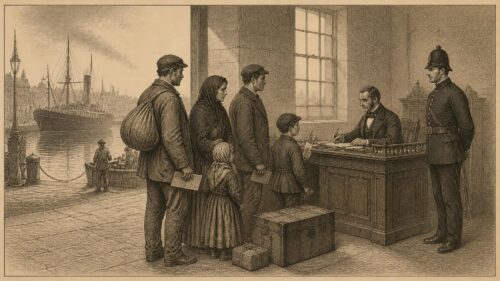
Within days of the robbery, Gardaí undertook a wide operation. Contemporary and archival material indicates that many people were detained under section 30 of the Offences against the State Act 1939. The names most centrally associated with the subsequent saga are Osgur Breatnach, Brian McNally and Nicky Kelly, together with John Fitzpatrick, Michael Plunkett and Michael Barrett. The scale of the arrests matters. It shows an investigation pursued under extraordinary statutory powers and amid a broad search for political and criminal connections.
The central evidential question quickly became the statements obtained during detention. Breatnach, McNally, Kelly and others alleged that they had been assaulted, threatened, deprived of sleep or otherwise subjected to oppressive interrogation in Garda custody. Garda witnesses denied mistreating the men. At later hearings, the State case included the contention that injuries visible on some detainees were self-inflicted or caused by accomplices. These were not minor discrepancies about recollection. They went to the reliability and admissibility of the statements on which the prosecutions depended.
Historical writing must not collapse allegation into proof. It is supportable to say that detainees made serious allegations of physical and psychological mistreatment, that Gardaí contested those allegations, and that courts at different stages reached very different legal conclusions about the resulting statements. It is less supportable to announce, without qualification, a settled finding that every named detective committed a particular assault. The surviving public record is shaped by contested testimony, litigation, journalism and campaigning as well as by judicial rulings.
Nonetheless, the condition of the detainees and the methods of interrogation were never peripheral matters. They were the substance of the case. The later Court of Criminal Appeal decision concerning Breatnach and McNally did not merely identify a procedural technicality; it found that their statements were not legally admissible. In a prosecution that relied overwhelmingly on admissions, the consequences were decisive.
The label “Heavy Gang” became attached in public discourse to detectives alleged to have used coercive methods in a series of cases. The phrase has acquired almost folkloric force, but it requires care. It was a contested contemporary description, not the formal title of an established Garda unit. Its use points to a pattern alleged by detainees, lawyers, journalists and civil-liberties advocates; it should not be used as a shortcut that dispenses with the particular evidence of each case. Sallins was important precisely because it helped carry those allegations from rumour and partisan argument into the centre of national debate.
Trial Collapse
The legal proceedings became extraordinary even before a conviction was obtained. The first major Special Criminal Court trial began in January 1978. It became exceptionally lengthy and was later abandoned after the death of one of the three judges, Circuit Court Judge John O’Connor. The judicial collapse required the prosecution to begin again, adding cost, delay and public strain to a case already dominated by concerns over the voluntariness of confessions.
The episode also generated one of the most enduring and disturbing elements of Sallins memory: allegations that Judge O’Connor had appeared to sleep during hearings. Defence lawyers, defendants and observers raised concerns. The court rejected the claim that it was unable properly to continue, and the effort to halt the proceedings did not succeed before the judge’s death. Later retellings understandably dwell on the image of a judge apparently dozing while evidence in a major criminal trial unfolded. It is a powerful symbol, but its symbolic power should not replace precision. The allegation was disputed within the legal process; the trial ended because of the judge’s death, not because a court formally accepted that he had slept through evidence.
Yet symbols can reveal why a case survives in collective memory. The sleeping-judge episode came to stand for an impression, widely held by campaigners, that institutions were willing to proceed despite obvious signs of failure. For others, it was a tragic and unusual episode involving an unwell judge, later exaggerated into a complete explanation of the case. Both interpretations circulated. What is documented beyond dispute is that the first trial did not produce a final verdict and that a second trial followed.
The collapse also illustrates the difference between a courtroom record and public confidence. Courts may decide questions by rules of evidence and procedure; citizens judge legitimacy through what they see, hear and remember. The longer the case continued, the more the public story enlarged beyond the original robbery. It became a drama about police conduct, legal representation, judicial capacity and the human endurance of those accused.
Second Trial
At the second Special Criminal Court trial, Michael Plunkett was acquitted. Osgur Breatnach, Brian McNally and Nicky Kelly were convicted in December 1978. Breatnach received twelve years’ penal servitude, McNally nine years, and Kelly twelve years. Kelly was tried in his absence after leaving the jurisdiction during the proceedings. The convictions rested fundamentally on statements said to have been made to Gardaí; the accused maintained that those admissions were not voluntary and that they had no part in the robbery.
For the court at that point, the confessions were admissible. The court rejected the defence account of coercion and accepted Garda evidence. That was the legal position when sentence was imposed, and it must be acknowledged in any historical account. A later acquittal or pardon does not make it accurate to pretend the original court never heard evidence or gave reasons. Rather, Sallins demonstrates how grave a difference can arise between a trial court’s assessment and a later appellate assessment of the same fundamental evidential problem.
The trial’s non-jury character has remained central to criticism. It is impossible to know whether a jury would have reached a different result, and historians should not claim certainty on that counterfactual. Nor was the Special Criminal Court unique to Sallins. But the case gave tangible form to objections that had often been expressed in general terms: that exceptional courts may magnify the importance of police testimony and contested statements, while placing defendants at a particular distance from ordinary civic participation in criminal justice.
The record also reminds us that a confession is not inherently unreliable merely because it is a confession, nor inherently reliable because it contains details. The law asks whether it is voluntary and whether it was obtained in circumstances compatible with fairness. In a period before modern safeguards such as routine audiovisual recording of Garda interviews, reconstructing the atmosphere of an interrogation depended heavily on conflicting accounts. That limitation made courts vulnerable to a stark choice between police and detainee testimony. Sallins became a warning about the risks of resolving that choice too readily.
Appeal Release
In May 1980, the Court of Criminal Appeal quashed the convictions of Breatnach and McNally. RTÉ’s contemporaneous television report records the significance of the decision: the court held that their statements to Gardaí were not legally admissible, and the two men left Portlaoise Prison after approximately seventeen months of imprisonment. The decision did not establish that no robbery occurred. It established that the admissions on which these particular convictions depended could not lawfully support them.
This is the pivotal documented event in the history of Sallins. It transformed what had seemed a successful prosecution into a major controversy over wrongful conviction. It also left difficult questions. Why had the trial court accepted the statements? What precisely had occurred in custody? Why had safeguards failed to prevent the disputed evidence from reaching a conviction? The appellate result did not answer every question in historical or moral terms, but it made it impossible to regard the case as straightforwardly closed.
Kelly’s position was more complicated. Because he had been tried in absence, his appeals followed a different course. He returned from the United States after Breatnach and McNally were released, but did not obtain the same immediate result. His conviction survived the appellate process at that stage, and he was imprisoned until 1984. The contrast became central to the public campaign: two co-accused had been freed because the statements were inadmissible, while Kelly remained subject to a sentence founded in the same troubled prosecution.
In 1992 President Mary Robinson granted Kelly a presidential pardon. The National Library of Ireland’s description of papers relating to the campaign records the pardon and subsequent compensation. A pardon is legally and historically significant, but it is not identical in every respect to an appellate quashing of a conviction. That distinction has contributed to later disagreement about the exact language through which the State should acknowledge what occurred. To campaigners, the pardon confirmed that Kelly should never have borne the stigma and punishment. To legal historians, it also exposes the uneven routes by which Irish law has addressed miscarriages of justice.
Kelly Campaign
The “Free Nicky Kelly” campaign turned Sallins from a courtroom story into a national civic cause. It drew support from civil-liberties activists, lawyers, trade unionists, journalists, local representatives and artists. Its effectiveness rested partly on the evident incongruity in Kelly’s position after Breatnach and McNally had been released. It also rested on a wider Irish and international concern about emergency laws, police powers and the treatment of political suspects during the Troubles.
Campaign material, songs, public meetings and graffiti made the case visible in streets and homes well beyond County Kildare. Such material is sometimes dismissed as propaganda, but it is also historical evidence. It reveals how citizens outside official institutions made an argument about justice. Campaigners selected images that could be readily understood: a train robbery, bruised men, a non-jury court, a sleeping judge, a prisoner who remained jailed when co-accused had been freed. The simplification involved in public campaigning should be recognised, but so should its democratic function. Without the campaign, the case might have been remembered as an obscure appellate anomaly rather than a lasting issue of national conscience.
The campaign’s language frequently treated the men as wholly framed and the prosecution as a deliberate State conspiracy. Some aspects of that language went beyond what a court had formally found. Its force came from moral conviction and lived experience rather than the cautious vocabulary of legal judgments. Historians need not adopt every campaign claim in order to recognise that activism helped preserve records, connect families with legal and international support, and sustain pressure for reconsideration.
It also shaped the subsequent careers and identities of those involved. Nicky Kelly later entered local and electoral politics. Osgur Breatnach continued to seek acknowledgment and accountability. Their persistence illustrates a feature of wrongful-conviction history often missed in accounts focused solely on verdicts: release ends imprisonment, but it does not necessarily end anxiety, damaged reputation, lost years or conflict with the State’s official account.
Public Memory
Memory of Sallins has been maintained by several forms of evidence rather than by one definitive archive. Newspaper reports preserve the urgency of the robbery’s first hours. RTÉ news film preserves the moment Breatnach and McNally left court in 1980, as well as later reporting on civil proceedings. The National Library of Ireland holds papers concerning Nicky Kelly and campaign material. Books, documentaries, radio programmes, plays and press investigations have supplied interpretation and personal testimony.
Each medium creates a different Sallins. The newspaper version is a crime story: red lamps, detonators, stolen mailbags, a hijacked van and a large missing sum. The courtroom version is a legal story: custody, admissibility, appeals, judicial findings and pardon. The campaign version is a story of injured men confronting entrenched institutions. The documentary version foregrounds memory, trauma and family testimony. No single version should automatically be mistaken for the whole.
Folklore grows where official explanation is incomplete. The case has accumulated anecdotes, sometimes repeated with increasing certainty: exact descriptions of interrogations, claims about particular detectives, stories of money, alleged intelligence failures and accounts of political intervention. Some may be rooted in truth; others may be distorted by repetition. A responsible history should identify the process rather than reproduce every tale. The fact that people continue to tell such stories is itself evidence of unresolved trust, but it is not proof of every detail contained within them.
Even the name “Sallins” performs this work of memory. It condenses a dispersed set of places and events into one word: the Kildare railway line, Garda stations in Dublin, Portlaoise Prison, the Four Courts, campaign meetings and private homes. Place-name memory makes the incident easier to carry, but it can also conceal the extent to which the case was national. Sallins was never solely a local story.
Historical Meaning
The greatest historical significance of the case lies in its challenge to the belief that legal process automatically corrects investigative error. In Sallins, the original convictions were rendered unstable not by the discovery that the train robbery was fictitious, but by the legal failure of the statements used to connect particular men to it. That distinction makes the case especially instructive. Serious crime produces powerful pressure for a solution; the legitimacy of the solution depends on the means by which it is reached.
It is also a history of institutional sequence. Garda interrogation was followed by prosecution; prosecution by adjudication; adjudication by appeal; appeal by campaigning; and campaigning by a pardon and settlement. At each stage, an institution could be understood as responding to what preceded it. Yet the cumulative sequence created a public impression that no institution had adequately addressed the entire chain. This is why calls for an independent inquiry have persisted even after convictions were quashed, compensation was paid and decades passed.
There is a broader Irish context. Sallins is commonly discussed alongside other alleged miscarriages of justice from the 1970s and 1980s, including cases in which disputed admissions played a central role. Such comparisons should be made carefully. They can illuminate common concerns about detention safeguards and police culture, but they must not erase the specific people, charges and evidential records involved in each case. The value of comparison lies in asking whether recurring weaknesses existed, not in assuming that all controversial prosecutions were identical.
The development of custody safeguards in later decades gives Sallins further relevance. Modern oversight mechanisms, legal access and recording practices do not retrospectively settle what happened in 1976. They do, however, show that the risks exposed by disputed confession cases were widely recognised as requiring stronger protections. Historical significance often lies in this practical afterlife: a case changes not only opinion but expectations about what a lawful investigation should look like.
Unanswered Questions
As of 2026, the case has not received the comprehensive public inquiry sought by campaigners and supported by some civil-liberties voices. In parliamentary discussion during 2026, the Minister for Justice stated that he did not consider a public inquiry warranted. This is an important present fact, but it should not be confused with a finding that every question has been answered. A refusal to establish an inquiry is a policy decision, not a complete historical adjudication.
Several questions remain difficult. Who precisely carried out the robbery? What became of the money? What was the full basis on which the men were selected as suspects? How should conflicting accounts of detention be assessed after half a century, when witnesses, records and institutional memories may be incomplete? Why did the legal system produce different outcomes for accused men arising from the same core investigation? And what form of acknowledgment, if any, would be adequate for those whose convictions were overturned or pardoned?
Not every historical question can now yield a conclusive answer. Evidence decays, memories alter and some records may never have existed in accessible form. That is not a reason to replace evidence with certainty. It is a reason to distinguish clearly between what is documented, what is strongly inferred and what remains unknowable. The documents establish the robbery, the prosecutions, the 1980 quashing of Breatnach and McNally’s convictions, Kelly’s later pardon, compensation settlements and continuing public controversy. They do not provide a universally accepted final account of every interrogation or identify, through an uncontested judicial process, all who robbed the train.
Memory Ethics
To remember Sallins well is to resist two temptations. The first is sensationalism: treating the case solely as Ireland’s dramatic train robbery, with masked men, detonators and vanished cash. The second is simplification: treating the later miscarriage solely as a morality tale in which every uncertainty has already been resolved. The evidence supports a more demanding conclusion. A grave armed crime occurred. Men were convicted in a process later found incapable, at least in crucial respects, of sustaining those convictions. One of them required a long campaign and a presidential pardon before his case received an exceptional form of redress.
That is enough to make Sallins a major Irish historical subject. Its value is not confined to legal specialists or to the families involved. It concerns the relationship between security and liberty in a democratic State; the authority accorded to confessions; the vulnerability of people held in custody; the consequences of exceptional courts; and the persistence required when formal justice does not command public confidence.
Memory, finally, should not be mistaken for mere commemoration. It can be an act of scrutiny. The surviving archive does not allow historians to speak with complete certainty about every allegation made in the case. It does require them to confront an unmistakable fact: the State’s original answer to a spectacular robbery was later shown to have failed some of the people it punished. That failure explains why, fifty years after the train was stopped in County Kildare, Sallins remains a living name in Irish history.

Sallins illustrates how a documented crime can become inseparable from debates about confession evidence, emergency justice and public confidence in institutions. The article carefully distinguishes unresolved allegations concerning interrogation from the established fact that key statements were later ruled inadmissible. It also shows how campaigning, journalism and television transformed legal proceedings into a lasting collective memory, particularly through Nicky Kelly’s different route to a pardon. The case invites comparison with other Troubles-era prosecutions where exceptional powers shaped evidential disputes. How should Ireland balance legal distinctions, personal testimony and public memory when assessing the long-term legacy of cases such as Sallins?