

Irish Carriages
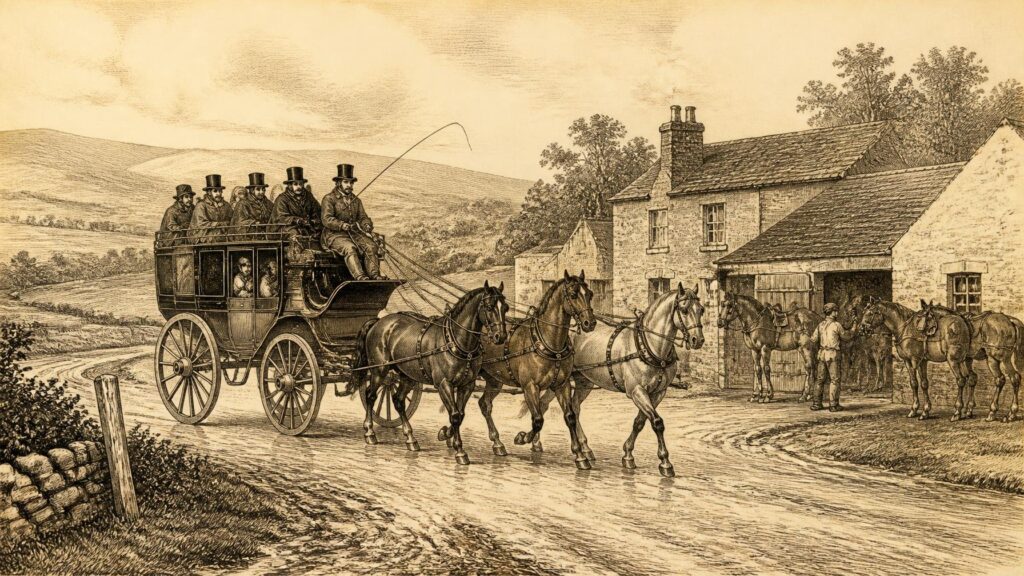
AI generated historical illustration, not a contemporary photograph.
At a Glance
For more than two centuries, the carriage was not merely a vehicle in Ireland: it was an infrastructure of everyday life. It carried landlords and labourers, mails and market goods, visitors and emigrants, policemen and politicians. Its wheels connected villages to fairs, provincial towns to Dublin, railway stations to remote districts, and urban streets to a constantly changing hierarchy of work, wealth and mobility. The history of Irish carriages is therefore not a decorative sideline to the history of roads. It is part of the history of social relations, commerce, administration, tourism and technological change.
Changing Meanings
The word “carriage” can mislead if treated as the name of one fixed object. In Irish historical usage it might mean a privately owned four wheeled coach, a public stagecoach, a mail coach, a light jaunting car, a sidecar, a cab, a cart adapted to carry passengers, or a long road car carrying people and parcels. The distinction between carriage, car, coach and cart was not always rigid. Contemporary observers often used “car” for hired passenger vehicles, while a household of rank might speak of its “carriage”. A vehicle’s social meaning depended upon who owned it, who sat where, how many horses drew it, which road it used, and whether its purpose was business, ceremony, recreation or necessity.
This variety matters because Ireland’s transport history was not simply a delayed version of English transport history. Roads, settlement patterns, seasonal fairs, dispersed rural populations and the political relationship with Britain all shaped travel differently. The island possessed coaches on principal routes and fashionable vehicles in cities, but much local movement depended upon adaptable, comparatively light horse drawn cars. The familiar Irish jaunting car, with passengers arranged sideways and facing outward, was one such adaptation. It was practical, highly visible and later became a powerful image of Irishness. Yet that later image should not obscure its original place in an uneven and often uncomfortable transport system.
Surviving sources favour the people and institutions most likely to leave records: road trustees, postal authorities, city corporations, commercial proprietors, travellers, newspapers and wealthy owners. They reveal routes, fares, regulations and striking vehicles more readily than they reveal the experience of a farm labourer walking beside a cart, a woman carrying produce to market, or a driver sleeping in a stable loft. Historians must therefore be cautious. The carriage is richly documented, but its history should not be mistaken for a complete history of how everyone travelled.
Road Conditions
Before regular coach travel could become dependable, roads had to permit wheeled travel at all. Earlier routes might be ancient in origin, but antiquity did not guarantee a surface suitable for a loaded coach. Roads could be rutted, narrow, steep, badly drained and difficult after rain. Fords, timber bridges and later stone bridges were decisive points in a journey. In mountainous or boggy districts, a few miles could take far longer than the same distance on a maintained route. For much of the population, walking, riding, packhorses and local carts remained more useful than expensive passenger conveyances.
The eighteenth century brought significant improvement to the main road system. Turnpike legislation, beginning on important Irish routes in 1729, made it possible to finance and manage selected roads through tolls. This did not create an equal network across the country, nor did it solve every problem of maintenance. It did, however, encourage the development of routes linking Dublin with major towns and ports. Better roads made the movement of mail, passengers, livestock and goods more predictable. They also made visible a new roadside economy of tollhouses, inns, smithies, stables, coach offices and places where horses could be changed.
A road fit for a carriage was a complex achievement. It required surveying, drainage, bridges, stone, labour, toll collection and continuing repair. The journey itself depended on an even wider system: horses with sufficient strength and condition, harness, wheels, skilled drivers, fodder, accommodation and a timetable that could survive weather and breakdowns. A coach could travel only as reliably as the weakest link in this chain. The romance later attached to coach travel—the horn, the flashing harness, the crowded inn yard—should not conceal its dependence on hard physical work by road labourers, ostlers, grooms, blacksmiths and drivers.
Road improvement also altered perceptions of distance. A town that had once seemed remote could become a practical destination for a market day, court sitting or business appointment. Still, “improvement” was relative. A route could be admirable by contemporary Irish standards while remaining rough, slow or hazardous to a traveller accustomed to the best English roads. The gains were concentrated on better served corridors. Many localities remained dependent on minor roads and local conveyances, and the contrast between a fast mail coach route and a difficult cross country journey could be dramatic.
Urban Hire
Dublin provides especially clear evidence of the carriage as a regulated urban service. Hackney coaches, hired for journeys within and around the city, were officially regulated from 1703. Their number was limited, and rules extended even to the height of the horses drawing them. Such measures show that civic authorities regarded hired transport as a matter of public order, street management and commercial oversight rather than simply private enterprise. Coaches occupied road space, required stands, attracted disputes over fares and could not be separated from the crowded life of a growing capital.
The city contained a broader ecology of conveyance than hackney coaches alone. Ask About Ireland records that Dublin had one horse “Ringsend Cars” serving the route from the centre to the then popular sea bathing area at Ringsend. Sedan chairs also remained important. In 1771, 400 sedan chairs were licensed in Dublin compared with 300 carriages, a useful corrective to any assumption that wheels had already displaced older forms of urban transport. A chair could be useful in narrow, busy or poorly surfaced streets, and it required neither stabling nor a place to turn horses.
These numbers illuminate social distinctions without making them absolute. A private carriage proclaimed household resources: horses, coachman, premises, maintenance and leisure. A hired coach made occasional mobility available to those who could pay. A sedan chair offered another form of paid access. Walking remained the ordinary means of movement for most people. The road and street brought these groups into close proximity. A grand coach might pass a chair, a cart, a delivery dray, a drover and pedestrians in the same congested space. Carriage traffic thus made inequality visible, audible and sometimes dangerous.
Urban carriage culture was also gendered and ceremonial. A vehicle could offer respectability and protection from mud, weather and intrusive attention; it could also restrict movement through cost and convention. Funerals, weddings, official processions, theatre visits and calls all used conveyances to communicate status. Newspaper reports and visual images naturally favoured the spectacular procession, but the more ordinary cab journey was historically significant as well. It made cities workable for visitors, commercial travellers, officials and residents who could not keep a private vehicle.
Roadside Labour
Every carriage journey was powered by animal labour. Horses were not an incidental detail but the central energy source of the system. Their purchase, feeding, shoeing, veterinary care and replacement determined the price and reliability of travel. Long journeys required changes of horses at stages, frequently associated with inns and extensive stabling. The stage was both a technical necessity and a social place: passengers ate, waited, exchanged news and watched fresh animals harnessed while drivers and ostlers managed the next departure.
The surviving description of Leixlip as a staging point on the Dublin to Galway mail route illustrates this dependence. Horses used by the stagecoach operator James Hartley were changed in the substantial stables on Main Street before the coach continued westward. Such sites joined national movement to local employment. A stable needed labour and supplies; an inn needed food, drink, bedding and customers; nearby trades could repair wheels, leatherwork and iron fittings. The carriage road was therefore a channel through which money and information entered towns as well as a route through which travellers left them.
Drivers possessed practical knowledge that rarely survives in full: the temper and pace of particular horses, dangerous corners, water crossings, gradients, likely delays and the manners of passengers. In popular memory the jarvey, the driver of a hired car, became a comic or colourful figure. Some jarveys were certainly noted for talk, local knowledge and performance before visitors. But the stereotype should not be allowed to replace the occupation. Driving required judgement, physical endurance and responsibility for people, animals and valuable goods. A driver’s apparent ease was often the product of experience.
Carriage work was not limited to passenger transport. Carts and vans carried milk, produce, parcels, building materials and commercial goods. A town’s “carman’s stage”, where travelling carters could obtain meals, lodging, oats and stabling, demonstrates the overlap between passenger and freight worlds. This was an economy of relatively small loads moving repeatedly rather than only grand coaches on formal schedules. It linked rural producers to markets and shopkeepers to suppliers. In a pre railway landscape, its rhythm influenced the practical geography of trade.
Public Coaches
By the later eighteenth century, stagecoach routes connected many of the more important Irish towns with Dublin. Mail coach services began in 1789 after the creation of a separate Irish Post Office in 1784. The mail coach combined state communication with passenger travel, lending timetables and routes a special importance. It accelerated correspondence where it ran, but it did not make all travel cheap or dependable. On roads without mail services, travellers might still depend on post chaise proprietors, local carriers or their own arrangements, with consequences for cost, comfort and safety.
The public coach was a vessel of social mixture, though not social equality. Seating was priced and ranked. Inside passengers were more protected from rain and road dirt; outside passengers endured exposure but sometimes paid less or enjoyed better views. Luggage was limited by space and by the need to balance a vehicle. The journey’s character changed with the season. In winter, a route could become a contest with darkness, mud and cold. In summer, dust and heat brought different discomforts. Claims of speed should always be read alongside these conditions.
Carriage travel also brought Ireland’s uneven development into sharp focus. A mail coach could bind a provincial centre to Dublin while neighbouring settlements remained difficult to reach. Its route expressed priorities of administration, commerce and communication. It did not necessarily follow the routes most useful to every local community. This limitation created an opening for more flexible services that connected market towns and cross roads rather than concentrating solely upon the capital.
It is tempting to treat the stagecoach as an uncomplicated symbol of progress. It did improve regularity on major routes, but it depended on tolls, fares and roads funded and governed in ways that could burden local people. The same road might serve a mail coach, a landlord’s carriage, soldiers, police, market traffic and a tenant bringing produce. Its meaning changed according to the traveller. Mobility was never distributed evenly, and the ability to pay for speed was itself a social advantage.
Jaunting Cars
The jaunting car became the carriage most strongly associated with Ireland. In its familiar outside form, it had two long lengthwise seats, with passengers facing outward to either side. Their feet rested upon boards, while the driver occupied a raised front seat on some examples. The body was mounted on springs over two wheels. This arrangement provided a compact, comparatively light passenger vehicle suited to hiring and to roads where a larger coach could be less convenient. It also made passengers unusually exposed—to scenery, conversation, rain, mud and public view.
The design was not simply a picturesque curiosity. It represented an answer to particular transport needs. A two wheeled car could be cheaper to maintain than a large coach, needed fewer horses, and could negotiate routes beyond the most heavily developed roads. Its outward facing seating made it easy to take up or set down passengers and to carry luggage in the central well. In the nineteenth century, people of means could hire jaunting cars for journeys that were beyond walking distance but not served by a regular coach. Visitors encountered them as practical local transport before they encountered them as a tourist emblem.
Descriptions of the jaunting car are often coloured by outsiders’ amusement or discomfort. A traveller might marvel at the driver’s handling of a horse, complain about exposure to weather, or treat the arrangement of the seats as evidence of national character. Such accounts are valuable, but they are evidence of the observer as well as of the vehicle. They should not be accepted uncritically as portraits of Ireland. The same car could be a livelihood for a driver, an affordable hire for one passenger, an uncomfortable necessity for another, and an exotic spectacle for a visitor.
The “Swinford car” described by John Barrow during an 1835 journey in the west shows the spectrum from formal coach to improvised local conveyance. His hired vehicle was essentially a cart with high wheels and little protection, and he travelled close behind the horse at a very slow pace. The description is not evidence that every rural passenger journey was identical. It does, however, preserve an important truth: road transport included makeshift and uncomfortable forms that stood far from the polished image of the fashionable carriage.
Bianconi Network
No figure is more closely linked to Irish carriage history than Charles Bianconi. Born in Lombardy in 1786, he arrived in Ireland as a young man and established himself first as a travelling print seller. His journeys gave him direct knowledge of the difficulty of moving between smaller towns. In July 1815 he began a scheduled passenger, goods and mail service between Clonmel and Cahir using a one horse, two wheeled car. The route was modest, but the idea was consequential: regular, lower cost transport could be organised across routes not adequately served by established coaching networks.
Accounts agree that Bianconi’s early undertaking faced uncertain demand. The well known story that he created an apparent rival service in order to stimulate public interest appears in later accounts and is repeated by reputable reference sources. It is plausible in the context of his business methods, but it is best treated as a reported episode rather than as an independently demonstrated fact in every detail. What is securely documented is the rapid extension of the service. By the end of 1815, routes linked Clonmel with Cashel, Thurles and Limerick, and the network soon reached Waterford and other towns.
Bianconi’s cars were widely called “Bians”, evidence of how an entrepreneur’s name entered ordinary language. Their significance lay not only in their size or speed, but in the network’s pattern. Rather than merely reinforcing the radial pull of Dublin, Bianconi connected provincial market towns through cross country routes. This created practical links between communities and commercial centres in Munster, Leinster and Connacht. Inns and stopping places acquired importance; local people could plan a journey around advertised departures; parcels and letters could accompany passengers.
The scale eventually achieved was remarkable. The Dictionary of Irish Biography records that by 1832 Bianconi owned about 300 horses and that his cars travelled around 1,800 miles each day. At the service’s peak in 1845, it records 100 cars, 1,400 horses, approximately 3,800 daily miles, service across twenty three counties and connections to around 120 towns and cities. These figures should be understood as measures of an integrated commercial organisation, not merely a collection of colourful coaches. The enterprise required depots, stables, staff, accounting, repairs, route planning and dependable local arrangements.
The National Museum of Ireland’s six 1856 prints after Michael Angelo Hayes offer a particularly valuable visual record of a Bianconi journey. Their scenes include preparation at Hearn’s Hotel in Clonmel, travel at pace, passengers being collected and set down, and arrival at Commin’s Hotel in Waterford. Such images are not neutral photographs of daily life: they were designed, engraved and marketed as prints. Nevertheless, they show the journey as a sequence of services—hotel, stable, road, driver, passenger, baggage and destination. They remind us that carriage travel was an organised performance as well as a movement through space.
Railway Adaptation
The spread of railways from the 1840s transformed the environment in which road carriages operated. Rail offered far greater capacity and, on its routes, generally greater speed and regularity. It could have made horse drawn passenger networks obsolete. Instead, Bianconi adjusted part of his business to the new reality. The National Museum of Ireland notes that his coaches served railway stations appearing along his routes. This was a logical adaptation: the railway carried a traveller between major points, while the car solved the “last mile” problem on a much larger nineteenth century scale.
This relationship between rail and carriage was not merely competitive. Stations created new centres of demand for cars, cabs, hotels and delivery vehicles. A rail passenger arriving in a provincial town still needed to reach an estate, a hotel, a market town, a harbour or a remote village. Freight moved similarly: railheads concentrated goods, but local horse drawn transport distributed them outward. The railway reorganised carriage work rather than immediately eliminating it. Indeed, a carriage’s flexibility was often its greatest advantage in a country of dispersed settlements.
The transition was uneven in time and place. In Mayo, for example, the Bianconi service between Clifden and Westport later came under the Midland Great Western Railway Company, which began a motor service between those towns in 1910. This sequence—horse car, railway connection, motor vehicle—captures a wider pattern without suggesting a single national timetable. Some roads saw motor traffic early; elsewhere horses remained useful for years because of cost, road quality, short routes or the nature of the load.
Railway development also changed how carriage travel was remembered. Once trains became dominant for long journeys, the coach and jaunting car could be recast as relics of a more picturesque age. That retrospective view flattened the reality of older travel, which was frequently cold, costly, rough and constrained by weather. Nostalgia preserves bells, harness and convivial inns; it often omits the labour of feeding horses, the insecurity of minor roads, and the fact that a substantial part of the population still travelled on foot.
Social Distinctions
Carriages made class legible. A well maintained private coach with matched horses, liveried servants and polished fittings announced wealth before its occupants emerged. In country houses, the carriage house and stable yard were themselves architectural statements. The ability to travel without dependence on public timetables or hired drivers offered practical power. It allowed attendance at social occasions, courts, markets and political meetings, and it enabled a household to bring guests from rail stations or neighbouring towns.
Yet ownership was only one side of the story. Public cars and hired jaunting cars expanded mobility for shopkeepers, commercial travellers, farmers, clerks, visitors and others who did not maintain a carriage establishment. A fare could still be prohibitive for the poor. Ask About Ireland notes that a Bray to Dublin return journey by Bianconi wagon cost about three shillings, described as the average weekly wage of many labourers. Whether that comparison held in every place and moment, it conveys the central point: regular service did not mean universal affordability. Public transport was more accessible than private carriage ownership, but it remained shaped by income.
Carriage travel could reinforce social distance even while reducing geographic distance. Different seats and fares marked degrees of comfort; servants might travel separately; luggage and dress affected how a passenger was treated. At the same time, the shared road created encounters that more secluded forms of travel did not. A coach could bring strangers together, carry political news between towns, and enable people to reach fairs, religious gatherings and family events. Its social effects cannot be reduced either to elite display or democratic connection. It performed both separation and contact.
For women, the carriage could offer a socially sanctioned means of travelling beyond the immediate neighbourhood, but access depended on class, family arrangements and safety. For disabled or elderly people, it could reduce the physical strain of walking while introducing other obstacles, including steps, uneven roads and expense. There is no single “passenger experience”. The historical record becomes strongest when it attends to these differences rather than treating a carriage as an abstract machine.
Tourist Images
By the late nineteenth and early twentieth centuries, the jaunting car had become a standard vehicle of tourism. Visitors hired cars to see lakes, mountains, ruins and country houses. The driver could act as guide, storyteller, negotiator and interpreter of local landscape. This work made economic use of an older technology at precisely the time when rail and motor transport were changing the wider system. A jaunting car was convenient on local roads, but it was also marketable. It promised visitors an encounter with a supposedly traditional Ireland.
That promise was often selective. Tourist imagery favoured cheerful drivers, spirited horses and scenic roads, while disregarding poverty, heavy labour and the uneven benefits of transport development. Folklore, comic anecdotes and postcards contributed to the durable figure of the eloquent jarvey. Such material has historical value when read as evidence of cultural representation. It tells us how Irish travel was sold and imagined. It cannot automatically tell us what every driver said, how every passenger felt, or how profitable the work was.
Photography offers a useful corrective to polished tourist scenes. Street photographs from Ballina around 1900, for instance, reveal a town in which horse drawn vehicles were still ordinary and motor cars conspicuously scarce. Images of cabs waiting at College Green in Dublin during the first years of the twentieth century show continuity amid electric tramways and the gradual arrival of the motor vehicle. The old and new did not replace one another overnight. Horses, trams, bicycles, cars and pedestrians coexisted, competing for streets and customers.
Tourism also preserved the carriage after it had ceased to be central to everyday mobility. This preservation was double edged. It maintained skills, vehicles and memories, but it could turn a working system into a stereotype. The historian’s task is to recover both realities: the tangible car, horse and road, and the later cultural image attached to them.
Lingering Wheels
Horse drawn vehicles survived longer than a simple story of motorisation suggests. They remained useful where journeys were short, loads were awkward, capital for motor vehicles was limited, or horses could work economically within an existing business. Delivery work was one such field. In north Dublin, Merville Dairy continued to build and use horse drawn vans and milk floats well into the twentieth century. One surviving vehicle, built in 1952, was used in the Finglas area and remained in service until 1978. This was not an untouched remnant of the nineteenth century, but a deliberate commercial choice in a modernising city.
The Merville example complicates assumptions about technological progress. The company also used diesel lorries for bulk collection, while retaining horse vehicles for tasks to which they were suited. Older and newer technologies could coexist within the same enterprise. The horse car’s low speed, accessibility and suitability for stopping frequently made it useful for crate deliveries. Its survival demonstrates that transport history is rarely a tidy sequence in which one invention wholly displaces another on a single date.
Today, museum collections, archive photographs, printed timetables and surviving buildings preserve fragments of this world. The National Library of Ireland holds Bianconi material, including a nineteenth century discussion of car travel and an 1842 list of routes, times and fares. Such records allow historians to trace formal systems, but they need to be read beside objects, images and local evidence. A timetable explains intended movement; a worn wheel, restored milk float or stable block speaks to maintenance, adaptation and labour.
The Irish carriage deserves attention because it occupied the boundary between private possession and public utility. It was a machine of hierarchy, yet it broadened practical travel. It was a local craft object, yet it depended on national road policy and international commerce in horses, materials and ideas. It preceded railways and motors, yet repeatedly adapted to them. Above all, it altered what movement could mean. To travel by carriage was to experience Ireland not as an abstract map but as a sequence of surfaces, tolls, inns, horses, delays, encounters and arrivals.
The article’s portrayal of Bianconi’s cross-country network usefully complicates any assumption that nineteenth-century Irish mobility simply strengthened Dublin’s dominance. By linking market towns, moving parcels, and sustaining inns, stables, and employment, its services may have created regional connections alongside capital-centred routes. Yet the article also notes that surviving evidence favours operators and institutions, making poorer travellers’ experiences and ability to pay harder to assess. How might comparison with mail coaches and railways help us judge whether Bianconi’s network genuinely widened social and economic opportunity for rural communities beyond the best-served corridors of nineteenth-century Ireland across the island’s varied social landscapes?