

Healing Passage
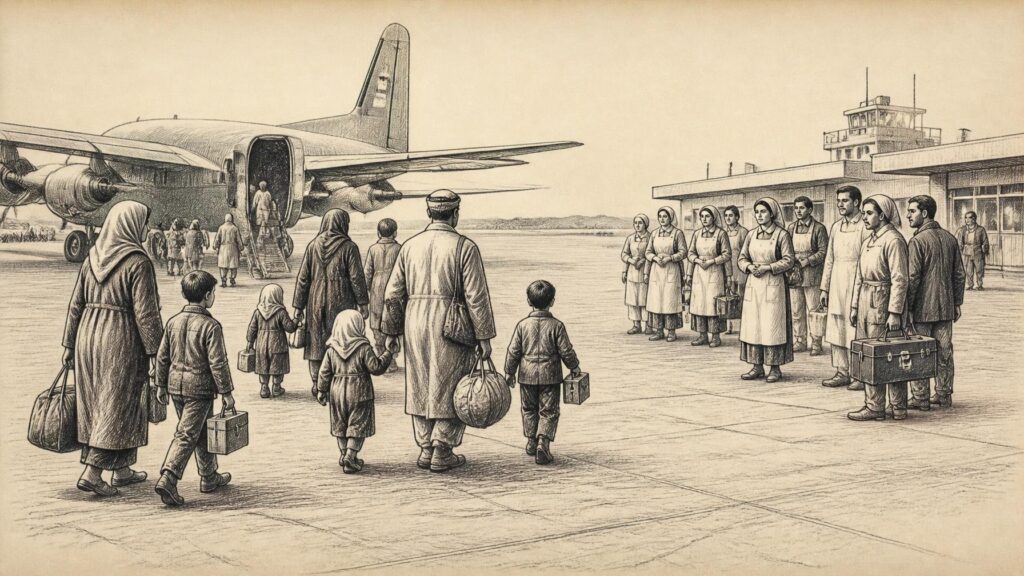
AI generated historical illustration, not a contemporary photograph.
At a Glance
Between December 2024 and October 2025, Ireland received successive groups of sick and injured Palestinian children evacuated from Gaza for treatment. The numbers were small beside the scale of medical need, but the missions formed a consequential Irish humanitarian record: an undertaking requiring clinical judgement, diplomatic negotiation, visas, transport, family care and a willingness to treat evacuation not as a symbolic journey but as the beginning of a difficult period of recovery.
Historical Setting
The phrase “Gaza children medical evacuations” can sound administrative, as though it describes a routine transfer between hospitals. Nothing about it was routine. It belonged to a medical emergency created by the war that followed the Hamas-led attacks of 7 October 2023 and Israel’s subsequent military campaign in Gaza. Children were among those who bore the gravest consequences: injury, chronic illness, interrupted cancer care, kidney failure, malnutrition, infection, displacement and profound psychological distress. The destruction and disruption of hospitals meant that illnesses which might ordinarily have been managed locally could become life-threatening.
Ireland’s participation should therefore be understood as part of a wider history of international humanitarian medicine rather than as an isolated gesture. Medical evacuation has long been used when a local health system cannot safely provide specialist treatment. Yet it is always an imperfect remedy. It helps particular patients, sometimes decisively, but it neither replaces functioning hospitals nor removes the conditions that made the evacuation necessary. In Gaza, the difficulty of leaving the territory added a further and painful dimension. A child’s clinical need could be urgent, while the route to care depended upon permissions, crossing arrangements, host-state acceptance, secure transport and the survival of medical infrastructure along the way.
For Ireland, the initiative acquired importance because it translated a stated foreign-policy and humanitarian position into a direct obligation of care. The State did not simply contribute funds from afar. It accepted children into Irish hospitals, arranged their reception at Dublin Airport, placed responsibility on health and social agencies, and made provision for parents, siblings and carers. This was a modern Irish history of institutions working together under pressure: departments of government, the Health Service Executive, Children’s Health Ireland, Irish diplomatic staff, the Irish Red Cross, the World Health Organisation, European Union bodies and partner governments.
Medical Collapse
The medical context explains why evacuation was necessary. The World Health Organisation described evacuation as life-saving for people with severe trauma, advanced infections, cancer and other conditions that could not be adequately treated in Gaza. Its accounts also made clear that the central objective remained the protection and restoration of healthcare inside Gaza. An evacuation scheme, however carefully managed, could not meet the need of a population whose hospitals had been damaged, deprived of supplies, overwhelmed by casualties and affected by repeated displacement.
Children present particular medical and ethical difficulties in war. They need paediatric specialists, age-appropriate drugs, rehabilitation, nutrition and safeguarding. They may also depend on family members for consent, reassurance, communication and daily care. A seriously ill child separated from a parent is not merely a patient travelling alone; the separation itself may worsen trauma and complicate treatment. These realities shaped the Irish programme from its beginning. The children did not arrive as unaccompanied clinical cases. They arrived with carers and, in the first mission, siblings as well.
The obstacles were not solely medical. WHO guidance records that an evacuation requires a referral process, a country prepared to provide care, authorisation for the patient’s exit and transit, and the practical availability of a crossing route. For children, a parent or guardian was normally required. The process contained no automatic guarantee. A doctor’s referral did not itself secure passage. In a conflict zone, every stage could be delayed by conditions beyond the patient’s control.
This point is essential to the historical record. Later public discussions in Ireland sometimes focused on the question of how many children had reached safety. That is a legitimate question, but it is not the only one. The larger history includes those who were medically assessed yet remained unable to travel, and the thousands whose care depended on a health system under extreme strain. The Irish missions were acts of relief within a far wider emergency, not evidence that the emergency had been resolved.
Irish Decision
In September 2024, following an appeal by the World Health Organisation, the Irish Government approved participation in an initiative to evacuate sick children from Gaza for treatment and care in Ireland. The decision emerged through the EU’s Union Civil Protection Mechanism, which had been activated in April 2024 at WHO’s request to assist the medical evacuation of Palestinian patients to Europe. It was an example of European civil protection being used not after a natural disaster but amid an armed conflict and a collapsing public-health environment.
The decision was deliberately limited and clinically framed. Ireland indicated that it would receive up to thirty paediatric patients, with individual cases accepted according to medical need and capacity. Government records described the intended clinical categories as cancer, haemodialysis and other severe conditions. Orthopaedic cases were excluded in order not to interfere with Irish efforts to increase domestic orthopaedic procedures. Such detail matters. It demonstrates that humanitarian commitment had to be reconciled with the finite capacity of the Irish health service. The programme was not a blank cheque, nor was it merely a diplomatic announcement. It was a planned allocation of specialist care.
That limitation should not be treated as indifference. Medical evacuation systems must match patients with treatment that can genuinely be delivered. Children’s Health Ireland clinicians worked with WHO to identify children likely to benefit from treatment in Ireland. The HSE coordinated the clinical response. The Department of Foreign Affairs and Ireland’s diplomatic missions addressed international arrangements; the Department of Justice managed visas; the Department of Social Protection assisted with access to supports. The Irish Red Cross provided accommodation, transport, casework, translation and practical assistance. The programme was, in effect, a temporary bridge between a child’s interrupted life in Gaza and a set of Irish public services.
First Arrival
The first group arrived in Dublin late on Thursday, 19 December 2024. Eight Palestinian children came with eight carers and eleven siblings. Their flight was provided by the Slovak Government, while the transfer was facilitated through the EU Civil Protection Mechanism. Irish medical staff and a translator travelled with the group. The children were to undergo full medical assessment before the detailed course of treatment was determined.
The composition of the group is historically significant. There were not eight children and eight accompanying adults alone. Eleven siblings travelled too. This reflected an understanding that a child’s recovery could not sensibly be separated from family life. Accommodation was arranged through properties managed by the Irish Red Cross; the organisation also prepared casework and social supports. Government statements emphasised winter clothing, welcome packs, transport to hospital appointments and assistance navigating unfamiliar services. Such practical provisions can be easily overlooked in an account dominated by aircraft and official receptions, but they made the mission viable.
The route also revealed the multinational character of the operation. WHO coordinated the movement of patients from Gaza into Egypt in cooperation with Egyptian authorities. The Irish team assessed patients at the Umberto Primo Hospital in Cairo, access to which was facilitated by Italian colleagues. Slovakia provided the aircraft for the onward medical evacuation. The journey therefore depended upon a chain extending from Gaza through Egypt to Ireland, with multiple governments and organisations carrying distinct responsibilities.
Official accounts did not publish identifying clinical details of the children, and that restraint was proper. Their status as patients and minors required privacy. The historical evidence instead records broad categories of urgent need and the apparatus created around them. The first mission showed that Ireland could receive families as well as patients and could place specialist medical treatment within a wider framework of care. It also established procedures that would be used and adapted during later missions.
Second Mission
A second group reached Ireland on 5 May 2025, confirmed publicly the following day. Four children arrived accompanied by immediate family members. This time the flight from Egypt was provided by the Norwegian Government. Two doctors and two nurses from Children’s Health Ireland travelled with the group, alongside Irish Red Cross caseworkers and a translator. As with the first arrival, the initial days in Ireland were to include assessment, settlement and the beginning of planned treatment.
The second mission made visible a feature of the programme that is often concealed by the simple word “evacuation”: treatment began well before the aircraft landed. Medical staff had to consider whether travel was safe, what care was required during transfer, what specialist service awaited in Ireland and how a child’s family could be supported in a country far from home. Clinical decisions were inseparable from administrative and diplomatic ones. A child could not travel simply because an Irish hospital had a suitable doctor; clearances, documentation, transport and support all had to align.
The Irish Government described the operation as the product of months of work by the Department of Health, HSE, Irish Red Cross and several departments, with support from the Irish Embassy in Cairo. Norway, Egypt, Italy, WHO and the European Union were likewise acknowledged. This was not ceremonial language. The web of participating bodies explains why evacuations occurred slowly even when all partners wished to assist. The movement of a seriously ill child from a besieged territory to another continent is necessarily dependent on cooperation across borders and institutions.
By May 2025, twelve children had been brought to Ireland through the first two medical evacuations. The figure was modest in relation to the upper commitment of thirty paediatric patients, and still more modest beside the needs recorded by WHO. Yet the fact that a second mission occurred was important. It demonstrated continuity rather than a one-off response. It also strengthened the operational relationships between Irish clinical staff, humanitarian organisations and European partners.
Family Questions
The question of family accompaniment became one of the most consequential elements of the Irish story. In theory, medical evacuation systems commonly work with a limited number of companions. In practice, a seriously ill child may have surviving parents, younger brothers and sisters, adult dependent siblings or relatives whose needs cannot be reduced to a neat numerical formula. The experience of the first two Irish missions showed that a narrow assumption of one patient and one carer did not fit every family affected by the war.
In July 2025, the Government amended the scope of the initiative so that parents, minor siblings and adult dependent siblings of paediatric patients could enter the State, subject to visas. This change applied both to future missions and to qualifying relatives of families already in Ireland. The record of the Seanad debate in September shows why the issue had become pressing. Senators raised cases in which separated siblings remained in Gaza and stressed that physical survival, emotional stability and family connection could not be disentangled.
This was not simply a dispute about immigration procedure. It concerned the meaning of care for children who had experienced war, injury and displacement. The State’s response recognised, at least in policy, that treatment cannot be understood only as surgery, medication or dialysis. It may require a familiar adult, the presence of siblings, interpretation, trauma support, stable housing and the possibility of family reunification. At the same time, government representatives stated that issuing an Irish visa did not give Ireland control over the practical extraction of a person from Gaza. That distinction was a hard one, but historically important.
Public debate naturally pressed for speed and compassion. The administrative record, meanwhile, shows the limits imposed by international permissions and travel conditions. Both realities can be true. It is reasonable to judge a humanitarian system by the families it fails to reunite as well as those it assists. It is also necessary to acknowledge that Irish officials did not control every border, crossing or security decision in the route from Gaza to Dublin. The programme was a site of Irish agency, but never of Irish sovereignty over the whole journey.
Third Mission
The third documented Irish mission arrived on 25 October 2025 and was confirmed by the Departments of Health and Foreign Affairs on 28 October. Seven children travelled to Dublin with twenty-nine accompanying family members. The number of relatives was striking and reflected the revised approach to family unity. It was the first Irish medical evacuation from Gaza City to travel through Jordan rather than through Egypt.
According to the official account, the group moved overland from Gaza to Jordan in a WHO medical evacuation convoy. An Irish medical team then accompanied them from Jordan on an aircraft provided by Norway. The mission required cooperation among WHO, Médecins Sans Frontières, the Jordanian Red Crescent, the European Union’s Civil Protection Mechanism, Norwegian authorities, Irish departments and the Irish Red Cross. It was described as a complex operation, and the evidence supports that description.
With the seven children in the third group, Ireland had received nineteen paediatric patients across three missions by the end of October 2025. The figure should be expressed carefully. It records arrivals, not a complete measure of treatment outcomes, nor a measure of all children referred for evacuation. Nor should it be used to infer that nineteen cases were medically alike. The children had differing conditions and would require differing pathways of care. What can be said with confidence is that the third mission demonstrated that the programme had become more than an initial experiment. It had developed routes, partnerships and procedures capable of handling changing circumstances.
The mission also made the historical significance of accompaniment impossible to ignore. Seven children travelled with twenty-nine family members. This was not an incidental addition to a clinical transport. It represented an operational acceptance that the children’s families were part of the humanitarian case. The Irish Red Cross was again charged with accommodation, Arabic-speaking casework, transport and assistance in accessing services. The HSE was to provide psychosocial assessment for patients and carers. In policy terms, medical evacuation had become family-centred rather than narrowly patient-centred.
European Framework
Ireland’s role formed one part of a broader European effort. The EU Civil Protection Mechanism was created to coordinate assistance among participating states in emergencies. In the Gaza medical evacuation context, it supplied a structure through which WHO could request support, states could offer hospital capacity or transport, and the European Commission could facilitate movement. The mechanism did not replace national healthcare systems. Rather, it joined them in a shared response.
The European framework was especially valuable because no one country controlled all stages of an evacuation. A patient might leave Gaza through a route agreed with relevant authorities, receive assessment in Egypt or Jordan, fly in an aircraft supplied by a third state, and be admitted in a fourth. Ireland’s first mission relied on Slovak transport; the second and third used Norwegian aircraft. Egypt was crucial to the earlier route, while Jordan was crucial to the later one. Italy provided access to clinical assessment facilities in Cairo. The European Union coordinated elements of transfer and offered the civil-protection mechanism through which assistance was organised.
In historical perspective, this interdependence is one of the principal meanings of the Irish missions. They were Irish in destination and in the care offered by Irish institutions, but they were international in execution. They also illustrate the limits of national humanitarian rhetoric. A government may wish to admit patients, but it needs clinical partners, neighbouring transit states, aircraft, permissions, interpreters, social workers and hospitals. The medical evacuation of a child is a condensed example of how humanitarian action depends upon cooperation that is both political and practical.
Clinical Limits
There is a danger in writing about evacuations as though arrival in a safe country is the end of the story. For the children and families concerned, it was only a change in the setting of hardship. Treatment could be prolonged. Rehabilitation might involve pain, uncertainty and unfamiliar routines. Parents and carers were living in a country not of their choosing while worrying about relatives left behind. Language services and caseworkers were therefore part of clinical care in the broadest sense, enabling families to understand treatment, attend appointments and manage daily life.
The official Irish plans recognised this. Accommodation was not treated as an afterthought. The Irish Red Cross arranged housing in properties already managed for migrants and displaced people, rather than taking homes from the ordinary rental market. It provided transport, practical support and Arabic-speaking workers. The HSE undertook psychosocial assessment for patients and carers. These measures did not erase trauma, but they show an awareness that physical treatment without social support is inadequate.
There were also limits in the programme’s scale. Ireland’s commitment of up to thirty children was meaningful to those received, but it was inherently selective. The WHO warned in early 2025 that thousands of patients, including many children, required evacuation and that the pace of movement was dangerously slow. This does not diminish the Irish contribution; rather, it places it in proportion. A historical account should resist two contrary distortions: the cynical claim that a limited mission was worthless, and the celebratory claim that it solved a vast medical crisis. It did neither. It provided serious care to particular children within an unmet international need.
Public Meaning
Irish medical evacuations from Gaza also carried political meaning, though the children should not be reduced to political symbols. The programme took place during a period in which Ireland was vocal in calling for a ceasefire, humanitarian access and protection for civilians. In May 2024, Ireland formally recognised the State of Palestine alongside Spain and Norway. The decision to receive children for treatment was distinct from diplomatic recognition, but both actions belonged to an Irish public posture that sought to combine international advocacy with material assistance.
Interpretation must be distinguished from documented fact here. The documented facts are that Ireland approved a paediatric evacuation scheme, received three groups by late October 2025, and organised care through public and humanitarian institutions. An interpretation is that these missions enhanced Ireland’s self-image as a humanitarian state and gave practical form to its diplomatic language. That interpretation is reasonable, but it remains interpretation. The evidence does not permit a claim that Ireland alone shaped the wider conflict, or that its medical programme determined events in Gaza.
Nor is there relevant folklore to repeat as history. The story rests on official statements, parliamentary debate, WHO guidance and European civil-protection records, not on tales of miraculous escape or anonymous heroic rescue. Individual acts of care by clinicians, translators, drivers, caseworkers and families were undoubtedly human and important, but public evidence should not embellish them. The strength of this history lies in its verifiable detail: dates, institutions, routes, numbers, responsibilities and the stated limits of what could be achieved.
Historical Record
The Irish record of Gaza children’s medical evacuations is still recent, and it should be written with caution. Much remains unknown to the public, properly so, because the children are entitled to medical privacy. It would be wrong to convert their cases into a catalogue of injuries or to pretend to know the course of every recovery. The available evidence is sufficient, however, to establish the outline of an important chapter in Ireland’s contemporary humanitarian history.
That outline begins with the WHO appeal and the Irish Government decision in September 2024. It continues with the arrival of eight children in December 2024, four in May 2025 and seven in October 2025. It includes the transition from an Egypt-based route to a Jordan-based route, the involvement of Slovak and Norwegian aircraft, the work of Irish and international clinical teams, and the revision of policy to better accommodate family members. It includes a commitment to receive up to thirty paediatric patients, while making clear that capacity, approvals and access could determine whether each potential case could travel.
Most importantly, it records a principle tested by circumstance: children requiring life-saving care cannot be understood apart from their families, their language, their trauma and the places from which they have been displaced. Ireland’s response did not end the medical catastrophe in Gaza. It did create a passage for nineteen children by late October 2025, and it built a network of care around them. That is neither a complete triumph nor a negligible act. It is a documented instance of Irish institutions attempting, within severe limits, to turn humanitarian obligation into treatment, shelter and sustained human support.
Ireland’s evacuation programme shows that paediatric care in wartime depends on more than hospital capacity: family unity, psychosocial support, visas and secure routes can shape whether treatment is possible and sustainable. The widening of accompaniment to include siblings and dependent relatives suggests that recovery was increasingly understood as a family-centred process, rather than a narrowly clinical transfer. Yet Ireland’s limited control over extraction exposes the gap between offering care and enabling access to it. How might future international evacuation arrangements better reconcile medical prioritisation with children’s need for family continuity, and what evidence should fairly guide those choices in practice?