

Digital Stewardship
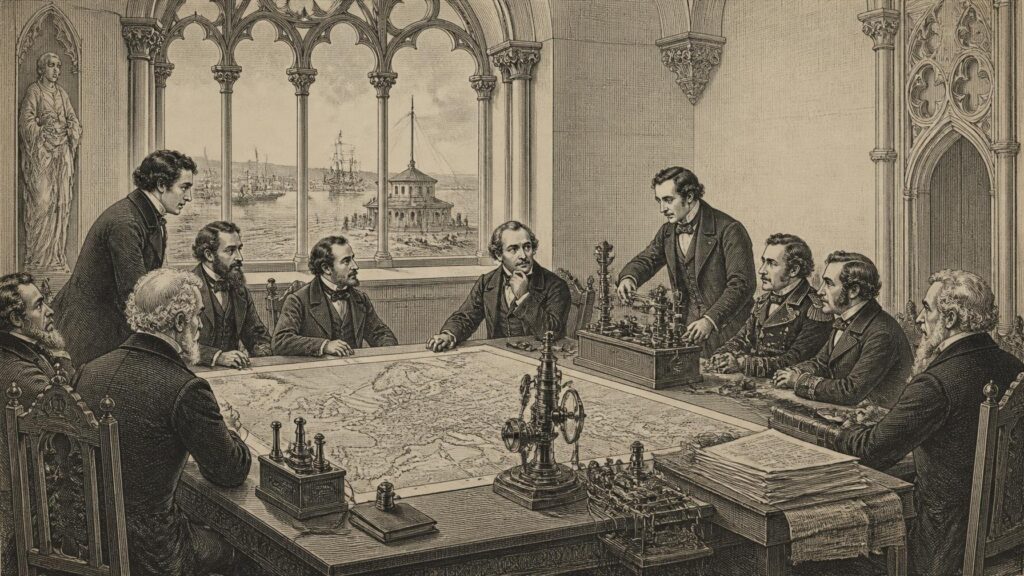
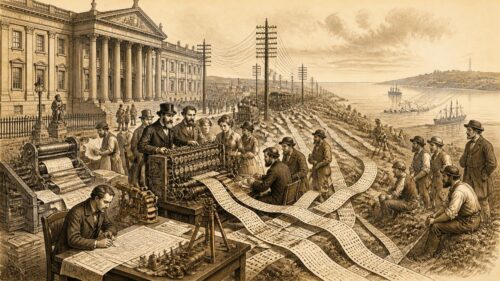
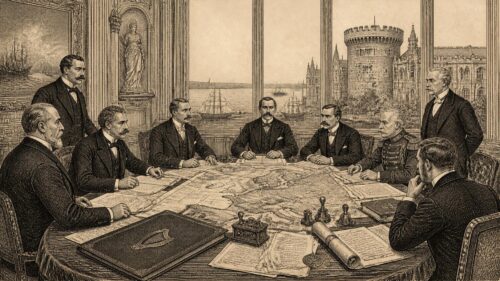
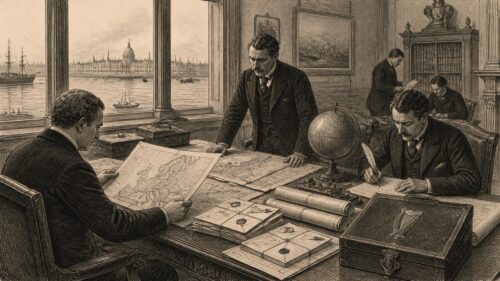
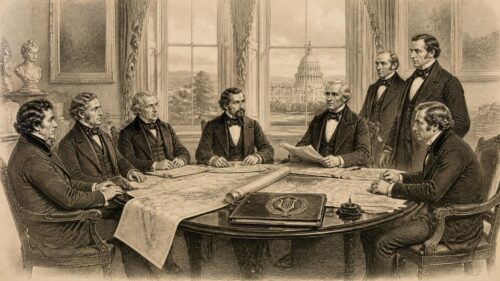
AI generated historical illustration, not a contemporary photograph.
At a Glance
Ireland’s presidencies of the Council of the European Union were never merely ceremonial turns at a European table. They were demanding periods of chairmanship in which Irish ministers, officials and diplomats had to organise meetings, reconcile national interests and move common business forward. Technology became especially visible in this work during the Irish Presidency of January to June 2013, when debates about networks, data, digital identity, cyber resilience and research funding were becoming central to the European project. The historical record shows an Irish contribution of real consequence, but it was a contribution of brokerage and preparation rather than solitary authorship.
Presidential Machinery
The Council presidency rotates between member states, ordinarily for six months. Its holder chairs most Council formations and their preparatory work, represents the Council in many dealings with the European Parliament and Commission, and seeks compromises among governments. It is therefore an office of procedure as well as politics. A presidency can influence pace, emphasis, drafting and the opportunities for agreement. It cannot ordinarily impose a national programme upon twenty-seven, or in earlier decades fewer, governments with their own priorities, legal traditions and domestic pressures.
This distinction is essential to any account of Irish EU presidency technology. It would be misleading to suggest that Ireland invented the European digital agenda, created the Union’s data-protection law, or alone fashioned its cybersecurity policy. The European Commission proposed much of the legislation; national delegations amended and contested it; the European Parliament shared legislative authority in many fields; and successive presidencies carried files onwards. Yet a chair can make progress possible. It can decide which questions require ministerial attention, require officials to clarify disputed language, convene negotiations, report honestly on disagreement and identify the narrow ground on which an eventual settlement may rest.
Ireland joined the European Communities on 1 January 1973. Its first Council presidency followed in 1975, and further terms came in 1979, 1984, 1990, 1996, 2004 and 2013. The sequence matters because it charts the changing character of European integration. In 1975, the Communities were still principally associated in Ireland with trade, agriculture, regional development and institutional adaptation. By 2013, communications infrastructure, online commerce, personal information, public data and scientific collaboration had become matters for European regulation and investment as well as national policy.
Technology, in this setting, should not be understood narrowly as machinery or software. It included the physical systems that carried communications, the legal standards that made electronic dealings credible, the research programmes that supported innovation, and the public services increasingly delivered through digital channels. It also included the political effort to make different national systems work together. Interoperability, in other words, was both a technical objective and a diplomatic problem.
Early Foundations
The earlier Irish presidencies did not preside over a European digital policy in the later sense. That absence should not be mistaken for irrelevance. They helped establish the working habits and institutional setting in which later technical regulation could be pursued. Ireland’s first presidency in 1975 organised the first formal meeting of the European Council at Dublin Castle. This was a formative event for the regular gathering of heads of state or government, an arrangement that later gave strategic direction to the Union’s priorities in innovation, telecommunications and the digital single market.
The 1979 presidency occurred after the first direct elections to the European Parliament. Ireland had to assist the development of relations between institutions whose respective roles were still evolving. That experience had a long afterlife. Technical policy rarely stays technical once legislation, budgets, consumer interests, industry concerns and civil liberties collide. By 2013, work on data protection and network security depended upon precisely the sort of institutional coordination which earlier presidencies had helped normalise.
During the 1984 presidency, Irish diplomacy was preoccupied with enlargement, budgetary questions, famine relief and institutional reform. The Dooge Committee on institutional affairs, chaired by the former Irish foreign minister James Dooge, produced recommendations that fed into the Single European Act of 1987. The Act is important to this story because it accelerated the project of completing the internal market. Later arguments for a digital single market were heirs to that earlier ambition: goods, services, capital and people had been the original vocabulary, but the logic of removing barriers subsequently reached information, online services and telecommunications.
The 1990 and 1996 presidencies were dominated by the transition from Cold War Europe, treaty-making and monetary union. In 1996, Dublin hosted the European Council at which the design of the future euro was officially unveiled. This was not digital policy, but it illustrates a larger truth about the presidency: Ireland repeatedly chaired difficult projects of European standardisation. A common currency required shared rules, technical preparation, institutional trust and political commitment. The later effort to make electronic identity, signatures and cross-border online services mutually recognisable had comparable, if less visibly dramatic, requirements.
Changing Instruments
By the Irish presidency of 2004, the practical environment of European governance had altered markedly. The Union was enlarged by ten states on 1 May, making administrative coordination more complex and more necessary. Ireland hosted the celebrated Day of Welcomes and helped secure political agreement on the draft Constitutional Treaty. The term involved large numbers of meetings and an extensive communications operation. Official accounts also identify it as the first Irish presidency to have a dedicated website.
That website should not be exaggerated into a technological revolution. It did not make policy, nor did it solve the democratic difficulty of explaining European negotiations to the public. Nevertheless, it is a useful historical marker. In 2004, the web had become part of the presidency’s public apparatus: a means of publishing information, presenting events and giving a dispersed European audience a visible route into the work of an otherwise intricate institution. Nine years later, the 2013 presidency’s online and live-streamed public presence would sit alongside a far more developed legislative agenda about the internet itself.
The decade between those presidencies also saw the European Union treat information and communications technologies as a question of competitiveness, social participation and market integration. The Commission’s Digital Agenda for Europe presented a broad programme intended to address fragmented markets, inadequate network provision, lack of interoperability, weak digital skills and deficits of trust. The agenda was not an Irish invention. It was a European framework inherited by the Irish chairmanship, with many initiatives already at different stages of proposal, negotiation or implementation.
Ireland nonetheless had particular reasons to take the agenda seriously. Its economic strategy had long sought foreign investment, export growth and a place in industries dependent on skilled labour, communications and international links. The national interest and the European brief were not identical: a Council president is expected to act impartially among member states. But they could align. An Irish government that valued research, enterprise, connectivity and cross-border trade could credibly argue that a more capable European digital economy was necessary for recovery after the financial crash.
Recovery Context
The seventh Irish presidency began on 1 January 2013, forty years after accession. It took place while Ireland was still emerging from a severe banking and fiscal crisis, and while the euro area remained preoccupied with stability. Its public theme was “Stability, Jobs and Growth”. This did not make the digital agenda a side issue. Rather, ministers presented it as one route through which growth could become less dependent on the old model of credit, construction and short-term demand.
The language of the period deserves careful reading. Official Irish documents repeatedly connected digital policy with jobs, entrepreneurship, innovation and the single market. Such language was partly economic analysis and partly political persuasion. It assumed that better online services, more competitive communications markets, re-usable public information and stronger digital trust could assist businesses and citizens. The assumption was widely shared in European institutions, although the scale and distribution of the promised benefits remained open to debate.
The Irish Action Plan for Jobs for 2013 set out an unusually broad technological programme for the presidency. It identified intellectual property, cybersecurity, electronic signatures and identification, data protection, broadband rollout and web accessibility as areas to be advanced. The document also placed Horizon 2020, the proposed European research and innovation programme for 2014 to 2020, among Ireland’s leading priorities. This was a coherent policy family rather than a collection of gadgets: research was to create knowledge, infrastructure was to connect users, legal rules were to build confidence, and a larger market was to help ideas become services and firms.
Interpretation must remain modest. A programme of priorities shows what a presidency hoped to achieve, not automatically what it achieved. In the Council system, the chair may complete a file, secure a partial agreement, produce a progress report, obtain conclusions, or simply make an issue more ready for the successor presidency. Each is a different outcome. The historical value of the 2013 term lies partly in its record of such intermediate work, much of which made later legislation possible without settling every question at the time.
Digital Market
At the heart of the agenda stood the ambition for a European digital single market. National boundaries still mattered sharply online. Telecommunications rules varied, radio spectrum was managed through national systems, consumer confidence differed, and businesses faced divergent legal conditions when selling or supplying services across borders. The June 2013 meeting of the Transport, Telecommunications and Energy Council, chaired during the Irish term, explicitly addressed the remaining obstacles to a single digital market and asked ministers to consider the characteristics of a European telecommunications market and the effectiveness of radio-spectrum harmonisation.
This was a substantial matter of policy, but it was not a moment of final settlement. The Irish presidency’s role was to stimulate ministerial discussion and submit a summary to the President of the European Council ahead of an October meeting intended to concentrate on innovation and the digital agenda. That procedure captures the presidency’s working method. Rather than announcing a finished Irish solution, it assembled the evidence of where governments agreed, where they differed and what needed to be decided at a higher political level.
Broadband also featured prominently. Fast connections were increasingly treated as basic economic infrastructure, akin in policy importance to roads, energy links or railways, although their construction and regulation raised different practical questions. Ireland’s own National Broadband Plan gave domestic context to the discussion. At European level, attention turned to reducing the cost of high-speed rollout and to the telecommunications element of the Connecting Europe Facility. The presidency could encourage deliberation on these files, but financing and implementation depended upon the larger negotiations over the Multiannual Financial Framework and the actions of member states and market operators.
Web accessibility formed another strand. The Council began examining proposals concerning the accessibility of public-sector websites. This was an important corrective to any account of digital history that focuses only on firms and markets. An online state that cannot be used by people with disabilities, or by citizens lacking particular devices or expertise, risks reproducing exclusion in a new form. The Irish presidency reported progress, not final legislation. The distinction matters, yet the inclusion of accessibility in the programme indicates that digital Europe was already being framed as a civic as well as commercial question.
Open Information
One of the clearer legislative achievements of the Irish term concerned the re-use of public-sector information. Public bodies held demographic, geographic, economic, legal and cultural material that could be valuable beyond its original administrative purpose. Agreement with the European Parliament on revised rules was reported during the presidency. The account of the Irish term stressed that museums, many libraries and archives would for the first time fall within the wider framework for access and re-use, normally at low or no charge.
This detail holds special interest for historical institutions. Archives and libraries are not merely repositories; they are sources from which new knowledge, tools, educational resources and commercial services can be made. Opening the possibility of re-use did not mean that every record became unrestricted, nor did it override copyright, privacy, conservation needs or institutional resources. It did, however, express an important shift in public policy: information generated or held by public bodies could be treated as an economic and social resource as well as an administrative possession.
The connection to Ireland is documented and direct. The presidency helped bring Council and Parliament towards agreement on the file. Its broader legacy, however, should not be claimed in a simplistic fashion. The availability of digitised cultural material continued to depend on national law, funding, technical standards and decisions by individual institutions. The presidency helped shape a European legal environment; it did not digitise Europe’s archives by itself. That more restrained conclusion is historically stronger than a tale of immediate transformation.
Trust Architecture
If the single market was the economic frame, trust was the governing idea beneath much of the 2013 programme. Online transactions require people and organisations to believe that identities are genuine, signatures have legal force, systems are secure enough and personal information will not be used without accountability. Irish ministers described electronic identification, authentication and signatures as key enablers of a functioning European digital market. Yet the technical complexity of those proposals and the concerns voiced by member states meant that the immediate goal was a comprehensive progress report rather than premature closure.
The resulting work on electronic identification and trust services provided a basis for later negotiations. Mutual recognition could potentially allow a person using a recognised national electronic identity to access services across borders in fields such as employment, education, taxation, social welfare and health. The attraction was plain: citizens and businesses should not have to navigate a completely separate technical identity system whenever they dealt with another member state. The difficulties were equally plain, involving security levels, liability, national administrative systems and the credibility of authentication methods.
Data protection was another central file. The presidency undertook a first technical examination of the proposed directive and advanced negotiations on the proposed regulation. It presented updated text on early chapters of the regulation to the Justice and Home Affairs Council and sought broad support for an approach balancing greater transparency for individuals with a risk-based approach to compliance. This was significant procedural work, but it was not the adoption of the General Data Protection Regulation. The GDPR was agreed later and became applicable in 2018.
That chronology is important. Retrospective accounts often allow a famous later law to swallow the more uncertain process that preceded it. In 2013, data protection reform was still contested. Governments and institutions disagreed about burdens, enforcement, territorial reach, business responsibilities and the appropriate relationship between national authorities and European rules. Ireland’s contribution was to take negotiations through a demanding stage, clarify options and preserve momentum. It belongs in the prehistory of the GDPR, not in a false claim of final enactment.
Cyber Security
Cybersecurity was not treated as a specialist matter detached from ordinary life. In the Council discussions of June 2013, electronic communications and information systems were described as increasingly vital to economies and societies, while differences in national preparedness were recognised as a weakness in interconnected networks. The proposed network and information security rules raised difficult questions: which operators should be covered, what incidents should be reported, what standards should apply, and whether European legislation should go beyond voluntary cooperation.
The Irish presidency’s documented achievements included agreement with the European Parliament on a renewed seven-year mandate for the European Union Agency for Network and Information Security, commonly known as ENISA. The agency had been established in 2004. Renewing and revising its mandate was not the same as creating a complete European cybersecurity regime, but it strengthened an institutional resource intended to support member states’ capacity and cooperation. The presidency also secured Council conclusions on a European cybersecurity strategy.
The historical significance lies in the recognition that security was becoming a condition of digital growth, not merely an afterthought. A market in which consumers fear fraud, public networks are vulnerable and essential services cannot respond to serious incidents cannot easily produce the trust sought by policymakers. The Irish term therefore linked commercial optimism to security obligations. This pairing has remained characteristic of European digital policy, even though later debates have become more concerned with geopolitical rivalry, supply chains, platforms and strategic autonomy.
There was no folklore of a uniquely Irish cyber breakthrough, and none is needed. The surviving official record is more persuasive: Ireland chaired deliberation at a moment when the Union was deciding whether fragmented national approaches were adequate to a cross-border problem. It advanced a mandate for an existing agency and helped move discussions from general concern towards common rules. That is a recognisable and valuable form of presidency work.
Research Capacity
Technology policy also depended on research. Horizon 2020 was designed as the Union’s major research and innovation programme for 2014 to 2020, intended to bridge the route from scientific investigation to marketable application while supporting collaboration across borders. The Irish government made political agreement on the programme’s measures a principal priority. This connected the presidency to a longer Irish history in which education, scientific capability and foreign investment had been treated as part of economic modernisation.
The objective was not confined to large corporations or elite laboratories. The policy language emphasised small and medium-sized enterprises, commercial partnerships and the European Research Area. Such aspirations were sometimes stated in broad terms, and their practical success varied by sector and country. Still, they reveal a central premise of the period: Europe’s economic future would depend not only on traditional industrial capacity but on the ability to generate, share and apply knowledge across national borders.
Here again, the Irish presidency functioned as a convening mechanism. It could work towards political agreement, steer ministerial meetings and coordinate negotiations alongside the budgetary framework. It could not guarantee that every scientific field would prosper or that innovation would be distributed evenly among regions. The presidency’s historical achievement was institutional: it helped bring a major programme closer to adoption during a period when the Union’s financial priorities were intensely contested.
Negotiating Limits
A balanced history must emphasise limits. The rotating presidency is influential but constrained by inherited agendas, the Commission’s right of initiative in many areas, the Parliament’s legislative role, the views of member states and the passing of files from one chairmanship to the next. The 2013 Irish term built upon work by Cyprus and handed unfinished business to Lithuania and later presidencies. Its own achievements report acknowledged progress reports and foundations for further work alongside completed agreements.
This is not a weakness in the record; it is the normal rhythm of European lawmaking. Large technical files are rarely settled in a single semester. Data protection reform, electronic identification, network security and telecommunications rules required years of drafting, consultation, amendment and political accommodation. A presidency which accurately identifies disagreement, avoids collapse and leaves usable text can perform a public service even if no dramatic summit declaration follows.
Nor should the digital agenda be detached from the social and economic questions of the time. Digital services could widen access to information and markets, but they could also expose inequalities in skills, broadband coverage, disability access and market power. Official documents placed digital skills and entrepreneurship alongside infrastructure and regulation. That combination suggests an awareness that technological change was not simply a matter of devices. It required institutions, investment, education and public confidence.
Public Presence
The 2013 presidency also showed how digital communication was changing the presentation of government. Its programme included events such as the Digital Agenda Assembly and eHealth gatherings in Dublin. Government reporting noted that the presidency website provided updates and that major events could be watched by live stream. These arrangements were modest by later standards, but they represented a move away from the older model in which European diplomacy was encountered chiefly through printed communiqués, newspaper reports and television bulletins.
Public visibility did not eliminate opacity. Council negotiation still involved technical working parties, confidential compromises and specialised legal texts. Yet online publication and streaming made it easier for interested citizens, journalists, researchers and organisations to observe at least the formal surface of the presidency. In that limited sense, the medium reflected the message. A presidency promoting online access, public information and digital participation was itself beginning to use networked communication as part of its civic practice.
Historical Meaning
The Irish story is best understood as one chapter in the European construction of digital governance. The country’s earlier presidencies helped cultivate a reputation for administration, consensus-building and institutional engagement. The 2004 term demonstrated the increasing importance of web-based public communication. The 2013 term brought the connection into sharp focus by making a linked suite of technology files part of a recovery agenda centred on stability, employment and growth.
Documented evidence supports several definite conclusions. Ireland chaired ministerial consideration of the Digital Agenda and telecommunications market; it advanced work on data protection and electronic identification; it helped secure agreement on public-sector information and the ENISA mandate; it obtained cybersecurity conclusions; it progressed web accessibility and broadband-related discussion; and it treated Horizon 2020 as a major research priority. These were concrete acts within the powers of a Council presidency.
Interpretation begins when assessing their importance. It is reasonable to see the term as an instance of Irish statecraft adapting to a Europe in which regulation of information had become as important as older questions of tariffs or farm prices. It is also reasonable to see a continuity between Ireland’s longstanding concern with European cohesion and its 2013 interest in interoperable systems, common standards and cross-border opportunity. Those are interpretations grounded in the record, not claims that Ireland possessed a single, unchanging technological destiny.
Folklore has little useful place in this subject. There is no need for tales of effortless Irish leadership or an imagined national exceptionalism. The more compelling account is of officials and ministers doing the patient work of chairing a complex union at a consequential moment. They inherited proposals, balanced interests, recorded advances and left a body of work on which others could build.
Measured Verdict
Irish EU presidency technology was therefore real, documented and historically meaningful, but it was collaborative rather than proprietary. Ireland did not create Europe’s digital order alone. Its 2013 presidency did, however, help make that order more governable at a time when the Union was trying to convert digital possibility into rules, infrastructure, research capacity and public trust.
That conclusion also explains why the episode belongs in Irish history. It illuminates Ireland’s development from a new member state of the European Communities in 1973 to an experienced chair of European negotiations four decades later. The technologies in question were European, transnational and contested. Ireland’s role was to provide stewardship: to make discussions work, to advance files where agreement was possible, and to show that the future of the single market would depend increasingly upon the governance of information itself.

The article’s account of Ireland’s 2013 presidency complicates the idea that policy influence belongs only to those who draft or adopt legislation. By chairing discussions on data protection, electronic identity and network security, Ireland helped define priorities, clarify disagreements and prepare subsequent decisions. This resembles earlier European standardisation projects, including the euro, where shared rules required technical design alongside political trust. Yet digital interoperability also touches privacy, accessibility and national administrative systems, making consensus especially delicate, visible only later. What criteria should historians use to judge whether a rotating Council presidency has made a lasting contribution to Europe’s digital governance?