

Caring Wages
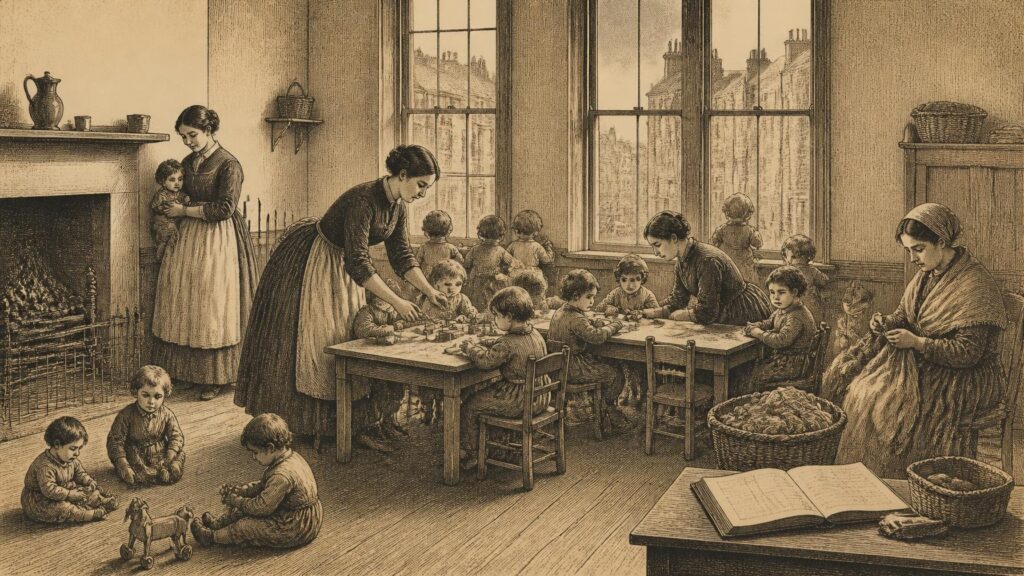
AI generated historical illustration, not a contemporary photograph.
At a Glance
In Ireland, the history of childcare funding is also a history of women’s work, children’s rights, local voluntary action and the difficult public recognition of care as skilled labour. For much of the twentieth century, the State concentrated its educational effort on primary schooling and left care before school age mainly to families, religious and voluntary bodies, private providers and informal networks. From the 1990s onward, that arrangement changed markedly. Public money began to build places, subsidise attendance, regulate services and, eventually, support a statutory floor beneath some workers’ pay. Yet the older settlement has not entirely disappeared: Ireland’s early-years system remains largely delivered by private and community organisations, so the question of who pays for care has remained inseparable from the question of what carers themselves can earn.
Private Beginnings
Childcare, in the modern sense of organised care and early education outside the child’s home, did not begin as a large public service in independent Ireland. Families made arrangements through kin, neighbours, domestic servants where income permitted, religious institutions, charitable organisations, nursery schools, playgroups and, later, commercial providers. These arrangements differed sharply by class, place and family circumstance. Rural households could sometimes draw upon extensive family networks, though that should not be romanticised as an effortless or universally available resource. Urban families, lone parents and women entering paid employment often faced more acute difficulties in reconciling work with care.
The historic tendency of the Irish State was to associate formal education with the primary-school system rather than with the years before it. A later official account of early learning described State involvement in preschool education from 1922 until comparatively recently as minimal, with public investment focused overwhelmingly on primary schooling. That judgement is supported by the uneven character of provision: early-years services grew in separate streams, shaped by local initiative rather than by a universal entitlement or a single national service.
This matters for the history of pay. Where care is regarded chiefly as an extension of private family responsibility, it is less likely to be funded as a public profession. People providing care may be thought of as helpers, mothers, minders or volunteers rather than employees with occupational status, training rights and collectively enforceable wages. Such language did not merely describe the work; it affected how public authorities and employers approached it. The work was real and demanding, but its economic value was often obscured by assumptions about women’s supposed natural aptitude for nurturing.
There were, of course, publicly supported interventions before the major programmes of the late twentieth century. The Early Start pre-school project, introduced in 1994, represented an important targeted educational intervention. Health boards and voluntary organisations also funded particular services, including services for mothers and children. These measures were significant for the families involved, but they did not amount to a universal childcare system. Nor did they settle the issue of labour standards across a fragmented field.
Evidence permits a clear conclusion about the structure of provision, but it should encourage caution about individual experience. There was no single ordinary Irish childcare story. A grandparent’s care, a childminder’s home, a community crèche, a religious nursery and a private day-care centre could all be called childcare, while carrying very different costs, expectations and working conditions. It is therefore misleading to treat informal family care as either a complete substitute for public provision or as evidence that formal childcare was unnecessary. Informal care sustained many families, but its availability was unequal and often depended upon women’s unpaid labour.
Social Change
The pressure for change gathered force in the closing decades of the twentieth century. Women’s labour-market participation rose, social attitudes altered, family forms diversified and the relationship between paid employment and care became a more visible public question. In 1996, the Oireachtas Joint Committee on Women’s Rights placed accessible, good-quality childcare within the pursuit of equality of outcome, not merely equality of formal opportunity. That distinction was important. It recognised that a legal right to seek employment meant little if the practical conditions for accepting or retaining work were absent.
The committee’s work recorded a policy world in transition. The Programme for Economic and Social Progress of January 1991 had acknowledged the need to encourage childcare development as a collective responsibility. Seed-capital funding was made available and a working party was established to consider suitable day-care models. Such measures were modest compared with later expenditure, but they marked a conceptual shift. Childcare could now be discussed not simply as a household difficulty, but as part of employment policy, equality policy and local development.
Economic change gave this discussion urgency. During the period associated with the Celtic Tiger, employment expanded and female participation in paid work increased. Official and parliamentary records repeatedly framed childcare as infrastructure needed to remove a barrier to women’s employment, education and training. This framing had clear benefits: it brought substantial money into a neglected field. Yet it also had limits. It could make children’s learning, workers’ professional status and the intrinsic social value of care appear secondary to the needs of employers and economic growth.
The Child Care Act 1991 was another turning point. It established a national regulatory basis for preschool services, a development later official accounts describe as a major change. Regulation did not instantly create enough places, guarantee affordability or establish a well-paid workforce. It did, however, create a public responsibility for standards and inspection. In historical terms, the Act helped move early childhood provision away from an almost wholly informal or locally variable sphere toward one in which the State could define minimum requirements.
Regulation and funding were not identical. A service can be regulated without receiving enough support to operate sustainably, and a funded place can exist without securing excellent wages or quality. The decades that followed would repeatedly demonstrate that distinction. The State increasingly required providers to meet standards while simultaneously relying on parents’ fees, local fundraising and provider income to finance much of the everyday cost. Because wages form the largest part of a labour-intensive service, pressures on fees were often transmitted directly to staffing levels, pay and retention.
European Impetus
Ireland’s childcare expansion cannot be understood solely as a domestic story. European equality policy and European Structural Funds were important catalysts. The 1996 Oireachtas report on women’s rights discussed the European Community’s New Opportunities for Women initiative, known as NOW. In Ireland, selected pilot projects explored ways of helping women enter training, employment and enterprise, with childcare among their concerns. European programmes did not invent Irish demand for childcare, but they supplied money, comparative ideas and a language of gender equality that strengthened domestic advocacy.
This connection was especially visible in the Equal Opportunities Childcare Programme, generally known as the EOCP. Running from 2000 to 2006, it combined Government and European Structural Fund resources. Its stated purpose was to develop quality childcare for parents in employment, education or training, while supporting social inclusion. The programme brought childcare into the machinery of national development in a way earlier initiatives had not. It also encouraged the building of local implementation structures, including county and city childcare committees, which linked national schemes with providers and communities.
The EOCP’s most tangible legacy was physical capacity. A 2011 Comptroller and Auditor General review stated that more than €500 million had been invested through the programme and that almost 40,000 childcare places resulted. Other official accounts use different measures and periods, reporting more than 65,000 subsidised places across the wider 2000–2010 decade. These figures should not be treated as perfectly interchangeable: one concerns the EOCP and another a longer sequence of programmes. Together, however, they establish the scale of the shift. Childcare ceased to be a small peripheral issue in public spending.
Capital spending solved an immediate and visible problem. Buildings could be bought, extended or adapted; rooms could be equipped; new services could open. Communities that had lacked any formal provision could see a crèche or preschool take shape. Capital grants could also be politically attractive because they yielded countable outputs: places created, premises opened and money committed. But buildings alone do not care for children. A room requires trained adults, manageable ratios, administration, insurance, utilities, food in some settings, relief cover and continuing maintenance. Above all, it requires revenue every week, including enough money to pay staff.
This was the central contradiction of the capital-led period. Public policy could celebrate the creation of places while leaving questions about their long-term viability unresolved. Community services often relied heavily on State subvention, while commercial providers relied substantially on fees. Both kinds of provider faced the reality that parents could not necessarily bear fee increases, particularly in areas of lower income. The result was a system in which access, affordability, sustainability and wages could pull in different directions.
Interpretation must be distinguished from documentary fact here. The documentary record clearly shows that policymakers sought to support women’s labour-market participation and expand supply. It is an interpretation, though a well-supported one, that the early concentration on capacity reflected the political urgency of expansion more than a settled commitment to professional pay. The later emergence of specific wage mechanisms suggests that pay was not yet securely built into the original funding architecture.
Capital Expansion
After the EOCP, the National Childcare Investment Programme continued the State’s expansionary approach. Introduced in 2006, it was allocated €575 million for 2006 to 2010. Like its predecessor, it supported infrastructure and services rather than creating a wholly public network. Parliamentary debate and official reports of the time show a growing awareness that childcare had to serve several objectives at once: parental employment, training, social inclusion, child development and the viability of community provision.
The pattern of delivery remained mixed. Ireland did not generally build a municipal childcare service staffed as a direct arm of the State. Instead, it subsidised a landscape of private businesses, community organisations and voluntary bodies. This preserved local diversity and enabled rapid growth, but it also made national reform difficult. A State wishing to improve pay or cap fees had to influence thousands of independent providers with different premises, occupancy rates, local labour markets and financial structures.
By the late 2000s, critiques of the system became sharper. A National Competitiveness Council statement observed that Ireland’s investment in early education for young children lagged behind several Nordic countries and that pre-primary provision was largely privately financed. It also noted uneven qualifications and the lack of a common quality-accreditation system. The Council’s comparison should not be used to imply that another country’s model could simply be transplanted into Ireland. It did, however, identify the underlying issue: an early-years system can neither be assessed only by the number of places nor repaired only by capital investment.
The economic crash after 2008 made these tensions more severe. Families faced constrained incomes, public finances tightened and providers could not readily raise fees. Yet the demand for care did not disappear. Childcare was increasingly recognised as part of the everyday infrastructure that allowed parents to work, study or seek work. At the same time, early learning gained greater policy attention in its own right. The next major reform would therefore combine a universal element for children with payments to participating providers.
Universal Preschool
The Early Childhood Care and Education programme, or ECCE, was announced in 2009 and first enrolled children in January 2010. It offered a free preschool year, delivered through participating services and financed through State capitation payments. Initially, it covered a set number of hours and weeks for children within a defined age range before primary school. In later years it was expanded, becoming a two-year entitlement in practice for many children through changes to age eligibility and enrolment arrangements.
ECCE was historically important because it made public support more visible and more universal. Instead of directing aid only at particular welfare or employment categories, it gave most eligible children access to a free preschool place for the funded hours. By the programme’s first decade, Government reported that more than 800,000 children had benefited and that public funding had exceeded €1.7 billion. Such figures convey scale, but their deeper importance lies in the new principle: early childhood education was no longer merely a discretionary or targeted intervention.
The programme also changed the relationship between funding and qualifications. Before ECCE, there had been no universal minimum qualification requirement for staff in the sector. Qualification targets were introduced through the programme, and later quality reforms required staff working with children to hold at least a Level 5 qualification on the National Framework of Qualifications or an equivalent, with stronger requirements for room leaders. Higher capitation was used to encourage more highly qualified staffing in some circumstances.
That policy linked public money to professionalisation, but it also exposed a longstanding injustice. Raising qualification expectations without ensuring pay that reflected those expectations could burden a predominantly female workforce with greater responsibilities while leaving incomes low. Early-years staff were asked to deliver curriculum frameworks, meet regulatory standards, document children’s development, communicate with parents and support inclusion. Many nevertheless encountered low wages, limited progression and high turnover.
ECCE did not provide full-day care for all working parents. It was a part-time preschool entitlement, not a complete answer to the practical requirements of a full working week. Parents needing longer hours still had to pay for wraparound provision or arrange care elsewhere. Thus, the programme could improve children’s access to early learning while leaving the broader cost of childcare high. The distinction is fundamental: preschool policy and childcare policy overlap, but they are not the same thing.
There is no reliable basis for presenting the universal preschool programme as a simple cure for inequality. High take-up was a major achievement, but access can still be harder for some families, including those facing disability-related barriers, poverty, transport difficulties or insecurity in local provision. The historical evidence supports a more careful conclusion: ECCE substantially enlarged public responsibility, yet it operated within a mixed system whose wider inequalities remained.
Workforce Crisis
By the late 2010s and early 2020s, workforce pay had become impossible to treat as a secondary matter. Research from the Economic and Social Research Institute, comparing early childhood education and care in Ireland and Northern Ireland, identified low pay and high turnover as common problems. It also noted the connection between employment conditions and continuity of experience for children. Continuity is not an abstract workplace benefit in this sector. Young children depend upon stable, trusting relationships with familiar adults; frequent departures can unsettle children, strain remaining staff and undermine a service’s capacity to develop quality practice.
Low pay had structural causes. Labour is the principal cost in childcare, but providers operating in a fee-sensitive market could be reluctant or unable to raise charges. Community services often had missions to serve disadvantaged areas and therefore limited scope to increase fees. Private providers could face similar constraints, especially where local competition or parental incomes kept prices down. Public programmes sometimes paid for particular hours, categories of child or quality requirements, but the overall funding did not necessarily cover the full cost of a professional wage structure.
It would be too simple to depict all providers and workers as opponents. Providers often argued that they wanted to retain skilled staff but lacked dependable multiannual funding. Workers and their representatives argued that care work had been undervalued and that qualifications, responsibility and the welfare of children required better remuneration. Parents, meanwhile, could be both sympathetic to workers and unable to absorb another fee increase. Public funding became the crucial missing variable because it alone had the potential to ease this three-sided pressure.
The language used to describe the workforce also evolved. “Childcare worker” remained common, but official policy increasingly used terms such as early-years educator, practitioner and lead educator. Terminology cannot by itself change wages, and it should not be mistaken for proof of professional equality with school teaching. Still, the shift reflected an attempt to recognise that the work involved both care and education. It also made the gulf between professional expectations and low pay more conspicuous.
Funding Reform
The Expert Group report Partnership for the Public Good, accepted by Government in 2021, set out the case for a new funding model. Its importance lay in treating affordability for parents, sustainability for services, quality for children and pay for staff as connected rather than separate problems. This was a significant departure from an earlier policy sequence in which capital grants, parental subsidies and preschool capitation often developed in parallel.
Core Funding began in September 2022. It provided programme funding to participating early-learning and school-age childcare services, with conditions including a fee freeze and commitments connected to quality and workforce development. The scheme did not nationalise providers; rather, it created a more direct and recurring relationship between the State and services. That distinction matters historically. Ireland moved toward greater public financing without abandoning mixed delivery.
Core Funding was linked to a new system of wage regulation. In September 2022, Employment Regulation Orders for the Early Years Services Sector introduced, for the first time, sector-specific minimum rates for defined roles. The initial rates ranged from €13 per hour for early-years educators and school-age childcare practitioners to higher rates for lead educators, managers and graduates in designated positions. Government stated that the agreements were supported through Core Funding and expected to increase the wages of a large share of staff.
This was a landmark, but it requires precise interpretation. The Orders created statutory minimums for covered roles; they did not establish a single national salary scale comparable to that of teachers in the public system. Nor did they guarantee that every service would be free of recruitment difficulties or that workers would receive pay commensurate with all qualifications and responsibilities. Later amendments increased rates for some roles, while the Workplace Relations Commission’s current sector page records further rates that took effect in October 2025. The historical significance is therefore not that the wage problem was solved, but that it was formally accepted as a matter for public policy and labour regulation.
The timing is revealing. More than two decades separated the large-scale expansion of childcare places under the EOCP from the first sectoral Employment Regulation Orders. During those years, the State had moved from limited involvement to capital grants, targeted supports, universal preschool, fee subsidies and recurring provider funding. Pay regulation arrived only after workforce shortages and retention problems had become central public concerns. This chronology supports the interpretation that Irish childcare policy developed by accumulation: each reform addressed a pressing weakness without immediately resolving all the weaknesses created by the wider system.
Public Questions
Childcare pay and public funding remain historical subjects because the choices now being made will shape institutions for decades. The enduring question is not simply whether the State should spend more. It is how public money should be designed. Funding directed only to parents may improve affordability but leave providers unable to raise wages. Funding directed only to providers may strengthen sustainability but fail to reduce family costs unless fees are controlled. Funding tied only to qualifications can encourage training but may disappoint workers if it does not produce reliable progression. Effective policy has to confront all these relationships at once.
There is also a question of public purpose. If childcare is understood only as a means of making parents available to employers, it risks being judged solely by labour-market outcomes. If it is understood only as early education, the long hours needed by working families can disappear from view. If it is understood only as a private consumer purchase, the quality and retention problems produced by low wages become easier to ignore. A durable system must recognise care as social infrastructure, education, employment support and paid work.
The mixed Irish model has practical strengths. Community providers can be rooted in local needs; private providers can create capacity rapidly; childminders and relatives can offer forms of care that centres do not replicate. But diversity does not remove the need for public responsibility. A system dependent on a workforce paid near statutory minima cannot easily promise stable, high-quality relationships for children. Equally, a system dependent on parent fees cannot easily promise equal access. The public interest is not opposed to local variety; it is the means by which variety can be made fairer and more sustainable.
No folklore is needed to explain this history. The documentary record is already clear: Irish childcare moved from marginal and fragmented provision toward substantial State involvement, while the workforce’s pay lagged behind the expanding expectations placed upon it. The precise balance of future funding, fee controls and wage-setting remains contested. What is no longer credible is the older assumption that childcare can be treated as a private domestic matter while also being expected to carry the weight of equality, economic participation and children’s development.
Evidence Limits
The surviving official record is strongest on programmes, expenditure, eligibility rules, places created and formal pay rates. It is less complete on the daily experience of individual workers, parents and children, particularly in informal care or small services that left few published records. Aggregate figures also vary because programmes counted different things: children enrolled, places created, places subsidised, service capacity or expenditure over different years. This article has therefore avoided combining unlike figures as though they measured the same outcome.
Interpretation has been identified where it goes beyond direct documentation. The evidence demonstrates that public funding expanded, regulation strengthened and sectoral wage floors were introduced. It supports the inference that previous funding arrangements placed persistent strain on pay and retention. It cannot prove that every provider, family or worker experienced policy change in the same way. That complexity is part of the history itself: Irish childcare was not built as one uniform public service, but through negotiations among families, communities, providers, workers, European institutions and the State.
The article highlights a persistent policy dilemma: public funding is expected to make childcare affordable, increase availability, strengthen quality and raise wages, although these aims can conflict within Ireland’s mixed network of private and community providers. Its account of ECCE and later professionalisation is striking, because higher qualification requirements may not translate into commensurate pay or careers. This raises questions about whether funding models should prioritise providers, parents, or workers, and how each choice affects children’s experience of continuity and care. What combination of public funding, wage-setting and provider regulation could reconcile affordability with professional recognition for Ireland’s early-years workforce?