

Neutral Ground
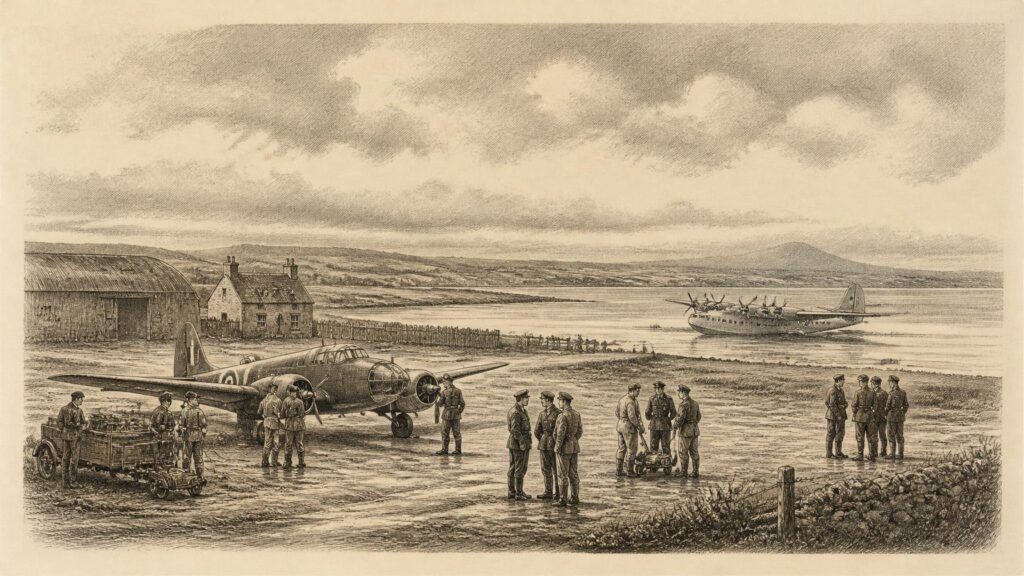
AI generated historical illustration, not a contemporary photograph.
At a Glance
Shannon Airport has long stood at the meeting point of geography, commerce and foreign policy. Its runway beside the Shannon Estuary was built to serve the Atlantic age, but it became something more consequential: a place through which Ireland’s contested understanding of neutrality could be tested. From the Emergency of 1939–45 to the Iraq War of 2003 and the subsequent controversy over rendition flights, Shannon has repeatedly made an abstract national principle immediate, visible and difficult to reconcile.
Shannon Setting
The story begins with location rather than ideology. The Shannon Estuary lies on Ireland’s western seaboard, facing the Atlantic routes that connected Europe and North America. In the interwar years, when long-distance aviation remained technically uncertain and often dependent upon intermediate stopping points, this position gave the estuary unusual value. Foynes, on the southern shore in County Limerick, developed as a flying-boat terminal; Rineanna, on the northern side in County Clare, became the site of the land airport later known as Shannon. Neither site was created primarily as a military installation. Both emerged from calculations about weather, water, distance, navigation and the future of civil transatlantic travel.
That civil purpose is important. Shannon’s later association with military transit can make it tempting to read its history backwards, as if the airport were always a strategic outpost placed at foreign powers’ disposal. The documentary record indicates a more complicated origin. Irish officials and aviation planners sought to make the young state a participant in the new Atlantic economy. Aviation offered a means of reducing the practical remoteness of the west of Ireland and of giving the State a role in traffic otherwise likely to pass through Britain or continental Europe. The airport was therefore bound up with sovereignty as well as commerce.
Foynes demonstrated the possibilities. Flying boats could use sheltered water and, before the widespread introduction of reliable long-range landplanes, represented a plausible technology for ocean crossing. Pan American and British services linked the estuary to a wider world of Atlantic aviation. The airport at Rineanna developed beside this maritime gateway. In the later language of Shannon’s promoters, the place was a bridge between Europe and America. That description was commercially useful, but it also contained a political truth: a bridge can connect territories while leaving the question of who may cross, and for what purpose, unresolved.
Neutrality Defined
Irish neutrality is often invoked as though it were a fixed constitutional condition, comparable to a permanent national emblem. Historically, it has been less settled than that. The Irish State’s policy of neutrality developed in the decades after independence, shaped by memories of British rule, partition, limited military resources and a determination that the State should not automatically be drawn into wars involving Britain. The policy acquired particular force under Éamon de Valera during the Second World War, which Ireland officially called the Emergency.
It is necessary to distinguish several meanings of the word. In international law, neutrality during a particular war brings duties as well as rights. A neutral state must not become a base for one belligerent’s operations and is expected to behave impartially between belligerents. In Irish political language, however, neutrality has also meant non-membership of military alliances, independence in foreign policy, preference for the United Nations, peacekeeping, and resistance to participation in wars led by larger powers. These meanings overlap, but they are not identical.
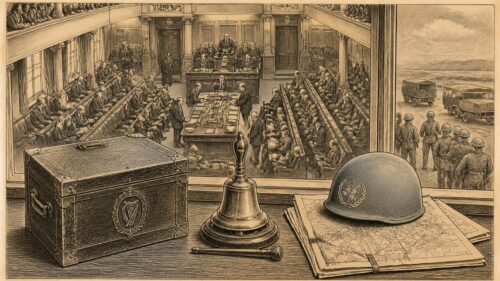
The distinction matters because Ireland’s neutrality has generally been a policy rather than an entrenched constitutional status. The Constitution expresses principles for the conduct of international relations, but it does not contain a simple clause declaring the State permanently neutral. Governments have consequently had room to define the policy in changing circumstances. Supporters have described that flexibility as prudent sovereignty. Critics have argued that it allows ministers to preserve the language of neutrality while making decisions which, in practice, assist one side in a conflict.
Shannon became a focal point precisely because it exposed this difference between principle and practice. A military alliance is a formal arrangement; an airport landing is a concrete event. An aircraft may be described as being in transit, but it may carry troops, equipment, supplies or prisoners. The administrative vocabulary of permits, refuelling and overflight can therefore conceal a larger question: when does hospitality to a foreign aircraft become assistance to a foreign war?
Wartime Origins
The Emergency placed the question of national independence under extreme pressure. On 2 September 1939, the day after Germany invaded Poland, the Irish government declared a state of emergency. Ireland did not join Britain and France when they entered the war. This decision was controversial abroad and remains debated in Ireland, but it was neither accidental nor merely passive. The State had recovered the Treaty Ports from Britain only in 1938. To surrender its freedom of action in 1939 would, in the eyes of de Valera’s government, have compromised the sovereignty which independence had been intended to secure.
Neutrality did not mean indifference to the danger posed by Nazi Germany, nor did it mean that Ireland stood outside the war’s material effects. Ireland’s trade, shipping, fuel supply, food arrangements and security were all shaped by the surrounding conflict. The State faced threats from Germany, from a possible British incursion, and from republican organisations which could exploit wartime instability. It lacked the capacity to defend its coast or airspace fully. Neutrality was therefore at once a declaration of independence, a diplomatic posture and an acknowledgement of strategic weakness.
Research based on Irish diplomatic material has shown that officials looked closely at the experience of other neutral countries. They considered questions such as censorship, internment, airspace, shipping and belligerent pressure in comparative perspective. This is a useful corrective to the assumption that Irish policy consisted solely of a bilateral quarrel with Britain. Ireland was a relatively new state facing its first world war as an independent neutral. Its decisions were improvised, contested and often constrained by circumstances beyond Dublin’s control.
Rineanna belonged to this wartime landscape. The Air Corps maintained a detachment there for coastal patrol duties, reflecting the strategic significance of the estuary, the approaches to Limerick and the developing airfield. Yet the Defence Forces’ own historical material also makes clear the limits of capacity. Ireland had only modest air resources. During the war, the Air Corps dealt with foreign aircraft which force-landed in the State, making weapons and explosives safe and sometimes salvaging entire airframes. The management of such incidents was part of neutrality’s practical business: territorial control was asserted as far as resources permitted.
Atlantic Threshold
The relationship between the wartime airport and neutrality should not be overstated. Shannon was not a grand Allied base comparable to those in Britain or Northern Ireland. Its significance lay partly in the fact that it was a civil aviation site situated near one of the war’s most important maritime theatres. Atlantic routes were vulnerable, aircraft technology was changing rapidly, and the neutral Irish west coast lay close to routes of immense strategic and commercial interest.
Foynes continued to handle flying-boat traffic during the war years, while Rineanna developed as a landplane airport. Commercial and official categories could be blurred in wartime aviation. Airlines served national interests; aircraft carried passengers, mail, freight and official personnel; routes depended upon permissions that were inseparable from diplomacy. Nevertheless, it would be misleading to represent every foreign flight through the Shannon Estuary as a breach of Irish neutrality. The legal and political significance of a flight depended on its aircraft, cargo, purpose, authorisation and the wider conflict in which it occurred.
One documented wartime episode illustrates both the ambiguities and the limits of Irish control. In July 1942 a United States Army Air Forces Douglas C-47 landed at Rineanna after its crew became uncertain of its position while flying from Iceland towards Scotland. The Irish authorities fed and accommodated the crew, refuelled the aircraft, and allowed it to depart next day for Northern Ireland. The incident has sometimes been used to imply a secret military corridor. The surviving account supports a narrower conclusion: it was treated as an accidental landing by an aircraft whose crew had lost their way and was resolved through military and diplomatic authority.
The episode nonetheless reveals why Shannon mattered. A single unplanned landing could immediately raise questions about sovereignty, internment, fuel and destination. In a small neutral state, the distinction between humanitarian assistance to stranded airmen and facilitation of an operational journey could be politically delicate. Such distinctions did not disappear after 1945. Instead, as American military power and air transport expanded, they became central to public arguments over Shannon.
Limited Defence
The mythology of wartime neutrality sometimes depicts Ireland as sealed off from the conflict behind an impenetrable curtain. The evidence does not support that image. Ireland’s territory was affected by belligerent aircraft, maritime warfare, espionage anxieties, rationing and the loss of merchant vessels and seafarers. Irish neutrality could not stop the war at the coastline. What it could do was provide a governmental framework for deciding how the State would respond and for insisting, at least formally, that Irish territory remained under Irish authority.
At Shannon and elsewhere, that authority was necessarily uneven. The State could post guards, regulate aircraft, patrol coastal areas and communicate with foreign governments. It could not make the Atlantic safe, nor could it command the resources available to Britain, the United States or Germany. This gap between formal sovereignty and practical power is central to understanding neutrality. It explains why neutrality was defended with such intensity by Irish governments, while also explaining why its implementation could be qualified by necessity.
The Air Corps record of coastal patrols from Rineanna is therefore significant beyond its immediate military detail. It shows that Shannon was not merely a commercial convenience in the Emergency. The State understood it as an area requiring protection. It was linked to other vulnerable sites, including ports, power infrastructure and sea routes. The airport’s later controversies should not erase that original defensive context, in which the principal question was how an under-equipped neutral state could keep its territory from being used or violated by others.
Folklore has naturally grown around a place associated with Atlantic crossings, wartime secrecy and famous passengers. Stories of clandestine VIP movement, covert arrangements and shadowy aircraft are attractive because Shannon’s geography appears to invite them. Some may contain elements of truth, but folklore is not evidence. The historical record is strongest where it identifies specific aircraft, official permissions, parliamentary statements, diplomatic records or court proceedings. Where such proof is absent, the proper conclusion is uncertainty rather than embellishment.
Postwar Passage
After the war, Shannon’s character changed rapidly. The airport entered the age of scheduled transatlantic landplane travel. In September 1945 a Pan American DC-4 made a proving flight from New York, and in October an American Overseas Airlines DC-4 passed through on the first scheduled commercial service identified in the airport’s own chronology. The long runway and western location made Shannon valuable when aircraft lacked the range to fly directly across the Atlantic without a stop.
Shannon’s postwar prominence was not a by-product of military policy. It rested on a carefully cultivated civil role. In 1947 the airport became associated with the world’s first duty-free airport scheme. Later, the Shannon Free Zone sought to create employment and enterprise beside the airport at a time when improvements in aircraft range threatened to remove the necessity for transatlantic refuelling stops. These projects made Shannon an important experiment in regional development, aviation commerce and state-led economic planning.
This commercial history complicates simplistic accounts of the airport. Shannon was not merely imposed upon a passive locality by external military interests. Its communities, workers, administrators and political supporters had compelling reasons to sustain international traffic. Foreign passengers, airlines, cargo and investment brought employment and prestige. The same infrastructure that made Shannon useful to ordinary travellers, however, also made it convenient to governments moving personnel across the Atlantic. Civil and military mobility shared runways, fuel systems and international permissions.
For Ireland, the postwar Atlantic relationship was politically delicate. The State maintained its policy of military neutrality and did not join NATO. Yet it also had close cultural, economic and diplomatic links with the United States, as well as enduring connections with Britain. Shannon became an especially tangible expression of this western orientation. Its role as a civil gateway did not automatically determine its role in war, but it made later requests for military access more plausible and more consequential.
Cold War
The Cold War changed the strategic environment without producing a simple Irish withdrawal from the world. Ireland remained outside the principal military alliances, but its airspace and airports existed within an Atlantic system shaped by American power. Longstanding arrangements for United States military overflight and landing developed in this period. Government representatives later described such facilities as matters extending back decades, rather than innovations devised for the wars after 2001.
That continuity became a major element in the official defence of Shannon’s use. If foreign military aircraft had been allowed to land or overfly under controlled conditions over many years, ministers could portray later permissions as an established practice rather than a departure from neutrality. Opponents answered that continuity did not settle legality or morality. A practice that caused little public alarm in peacetime, or during a conflict broadly regarded as collective security, might have a very different significance when troops were travelling to a contested invasion.
The dispute is partly semantic, but not merely so. Governments tended to emphasise military neutrality as non-membership of a defence alliance with automatic obligations. On this view, Ireland could retain its independent position while permitting individual flights. Critics generally relied on a broader conception. For them, neutrality required abstention from material assistance to belligerents, especially where a war lacked explicit United Nations authorisation. Shannon was the place where these competing definitions could be measured against the practical fact of troop movements.
The Cold War also entrenched the idea that the airport was an international facility whose value should not be confined to Irish domestic considerations. This did not abolish sovereignty; each foreign military aircraft still required permission under Irish rules. But it made Shannon part of a wider infrastructure of movement. By the beginning of the twenty-first century, the old questions of access, inspection and accountability had acquired a new urgency.
Iraqi Transit
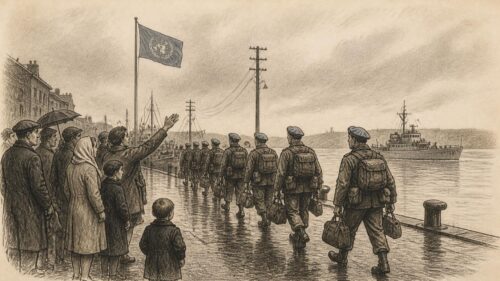
The invasion of Iraq in March 2003 transformed Shannon into a national and international symbol. The United States and its allies prepared for war after a prolonged dispute at the United Nations. Ireland did not join the invasion. Its government nevertheless decided to retain arrangements allowing United States military and civilian aircraft to overfly Irish airspace and land in Ireland. Troops travelling towards the Middle East passed through Shannon, where aircraft refuelled and personnel rested before continuing their journeys.
The decision provoked some of the largest anti-war protests in the history of the State. Demonstrators at Shannon and elsewhere argued that a country claiming neutrality could not credibly permit troops en route to a war to use its territory. Their argument did not depend on the claim that Ireland had formally joined the United States-led coalition. Rather, it focused on practical assistance. A neutral state, they contended, could not divide war into politically separate fragments—refuelling here, deployment elsewhere—and then disclaim responsibility for facilitating the whole.
The government’s position was different. In a Dáil motion of March 2003, it recalled longstanding arrangements for the overflight and landing of United States military and civilian aircraft and supported their continuation. This formulation was revealing. It placed the decision within continuity, alliance independence and administrative permission rather than in terms of participation in the war. The State opposed the conflict politically while declining to treat transit facilities as participation in it.
Parliamentary opposition showed how sharply this reasoning was contested. Proposed amendments described the invasion as contrary to the United Nations Charter and called for facilities at Shannon to be withdrawn. Others argued that Irish territory, waters and airspace should be closed to the military craft of states involved in the war. These debates were not marginal disputes over airport management. They were arguments about whether Irish neutrality had content when that content carried diplomatic and economic cost.
Legal Challenge
The controversy moved from protest to court in Horgan v An Taoiseach. Edward Horgan, a retired Irish Army commandant, challenged the government’s decision to permit United States military aircraft and civilian aircraft carrying American troops to land at Shannon or use Irish airspace. He argued that the policy breached international law on neutrality and was inconsistent with constitutional commitments governing Ireland’s international relations.
The case brought a difficult legal problem into unusually clear focus. The law of neutrality traditionally prohibits belligerents from moving troops or convoys of munitions and supplies across the territory of a neutral power. Horgan’s case contended that Ireland could not preserve neutral status while allowing substantial troop movements connected with the Iraq War. The government responded that the court should not determine matters of high foreign policy, including the legality of the war itself, and maintained that Irish neutrality was nuanced rather than absolute.
In April 2003 the High Court dismissed Horgan’s claim. Later legal analysis by the Law Reform Commission summarised the decision as resting principally on the established judicial reluctance to review the Executive’s exercise of foreign-affairs powers. The dismissal did not make the ethical controversy disappear, nor did it convert every claim about Shannon into settled law. It demonstrated, instead, the limits of litigation as a means of resolving a dispute that was legal, constitutional, diplomatic and political at once.
The judgment is often simplified by supporters on both sides. It should not be treated as a comprehensive judicial endorsement of all military transit through Shannon, nor as a ruling that international neutrality law has no relevance to Ireland. The case raised important public-law questions, and the court’s treatment of costs recognised the seriousness with which they had been advanced. Its larger historical importance lies in showing that the State’s policy could survive legal challenge while remaining profoundly contested in public life.
Rendition Questions
Concerns about extraordinary rendition added another dimension. Extraordinary rendition refers to the secret transfer of individuals by or on behalf of state agencies, often outside ordinary legal safeguards and, in notorious cases, towards detention or interrogation involving torture or cruel treatment. Allegations that aircraft connected with United States intelligence operations had used Irish airports made Shannon a focus of concern for human-rights advocates as well as anti-war campaigners.
The Irish Human Rights Commission examined the issue in a major report. It considered Ireland’s human-rights obligations, the nature of allegations concerning aircraft movements and the adequacy of safeguards. The report did not establish a simple public narrative in which every suspicious flight passing through Shannon carried a rendition victim. Such a claim would exceed the evidence. It did, however, underline the serious difficulty of relying solely on diplomatic assurances where aircraft may be opaque, passengers inaccessible and the consequences of error grave.
Government responses stressed that allegations should be presented to An Garda Síochána for investigation and referred to assurances from the United States that Irish territory was not being used for extraordinary rendition. Human-rights critics replied that a system dependent on assurances, without routine inspection of suspect aircraft, could not adequately discharge Ireland’s positive obligations to prevent unlawful transfer or mistreatment. The disagreement concerned evidence and procedure as much as political trust.
Here again Shannon exposed the tension within Irish neutrality. Even if an aircraft’s passage did not amount to participation in a war, a neutral state still had responsibilities under human-rights law and under its own criminal law. The issue was not confined to whether Ireland was militarily aligned. It was whether state authorities had sufficient knowledge and control over what happened within their jurisdiction. This question remains historically significant because it broadened public debate from neutrality in wartime to accountability in transnational security practice.
Public Argument
Shannon’s history has generated competing memories. For many local people, the airport is first a source of employment, connection and regional possibility. It is associated with flying boats, emigrants, visitors, duty-free commerce, American links and the remarkable effort to build an international transport hub in the west of Ireland. For campaigners, it is also a reminder that the ordinary infrastructure of travel can become part of war. Neither memory is invented, and neither cancels the other.
Public argument has sometimes suffered when either side reduces the other to caricature. To describe all supporters of military transit as indifferent to neutrality ignores the complexity of their concern for sovereignty, commercial viability and diplomatic relations. To describe all opponents as hostile to the United States or unaware of Shannon’s economic importance ignores the legal and ethical seriousness of their objections. The historical evidence suggests that the conflict was genuine because competing values were genuine.
Interpretation should also be separated from documented fact. It is documented that Ireland remained outside NATO, that the government allowed United States military transit through Shannon, that the Dáil debated the issue, that Horgan’s challenge failed in the High Court, and that human-rights bodies raised serious concerns about rendition safeguards. It is interpretation to conclude that these facts prove Ireland was never neutral, or alternatively that they are fully compatible with neutrality. Those conclusions depend on which definition of neutrality one adopts and what moral weight one gives to facilitation.
Shannon has also attracted claims that reach beyond available proof. Assertions about particular secret flights, covert cargoes or hidden passengers require specific evidence. Aircraft registration, flight plans, official records, witness testimony and credible investigation matter more than rumour. A historical article should neither dismiss all suspicion as fantasy nor transform suspicion into certainty. The proper task is to identify what the record establishes, what remains disputed and where documentary gaps prevent a final conclusion.
Historical Meaning
The history of Irish neutrality and Shannon does not yield a neat verdict. The airport was born from civil ambitions, developed in the shadow of global war, helped connect Ireland to the Atlantic economy and later became an arena for arguments about military transit and human rights. Its significance rests precisely on that layered history. Shannon was never only an airport, and neutrality was never only a word.
The Emergency established a powerful political inheritance: Ireland would claim the right to make its own decisions in war and peace. The later use of Shannon tested how far that claim could coexist with practical cooperation with the United States. Governments emphasised independent policy, legal permissions and long-established arrangements. Critics emphasised the material reality of troops crossing Irish territory towards war. Both drew upon recognisable elements of Irish history, but they reached sharply different conclusions.
For historians, the enduring value of Shannon lies in its ability to make national policy concrete. It directs attention away from slogans and towards institutions: permits, runways, military guards, Dáil motions, court pleadings, diplomatic assurances, inspections and protests. These are the mechanisms through which neutrality is either practised, qualified or challenged. They also show why neutrality remains a living subject rather than a settled inheritance.
Shannon’s runway faces outward across the Atlantic, but its history returns repeatedly to an Irish question: how can a small state preserve independence while participating in an interconnected world? There has never been a final answer. The record instead shows successive governments, officials, workers, campaigners and courts struggling with the same dilemma in changing forms. That struggle—not a simple tale of consistency or betrayal—is the proper historical meaning of neutral ground.


Shannon’s history presents neutrality as a lived practice rather than a fixed label, shaped by civil aviation, regional employment, sovereignty and the movement of foreign forces. The airport’s commercial origins complicate claims that it was simply a military facility, yet its usefulness for American transit during the Iraq War made the boundary between access and assistance contested. The article stresses the difference between documented evidence and later speculation, especially over rendition. How should Ireland interpret neutrality when a significant civilian airport facilitates military journeys: chiefly through legal obligations, diplomatic independence, public consent, moral consequences, or some balance among them today?