

Winter Reckonings
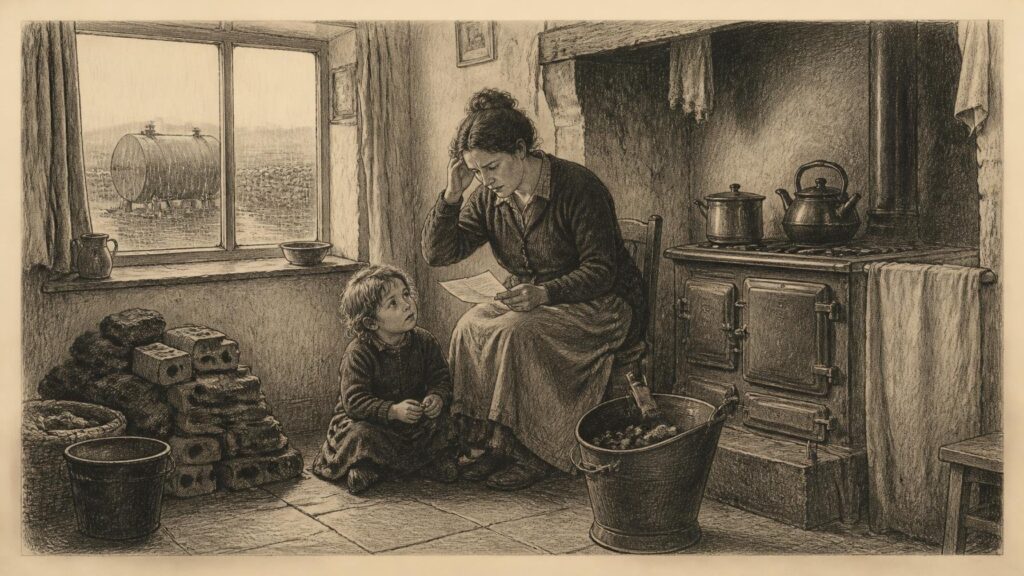
AI generated historical illustration, not a contemporary photograph.
At a Glance
Energy crisis in Ireland was never merely a matter of tankers, power stations and international diplomacy. It entered the household through an empty coal scuttle, an unaffordable oil delivery, a meter that consumed too many coins, or a decision to heat one room rather than the whole house. The oil shocks of the 1970s made this intimacy unmistakable. They exposed the vulnerability of a small, import-dependent state, but they also revealed older divisions in Irish domestic life: between urban gas users and rural oil users, between centrally heated homes and houses warmed by a range or open fire, and between families able to absorb higher bills and those for whom fuel competed directly with food, clothing and rent.
Imported Dependence
By the early 1970s, the Republic of Ireland had entered a period of greater economic openness. Accession to the European Economic Community in 1973 symbolised that change, but it also coincided with an international upheaval over which Dublin had very little control. The Arab–Israeli war of October 1973 and the subsequent restriction of oil supplies by Arab exporting states transformed the price and perceived security of petroleum. A second, severe shock followed after the Iranian Revolution of 1979. These were global crises, but Ireland’s exposure was unusually acute because imported oil had become central to transport, domestic heating and electricity generation.
The language of “energy crisis” can imply a single, sudden event. In practice, Irish households experienced a sequence of pressures: higher prices, uncertain deliveries, inflation, anxiety about supplies and altered patterns of heating. The shocks also arrived during wider economic difficulty. International recession, domestic inflation and unemployment made the cost of fuel more difficult to bear. The ESRI’s contemporary study of energy prices between 1973 and 1981 treated energy costs not as an isolated inconvenience but as a major disturbance affecting prices, production, national income and households’ purchasing power.
Oil had offered convenience. It could be delivered to a tank, burned in a boiler, used in portable heaters and converted into electricity in large generating stations. In the 1960s, this flexibility seemed advantageous. The Electricity Supply Board was especially reliant on fuel oil for generation, and stable oil prices had made that reliance appear manageable. After 1973, however, the apparent modernity of oil-fired energy became a strategic weakness. The shift was felt indirectly by every electricity customer and directly by families dependent on home-heating oil.
Ireland had indigenous energy resources, but these did not free the State from dependence. Peat, coal, hydroelectricity and, later, offshore natural gas all had roles, yet none could instantly replace imported oil in every domestic or industrial use. The historical significance of the crisis lies partly in this mismatch. Irish households did not inhabit an economy with one fuel system. They depended on an untidy coexistence of turf, coal, briquettes, electricity, town gas, bottled gas and oil. Each carried its own geography, supply chain, appliance requirements and social meanings.
Domestic Landscapes
The household effects of the oil shocks must be understood against the housing conditions of the period. Ireland in the 1970s still contained many dwellings built before modern insulation standards, with single glazing, draughts, open fires and limited central heating. Rural homes could be far from piped gas networks and often relied on solid fuel, oil or a mixture of both. In cities, the pattern was no less varied. Some homes had coal ranges or open fires, some used town gas, others had electric appliances, and newer suburban houses increasingly installed oil-fired central heating.
The 1981 Census, the first Irish census to collect detailed information on central heating and the principal fuel used to heat a dwelling, provides an unusually clear view of this mixed domestic landscape. It recorded 896,054 private dwellings in permanent housing units. Some 628,105, or 70 per cent, used solid fuel as their principal heating fuel. Oil was the main fuel in 140,682 dwellings, electricity in 58,255 and gas in 41,210. Only 39 per cent of dwellings had central heating. Even among those homes, central heating was not always the principal means of keeping warm.
Those figures belong to 1981, after both major oil shocks, but they illuminate the character of the preceding decade. The Irish home was not uniformly moving from an old fuel world into a new one. Many households retained solid fuel because their dwelling, equipment, finances or local supply made it practical. Others combined systems: a central-heating boiler could heat water or selected rooms while a kitchen range, stove or fire remained the daily source of warmth. The distinction matters because a household’s response to rising oil prices depended not only on income but on whether it possessed any usable alternative.
It is tempting to regard solid fuel as a relic which the crisis briefly revived. That would be misleading. Coal, turf and briquettes had long been integral to domestic life. They demanded labour and storage: fuel had to be bought, carried, stacked, dried, fetched from a shed or cut from a bog. Their warmth was local rather than evenly distributed. A fire could make a kitchen or parlour habitable while bedrooms remained cold. Yet solid fuel also gave some households a degree of independence from oil deliveries and electricity bills, particularly where turf-cutting, family labour or local suppliers supplemented cash purchases.
That autonomy had limits. Not every household had access to turf, a place to store coal or the physical capacity to carry fuel. Older people, tenants, urban families in small dwellings and households without secure income could be especially exposed. Furthermore, a household using coal or briquettes was not outside the energy crisis: shortages and price changes affected solid fuels too, while the cost of producing and transporting them rose with wider inflation and petroleum use.
Oil Shock
The first oil shock overturned assumptions formed in the era of cheap petroleum. Official Irish discussions in the mid-1970s repeatedly returned to the danger of continued dependence on imported oil. An Oireachtas report on energy policy in 1975 considered the wider European effort to reduce reliance on oil imports and acknowledged that Ireland faced particular constraints. Nuclear power was discussed in that period, but even advocates accepted that it could offer no immediate solution. The household problem was more immediate: how could homes be heated and supplied with electricity when the imported fuel underpinning both had become expensive and insecure?
Oil prices were transmitted through several channels. Home-heating oil was the most obvious. A delivery that had once represented a predictable seasonal expense became a source of worry, especially for families with tanks to fill in a single purchase. Electricity costs also reflected fuel prices because oil was important in generation. Goods and services became dearer as energy costs passed through the economy. Thus even a household heating mainly with turf or coal could face a broader reduction in real income.
The crisis also changed the political value of conservation. In an earlier period, advice to save fuel might have been framed as thrift or household management. After 1973 it acquired national importance. Lower consumption was presented as a way to protect the balance of payments, reduce dependence and limit the social damage of price rises. This did not mean that families could easily conserve. A poorly insulated house required heat simply to remain tolerable in winter, while many homes had few technical options beyond closing doors, heating fewer rooms and using a fire as sparingly as comfort allowed.
There is limited value in treating every recollection of the period as a reliable national pattern. Later memories often condense several winters into one story of queues, shortages and fires kept low. Such accounts are important as testimony to feeling and practice, but they must be distinguished from documented evidence. The documentary record establishes the sharp rise in imported-fuel costs, the State’s concern about supply, and a substantial revival of demand for indigenous solid fuels. It does not establish that every Irish family experienced a dramatic shortage or identical hardship.
The first shock therefore produced neither universal deprivation nor a simple national return to turf. It produced a recalculation. Homeowners considered boilers and fires in new ways. Suppliers reconsidered stock. State bodies reconsidered the economic place of peat, coal and gas. The energy system became visible precisely because it had ceased to be cheap and dependable.
Peat Revival
Bord na Móna occupied a distinctive position in this recalculation. Since the middle decades of the twentieth century, the semi-state body had developed peat resources for electricity generation and domestic fuel. Before the oil crisis, peat could appear commercially disadvantaged beside cheap imported oil. The dramatic rise in oil prices changed the comparison. In 1980, an Oireachtas committee examining Bord na Móna concluded that the competitive relationship between turf and oil had altered markedly after 1973.
The evidence is particularly revealing for domestic briquettes. The committee recorded that Bord na Móna had been unable to meet demand since 1976 and had operated a rationing system. This was not a nostalgic revival of an old fuel in the abstract. It was a documented supply pressure. Briquettes were convenient by the standards of solid fuel: regular in size, portable and suited to many domestic fires and ranges. They also had a price relation to domestic alternatives that made them attractive during a period when oil prices were governed by international markets.
Still, peat’s importance should not be romanticised. Turf was associated with resourcefulness and rural continuity, and later popular memory often casts it as an uncomplicated national safeguard in hard times. The historical record is more complex. Peat extraction involved environmental transformation, demanding work and regional inequalities in access. Briquettes required industrial production and distribution. Their availability depended on factories, transport and retail networks. A family in a city or distant town was not made self-sufficient merely because the fuel was indigenous.
Nor did indigenous fuel automatically mean low cost. Haulage, handling and retail margins mattered. In parliamentary evidence, Bord na Móna representatives noted that consumer prices could vary considerably according to distribution costs. A policy which praised native resources at national level could therefore still leave individual households paying very different amounts. The crisis revealed the difference between national energy security and household affordability. A fuel might improve the former without resolving the latter.
Nevertheless, the turn towards peat had real political significance. It supported an argument that energy policy should account for security of supply as well as immediate market price. This argument would later assist investment in a more diversified energy system. For households, however, its meaning was humbler and more immediate: briquettes, turf and coal offered alternatives where oil had become frighteningly expensive.
Coal Return
Coal also gained renewed importance. In domestic settings it remained a familiar fuel for grates, ranges and stoves. The 1981 Census confirms that solid fuel, a category including coal and peat as well as other fuels, still dominated principal household heating. The persistence of solid fuel complicates any account which identifies Irish energy history solely with oil dependence. Oil may have dominated national vulnerability, but many homes continued to be warmed by combustible materials bought in bags, delivered by merchants or gathered through local custom.
The crisis encouraged officials to consider coal not only as a domestic fuel but as part of a national diversification strategy. An Oireachtas committee in 1984 described a noticeable move towards solid fuel in domestic use and stressed the strategic value of indigenous coal and peat in a small island state. This was part of the reasoning behind the greater role eventually assigned to coal-fired electricity generation, most visibly at Moneypoint in County Clare. The station came into operation later in the 1980s, beyond the immediate shock years, but its rationale was shaped by the recognition that an electricity system heavily dependent on oil was exposed.
The domestic consequences of a coal return were ambiguous. Coal could be an accessible substitute for some households, but it brought dirt, ash, smoke and physical work. It could worsen urban air pollution, particularly in dense neighbourhoods where open fires were common. The political attraction of security could sit uneasily beside the lived reality of smoke-blackened walls, respiratory discomfort and the daily task of tending fires. The historical lesson is not that one fuel was simply better than another, but that each solution distributed costs differently.
There was also a temporal difference between policy and household need. A power station, fuel plant or new gas network required years of planning and capital. A family confronting a cold week required heat immediately. In this sense, households were always ahead of long-term energy strategy. They improvised with the appliances and fuels already available. Governments could promise diversification; a parent still had to decide whether to light the fire, turn on a heater or conserve the remaining oil.
Electric Burdens
Electricity converted the international oil problem into a universal household concern. Even homes without oil-fired heating relied on lighting, cooking, refrigeration and appliances. The ESB’s later evidence to an Oireachtas committee showed how decisively oil costs affected the organisation. Fuel had comprised about one fifth of ESB costs in the 1960s and about one quarter in the early 1970s. Following the 1973–75 increase in fuel-oil prices, the fuel element rose above 40 per cent. The second crisis pushed it above 49 per cent in 1980–81.
These were institutional accounts, but their implications reached domestic bills. The ESB faced the problem of recovering costs while maintaining supply and responding to political pressure. Price increases were never merely technical. A uniform increase could be defended as administratively straightforward, but it took no account of households with different incomes, dwelling conditions or dependence on electricity. A low-income family using electric heating or appliances could be much more affected than a better-off household for whom electricity was a smaller share of expenditure.
Electricity also intersected with regional inequality. Rural electrification had transformed daily life in previous decades, yet access to electricity did not guarantee cheap heating. In some homes, storage heaters or portable heaters were used because there was no convenient alternative. In others, electricity supplemented a fire rather than replacing it. The 1981 Census found more than 58,000 dwellings naming electricity as the principal heating fuel, while many more used it in some capacity. The distinction between principal fuel and actual household practice is crucial: homes commonly relied on several energy sources.
The second oil shock deepened this pressure. By the end of the 1970s, the price of fuel oil had changed so dramatically that the ESB accelerated efforts to diversify away from it. The later reduction in oil use for generation was a major structural response to the crisis. Yet structural adaptation did not erase the immediate burden on consumers. Electricity bills remained one of the most regular reminders that international energy markets could reach an Irish kitchen or sitting room.
Gas Questions
Gas users encountered a related but distinct problem. In Dublin, manufactured town gas had a significant domestic role. Its production depended on feedstocks whose costs were affected by the oil crisis. Oireachtas evidence from the late 1980s recalled that the State subsidy for town gas arose when the cost of naphtha escalated after the first oil shock. Governments chose to cushion consumers because the domestic content of gas use was politically and socially significant.
That decision demonstrates an important feature of Irish energy history: governments did not merely observe international price changes. They intervened selectively, balancing public expenditure, household protection and the viability of energy undertakings. Subsidy could soften an immediate shock, but it could also postpone difficult decisions about prices, infrastructure and the future of particular fuels. The later development of natural gas from the Kinsale field offered a different path, though its benefits reached households unevenly and over time.
Gas networks were geographically limited. A house connected to gas had options unavailable to a rural household dependent on oil, bottled gas or solid fuel. Consequently, national averages conceal sharply different experiences. A suburban household with a gas cooker and heating system was situated differently from a farmhouse with an oil tank and range, or a city-centre tenant reliant on a coal fire. The term “Irish households” is therefore useful only if it is understood as a broad category containing many unequal fuel circumstances.
Unequal Winters
The harshest consequence of energy crisis was not necessarily a spectacular shortage. It was the slow erosion of comfort and security among households already living close to the margin. Higher fuel prices could lead to colder rooms, reduced bathing, deferred payments, debt to suppliers or dependence on family assistance. These decisions rarely appear in national energy statistics, yet they are central to the social history of heating.
Modern researchers use the term energy poverty for the condition in which a household cannot adequately meet energy needs without excessive financial strain. That vocabulary was not consistently used in Irish public debate during the 1970s. Its later emergence should not lead historians to project present categories uncritically backwards. Still, the underlying experience was recognisable: some households lacked the income, efficient homes or adequate heating systems needed to remain warm without sacrifice.
The ESRI’s later historical analysis of household expenditure begins with survey data from 1987, so it cannot furnish a precise national rate for energy poverty during the oil shocks. It does, however, show why fuel costs must be read alongside disposable income, dwelling quality and fuel type. Using the common measure of spending more than 10 per cent of disposable income on household energy, the research found substantial vulnerability in later decades and identified a previously recorded high rate in 1994–95. The absence of equally detailed 1970s household data is a limitation, not a licence to invent figures for the earlier crisis.
Age, disability, household composition and housing tenure all shaped risk. An older person living alone in a large, poorly insulated house might need more heat per person than a younger family in a newer dwelling. A tenant might be unable to alter a boiler or insulate walls. A rural household could face the large periodic cost of filling an oil tank, while an urban household might pay smaller but persistent sums for coal, gas or electricity. Fuel expenditure was not simply an economic category; it expressed the physical form of the home and the social position of those within it.
Folklore and family memory rightly preserve images of economic pressure: children being told to stay near the fire, doors kept shut against the cold, and households timing fuel purchases around paydays. Such memories should be treated respectfully, but not generalised without evidence. They are strongest when used to convey the texture of domestic adaptation rather than as proof of a universal experience. Census returns, parliamentary reports and economic studies supply the broader frame; remembered stories reveal what that frame could mean inside a house.
State Measures
During the crisis years, the State’s principal long-term response was diversification. Policymakers encouraged conservation, reconsidered peat and coal, developed natural gas capacity and sought to reduce the electricity system’s heavy oil reliance. These measures were important, but they operated on a different timetable from household need. Direct protection for low-income households developed gradually through social welfare and local authority arrangements rather than appearing as a single response to the 1973 shock.
Before the national Fuel Allowance scheme, an Urban Fuel Scheme operated through local authorities for certain pension and welfare recipients in their areas. The national scheme was introduced in 1988, after the immediate oil-crisis era but in a society whose energy debates had been shaped by it. Its purpose was explicitly limited: it contributed towards normal heating expenses rather than meeting them in full. That modest formulation is historically revealing. The State accepted an obligation to assist with warmth, while retaining the assumption that households would carry most of the cost themselves.
Fuel Allowance should not be described as the direct creation of the 1973–75 crisis alone. It emerged from later welfare policy, economic hardship and older local schemes as well as from the broader recognition that heating costs could produce deprivation. Yet the oil shocks had made household energy insecurity politically visible. They taught policymakers that reliance on markets and imported fuels could create social consequences that no individual household could solve through thrift.
The development of welfare supports also marked a shift in emphasis. Earlier public discussion often concentrated on supply: whether enough oil, coal, peat or electricity could be secured. Later discussion increasingly asked who could afford the energy available. Both questions were necessary. Supply security without affordability leaves cold homes; affordability measures without secure supply leave households exposed to external shocks.
Lasting Legacies
The energy crises of the 1970s did not produce a final solution to Ireland’s household fuel problem. They did, however, alter the country’s energy trajectory. Oil’s dominance in electricity generation was reduced through diversification. Coal, peat and gas assumed roles that had been reconsidered in the light of the shocks. The country acquired stronger habits of thinking about energy security, even if later periods of lower prices sometimes weakened the urgency of those lessons.
For household history, the most durable legacy was an awareness that warmth depends on more than fuel supply. It depends on the condition of the dwelling, the kind of heating system installed, access to networks, household income, age and health, and the capacity to meet a large bill before winter. The 1981 Census, with its striking evidence of solid-fuel dependence and limited central heating, captures a society in which energy transition was incomplete and uneven.
Subsequent decades brought major change. Natural gas expanded in some areas; oil-fired central heating became widespread in others; electricity use increased; insulation standards improved; and environmental concerns transformed the public assessment of coal and peat. Yet historical patterns persisted. Later energy-price shocks again exposed the vulnerability of households dependent on imported fuels and inefficient homes. The resemblance does not mean that circumstances were identical. Modern Ireland has different infrastructure, regulations and welfare mechanisms. It does mean that the core problem recognised in the 1970s remains intelligible: a household cannot choose its way out of an energy system shaped by geography, investment and international markets.
“Energy crisis” is therefore too impersonal a phrase if it is allowed to remain at the level of policy papers. Its Irish history belongs equally to the fire laid before dawn, the briquettes rationed in the 1970s, the oil tank only partly filled, the electric bill opened with apprehension and the later welfare payment intended to make winter survivable. The oil shocks exposed national dependence, but their deepest historical meaning lies in the unequal domestic reckonings they forced upon Irish households.
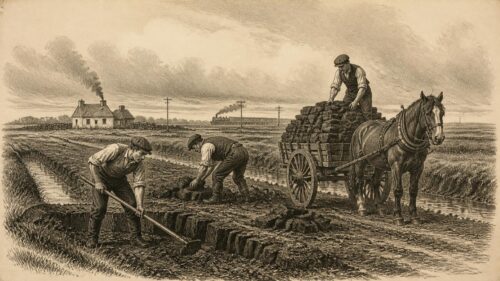

The article exposes a tension between national energy security and household affordability during Ireland’s oil shocks. Peat, coal and briquettes reduced reliance on imported oil, yet their practical value depended on distribution, housing quality, physical capacity and local access. Electricity and gas policies likewise spread or softened costs unevenly, while many families combined fuels rather than relying on one system. This suggests that energy transitions should be assessed not only through supply resilience, but through warmth, labour and health in situated homes. How should historians compare the benefits of indigenous-fuel diversification with its unequal social and environmental consequences for households?