

Fuel Neutrality
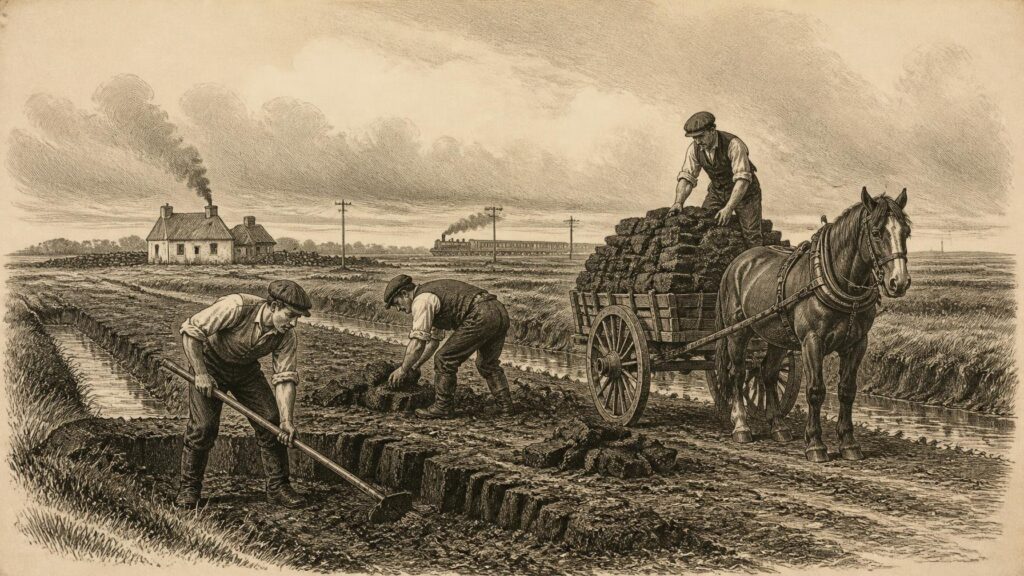
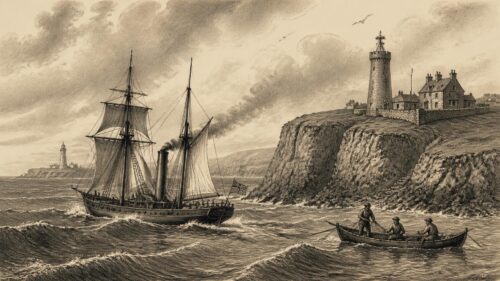
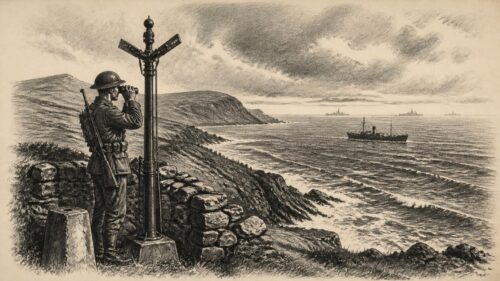
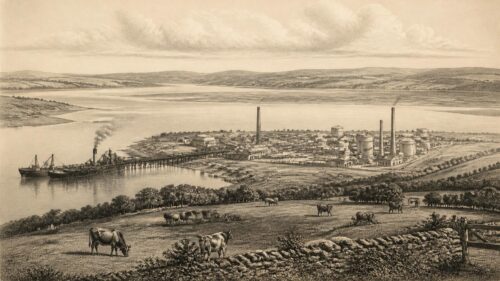
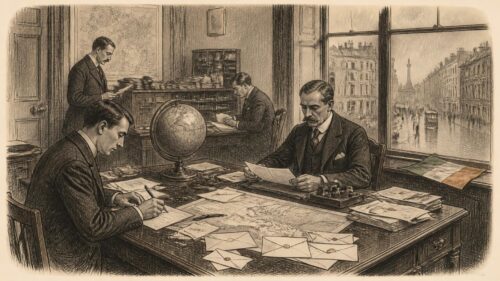
AI generated historical illustration, not a contemporary photograph.
At a Glance
Irish neutrality has usually been told as a diplomatic and military story: the young State’s determination to avoid belligerency in the Second World War, preserve sovereignty and refuse formal military alignment. Yet neutrality also had a material foundation. A country that could not heat homes, move food, power railways, supply industry or keep electricity generating would possess only a fragile independence. The history of Irish energy security therefore reveals neutrality not as an abstract principle, but as a daily contest over coal, turf, petrol, ships, labour, roads, bogs and the limits of state power.
Island Exposure
At the outbreak of the Second World War, Ireland’s constitutional and political independence was recent, incomplete in emotional terms and exposed by geography. Partition remained a defining fact. The United Kingdom was the State’s principal commercial partner and lay across the routes by which much of its fuel, manufactured goods and foodstuffs travelled. Ireland possessed peat, rivers capable of hydroelectric development and limited coal resources, but it had no domestic oil industry and depended heavily upon imported coal and petroleum. That dependence was neither obscure nor theoretical. Officials had spent the interwar years considering how an interruption of trade might affect employment, transport and essential services.
The decision to remain neutral in September 1939 consequently involved more than keeping troops outside the war. It required a small, comparatively poor and import-dependent state to sustain civil life while the seas around it became dangerous and while the neighbouring island directed its own resources to war. The Government declared a state of emergency on 2 September 1939; the Emergency Powers Act followed on 3 September. Its scope was deliberately broad, permitting controls over prices, supplies, transport, labour, industry and property as well as more familiar measures of censorship and security.
The word “neutrality” can mislead if it suggests insulation. Irish neutrality was a policy adopted in a world of powerful belligerents, not a guarantee that foreign events would stop at the border or shoreline. Economic links with Britain remained indispensable. British control of shipping routes, the mobilisation of British coal production, German submarine warfare, and the scarcity of ships all affected Ireland. The State had to retain sufficient working relations with Britain while refusing the strategic concessions that Dublin believed would compromise sovereignty, especially any restoration of British use of the former treaty ports.
Energy insecurity was thus part of the price of political autonomy, but it would be too simple to describe every shortage as a deliberate punishment for neutrality. Britain itself was under immense pressure to allocate coal, shipping, food and industrial capacity for survival and victory. Irish scholars have nevertheless shown that the restrictions imposed upon supplies became entangled with the political dispute over ports and wartime cooperation. The evidence supports a picture of pressure, scarcity and bargaining rather than a single uncomplicated policy of blockade.
This distinction matters because later memory has sometimes converted the Emergency into a morality play with only two sides: an embattled neutral Ireland and an overbearing Britain. The documentary record is more difficult and more interesting. Ireland was vulnerable because it had inherited an economy closely tied to Britain, because international war disordered trade, and because a modernising country still lacked a broad indigenous energy base. Neutrality exposed those weaknesses; it did not create them from nothing.
Peat Inheritance
Long before the Emergency, turf had been among the principal domestic fuels of rural Ireland. In many districts, cutting, drying, saving and carrying turf formed part of the annual household economy. Its importance should not be romanticised. Turf was labour-intensive, bulky, variable in quality and often inconvenient where urban dwellings, railways or industrial boilers had been designed around coal. Yet it was local. That quality made it politically significant in a country anxious about external dependence.
In the nineteenth century, peat and potatoes were frequently paired in descriptions of subsistence life. Both could be produced close to home, and both were bound into landscapes of small holdings, common rights and seasonal labour. This was not energy independence in any modern technical sense. Domestic turf users still relied on tools, transport, markets and other goods that could come from beyond the locality. Nor did peat offer an easy substitute for coal in every furnace or engine. But the bog represented a reserve of heat which did not have to pass through a foreign port.
The Irish Free State inherited this resource and the strategic imagination attached to it. During the 1930s, government intervention encouraged organised peat development. The Turf Development Board, established in 1933, was expected to bring mechanisation, drainage, transport and scientific methods to a resource which had largely been worked on a smaller scale. The project united several ambitions: rural employment, industrial development, imported-fuel substitution and the assertion that an independent state could make better use of its own territory.
There was also a powerful contrast between peat’s symbolic abundance and its practical limitations. Bogs covered extensive areas, but usable fuel had to be won from them, dried adequately, loaded, carried and delivered. Wet weather could ruin plans. Labour could be scarce. Railways and lorries required fuel in order to move fuel. A turf industry capable of serving a city or a power station involved drainage schemes, narrow-gauge railways, machinery, depots and managerial coordination. The supposedly native fuel was therefore a complex industrial undertaking as well as a traditional household practice.
Hydroelectricity offered a different version of indigenous energy. The Shannon scheme at Ardnacrusha, completed in the late 1920s, was an extraordinary statement of state ambition. It centralised electricity supply under the Electricity Supply Board and demonstrated that Irish rivers could reduce reliance on imported fuel. Its historical importance lies not merely in engineering achievement, but in establishing an institutional model: a public utility, national grid and large infrastructure project directed toward economic modernisation.
Yet hydroelectric power could not solve every problem. River flows varied, electricity demand was limited by the still modest scale of electrification, and electricity could not readily replace coal in domestic grates, rail transport, shipping or many industrial processes. The State entered the war with a useful hydroelectric base, a developing peat policy and an electricity authority, but still with an energy economy dominated by imported fuels. The coming crisis showed how wide the difference was between possessing resources and securing usable energy.
Emergency Measures
The Emergency transformed energy from a matter of commercial supply into a matter of public administration. The Department of Supplies, led by Seán Lemass, was created immediately after war began. Its central task was to preserve supplies and services essential to the community. At first, price controls appeared a plausible means of preventing profiteering and panic. They soon proved inadequate. When goods are physically scarce, a fixed price can merely produce empty shops, clandestine dealing and unequal access. Controls therefore multiplied into rationing, licensing, allocation and direction.
Fuel was among the hardest commodities to manage. Petrol rationing began early. Coal, kerosene and fuel oil later came under stringent control. Each shortage had wider consequences. A shortage of coal affected domestic heating and cooking, but also railways, industrial boilers, bakeries, gas works and electricity generation. A shortage of petrol affected ambulances, buses, agricultural distribution and the ability to move alternative fuels. A shortage of fertiliser or animal feed affected food supply, which in turn placed more pressure upon transport and household fuel. The emergency economy was an interlocking system, not a series of separate queues.
Government action went far beyond ration books. Emergency orders controlled industry, public utilities and the movement of goods. They regulated labour and enabled the acquisition of land. Tillage orders compelled the cultivation of a specified share of arable holdings, while separate arrangements sought workers for agriculture and turf production. Parliamentary records show that the State could intervene directly where it thought food or fuel provision required it. This was an unusually intrusive extension of administrative authority, justified by circumstances that officials believed threatened the ordinary life of the country.
The scale of the effort makes clear that turf was not treated as a nostalgic fallback. It became an emergency fuel programme. County councils, state agencies, farmers, private cutters and temporary workers were all drawn into expanding output. Officials sought bog land, organised transport, issued directions and tried to build stocks before winter. In parts of the country, local authorities created or administered turf schemes for hospitals, institutions and urban consumers. The effort was inherently uneven because the resource itself was unevenly distributed.
The railway system acquired particular importance. It moved turf from producing areas to places where coal had formerly been normal. But locomotives themselves needed fuel, and coal of suitable quality was difficult to obtain. Experimental substitutes and adaptations became necessary. The State’s wartime economy has aptly been described by historians as a vast experiment in fuel substitution, with railways acting as one of the channels by which bog fuel could become a national resource. This was resourcefulness under duress, not proof that peat could effortlessly replace coal.
Documentary evidence also records the mundane difficulties which grand accounts can overlook. Turf could not be measured with the same precision as standardised coal. Its moisture content, packing and density varied. Army and public bodies struggled to estimate stocks, make fair allocations and verify delivery. These administrative problems illuminate a basic truth: energy security depends on information and logistics as much as on deposits in the ground. A bog could not warm a barracks unless its output was cut, dried, counted, transported and stored.
Cold Hearths
The crisis was most keenly experienced in homes. Coal had become essential in many towns and cities, particularly where houses had grates and cooking arrangements suited to it. Turf and firewood were not universal replacements. A small urban grate might accommodate neither sufficiently, while smokier or less concentrated fuels could make cooking harder. Households with money, contacts, carts or access to rural kin did not meet scarcity in the same way as families confined to poor urban rooms. Rationing was intended to distribute shortage more fairly, but it could not abolish inequality.
Food and fuel were intimately connected. Bread, milk, vegetables and other necessities had to be grown, processed and carried. Where fuel shortages constrained transport, food distribution suffered. Where coal was scarce, cooking became difficult. The wartime shortage of imported feed and fertiliser intensified the pressure to expand tillage and reshape agricultural production. Emergency Ireland was therefore not simply a country with darker rooms and fewer car journeys; it was a society in which energy constraints entered diet, work, mobility and health.
Popular recollections of the period often emphasise bicycles, horse-drawn transport, improvised fuels, long queues and the distinctive odour of poor-quality turf. Such memories are valuable evidence of experience, but they must be handled carefully. They are not statistical records and can compress several winters into one vivid story. Documentary sources confirm the broad pattern of severe shortage and substitution; personal memory conveys what those conditions felt like. Neither kind of evidence cancels the other, but they answer different historical questions.
There was also a moral economy of fuel. People complained when they believed merchants withheld stocks, when neighbours acquired more than their share, or when black-market dealing advantaged the well-connected. Government regulation made such questions unavoidable. If the State allocated scarce coal and oil, it assumed responsibility not only for volume but for fairness. Enforcement, prosecutions and public criticism followed. This was one reason the Emergency left a lasting impression of government presence in ordinary life.
The hardship should not be overstated into a claim that all Irish households suffered identically or that the country became wholly self-sufficient. Imported goods continued to arrive in reduced quantities. Agricultural production did not collapse. Informal exchange, local resources and adaptation eased some shortages. But the decline in household coal imports was dramatic, and the strain on lower-income households was real. The Emergency revealed how quickly a modernising society could be pushed back toward forms of fuel use that had seemed to belong to an earlier generation.
That apparent reversal produced an enduring ambiguity. Turf could represent resilience, because it gave households and the State a resource beyond foreign supply chains. It could also represent deprivation, because people often used it not by free choice but because coal, oil and manufactured alternatives were unavailable. Both interpretations are supported by the historical record. The mistake is to choose one and erase the other.
Strategic Bargains
Fuel insecurity cannot be separated from diplomacy. The British government sought greater Irish cooperation in the Atlantic war and regarded the former treaty ports as strategically valuable. Dublin, led by Éamon de Valera, regarded their return to British use as incompatible with the sovereignty whose practical meaning neutrality was meant to affirm. Trade and supply questions operated in this charged atmosphere. The British position was shaped by its own wartime needs, while Irish ministers feared that economic dependence could be converted into political leverage.
Irish neutrality was never equivalent to political indifference. The State’s conduct included measures that favoured the Allied war effort in particular ways, although these were not always publicly acknowledged at the time. The Government’s overriding public aim was to prevent Ireland becoming a battlefield or a base for another power. In this setting, the possibility of supply interruption assumed strategic importance. A country unable to feed or fuel itself might be compelled to concede more than it wished.
It follows that energy security had a constitutional dimension. Sovereignty is normally discussed through laws, territory, diplomatic recognition and defence forces. During the Emergency it also rested on whether civilian society could endure disruption. The Government’s concern with turf, tillage, stockpiles and transport was therefore not peripheral to neutrality. It was one of the means by which neutrality could be maintained long enough to have meaning.
There is, however, an important qualification. No amount of turf production could have made Ireland militarily self-sufficient. The Defence Forces were small, poorly equipped by the standards of the major powers and dependent upon imported matériel. Military Archives material concerning defence planning demonstrates how seriously invasion scenarios were considered. Economic measures could buy time, reduce vulnerability and preserve public order; they could not eliminate the profound imbalance between Ireland and potential invaders.
Historians differ in emphasis. Some stress neutrality as a principled expression of national self-determination and anti-imperial political culture. Others stress its pragmatic usefulness to a state with limited capacity and an exposed geographical position. The energy record suggests that principle and pragmatism were not opposites. A principled refusal to enter the war required practical arrangements for food and fuel. Conversely, practical measures acquired symbolic force because they protected the freedom to decide.
State Capacity
The Emergency was a testing ground for Irish state capacity. Departments had to gather information, negotiate supplies, regulate prices, organise labour, communicate rules and cooperate with local authorities. Institutions created before the war, including the Electricity Supply Board and peat-development agencies, mattered because they provided technical knowledge and organisational reach. Institutions created or enlarged during the crisis mattered because the scale of shortage exceeded normal commercial arrangements.
Seán Lemass’s Department of Supplies has often been treated as evidence of an expanding developmental state. That assessment is reasonable, provided it is not converted into a story of effortless competence. Emergency administration involved delay, error, resistance and compromise. Supply forecasts could be wrong. Machinery and transport were scarce. The requirement for skilled turf workers competed with agriculture, industry, military mobilisation and emigration. The State could command effort on paper, but it could not instantly produce dry fuel, suitable vehicles or a trained workforce.
Compulsory measures exposed tensions between national necessity and local autonomy. Farmers could be directed to till land. Men could be pushed toward agricultural or turf work through the rules governing assistance and employment. Local authorities could be enlisted in fuel schemes. Such powers reflected a belief that emergency survival justified exceptional intervention. They also generated resentment, especially where people felt that officials did not understand soil, weather, household need or the realities of rural labour.
Peat extraction illustrates the mixed outcome. Output rose, new labour was mobilised and organised schemes expanded. For a time, the bogs became central to the national economy in a way they had not been before. Yet peat’s physical characteristics imposed limits that orders could not repeal. Inadequately dried turf, difficult transport and unsuitable appliances reduced its usefulness. In many urban areas it was an imperfect substitute, while the effort to supply it could be costly and cumbersome. The State learned that indigenous resources were valuable but not infinitely elastic.
This lesson outlived the war. The creation of Bord na Móna in 1946 inherited both the assets and the ambitions of the wartime turf effort. The new body represented a belief that peat could contribute to employment, electricity and fuel supply under more orderly peacetime conditions. It also embodied a broader postwar confidence in publicly directed infrastructure. The Emergency had made the costs of dependence visible; state enterprise appeared one response.
Postwar Choices
The end of the Second World War did not instantly restore normality. Rationing and emergency controls unwound gradually. Fuel supplies remained a concern into the late 1940s, and official records show continuing competition between domestic consumers and institutional users for available turf. The postwar years were marked by reconstruction abroad, shortages in Europe and the slow reorganisation of trade. In Ireland, the memory of cold homes and constrained travel made energy provision a continuing political issue.
Peat retained a prominent place in national planning, but the longer postwar trajectory was toward a more varied energy economy. The Electricity Supply Board extended generation and networks. Rural electrification altered domestic life and agricultural work. In this period electricity became a symbol of modern citizenship: light, appliances, communication and productive capacity reaching areas previously underserved by commercial systems. Hydroelectricity and peat-fired generation both contributed, but neither displaced imported fuels altogether.
The central postwar dilemma was not whether Ireland should use indigenous resources. It plainly would. The issue was how far national development could be based on fuels that were domestic but expensive, environmentally disruptive or technically limited, rather than on imported fuels that appeared cheap and efficient. In the 1950s and 1960s, oil increasingly seemed to offer the answer. It was energy-dense, convenient for transport and electricity generation, and widely available in international markets at prices that encouraged confidence.
That confidence helped to change the balance of the energy system. Oil-fired generating capacity expanded, including major stations serving the growing economy. A refinery at Whitegate opened in 1958. Motorisation increased, home heating patterns changed and industrial growth raised demand. The new economy was more prosperous and more connected than Emergency Ireland, but it also became tied to a global petroleum system over which Irish governments had little control.
The irony is striking. The Emergency had taught the dangers of reliance on imported fuels; the prosperity of the following decades made imports seem manageable again. This was not simply a failure of memory. Policymakers faced real constraints. Domestic peat could be costly, hydro resources were finite, coal was limited and nuclear generation posed financial, technical and political questions. Imported oil enabled growth at a time when its security seemed far less doubtful than it later proved.
Oil Reckoning
The oil shocks of the 1970s brought the old vulnerability back into view in a new form. Ireland joined the European Economic Community on 1 January 1973. Later that year, the Arab–Israeli war and decisions by oil-producing states precipitated an international energy crisis. The impact reached a country whose energy economy had become heavily oil-dependent. The crisis was not a replay of the Emergency: Ireland was wealthier, institutional capacity was greater and international cooperation had changed. But the underlying question was recognisable. What happens to national life when essential energy is largely controlled elsewhere?
Official assessments of the period recorded the scale of the dependence. By 1973, imported oil supplied close to four-fifths of Ireland’s primary energy requirements. The rise in oil prices therefore affected transport, household budgets, industry, electricity costs, inflation and the balance of payments. The first shock was followed by another period of severe disruption at the end of the decade. Ireland’s energy problem was no longer primarily a shortage of coal ships in wartime waters. It was exposure to price, supply and geopolitical instability in a global commodity market.
The response was diversification. Natural gas from the Kinsale field, discovered in the early 1970s and brought ashore later in the decade, offered a significant indigenous contribution. Bord Gáis Éireann was established in 1976 to develop gas transmission and distribution. Peat remained important in policy, while coal returned to strategic discussion despite its own import dependence. Construction began on the coal-fired station at Moneypoint in 1979. Conservation, insulation and more efficient energy use gained a prominence they had not previously possessed.
Nuclear power also entered public debate. Plans associated with Carnsore Point in County Wexford reflected the urgency with which diversification was discussed after the oil crisis. They did not proceed. The reasons included public opposition, changing economic circumstances, uncertainty over demand, financial risk and wider concerns about safety and waste. It would be misleading to claim that neutrality alone decided the matter. The nuclear controversy instead demonstrated that energy security could conflict with other public priorities and that a technical answer might lack political consent.
In the 1970s, energy security was increasingly embedded in European rather than solely national arrangements. Ireland’s membership of the European Communities opened channels of policy coordination, financial support and common rules. The International Energy Agency, established in 1974 among industrialised states, also represented the recognition that oil emergencies could not be managed only within national borders. This did not remove Irish vulnerability, but it altered the setting in which governments sought resilience.
The contrast with the Emergency is instructive. In the 1940s, the State had sought survival through rationing, domestic fuel substitution and tightly managed scarcity. In the 1970s, it sought a more diversified portfolio: gas, peat, coal, hydroelectricity, conservation, interconnection and participation in international institutions. The vocabulary had changed, but the central insight had not. Dependence on a single imported fuel created political and economic risk.
Neutrality Debates
How, then, should neutrality and energy security be connected? The strongest historical claim is not that Ireland’s neutral policy mechanically caused every energy decision. Many later developments arose from economic growth, technology, environmental concerns and European integration rather than from military non-alignment. Nor has Ireland ever declared itself permanently neutral in the legal sense adopted by some European states. Its policy has been more accurately described as military neutrality or non-alignment.
The connection is nevertheless substantial. The Emergency made clear that military neutrality without economic resilience was precarious. It also embedded a political association between domestic resources and national independence. Turf, electricity and later gas carried more than commercial significance. They represented attempts to ensure that Ireland could retain room for manoeuvre when international conditions deteriorated. This was especially important in a state whose modern history included colonial rule, partition and persistent economic dependence upon its nearest neighbour.
Interpretation must be distinguished from documentary fact. It is documented that the State expanded turf production, rationed fuels, directed labour and created machinery for supply control during the Emergency. It is documented that postwar governments developed state energy bodies and that oil dependence became a grave concern in the 1970s. It is an interpretation, though a persuasive one, that these policies formed a continuous national tradition of energy sovereignty. Continuities existed, but so did changes in technology, markets and political context.
Folklore and public memory add another layer. Stories of turf cutting, smoky fires, bicycles and ingenious substitutes preserve a vernacular history of endurance. They can encourage a comforting belief that Ireland was once fully self-reliant because every household knew the bog. The evidence does not sustain that conclusion. The Emergency economy survived partly through domestic adaptation, but it remained constrained by a lack of coal, oil, machinery, shipping and manufactured goods. The traditional fuel was essential precisely because the modern imported system had been disrupted.
The more useful legacy is not self-congratulation but realism. Energy security is not autarky. A small island economy cannot produce every fuel, technology or service within its borders. Security lies in diversity, adequate infrastructure, stored capacity, resilient institutions, trustworthy information, fair distribution and workable international relationships. In the Irish case, it has also depended upon recognising that sovereignty is weakened when basic necessities are vulnerable to sudden external disruption.
Enduring Lessons
The history of neutrality and energy security in Ireland begins with a paradox. The State’s determination to stand apart from war increased the significance of its connection to the wider world. Neutrality could not suspend geography, commercial dependence or the physical needs of homes and farms. Instead, it compelled government to confront them. The Emergency was a harsh education in the distance between a sovereign policy and the material capacity needed to sustain it.
Peat was central to that education. It was a local resource, a source of employment and a vital emergency substitute. It was also difficult to harvest, transport and burn efficiently at scale. Its role should be remembered neither as a quaint survival nor as an uncomplicated national success. The bogs assisted Ireland through an exceptional crisis, but they could not wholly replace the imported coal and oil on which much of the economy had come to rely.
Electricity policy supplied a more durable institutional legacy. Ardnacrusha, the Electricity Supply Board, rural electrification and later gas infrastructure demonstrated the value of long-term public investment. These systems did not abolish dependence, but they broadened the State’s options. The 1970s then reinforced the case for diversification when oil’s apparent abundance proved politically contingent and economically costly.
For historians, the subject resists a narrow focus on cabinets, diplomats and military plans. It belongs equally to households trying to cook with inferior fuel, turf workers on wet bogs, railway staff handling awkward loads, engineers balancing generating systems, local officials arranging deliveries and civil servants drafting emergency orders. Their work made neutrality tangible. The State’s independence was lived through warmth, light, movement and food as much as through declarations of policy.
That is why the history remains significant. It shows that national security has always included civilian infrastructure and energy supply, even when the language of “energy security” was not commonly used. Ireland’s experience during the Emergency and the oil crises did not provide a final formula. It did, however, leave a durable historical warning: political freedom is more secure when the systems that sustain ordinary life are varied, governable and capable of enduring shocks.
Enduring Lessons
The connection is nevertheless substantial. Irish military neutrality depended on the State retaining room for independent judgement during crises, and that room narrowed whenever fuel, transport or electricity became insecure. This did not mean that self-sufficiency was either possible or desirable. The experience of the Emergency showed instead that dependence had to be managed: through stocks, alternative supplies, public utilities, transport planning and a capacity to direct scarce resources when ordinary markets failed. Energy policy was therefore not an adjunct to sovereignty. It was one of the practical conditions under which sovereignty could be exercised.
That conclusion helps explain the recurring appeal of indigenous energy. Peat, hydroelectricity and, later, natural gas carried importance beyond their immediate commercial return because each promised some reduction in exposure to foreign supply decisions. Yet the historical record warns against treating domestic resources as an automatic guarantee of security. Turf required large amounts of labour, drainage, machinery and transport; hydroelectricity depended upon geography and water flows; gas deposits were finite. A resource counted in the ground, or in national territory, was not necessarily available at the moment or in the form in which homes, factories and power stations required it.
The most durable lesson was therefore diversification rather than isolation. In the Emergency, diversification often meant difficult substitution under conditions of shortage: turf for coal, bicycles and horses for petrol-driven transport, and tightly controlled allocation in place of normal trade. After the oil shocks, it meant a more deliberate attempt to spread risk across peat, coal, natural gas, electricity generation, conservation and European cooperation. The difference was significant. Wartime policy was largely an effort to endure deprivation; later policy sought to reduce the chance that disruption would force such deprivation again.
European membership complicated older ideas of independence without simply displacing them. Community measures for solid fuels and the wider international response to the oil crises made energy increasingly a matter of cooperation among states. For Ireland, participation in these arrangements offered access to finance, information and collective planning, while also placing national choices within shared rules and markets. This was a different kind of security from the self-reliance imagined around the bogs during the Emergency. It rested less on standing apart than on ensuring that interdependence was broad enough not to become a single point of pressure.
The history also qualifies any easy celebration of emergency state power. Rationing, direction and compulsory measures demonstrated that the Irish State could intervene deeply in economic life when survival appeared at stake. They also revealed the limits of command. Officials could allocate what existed, but could not make wet turf burn efficiently, create ships at short notice or prevent hardship from falling unevenly. Later energy choices likewise required public acceptance. The controversy surrounding nuclear proposals showed that a measure presented as strategically prudent could still fail if citizens judged its financial, environmental or social costs too high. Security was not merely a technical calculation made by engineers and ministers.
Fuel neutrality, then, was never a separate doctrine proclaimed alongside military neutrality. It was the material discipline imposed by Ireland’s geography, economic history and political ambitions. The country repeatedly learned that autonomy did not require severing outside connections, but it did require avoiding excessive reliance on any one fuel, route, supplier or political relationship. From the turf schemes of the Emergency to the diversification debates of the 1970s and 1980s, Irish energy policy carried the same underlying question: how could a small state remain connected to the world without becoming helpless when that world was disrupted?
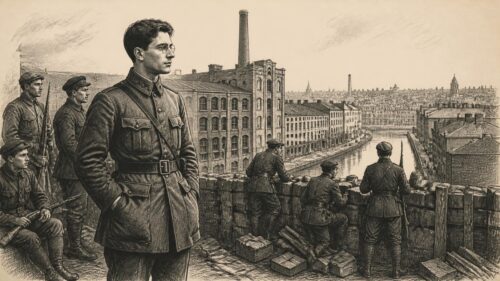
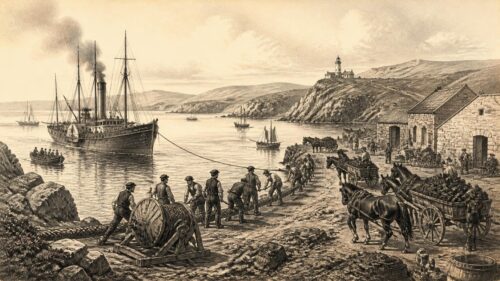
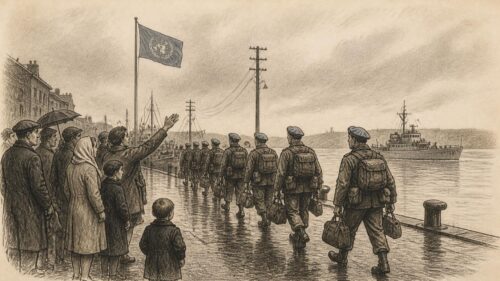


The article’s treatment of turf is compelling because it resists portraying peat either as national self-reliance or merely as wartime backwardness. Instead, turf appears simultaneously as a locally available resource, an instrument of sovereignty, and a source of unequal hardship when transport, labour, weather and household equipment limited its usefulness. This ambiguity also complicates memories of the Emergency and postwar development: indigenous energy could strengthen autonomy while demanding state coordination and leaving international dependencies intact. How should we interpret turf’s role during the Emergency: chiefly as evidence of neutrality, as an exposure of social and infrastructural weakness, or as both?