
Cultural Commons
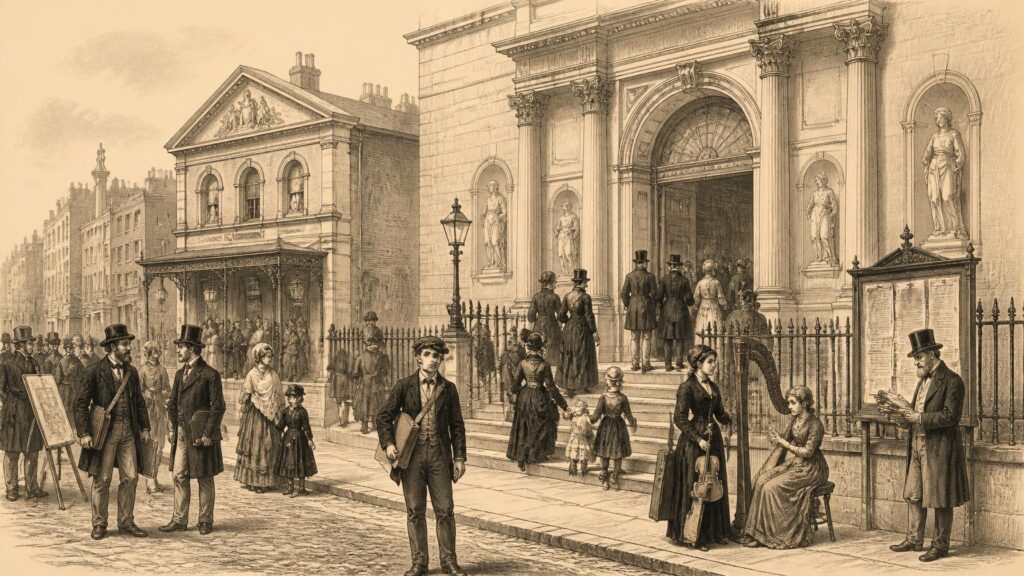
AI generated historical illustration, not a contemporary photograph.
At a Glance
Public support for the arts in Ireland has never been merely a question of grants. It has concerned who may encounter a painting, hear a concert, enter a theatre, preserve a local memory, make work without private means, or recognise their own community in the shared life of the nation. From nineteenth-century galleries to twentieth-century legislation and later programmes of participation, the history of arts funding is also a history of public culture: its institutions, exclusions, arguments and ambitions.
Civic Beginnings
Irish public culture did not begin with an arts council, a ministerial department or a formal cultural policy. Its earlier foundations lay in a mixed world of civic subscription, philanthropy, learned societies, municipal effort, religious and educational institutions, commercial display and imperial administration. Such arrangements could make art visible to a public, but they did not necessarily make that public socially broad, politically equal or geographically well served. The word “public” has always required scrutiny. It may mean that a building is open to visitors, that a collection is held in trust, that an event is financed from taxation, or that citizens can take part in making culture rather than merely receiving it.
The National Gallery of Ireland provides an important nineteenth-century example. Its origins followed the Dublin International Exhibition of 1853, backed by railway entrepreneur William Dargan, and the campaign that followed for a permanent gallery. Founded under the National Gallery of Ireland Act 1854, the institution opened to the public on 30 January 1864. It was both a cultural amenity and a statement about the value of art within civic life. The history is not a simple tale of a nation creating itself through art: the Gallery emerged within the constitutional setting of the United Kingdom, and its early collection included works purchased abroad and loans from London. Yet the permanent public collection created a durable site in Dublin where works of European and Irish art could be encountered outside private houses.
The Gallery’s early portrait collection reveals how funding and cultural definition could be inseparable. Henry Doyle’s proposal for a distinct Irish portrait collection met Treasury resistance, partly because Irish figures were already represented in London’s national collection. Doyle nevertheless opened a portrait room in 1875 without additional funding. That episode demonstrates a recurrent Irish problem: the question was not only whether art deserved support, but whether Ireland possessed the institutional means to frame its own history, choose its own representative figures and preserve them for public use.
Public culture also developed through less monumental places: libraries, schools, parish halls, reading rooms, exhibition societies, music associations and local festivals. Their histories vary widely from place to place. It would be misleading to describe all such activity as state provision. Much was voluntary, locally organised or dependent on patrons. Nevertheless, it accustomed people to the idea that books, performance, visual culture and collective memory were not simply private luxuries. They could be matters of local dignity, education and association. The later language of access and participation had older, if uneven, roots.
National Theatre
The Irish literary revival made culture more explicitly political, even when artists resisted political instruction. The Abbey Theatre, founded in 1904 by W. B. Yeats and Lady Gregory, was created as a national theatre before the existence of an independent Irish state. Its early survival rested in significant measure on the patronage of Annie Horniman, whose support enabled the conversion of buildings in Abbey Street and Marlborough Street into the theatre. The Abbey’s origin is therefore a useful corrective to any assumption that national culture is always born through public expenditure. Private benefaction, voluntary organisation and artistic networks mattered profoundly.
Yet the Abbey also demonstrates why patronage alone could not settle the question of public culture. A theatre presenting plays about rural life, class, sexuality, religion, rebellion and national memory could bring argument directly before audiences. The disturbances around The Playboy of the Western World in 1907 and Sean O’Casey’s The Plough and the Stars in 1926 have often been retold as proof that Ireland instinctively fears artistic freedom. That is an interpretation, not an established national characteristic. The documented fact is that controversy occurred. The larger historical point is that public culture was contentious because it was public: audiences believed the stage concerned them, their values and their history.
The fire that damaged the Abbey’s original buildings in 1951 carries a symbolic weight in retrospect, but it should not be turned into myth. It did not by itself create Irish arts policy. Rather, it occurred in the same period in which the new State was beginning to debate whether cultural institutions required organised support. The Abbey’s history shows the persistence of a central tension: a theatre may be called national, but who pays for it, who governs it and what it may say remain separate questions.
State Hesitation
Independence did not produce an immediate, comprehensive cultural system. The State inherited institutions and responsibilities while facing constrained public finances, widespread poverty, emigration and competing claims from housing, agriculture, health, education, transport and industrial development. In that setting, arts expenditure could easily be characterised as secondary. This was not uniquely Irish; however, the scale of the new State’s economic limitations gave the argument particular force.
There was, even so, no total absence of cultural activity or official interest. National collections continued, Irish-language policy possessed a strong official presence, and theatre, music, publishing, craft and festivals developed through overlapping voluntary and public channels. The more accurate description is one of fragmented provision. Funding often depended on annual decisions, personal advocacy or the endurance of organisations rather than on a settled national policy.
That fragmentation shaped later arguments. Advocates did not simply seek more money; they sought recognition that artistic work and public access should not be treated as incidental. They also had to address a practical problem: direct ministerial patronage could make arts support vulnerable to political preference. A durable system would need public funds while allowing some distance between government and artistic judgement. The eventual Irish answer was the arts council model, an arrangement intended to be publicly financed but comparatively autonomous.
Council Formation
The decisive institutional beginning came after the inter-party government commissioned Dr Thomas Bodkin in 1948 to investigate the condition of the arts in the twenty-six counties. Bodkin’s report concluded that the arts were suffering neglect. John A. Costello’s government brought forward the Arts Act 1951, creating An Chomhairle Ealaíon, the Arts Council. The Council’s statutory purposes were broad: to stimulate public interest in the arts, promote knowledge, appreciation and practice, and assist in improving artistic standards. Its initial remit extended across painting, sculpture, architecture, music, drama, literature, design in industry and the fine and applied arts.
The first full meeting took place on 25 January 1952. Its inaugural State endowment for the financial year 1952–53 was £10,000. In absolute terms this was modest, and its modesty matters. The Council was not founded as an all-powerful cultural ministry capable of building every theatre, buying every collection or securing every artist’s livelihood. It was a small agency expected to encourage, advise, convene and distribute limited assistance. Yet its establishment marked a major change in principle. The arts had acquired a recognised place in public administration.
The legislative debates also established an enduring ideal of arm’s-length support. Costello argued that art should be encouraged by the State without being controlled by it. The phrase should not be treated as a guarantee that politics disappeared from cultural life; appointments, budgets, legislation and public controversy have always kept culture near politics. But it identified a constitutional aspiration: government might supply funds, while decisions about artistic merit should not become routine ministerial direction.
This was a significant departure from a purely ceremonial view of national culture. The Council could assist exhibitions, productions, recitals, lectures and publications; support artists and organisations; help bring foreign work to Ireland and Irish work abroad; mount schemes; administer trusts; and advise government. Its archive records activities ranging from direct grants to touring and exhibition initiatives. Public culture was thereby conceived not only as the preservation of a canon, but as an active field of creation, circulation and encounter.
Rural Reach
The word “national” carried a geographical obligation. Dublin contained major cultural institutions, but a public arts policy confined to the capital would reproduce an older imbalance. The Arts Council’s early activities included assistance for organisations and schemes directed beyond the metropolis, including a joint-purchase approach and support connected with halls in rural areas. The evidence does not justify a romantic claim that such programmes eliminated uneven access. Travel, disposable income, transport, local facilities and entrenched social divisions remained real barriers. Nonetheless, the Council’s remit accepted that cultural opportunity ought not be imagined only in terms of a capital-city audience.
This matter was more than logistical. Touring theatre, local exhibitions, music societies and festival activity could form audiences as well as serve them. An audience is not simply a body of consumers waiting to be reached. It is built through familiarity, education, repeated occasions and the confidence to enter a venue or join an activity. Public funding could therefore affect the cultural map even where grants were small. It could underwrite the risk that a rural tour, a local festival or a first exhibition might otherwise be unable to bear.
Accounts of the 1951 legislation show that parliamentarians themselves worried about unequal access outside Dublin. Those concerns were often framed in the period’s paternal language of improving taste, a language that can sound restrictive now. It nonetheless contained a practical recognition that the distribution of culture mattered. Modern ideas of cultural rights and participation are not identical to that earlier outlook, but they inherit its question: how can artistic life be available across the country rather than concentrated among those already close to institutions?
Taste Disputes
Public subsidy creates an unavoidable difficulty: someone must make choices. To fund one company, exhibition or artist is not necessarily to condemn another, but resources are finite and criteria carry values. Debates over “high” and “popular” art, traditional and experimental work, professional and amateur practice, established institutions and emerging artists have therefore been part of Irish funding history from the beginning.
The tenure of writer Sean O’Faoláin as Director of the Arts Council between 1956 and 1959 provides a revealing case. In 1959 the Council refused to support the Royal Hibernian Academy’s annual exhibition through a scheme that enabled local authorities to purchase works. The dispute became public and acrimonious. Brian McKenzie’s scholarly study treats the episode not as a minor personality clash but as evidence of competing ideas about national culture, public taste and the role of cultural elites. The incident demonstrates that the supposed neutrality of arts administration is often illusory. Decisions about quality, innovation and value can become arguments about authority.
Interpretation is especially necessary here. It would be simplistic to conclude that state support inevitably imposes a single official taste. The Council’s very existence created opportunities for artists and organisations outside direct departmental control. Equally, it would be naïve to imagine that grants remove power from cultural life. Panels, boards, professional norms, applications and institutional histories all influence whose work becomes visible. A mature public culture must acknowledge that tension rather than conceal it behind the language of excellence alone.
Folklore belongs in this story differently. Traditional music, storytelling, song and local custom were often transmitted through families, communities and gatherings rather than through formal funding. Their survival cannot be credited to the State. Later support could assist documentation, teaching, performance and recognition, but it did not invent the practices it supported. Treating living tradition merely as heritage to be administered risks flattening it; treating it as untouched by institutions ignores the ways education, broadcasting, festivals and grants can affect its transmission. The historical evidence supports complexity rather than either legend.
Legislative Shift
The Arts Act 1973 expanded the legal framework in which the Council worked. Contemporary analysis of the period records an intention to broaden representation and move beyond a perception that the Council favoured a limited range of prestigious art forms. This did not instantly resolve every imbalance, but it reflected a changing understanding of the arts as a wider field. The Council’s public function increasingly had to address new forms, changing audiences and the cultural effects of social change.
The Arts Act 2003 subsequently repealed the 1951 and 1973 Acts while continuing An Chomhairle Ealaíon in being. Its definition of the arts was deliberately expansive, encompassing creative or interpretative expression in traditional or contemporary forms, including visual arts, theatre, literature, music, dance, opera, film, circus and architecture. This legislative wording matters historically because it acknowledges that culture is not fixed to a short list of inherited disciplines. It also places participation, as well as artistic development, within the purpose of the Act.
Such legislation did not create an unlimited entitlement to funding. It did, however, change the terms in which the State could be held accountable. Once participation and development appear in statute, citizens and organisations can ask whether systems of funding, education and infrastructure match those stated aims. Law does not settle the answer, but it provides a public language in which the question may be asked.
Artists Livelihoods
Direct grants to organisations are only one way in which public policy can shape artistic life. Tax policy also matters. Section 2 of the Finance Act 1969 created an exemption for certain earnings of writers, composers and artists from original and creative works in specified categories. The provision was later incorporated and amended in tax law, but its introduction in 1969 was an unmistakable public recognition that creative labour had distinctive conditions.
That measure has frequently been described as support for “the artist,” but its effects have never been uniform. An exemption assists only people with taxable qualifying earnings. It cannot substitute for affordable workspace, reliable commissions, access to training, social protection, small-scale venues or audiences willing and able to pay. Nor does it cover every creative discipline in the same way. The historical importance of the policy lies not in a claim that it solved artistic precarity, but in the fact that Irish fiscal policy was used to recognise cultural production as economically and socially significant.
The broader lesson is that funding should not be reduced to an annual grants figure. Artists work within an ecology of income, taxation, education, housing, intellectual property, venues, institutions and informal networks. A public culture may celebrate internationally known writers, musicians or performers while leaving less visible workers exposed to insecurity. Historical praise for Irish creativity can therefore obscure material conditions. The record of policy is strongest when read alongside the conditions under which people can actually continue making work.
Local Culture
Over time, cultural provision increasingly involved local authorities, libraries, arts offices, county museums, venues and community organisations. This change widened the practical meaning of public culture. National institutions remain vital, but the nearest encounter with art is often not in a national gallery or flagship theatre. It may be a local library workshop, a public art commission, a youth music project, an exhibition in a regional centre or a festival shaped by volunteers and professional organisers together.
Local provision does not mean that every locality receives equal resources. Larger urban areas often possess more institutions, audiences and specialist staff, while smaller places may rely on a small number of committed workers. Yet the turn towards local cultural planning brought a different principle into view: culture is linked to place. It can be concerned with the histories, languages, landscapes and social relationships of particular communities, not solely with touring a central programme outward.
This is where the distinction between documented evidence and aspiration is essential. Policy documents frequently promise access, inclusion and participation. These are important commitments, but a commitment on paper is not evidence that every barrier has been removed. A historian can record the emergence of the language and the institutions; assessing lived access requires further evidence about attendance, cost, disability access, transport, representation and local decision-making. The ideal of cultural democracy remains work in progress rather than a completed national achievement.
Heritage Institutions
Public culture in Ireland has never been confined to contemporary arts. Museums, archives, galleries, historic places and collections preserve objects and stories through which people encounter the past. Their work raises related questions of access, interpretation and authority. What is collected? Whose memories are catalogued? Which languages and communities appear in displays? Who has the resources to conserve a building, manuscript, photograph or oral history?
The legal development of national cultural institutions illustrates the long duration of public responsibility. The National Gallery remains an autonomous national cultural institution operating under the aegis of the relevant government department, with governance shaped by legislation from its nineteenth-century foundation through later National Cultural Institutions Acts. This continuity should not be mistaken for stasis. An institution may be old while its audiences, collecting priorities and educational responsibilities change substantially.
Heritage funding adds another dimension to the story. The Heritage Council supports projects by community groups and organisations across Ireland, while newer initiatives have also sought collaboration between collection-holding bodies in Ireland and Northern Ireland. These measures show how public culture may be rooted in local archives, material heritage and community stewardship as much as in professional arts production. Their significance lies partly in recognising that the past is not held only in national buildings; it is also embedded in towns, landscapes, family records and shared practices.
Northern Context
An all-island historical perspective requires care. Cultural administration in Northern Ireland has developed under a distinct constitutional and governmental framework. The Arts Council of Northern Ireland is a non-departmental public body, funded by grant-in-aid through Northern Ireland’s Department for Communities, and was established as a statutory body under the Arts Council (Northern Ireland) Order 1995. Its legal position is therefore not an extension of An Chomhairle Ealaíon’s remit in the Republic.
That distinction does not mean cultural life stops at the border. Artists, audiences, publishers, festivals, traditional musicians, heritage workers and institutions have long maintained relationships across the island and beyond it. But cross-border cultural contact should not be romanticised as automatic harmony. Different funding systems, political histories, identities and institutional priorities shape the terms of cooperation. When public programmes support shared heritage or collaborative activity, they operate within that layered history.
The result is a useful warning against easy national narratives. There is no single Irish system of public culture, even where there are shared traditions and intertwined artistic worlds. The history is made of connections, separations and negotiated partnerships. To acknowledge this is not to diminish cultural exchange; it is to describe its conditions accurately.
Centenary Moment
The centenary of the Easter Rising in 2016 gave renewed force to the relationship between commemoration, participation and public culture. The State’s Ireland 2016 programme prompted widespread events and local engagement around identity, citizenship, history and memory. Its legacy included Creative Ireland, established in 2017 as an all-of-government culture and wellbeing programme. The programme explicitly drew inspiration from the public response to the centenary and sought to connect cultural activity with communities, young people, health, creative industries and local government.
Creative Ireland marked a notable shift in official vocabulary. Earlier arts policy often emphasised standards, excellence and support for particular art forms. Those themes remained, but the newer programme placed greater stress on creative potential, participation and wellbeing. This does not mean that culture suddenly became democratic in 2017; local cultural activity had long existed, and earlier Arts Council work had addressed access. Rather, it indicates that participation was increasingly presented as a central policy purpose, not merely a beneficial side effect.
The programme also illustrates the advantages and risks of broad cultural language. It can bring arts, heritage, language, education and community development into productive relation. It can also make “creativity” so expansive that difficult questions about sustained funding for artists and specialist institutions become blurred. A festival, a school project, an archive, a film production and a major theatre all contribute to public culture, but they do not have identical needs. Good policy requires both connection and distinction.
Public Value
In 2019 the Government published Culture 2025, described as Ireland’s first national cultural policy framework. It stated that everyone has a right to enjoy, create and participate in their country’s culture. The language is significant. It moves beyond the older assumption that the State’s task is primarily to preserve treasures or subsidise exceptional institutions. It frames culture as something to which people have a relationship as citizens and residents.
Such language should be judged with proportion. Cultural rights do not mean that every preference can be publicly funded, nor that artistic decisions can be made by opinion poll. They do mean that public bodies must consider barriers to access and participation seriously. A culture funded only for those who can pay high ticket prices, live near major venues or already possess confidence in elite spaces is public in a narrow legal sense but limited in practice.
The economic case for arts funding is often made through employment, tourism, regeneration and international reputation. Those effects can be real and may be documented in particular circumstances. Yet they are insufficient as the sole justification. If culture must always prove itself by visitor spending or export earnings, forms of work with deep local, educational or experimental value may be disadvantaged. The older argument that art is a luxury and the newer argument that art is an industry are opposites only on the surface. Both can fail to describe culture as a shared field of meaning, criticism, memory and imaginative freedom.
Lasting Questions
The history of Irish arts funding suggests no final formula. Public support has advanced through small grants, statutory institutions, tax measures, local initiatives, national collections, heritage schemes and cross-government programmes. It has been defended in the language of national identity, education, regional balance, artistic excellence, social wellbeing, economic development and cultural rights. Each language captures something true, but none is sufficient by itself.
One lasting question concerns independence. Arm’s-length funding remains attractive because it protects artists and organisations from direct political command. Yet independence must coexist with transparent governance, fair procedures and accountability for public money. Another question concerns equality. More funding does not automatically make culture more accessible if resources remain concentrated, applications are difficult to navigate or institutions fail to reflect the communities they serve. A third concerns time. Creative work, conservation and audience development often require patient support, whereas political and budgetary cycles can be short.
There is also the question of historical memory. Ireland’s public culture is sometimes presented as the natural flowering of a uniquely creative people. That is closer to national folklore than to historical explanation. The documentary record shows something more demanding: artists, patrons, civil servants, elected representatives, local organisers, educators and audiences repeatedly made arguments for culture under conditions of scarcity and disagreement. Institutions were founded, revised and contested. Access was enlarged, but unevenly. Traditions endured through communities as well as through official recognition.
The cultural commons is therefore neither a finished inheritance nor a decorative addition to public life. It is the continuing arrangement by which a society decides what it will preserve, what it will enable, who will be heard and how widely the means of imagination will be shared. Ireland’s history of arts funding shows that these decisions are never purely administrative. They are arguments about the kind of public the country wishes to become.


One striking theme is the tension between public funding as a means of widening cultural access and as a system that inevitably makes judgements about merit, geography and participation. The article suggests that Ireland’s arm’s-length Arts Council model sought to protect artistic independence while addressing longstanding concentration of institutions and opportunities in Dublin. Yet later legislation’s broader definition of the arts raises questions about whether formal inclusion translates into equal practical access for artists, audiences and living traditions. How should Ireland assess whether contemporary funding balances artistic autonomy with cultural participation across rural communities, different art forms and social backgrounds?