
Remote Care
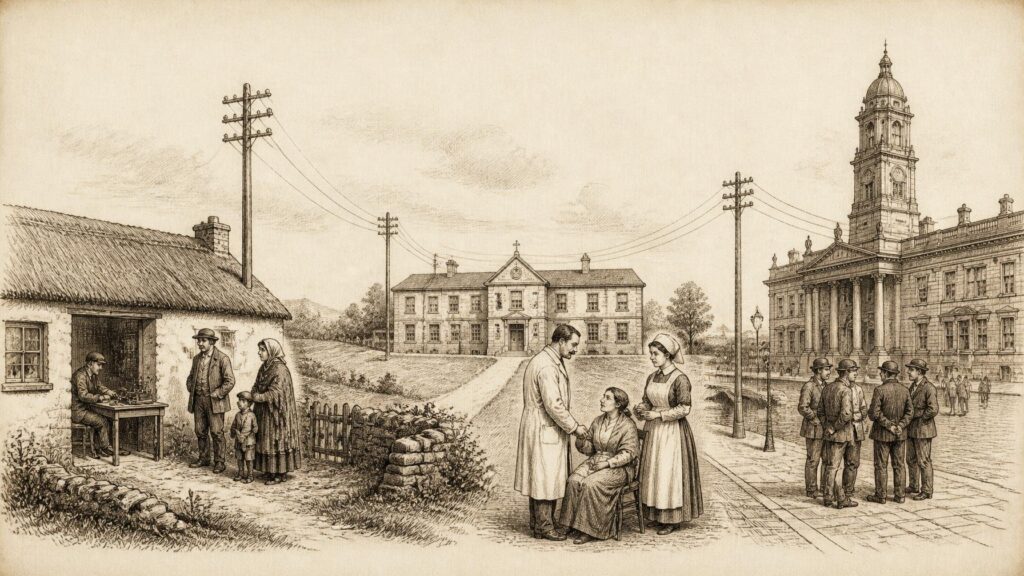
AI generated historical illustration, not a contemporary photograph.
At a Glance
Digital mental health in Ireland is not a tale of machines replacing care. It is the recent history of a health system, voluntary organisations, researchers and service users attempting to bring advice, contact and structured therapy closer to people whose needs have often been met late, unevenly or far from home. Its decisive years have been the decade before and after the Covid-19 emergency, but its origins lie in older Irish arguments about institutions, community care, access and the proper place of the patient’s voice.
Historical Setting
The phrase “digital mental health” can suggest an abrupt technological novelty: an application on a telephone, a video appointment, a web-based cognitive behavioural therapy course, or a text conversation during a night of distress. In Ireland, however, the subject belongs to a longer history. It should be understood as one chapter in the difficult movement away from a mental-health system long associated with large institutions and towards services intended to be delivered in communities, through primary care, specialist teams and voluntary bodies.
That movement was neither uniform nor complete. The Mental Health Act 2001 created important safeguards around involuntary admission and established the Mental Health Commission and the Inspector of Mental Health Services. Yet legislation did not itself settle the practical questions of waiting times, local capacity, specialist staff or access to talking therapies. The national policy A Vision for Change, published in 2006, gave formal expression to a community-oriented model. Its successor, Sharing the Vision: A Mental Health Policy for Everyone, published in June 2020 for the period to 2030, retained that broad ambition while placing greater weight on prevention, primary care, recovery, rights and service-user participation.
Digital tools entered this inherited landscape as possible additions to, rather than straightforward replacements for, local care. Their appeal was understandable. Ireland has a widely dispersed population, marked differences between urban and rural provision, and a health service in which a person may encounter a general practitioner, a public service, a charity, a school or college service, and private therapy by different routes. A web resource can be reached without a journey; a text line may be used privately; a guided programme can be completed outside normal clinic hours. Such advantages matter, but they also reveal a historical problem: if a service is designed chiefly to compensate for shortages elsewhere, technology can expose rather than solve inequalities.
For this reason, the history is best approached as one of changing channels of care. Earlier public discussion centred on beds, hospitals, professional authority and formal referral. By the late 2010s, it increasingly included websites, telephone supports, online counselling, video links, moderated peer communities and digital self-help. The change was not merely technical. It altered who could initiate contact, how quickly information could be found, what counted as an encounter with a service, and how responsibility might be divided between a person, a clinician and an online platform.
Policy Origins
Irish policy did not begin with a single digital masterplan. The record instead shows a gradual convergence of mental-health reform, broader public-service digitisation, suicide-prevention work and voluntary-sector innovation. By 2018, ministers were publicly discussing e-mental-health initiatives, pilots in tele-counselling, a dedicated mental-health telephone number and a crisis text service. The redesigned YourMentalHealth information service represented an important, if modest, form of digital infrastructure: not treatment in itself, but a public doorway intended to direct people towards appropriate supports.
This distinction is important. A webpage offering reliable explanations and local contacts does not have the same clinical function as psychotherapy; a moderated text exchange does not have the same function as emergency medical care; and a video consultation does not automatically provide the same experience as meeting in a room. The developing Irish approach nevertheless grouped such tools within a broader continuum. Information, prevention, early intervention, guided self-help, counselling, peer support, crisis response and specialist care could all use digital means, though they required different safeguards.
The policy language of the early 2020s reflected this breadth. Sharing the Vision envisaged mental-health supports across a continuum rather than a system defined only by acute services. Its implementation planning included guided online cognitive behavioural therapy among practical objectives. In 2022, a Digital Mental Health Specialist Group was established in connection with the policy’s implementation. This was a sign that digital provision had moved beyond isolated experiments and had become a matter of governance, planning and national coordination.
It would be misleading, however, to portray Ireland as beginning from nothing. Community and voluntary organisations had already developed ways of using telephones, websites and online forums to reach people reluctant or unable to seek conventional appointments. Bodies such as Jigsaw, SpunOut.ie, Turn2Me, MyMind, Aware, Pieta and the Samaritans formed part of a mixed ecology in which state agencies, charities and social enterprises each had distinct roles. The HSE’s 2021 response to a parliamentary question listed a wide range of organisations receiving national support in mental health and suicide prevention. That administrative record illustrates the depth of the voluntary contribution, but it should not be read as proof that every organisation offered the same service or was equally accessible in every part of the country.
Remote Care
The Covid-19 pandemic gave the emerging field an extraordinary acceleration. Public-health restrictions made ordinary face-to-face meetings difficult or impossible at times, while anxiety, bereavement, isolation, financial uncertainty and disruption placed additional strain on many people. In early 2020 the HSE formed a Psychosocial Response Project Group and created a framework for the psychological and social effects of the emergency. Its approach used layered support: broadly available information and self-help at one level, with more focused responses for people whose needs were greater.
Remote consultation became a practical necessity. HSE reporting for 2020 described extensive use of systems such as Attend Anywhere to maintain continuity of community mental-health services. Video-enabled appointments could reduce infection risk and travel, and could sometimes sustain a therapeutic relationship when no physical meeting was possible. But necessity is not the same as evidence of universal suitability. Remote sessions depended on devices, connectivity, a private place to speak, digital confidence and the willingness of both patient and practitioner. A crowded household, an unstable connection or fear of being overheard could make the apparent convenience of video care illusory.
The pandemic also brought a sharp expansion in demand for online content, telephone support and online counselling. The HSE later stated that the groundwork for digital supports had begun before Covid-19, but that public use of these channels rose to unprecedented levels during the emergency. This is a valuable contemporary observation rather than a complete social history. It documents institutional recognition that digital provision had become more central; it does not establish that all those who needed help could obtain it, nor that online contact alone resolved deeper pressures on services.
The new arrangements included practical supports for grief, multilingual mental-health information and online programmes for stress and wellbeing. In Castlerea, County Roscommon, the 2020 launch of CAMHS Connect and the associated mental-health hub offered a particularly visible example of telepsychiatry’s possibilities. The plan envisaged digital outreach from professionals to emergency and inpatient settings across a broad western catchment. Historically, the initiative is significant because it connected a local facility to a national debate about geographical reach. Its meaning lay not in the novelty of a screen, but in the attempt to lessen the limits imposed by distance.
There is a temptation to tell the pandemic story as a simple triumph of adaptation. The evidence warrants a more careful interpretation. Digital options preserved contact for some people, expanded routes into support and helped services continue under severe constraints. At the same time, they drew attention to the people for whom remote care was unsafe, inaccessible or clinically unsuitable. The enduring lesson was not that every service should migrate online, but that a public system needs several routes of entry and must be able to judge which route is appropriate for whom.
Guided Therapy
The best-documented national clinical programme in this period is the HSE’s guided digital cognitive behavioural therapy service, delivered through SilverCloud. Cognitive behavioural therapy, commonly known as CBT, is a structured talking therapy that explores connections between thoughts, feelings and actions. In a guided digital format, a person works through online material while receiving support from a trained supporter. The HSE service is referral based: routes include general practitioners, primary-care psychology, counselling in primary care, community mental-health teams and Jigsaw.
The service began nationally after an initial pilot, with the principal period studied in a published one-year evaluation running from 20 April 2021 to 19 April 2022. The study is especially useful because it is not simply promotional material. It examined routine service data, including referrals, activations, participant characteristics, programme use, symptom questionnaires and satisfaction. It found that users came from all 26 counties of the Republic of Ireland, though numbers were heavily concentrated in Dublin. Anxiety programmes were particularly widely used. The analysis also reported reductions in depression and anxiety measures among participants who supplied outcome data.
Those findings should be read with care. A retrospective service evaluation can show what happened within a programme and can offer encouraging evidence of feasibility and likely benefit; it cannot, by itself, answer every question about causal effect, unmet need or long-term outcomes. The researchers themselves noted constraints on early availability and promotion, and identified poor interoperability between systems as an administrative burden for referrers. Moreover, the service was designed for adults with mild to moderate difficulties and was not suitable for people in acute distress, with severe symptoms or at immediate risk. This qualification is central rather than incidental. A guided online course is a structured treatment option, not a universal substitute for clinical assessment, crisis intervention or specialist care.
Its historical importance lies in scale and incorporation. Digital CBT was not left as an unconnected commercial product downloaded by individual consumers; it was placed, though imperfectly, within public referral pathways. A GP or other professional assessed suitability, a supporter checked in during the programme, and risk procedures were built into the service. The HSE describes the ordinary course as lasting roughly six to eight weeks, with weekly contact from a supporter. This model attempted to combine the flexibility of online self-help with a measure of human oversight.
It also reveals changing expectations of access. A referral can enable a person to begin a supported programme quickly, at least where capacity permits. That may compare favourably with a prolonged wait for other forms of care, but speed should not be confused with comprehensiveness. Digital CBT asks users to read, reflect, type and sustain engagement. It may suit someone seeking structured work on anxiety, sleep or low mood, while being less usable for another person because of literacy, disability, language, privacy, exhaustion or personal preference. A historically responsible account therefore treats uptake as evidence that a service has a place, not as evidence that it has displaced the need for face-to-face care.
Crisis Texts
The rise of text-based support provides another perspective on how digital mental health changed public contact. Text About It, delivered by SpunOut.ie in partnership with the HSE, offers a round-the-clock text service. It operates in a space between general information and clinical treatment: a person can begin a conversation with a trained volunteer through a familiar device, often at a time when telephoning or attending an appointment may feel impossible.
The form matters. Text can offer relative privacy, allow a person to compose thoughts slowly and lower the threshold for seeking help. It may be particularly appealing to younger users accustomed to communicating through messages. Yet text is not inherently private, and it cannot reliably convey every element of a person’s condition. Volunteers work within protocols, and a serious safety concern may require emergency intervention. The service should therefore be understood as a crisis-support and listening channel, not as a replacement for emergency services, medical care or sustained therapy.
HSE material published in 2024 reported that, since the service’s launch in September 2019, Text About It had exchanged millions of messages, supported hundreds of thousands of conversations and initiated emergency interventions where necessary. These figures demonstrate considerable use, but they should not be turned into a crude count of illness, recovery or lives saved. One conversation may be brief, another prolonged; a user may return; and the reasons for contact are diverse. The more defensible historical conclusion is that text-based support became a recognisable element of Ireland’s mental-health and suicide-prevention landscape within a few years.
Its arrival also altered the public vocabulary of help-seeking. The older image of assistance might involve a doctor’s surgery, a hospital ward or a voluntary helpline. By the early 2020s, a young person could be directed to a web page, a text conversation, a video consultation or an online support resource as well as a physical service. This multiplication of channels had democratic potential, but it also placed greater importance on clear public information. People in distress must be able to understand what a tool can do, what it cannot do, how data are handled and where to turn if their situation becomes urgent.
Unequal Access
Access has been the central promise of digital mental health, but it is also its central historical tension. Technology can bring services across distance, permit use outside office hours and reduce the awkwardness of entering a clinic. It can make material available repeatedly and allow some people to proceed at their own pace. For a student, a rural resident, a person with mobility difficulties or someone constrained by work or caring duties, these advantages can be meaningful.
Yet the same service can exclude. A person needs a suitable device, data or broadband, enough digital confidence, the ability to navigate forms and a sufficiently safe and private setting. The requirement may be especially consequential for older people, people with low income, people living in temporary accommodation, those whose first language is not English, and people whose disabilities make particular platforms difficult to use. The public description of the HSE’s digital CBT service itself requires internet access and use of a smartphone, tablet or computer. Such conditions are practical facts, not merely technical details.
There is also a subtler inequality of voice. Much early data about online services come from the users who registered, activated accounts and completed questionnaires. Those who never received a referral, could not get online, declined the service, abandoned it early or had no private space may be less visible in the record. The published Irish evaluation of guided digital CBT noted that its user group was predominantly female, White Irish, well educated and aged between eighteen and forty-four. That does not invalidate the reported outcomes; it limits how confidently they can be generalised. The pattern suggests that availability alone does not ensure equal reach.
For that reason, the language of “choice” needs scrutiny. Choice is meaningful only where a person can realistically choose. A video appointment is an additional option when face-to-face care remains available and clinically appropriate. It becomes a constraint if it is offered because there is no accessible alternative. Similarly, a self-guided programme may be empowering for one person and burdensome for another. Irish policy has increasingly acknowledged this problem through emphasis on access, equity, digital literacy, co-production and governance. Whether those commitments result in practice is a question for continuing evaluation rather than a matter that can be settled by a strategy document alone.
Public Partnerships
One of the distinctive features of the Irish story is the partnership between public services and non-state organisations. The HSE has funded or collaborated with charities and community bodies that often possess trusted identities, specialist knowledge or close links with particular age groups and communities. Digital provision has therefore developed as a network rather than as a single state-owned system.
This arrangement has strengths. Charities can sometimes innovate rapidly, communicate in a less formal voice and build communities of peer support. Organisations focused on youth, bereavement, LGBTQ+ people, families, eating disorders or other particular concerns may make support more recognisable to people who do not identify with generic services. Public funding can help these organisations maintain national reach while leaving room for specialist practice.
It also raises questions of accountability and continuity. A person seeking help may encounter different safeguarding rules, eligibility criteria, data practices and professional arrangements depending on the platform they find. Public authorities must therefore do more than signpost. They must establish clear standards, ensure that referrals and risk escalation work, examine outcomes, protect privacy and explain the boundaries between information, volunteer support and clinical treatment. The national digital mental-health strategy launched in February 2026 explicitly foregrounded governance alongside access, collaboration, infrastructure, research and capability. That emphasis reflects a maturing field: digital care is no longer treated merely as an innovation to be welcomed, but as an area that requires durable oversight.
Universities and researchers have also become important participants. The University of Limerick, the Health Research Board and the HSE were associated with national discussion of the subject, while Trinity College Dublin researchers contributed to the ethics-reviewed evaluation of the HSE’s digital CBT service. This research presence matters historically because it creates records beyond publicity: usage statistics, outcome measures, stated limitations and questions for further inquiry. It cannot remove all uncertainty, but it makes the development of services more open to examination.
Future Questions
The launch of the Sharing the Vision Digital Mental Health Strategy 2026–2030 marked a new stage. Government described it as Ireland’s first standalone strategy devoted solely to digital mental health. It is aligned with the wider Digital for Care framework and seeks to guide activity across promotion, early intervention, primary care, suicide prevention, crisis response and specialist services. Its stated themes include equitable access, staff and public capability, integrated offerings, co-production, technology, research and governance.
That strategy is a historical source in its own right. It records what the Irish state and health service believed had been achieved after nearly a decade of work, and what they regarded as unfinished. It recognises the appeal of smartphones, online therapies, virtual appointments and better-connected records. It also shows that technical transformation is tied to older administrative ambitions: continuity of care, fewer fragmented pathways, better information-sharing and services nearer to everyday life.
The future will depend on questions that cannot be answered by technology alone. How will confidentiality be protected when health information moves between systems? How will algorithms, automated triage or artificial intelligence be assessed before they influence care? Who will decide whether an application is safe and effective? Can clinical staff be given time and training to use digital systems without adding administrative work? Will people without reliable access be offered equivalent non-digital routes? And will the experience of service users shape design from the beginning rather than after a product is built?
There is no need to invoke folklore to explain the importance of these questions. The documented record is sufficient. Ireland’s mental-health system has been trying to move care outward from the old institutional centre for many years. Digital mental health is one of the latest instruments in that movement: capable of widening connection, but equally capable of reproducing distance if treated as a cheap abstraction. Its historical value will be judged less by the number of platforms launched than by whether people receive timely, humane and appropriate help, in the form that they can genuinely use.
The story remains unfinished. The evidence supports guarded conclusions: online CBT, text support, telehealth and digital information have become established parts of the Irish landscape; their development accelerated during Covid-19; and national policy now gives them a defined strategic place. It does not support the stronger claim that digital means have solved Ireland’s mental-health difficulties. The enduring task is integration: ensuring that a screen, a message or a website opens a path towards care rather than becoming the end of it.
The article highlights a persistent tension: digital services can reduce distance and waiting barriers, yet their apparent convenience may conceal unequal access to devices, privacy, literacy and suitable clinical alternatives. The SilverCloud evaluation’s concentration among younger, well-educated White Irish users particularly suggests that uptake does not necessarily demonstrate equitable reach. This raises an important policy interpretation: digital provision may broaden choice only when meaningful face-to-face and crisis pathways remain available. As Ireland develops its 2026 strategy, how should policymakers fairly measure whether digital mental-health services are genuinely reducing inequality, rather than chiefly serving people already best placed to use them?