Nicholas Street
At a Glance
Street Evidence
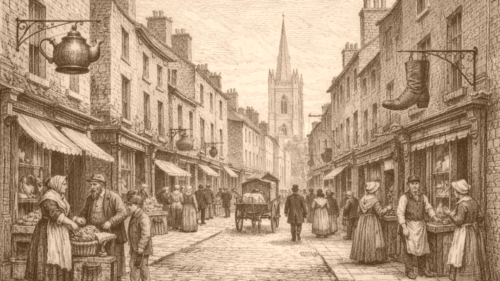
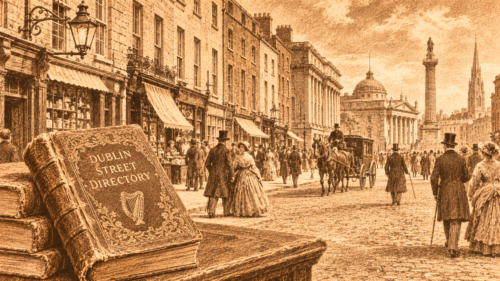
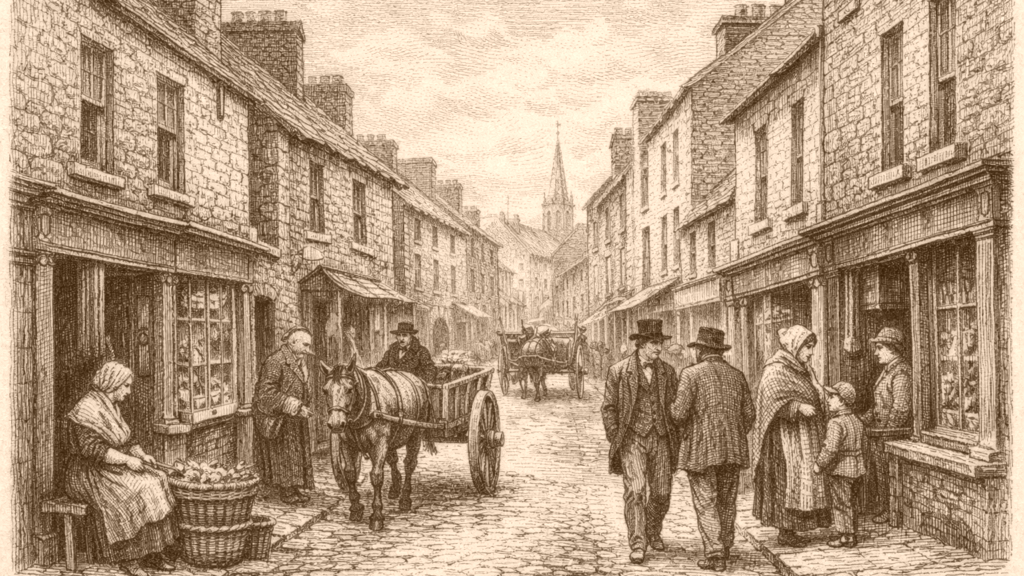
The name Nicholas Street appears in different urban records, but the surviving material here does not identify a McMahon shop on that street in 1970. One directory places Nicholas Street in Limerick and lists trades such as skin and feather ware-house, toy-shop, hardware-house, and other retail or craft occupations along the street. Another directory places Nicholas Street in Dublin and records many householders and trades over numbered premises, showing that the street name could mark a dense commercial address rather than a single establishment.
The Dublin directory is especially useful because it lays out the street in numbered order and records a succession of occupiers, including grocers, provision dealers, hatters, clothes brokers, and victuallers. It also notes side lanes and courts branching off Nicholas Street, which suggests a tightly packed streetscape. Those entries support a picture of a mixed retail and residential corridor, but they do not by themselves establish that any McMahon business stood there in 1970.
Dublin Context
A modern archaeological record for Nicholas Street and High Street in Dublin confirms that the area remains historically sensitive ground. The report describes the site as a multi-period historic town location within a triangular block bordered by High Street, Nicholas Street, and Back Lane. It also notes that the roads formed part of the medieval streetscape of Dublin City and that town-defence lines lay nearby. This confirms the historical depth of the location, not the identity of any particular shop.
The same report says bore holes revealed substantial archaeological deposits beneath the existing ground level, beginning below the surface, and that piling was used to minimise disturbance. It also recommends adding the area as a sub-constraint so future development will protect the deposits. These details matter because they show how little of the later street history is visible in the ground itself; however, they do not reveal any 1970 retail tenancy.
Chronicle Method
The annalistic material included here illustrates a different documentary habit from street directories and excavation reports. The chronicle entries are brief, recording names, offices, deaths, hostings, and depredations in compact form. One introduction to the chronicle tradition remarks that the text consists largely of entries of names and facts. That observation helps explain why annals are poor tools for reconstructing a twentieth-century shopfront unless a later entry explicitly names it.
The chronicle excerpts themselves also show how specific their notices can be when they do mention people: bishoprics, deaths, hostings, and other events are named directly. A later annal records a Mac Mahon death and a Lord of Oriel death, but those notices concern medieval figures, not a Dublin shop. Their presence only shows that the surname Mac Mahon appears in the sources; it does not connect that surname to Nicholas Street in 1970.
Commercial Reading
Read together, the directory evidence indicates that Nicholas Street was a commercial place name attached to many small businesses rather than one fixed retail identity. In Limerick, the street included merchants, dealers, makers, and shopkeepers in close sequence. In Dublin, the street directory lists a long run of trades at individual numbers. The parallel is useful only as a comparison: it shows what kind of documentary trail a Nicholas Street shop might leave, not the existence of a particular McMahon shop in 1970.
The Dublin listing also includes a line for a later crossing named Nicholson's-court, showing that the page captures nearby street detail as well as the main street itself. Because the directory is a snapshot of occupants rather than a narrative account, it cannot confirm changes of ownership across later decades. That limitation is central here: the document records the street's business fabric, but not the specific 1970 situation named in the subject.
Evidential Limits
No excerpt here names a McMahon shop on Nicholas Street in 1970, and no excerpt supplies a shopfront photograph, tenancy list, or directory page for that year. The best-supported conclusion is therefore negative and bounded: these records can place Nicholas Street within older commercial and archaeological settings, but they do not identify the shop, the proprietor, or the year sought. Any stronger statement would go beyond the record and into conjecture.
That restraint matters because the records come from different centuries and different places with the same street name. The Limerick directory and the Dublin directory are not interchangeable, and the archaeological report concerns a Dublin location rather than a retail ledger. The evidence can therefore support a careful historical description of Nicholas Street as an urban commercial space, while leaving the McMahon reference unresolved.
Historical Trace
The most defensible historical trace is therefore spatial rather than personal. Nicholas Street appears as a named urban thoroughfare in directories and as part of a medieval street system in Dublin. It carries retail, residential, and archaeological associations in the records at hand. What remains absent is the direct bridge from those associations to a single McMahon business in 1970, so the record should be read as context, not confirmation.
If a future search uncovers a 1970 directory, valuation roll, newspaper notice, or business register, it could be compared with these older street records to establish whether a McMahon shop occupied Nicholas Street and, if so, which Nicholas Street was intended. Until then, the evidence supports only a modest conclusion: Nicholas Street was commercially documented, archaeologically layered, and historically well attested, but the specific 1970 shop remains unproven here.