Gerald Griffin
At a Glance
Early Life
The chronology places Gerald Griffin’s birth in Limerick on 12 December 1803 and identifies his family as Catholic and literate in outlook. It says he was one of fifteen surviving children, that his father Patrick Griffin was a brewery farmer, and that his mother Ellen Griffin came from the O’Briens. The same entry sketches a move around 1810, when the family left Limerick for Fairy Lawn, where his childhood is described as close-knit and rural in setting.
The same chronology links Griffin’s early education with changing family circumstances. It states that he received a classical education that was often irregular, and it connects that irregularity to his father’s declining fortunes and to the condition of Catholic education at the time. The entry also associates Fairy Lawn with the natural surroundings above the Shannon estuary, presenting the place as an influence on his imagination, though it does not document that influence with a separate contemporary statement.
Family Removal
A later dated entry records a decisive family change in 1820. Patrick Griffin is said to have emigrated to Pennsylvania after failed business ventures, while Gerald remained in Ireland with his older brother William in Adare, County Limerick. The chronology states that he never saw his parents again. Within the scope of this record, the fact of separation is explicit, while the emotional effect attributed to it is presented as the compiler’s interpretation rather than as a direct observation.
The same item also situates Griffin’s brother William as a continuing household presence in Adare. The chronology gives William’s dates and says Gerald went to live with him there. This is the only directly stated residential arrangement in the excerpted record, and it is presented in a way that keeps the family story tied to movement, loss, and changing location rather than to a wider social or political setting.
Literary Shift
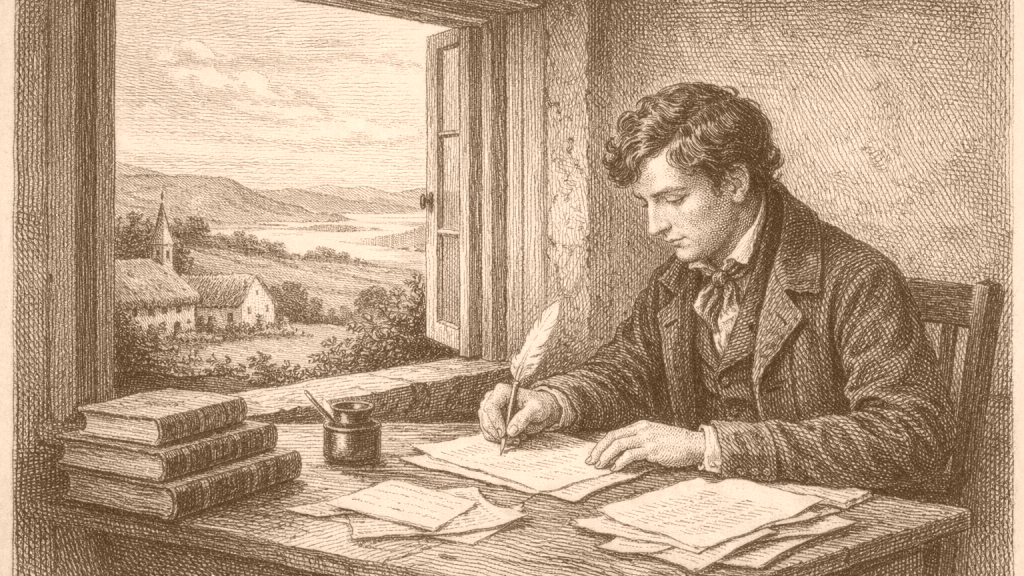
By 1823 the chronology shows Griffin turning away from medicine and toward literary work. It says he had previously considered following his brother into medicine, but abandoned that idea after meeting John Banim. In the same year he completed a full-length tragedy called Aguire, now lost, and then left Adare for London after William allowed him to try for a literary career there. The record thus preserves both the title and the loss of the play.
The chronology further notes an unsuccessful London trial. Griffin submitted the tragedy to a London actor, probably Macready, and it was rejected. The sequence is compact and factual: prior interest in medicine, a meeting that shaped his direction, a completed tragedy, departure for London, and rejection. No manuscript of the play is described here, and no reason for the rejection is supplied in the excerpt.
London Work
The London period begins in the chronology with financial hardship and continuing literary effort. Early 1824 is described as a bleak time, with poverty, poor health, bad news from home, and uncertainty about his future in letters. The record then says that in June 1824 he began earning money by writing under several pseudonyms for London journals, including the Literary Gazette and the News of Literature and Fashion.
The same entry describes the content of those pieces as being based on his knowledge of Irish customs and aimed at explaining Irish practices to an English audience. It also reports a self-understanding, attributed in the chronology, that Griffin needed to act as interpreter for Gaelic-speaking people and for an emergent Anglo-Irish readership. This is a statement about his work as described in the chronology, not an independent manifesto preserved elsewhere in the excerpt.
Prose Record
The chronology continues into 1825, when Griffin began writing regularly for the News of Literature and Fashion. It says he sent sketches of London life anonymously and, for a time, refused to reveal his identity to the editor. Later in the same entry, he is said to have obtained the reviewing department of Walker’s paper and become a critic and regular theatrical reviewer, showing a documented shift from anonymous contributions to a more visible journalistic role.
Outside the chronology, another listing identifies Griffin among Irish literary classics, placing his name beside other authors in an index of Irish literature. A separate research note points to The Collegians as a novel by a Limerick man, set in contemporary Munster, and says Joyce cites Griffin as a faithful source for southern Irish English. Those statements concern later reception and reference use, not the full contents of Griffin’s prose.
Later Traces
Griffin’s later documentary presence appears in separate collections and catalogues rather than in the chronology itself. One archive description identifies a copy of Tales of the Jury Room and gives the author as Gerald Griffin. Another collection notes letters to Brother Allen from Loretta Roach regarding Gerald Griffin. These references do not explain the contents of the letters or the relation between the items, but they do show his name persisting in institutional holdings.
Taken together, the records preserve a coherent sequence: birth in 1803, family movement around 1810, emigration of his parents in 1820, literary choice in 1823, London journalism in 1824 and 1825, and continuing archival traces afterward. What they do not supply here is a complete account of his whole career, his death, or the full range of his works. The evidence is enough to map a life, but not to fill every gap in it.