Irish Sport
At a Glance
Archive Scope
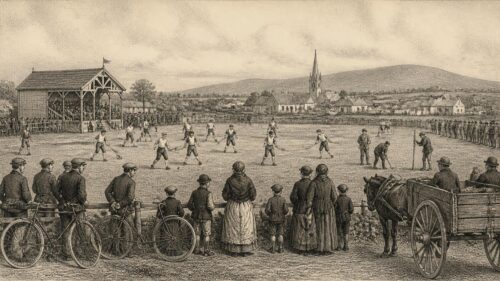
The O Fiaich library describes its sporting holdings as a major and popular part of the collection. Its chief emphasis is on native Irish sports and pastimes, especially the Gaelic games and road bowls named in the catalogue. The same passage also notes hundreds of books on these subjects and identifies minute-books of the Ulster Council of the GAA among the most valuable items, placing books and records side by side.
The GAA Museum and Archive presents a different but related description. It identifies itself as the national repository for the Association's records, archives, and publications, and says that its holdings run from the 1880s to the present day. The mission statement adds that the material records the values, culture, and history of the Association, Gaelic games, and contributors to it, which places the collection in an explicitly institutional frame.
Gaelic Games
Within the O Fiaich catalogue, the named games are not abstract categories but listed as holdings with specific record types. Hurling, shinty, Gaelic football, handball, and camogie are mentioned together, and the collection is said to include minute-books from the Ulster Council, Central Council, and national congresses. That combination shows a preference for administrative records alongside the games themselves, rather than treating the sports as isolated pastimes.
The same archive extends that pattern through local and visual material. It lists minute-books from county boards and clubs, correspondence from several counties, match programmes, and photographs. The catalogue therefore presents Gaelic games through layered forms of documentation: governing minutes, club records, souvenirs, and images. These holdings are described as tools from which information on local sport and society may be gleaned, making the social frame part of the catalogue itself.
Local Records
The O Fiaich collection also singles out road bowls as a feature of the surrounding Armagh and Tyrone area. Its holdings for that sport include minute-books from the 1960s and 1970s, together with books, programmes, photographs, and trophies. The wording is useful because it ties a regional pastime to both paperwork and objects, and it shows that the archive preserves more than league or championship documentation alone.
Beyond the sports-specific material, the same collection includes bound minute-books of the Youth and Sports Council for Northern Ireland for two triennial periods in the 1960s and 1970s. The catalogue says these records are not available in any other public archive and identifies them as evidence for the first statutory body on the island appointed specifically to deal with sport and recreation. That is a narrow and explicit claim about the records' administrative subject matter.
Access Terms
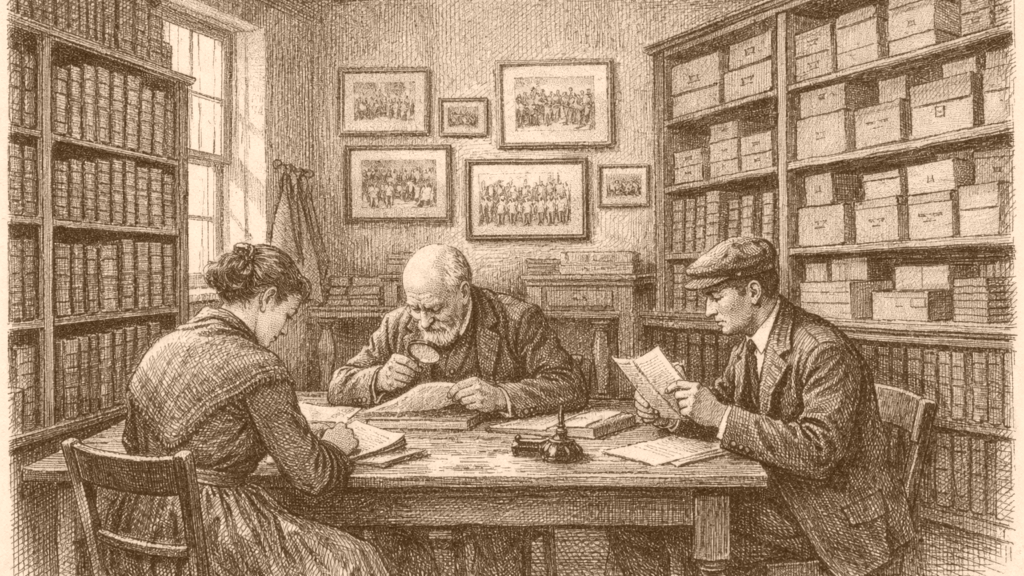
The GAA Museum entry is explicit about access conditions. Its records and publications are available only in a supervised reading room, by appointment, and subject to reading-room rules. This is a practical detail rather than an interpretive one, but it matters because the catalogue presents the archive as an organized research environment. The same page also names its institutional memberships, linking the collection to professional archival and library bodies.
The CELT pages provide a parallel example of restricted access in a different setting. The History of Ireland text and the Annals of Tigernach are both marked as available for academic research and teaching only, and the annals page notes manuscript sources and editorial information for the text. These notices do not describe sport, yet they show a comparable documentary style in which access, provenance, and editing are set out before the text itself.
Chronology Reach
The GAA archive describes holdings that begin in the 1880s and continue to the present, while the O Fiaich catalogue gives narrower dates for particular minute-books and club records. The Ulster Council books run from 1917 to 1975, the Armagh County Board from 1933 to the 2000s, and Tyrone from 1926 onwards. These are direct cataloguing statements, and they show a collection built around long runs rather than isolated items.
The annals catalogue offers a different kind of chronology, concerned with manuscript witnesses and textual ranges. It identifies two Rawlinson manuscripts, one from about 1050 to 1150 and another from about 1350 to 1400, and describes the annals' contents as surviving in separate chronological fragments. This is not sporting material, but it provides a clear contrast with the modern archive listings: here the emphasis is on manuscript provenance and textual span rather than club administration.
Comparative Form
Across these catalogues, the common feature is a preference for description over narrative. The sporting collections enumerate games, books, minute-books, programmes, photographs, correspondence, and trophies, while the annals and CELT pages enumerate manuscripts, editions, text IDs, and access conditions. That is an observable similarity in format, not a claim about historical meaning. Each entry tells the reader what kind of material exists and how it is organized for consultation.
The descriptive emphasis also makes visible what is and is not present in each set of notes. The sporting catalogues explicitly name local boards, clubs, and regional games, but they do not offer a full social history beyond brief phrases such as insight into nationalist perspectives or information on local sport and society. The annals catalogue, by contrast, concentrates on manuscript witnesses and editorial literature. The evidence therefore supports comparison of archival framing, not a wider historical synthesis.