Archived: 24 September 2026
Abstract
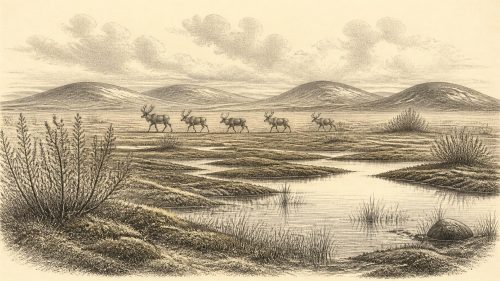
Around 30,766 BCE, Ireland lay within the unstable Late Pleistocene MIS 3 interval, not a precisely datable historical year. Derryvree, County Fermanagh, preserves freshwater sediments between glacial tills, indicating an ice-free episode with cold, treeless wetlands, plants and insects. Castlepook Cave, County Cork, yielded remains of mammoth, reindeer, hyaena and other cold-stage fauna, demonstrating open habitats and ecological links with north-west Europe. A possibly cut-marked reindeer bone may suggest very early human activity, but cannot prove settlement. Glacial advances, changing sea levels and uncertain travel routes shaped the island. Evidence supports environmental reconstruction, not accounts of societies, politics or events.
Read Article

Archived: 9 September 2026
Abstract
Around 31,883 BCE, Ireland lay within the unstable cold conditions of Marine Isotope Stage 3, rather than a documented historical era. Derryvree, County Fermanagh, preserves buried freshwater silts dated broadly to this period, demonstrating an ice-free, open tundra landscape before later glaciation. Climatic fluctuations occasionally created milder local conditions. Cave deposits, especially at Castlepook, record varied cold-adapted fauna, including reindeer, mammoth, giant deer and predators, but accumulated over millennia rather than simultaneously. A possibly cut-marked reindeer bone may indicate brief human activity around 33,000 years ago, though no settlement evidence exists. Subsequent ice expansion buried, eroded and obscured sparse record.
Read Article




