

Related Archive: Fossil flora

Derryvree’s Arctic-Alpine Flora

Derryvree’s Arctic-Alpine Flora

Archived: 25 September 2026

Abstract

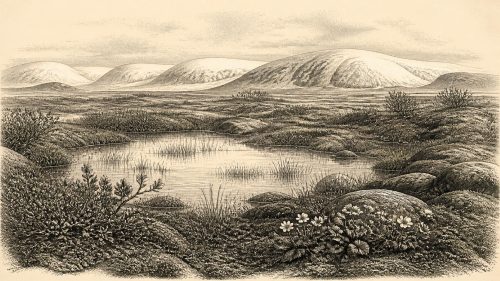
Around 30,687 BCE, Ireland was experiencing unstable Late Pleistocene conditions rather than a recordable historical year. At Derryvree, County Fermanagh, freshwater sediments preserved between glacial tills show an ice-free interval with cold, wet, treeless tundra vegetation. Mosses, sedges, aquatic plants, mountain avens, dwarf willow and other Arctic-alpine species indicate shallow water, saturated ground and brief growing seasons. Cave finds elsewhere confirm that reindeer, mammoth, hyaena and giant deer inhabited Ireland during broadly comparable periods, though not necessarily locally together. No secure evidence establishes human settlement then. Derryvree therefore records a local, changing ecosystem between glacier advances, not an inhabited society.


Read Article

The Derryvree Fossil Flora

The Derryvree Fossil Flora

Archived: 21 September 2026

Abstract

30,954 BCE is a modern label for a Late Pleistocene interval, rather than a recorded Irish year. Derryvree, County Fermanagh, preserves freshwater sediments beneath glacial till, radiocarbon dated broadly to 36,900–31,700 cal BP. Its pollen, plants and insects reveal locally ice-free, open tundra-like wetland with pools, sedges, herbs, juniper and severe periglacial conditions. Castlepook Cave, County Cork, contains time-mixed remains of mammals, demonstrating intermittent ecological connections with north-west Europe, but not simultaneous populations. A marked reindeer bone may indicate early human butchery, yet lacks secure archaeological context. No evidence supports settled communities; environmental change and later ice dominate Ireland's record.

Read Article

