
Archived: 18 September 2026
Abstract
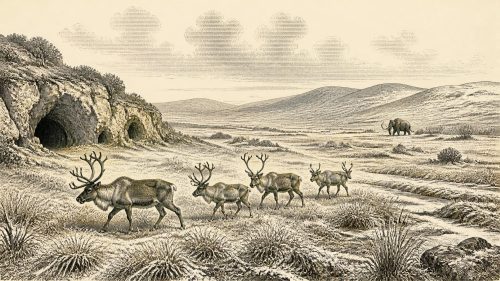
Around 31,329 BCE, Ireland lay within the unstable late Ice Age. Derryvree in County Fermanagh preserves freshwater sediments between glacial tills, dated broadly to this interval, showing ice-free, tundra-like wetlands with Arctic-alpine plants. Castlepook Cave in north Cork yielded Late Pleistocene remains including mammoth, reindeer, giant deer, predators and lemmings, demonstrating changing open-country habitats but not a single contemporary fauna. A cut-marked reindeer femur may indicate Upper Palaeolithic butchery, yet no secure evidence confirms permanent human settlement. Environmental change, advancing ice and later erosion shaped a fragmentary record, while political, social and cultural history remain unknowable for this remote period.
Read Article
Archived: 16 September 2026
Abstract
Around 33,500 calibrated years before present, later Marine Isotope Stage 3 Ireland was a cold, changing, largely treeless landscape, not an unbroken glacier. Castlepook Cave near Doneraile, County Cork, preserves important but mixed animal deposits, including mammoth, giant deer, reindeer, brown bear and spotted hyena. These animals indicate productive open steppe-tundra and complex predator-scavenger activity. Revised radiocarbon dates place some fauna well before the Last Glacial Maximum. A marked reindeer femur may record stone-tool butchery about 31,000 BC, suggesting fleeting Upper Palaeolithic visitors. However, no associated settlement, hearth, tools or other proof establishes permanent human occupation, institutions or continuous habitation.
Read Article





