Awbeg Cave Fauna31329 BCE
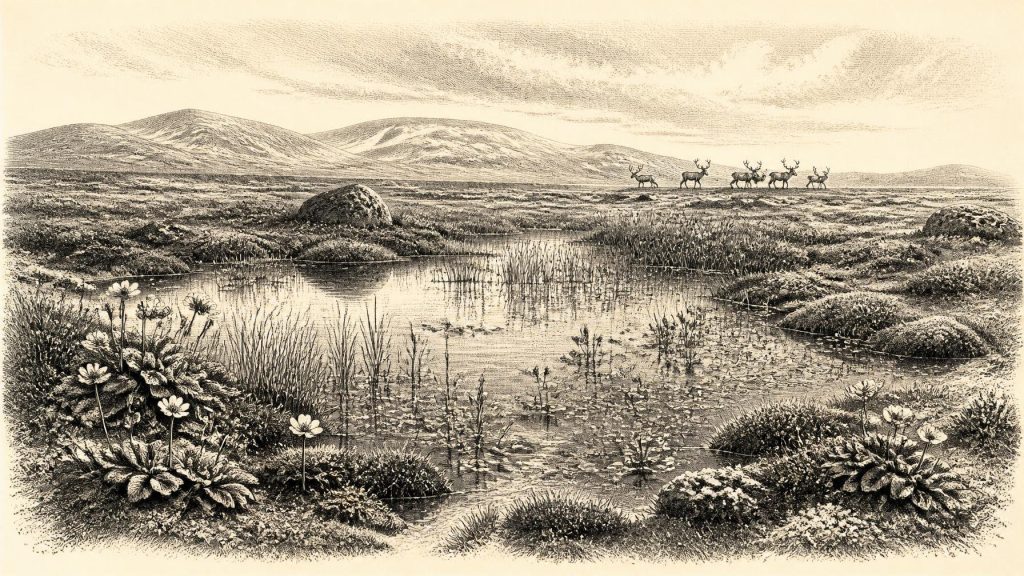
Around 31,329 BCE, Ireland lay within the unstable late Ice Age. Derryvree in County Fermanagh preserves freshwater sediments between glacial tills, dated broadly to this interval, showing ice-free, tundra-like wetlands with Arctic-alpine plants. Castlepook Cave in north Cork yielded Late Pleistocene remains including mammoth, reindeer, giant deer, predators and lemmings, demonstrating changing open-country habitats but not a single contemporary fauna. A cut-marked reindeer femur may indicate Upper Palaeolithic butchery, yet no secure evidence confirms permanent human settlement. Environmental change, advancing ice and later erosion shaped a fragmentary record, while political, social and cultural history remain unknowable for this remote period.
Dateline
31,329 BCE is not a year that can be recovered from Ireland’s prehistoric record in the ordinary historical sense. It is a modern calendar label, roughly 33,280 years before the conventional radiocarbon reference date of AD 1950. No Irish community then used such a calendar; no written record, named person, political event or annual sequence survives. The responsible scale is therefore a broad one: late Marine Isotope Stage 3 (MIS 3), a climatically unstable portion of the last Ice Age. The closest evidence consists of deposits and bones dated in ranges measured in centuries and millennia, not in individual years.
That distinction matters especially here. Around this notional point, Ireland was approaching the growth of the last major British–Irish Ice Sheet, but had not yet reached the Last Glacial Maximum, when ice later covered Ireland and much of its continental shelf. Conditions changed markedly by region and through time. A sediment bed in County Fermanagh and animal remains in a north Cork cave show that parts of Ireland could support life during this long cold interval; neither provides a day-by-day, or even year-by-year, account of the entire island.
A Date Within a Glacial Interval
The most useful environmental evidence near this date comes from Derryvree townland, about two kilometres north-east of Maguiresbridge in County Fermanagh. Roadworks in 1969 cut through a drumlin and exposed a remarkable sequence: a lower till laid down by glacier ice, freshwater silts and fine sands with organic material, and then an upper till from a subsequent ice advance. The layers demonstrate a basic regional history. Ice had crossed the ground; an ice-free interval followed, allowing shallow freshwater and plants to leave a record; later ice buried and protected much of that evidence.
Organic material from Derryvree produced the radiocarbon determination BIRM-166, 30,500 ± about 1,100 radiocarbon years BP. Calibration converts this into a broad range of approximately 36,900–31,700 calibrated years BP, or roughly 34,950–29,750 BCE. The modern label 31,329 BCE falls within that span, but it cannot be attached to a particular season of sediment accumulation, plant growth or glacier movement. The range is evidence that an ice-free freshwater environment existed at Derryvree during part of the interval; it is not a precise weather report for Fermanagh, still less for all Ireland.
This was an Ireland of transition rather than a uniformly frozen island or a temperate green landscape. Reconstructions of the final Irish ice-sheet build-up suggest that north-central areas retained ice-free ground until around 34,000 years ago, while major expansion continued thereafter and the southern margin was reached much later. Such reconstructions are necessarily revised as dates and landforms are reassessed. At about 33,280 years BP, it is safest to envisage a patchwork of exposed terrain, local or advancing ice, periglacial ground and changing coastlines, rather than one fixed national environment.
The Derryvree Wetland
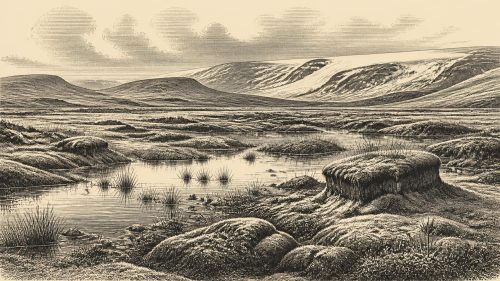
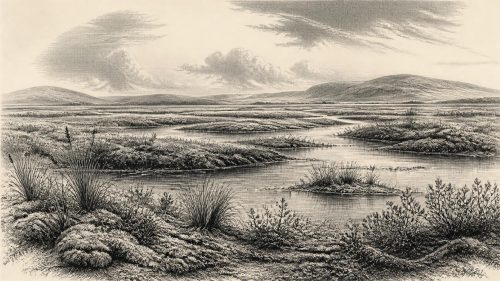
Derryvree’s freshwater deposits make the cold landscape unusually tangible. Pollen was poorly preserved, but it was chiefly from herbaceous plants. Plant macrofossils and spores included species associated with open, northern and Arctic-alpine conditions. Bogbean (Menyanthes trifoliata), lesser clubmoss (Selaginella selaginoides), mountain avens (Dryas octopetala) and alternate water-milfoil (Myriophyllum alterniflorum) are among the traces reported from the deposit. Together they support an interpretation of treeless tundra-like vegetation and wet, shallow-water habitats under a periglacial climate.
‘Tundra’ should not be mistaken for an empty white wilderness. The word describes vegetation constrained by cold, short growing seasons and difficult soils, not an absence of biological activity. Around pools, channels and saturated ground, mosses, sedges, aquatic plants and low herbs could exploit the brief summer. Elsewhere, sparse vegetation and frost-affected soils probably left much ground exposed. Winter freezing, strong winds and seasonal darkness imposed severe limits, while meltwater and standing water created local opportunities. The drumlin that now contains this archive was not then the familiar settled farming country of modern Fermanagh, but a changing glacial-margin terrain.
There is no warrant, however, for turning this flora into a reconstructed garden or assigning every recorded plant to 31,329 BCE. Fossils accumulated through an interval, were transported and preserved in water, and were later compressed beneath ice-derived sediment. Their value lies in showing the kinds of habitat that existed locally. They demonstrate survival and reproduction in a cold landscape; they do not identify a continuous plant cover across the island or determine the temperature of a particular year.
Animals in the Cork Caves
For large animals, the principal Irish archive is Castlepook Cave, also known as Mammoth Cave, near Doneraile in the Awbeg valley of north County Cork. Its complex passages yielded the richest known Irish assemblage of Late Pleistocene vertebrates. Finds attributed to different portions of MIS 3 include woolly mammoth, reindeer, giant deer, brown bear, wolf, Arctic fox, lemmings and spotted hyaena. This is powerful evidence that cold-adapted and open-country animals reached or survived in southern Ireland during favourable phases before the ice sheet’s greatest expansion.
Yet Castlepook is not a census taken in one landscape at one moment. Cave deposits can gather bones over long periods. Carnivores may drag prey inside; water, collapse and later disturbance can move material; and much of the original excavation occurred between 1904 and 1912, before modern standards of stratigraphic recording. Recent redating has shown that some earlier radiocarbon results for southern Irish cave fauna were too young, underlining the need to treat individual specimens and contexts with care. The assemblage establishes a broad Ice Age fauna, not a claim that mammoth, hyaena, giant deer and every other listed species stood together beside the Awbeg in this particular BCE year.
Even so, the fauna reveals an ecological system more varied than a simple image of bare ice permits. Reindeer imply grazing country and mobile herds; wolves and hyaenas indicate predators and scavengers supported by substantial prey; Arctic foxes and lemmings reinforce the evidence for severe, open-country conditions. Mammoth and giant-deer remains are striking, but their presence should not be converted into claims of abundance. Ireland was at Europe’s north-western edge, where access routes, sea level, ice margins and available habitat altered repeatedly.
The Single Human Question
Castlepook also holds the most consequential, but still limited, possible evidence for people in Ireland at this depth of time: a reindeer femur bearing a deep incision. Zooarchaeologist Ruth Carden has interpreted the mark as having been made on fresh bone with a sharp stone implement during carcass processing. The specimen has been publicly described as about 33,000 years old, broadly close to the period denoted by this article. If the modification is confirmed as anthropogenic, it would show that one or more people handled a reindeer carcass in Ireland during the Upper Palaeolithic, far earlier than the long-established Mesolithic settlement record.
That is a significant possibility, not a licence to invent an Ice Age Irish population. The bone’s age dates the animal, while the identification of a human-made cut is a specialist interpretation. No securely associated hearth, stone-tool assemblage, dwelling floor, burial, repeated camp sequence or contemporary artwork has been published from Castlepook. The National Museum of Ireland accordingly still stresses the lack of clear general evidence for a Palaeolithic population on the island. The most defensible conclusion is that a brief human visit or episode of butchery is plausible, but permanent settlement, population size, ancestry, language and route of arrival are unknown.
Low sea levels may at times have changed the geography between Ireland, Britain and continental Europe, but they do not prove a simple land bridge or a specific migration path at this date. People, if present, might have arrived during a favourable interval, perhaps following animal movements; that remains interpretation rather than demonstrated fact. Later ice erosion and submergence of former coastal landscapes help explain why evidence is sparse, but absence of evidence cannot by itself establish either long-term occupation or complete emptiness.
What Cannot Be Written
There were no Irish states, chiefs, treaties, armies or diplomatic relations that archaeology can identify for this period. Nor is there evidence for agriculture, domestic animals, farming settlements, trade networks, monuments, ritual sites, schools or formal religious institutions. A single possible butchery mark might indicate the practical use of a sharp stone edge, but cannot reveal a shared language, social rank, kin group or belief. It would be misleading to fill these silences with later Celtic, medieval or even Mesolithic ideas of Ireland.
If people did visit, their immediate economy would have depended on hunting, scavenging and gathering in a highly seasonal environment. That is a reasonable inference from Upper Palaeolithic lifeways elsewhere in north-west Europe and from the possible processing of a reindeer limb, but it is not directly documented as an Irish economy. The Derryvree wetland and the Awbeg cave fauna instead provide firmer ground: they reveal habitats, animals and the effects of ice, water and climate on the island’s possibilities.
The chief historical development around 31,329 BCE was therefore environmental and archaeological rather than political. Ireland lay within a volatile late-Ice-Age world: locally capable of sustaining freshwater vegetation and substantial mammals, increasingly vulnerable to renewed glaciation, and perhaps visited fleetingly by people whose presence has not yet become a settlement record. The later advance of the ice sheet would transform the landscape again and erase much evidence. What survives is fragmentary, but it is enough to replace both myths of an eternally ice-bound Ireland and confident stories of an early settled nation with a colder, more complicated past.
Primary Sources
- Trimlines, blockfields and the vertical extent of the last ice sheet in southern Ireland
- A reconsideration of the radiocarbon dating of the Marine Isotope Stage 3 fauna from southern Ireland
- First evidence of a Late Upper Palaeolithic human presence in Ireland
- Late Pleistocene chronostratigraphy and ice sheet limits, southern Ireland
- Early deglaciation of western Ireland and implications for the western sector of the British-Irish Ice Sheet
- Castlepook Cave, County Geological Site Report
- Spotted Hyena Skull
- Prehistoric Details
- Palaeoecology
- The Subdivision of the Quaternary Period in Ireland
- Exploring controls of the early and stepped deglaciation on the western margin of the British Irish Ice Sheet
- Ireland: Submerged Prehistoric Sites and Landscapes
- New insights on the fauna of Ireland's Younger Dryas and Early Holocene from Alice & Gwendoline Cave
- Revisiting Alice and Gwendoline Cave, Co. Clare: New light on the 1902 excavations
- 32564: Castlepook Cave, Castlepook, Co. Cork
- Heritage Artefacts of County Cork
- BSBI: Menyanthes trifoliata
- BSBI: Selaginella selaginoides
- BSBI: Dryas octopetala
- BSBI: Myriophyllum alterniflorum