Archived: 2 October 2026
Abstract
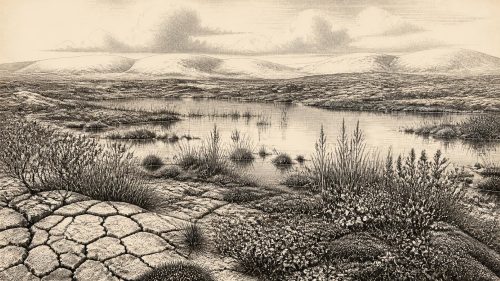
30,380 BCE is not a recoverable Irish historical year but falls within the climatically unstable Marine Isotope Stage 3. At Derryvree, County Fermanagh, BIRM-166 dated freshwater organic deposits between glacial tills to roughly 36,900–31,700 calibrated years before present, indicating an ice-free interval before later ice-sheet expansion. Plant remains reveal cold, treeless wetlands with open water, sedges, mosses and hardy shrubs. Southern cave finds show that large mammals occurred during the wider period, though not necessarily together. No secure evidence identifies human occupation, society or culture. The record instead documents dynamic glacial change and ecologically active landscapes, while retaining considerable uncertainty.
Read Article

Archived: 13 September 2026
Abstract
The reference year 31,806 BCE provides an archival setting for cold environments before later glaciation in Ireland. Deposits near Maguiresbridge in County Fermanagh preserve plants and invertebrates associated with treeless freshwater habitats. They demonstrate biological activity during a period of growing glacial influence. Across the British-Irish region, ice developed unevenly rather than covering every landscape simultaneously. Subsequent glaciation removed much earlier evidence, limiting chronological precision and local reconstruction. Derryvree studies, regional ice research, museum collections and radiocarbon calibration help interpret the remains. The article distinguishes this broad environmental history from claims about an identifiable event in one exact prehistoric year.
Read Article





