
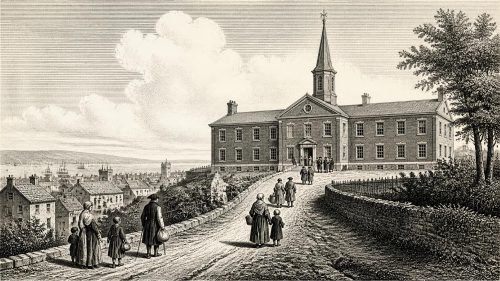
Clifton House
Archived: 12 October 2026
In 1774, Ireland saw developments reflecting urban growth, religious inequality and economic ambition. Belfast’s Charitable Society was incorporated, opened its Poor House and Infirmary, later Clifton House, and began admitting residents, providing elite-supervised relief amid poverty generated by commercial expansion. Parliament allowed Catholics to swear allegiance instead of supremacy, but preserved penal restrictions on property, education and political participation. In Armagh, Archbishop Richard Robinson’s infirmary and Royal School extended an Anglican institutional landscape. Legislation promoted Lagan navigation to link Belfast with inland trade, despite difficulties. Cultural landmarks included Thomas Leland’s History of Ireland, Oliver Goldsmith’s death, and Francis Beaufort’s birth.