Clifton House1774 CE
In 1774, Ireland saw developments reflecting urban growth, religious inequality and economic ambition. Belfast’s Charitable Society was incorporated, opened its Poor House and Infirmary, later Clifton House, and began admitting residents, providing elite-supervised relief amid poverty generated by commercial expansion. Parliament allowed Catholics to swear allegiance instead of supremacy, but preserved penal restrictions on property, education and political participation. In Armagh, Archbishop Richard Robinson’s infirmary and Royal School extended an Anglican institutional landscape. Legislation promoted Lagan navigation to link Belfast with inland trade, despite difficulties. Cultural landmarks included Thomas Leland’s History of Ireland, Oliver Goldsmith’s death, and Francis Beaufort’s birth.
Dateline
In 1774, no single dramatic national event transformed Ireland. The year is better understood through a cluster of firmly dated developments that expose how the country was governed and how its towns were changing: a cautious alteration to the legal position of Catholics; new institutional buildings at Armagh; legislation for the Lagan navigation; and, most vividly, the opening of Belfast’s Poor House and Infirmary, later known as Clifton House. These were not signs of an equal or prosperous society. They were responses to its pressures: religious exclusion, dependence on landlord and mercantile power, urban poverty, and the challenge of connecting inland producers to expanding ports.
A Poor House for a Growing Town
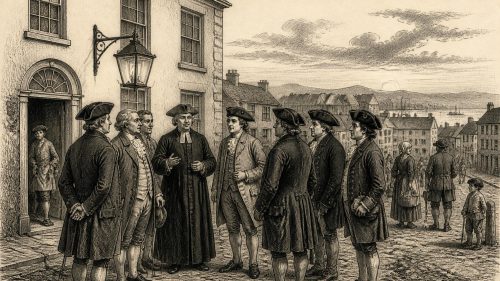
Belfast supplied the clearest event of the year. On 1 June 1774, the Belfast Charitable Society was incorporated by an act of the Irish parliament. It had existed since 1752, collecting subscriptions and raising lottery money for a poor house and infirmary. Incorporation gave a body of prominent local subscribers a legal personality and a more formal civic role. This mattered in a town where government was narrow, property qualifications restricted political influence, and practical provision for public welfare was limited. The Society’s charitable language was sincere, but it was also an answer to the anxieties produced by visible poverty in a rapidly expanding commercial town.
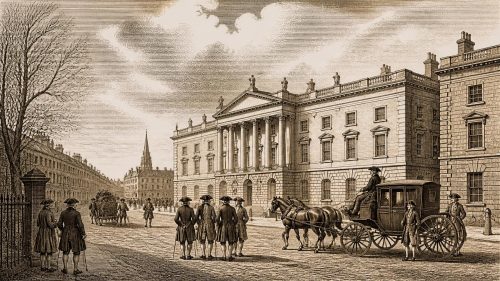
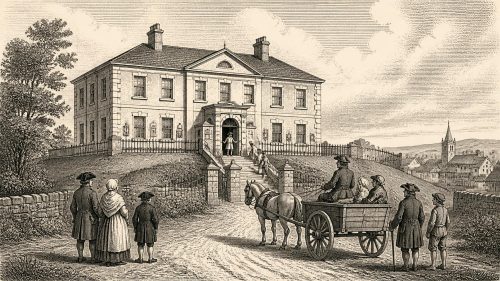
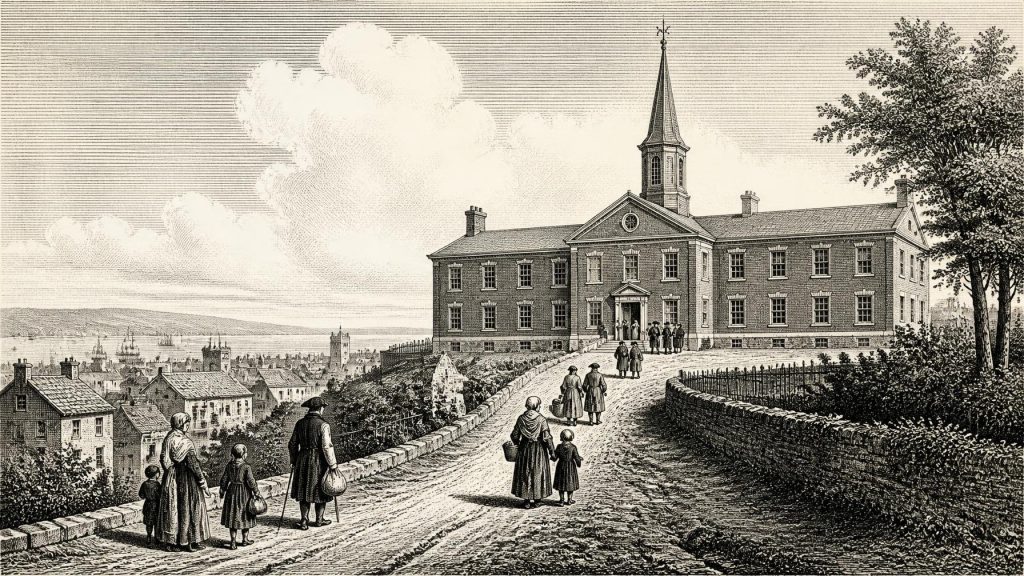
The building which the Society had commissioned on land north of the town was completed in 1774. Contemporary and later institutional accounts preserve several stages rather than one uncomplicated opening day. Clifton House was formally opened on 17 September; the Society held its first meeting in its new boardroom on 24 October; and the first residents were admitted on Christmas Eve. Those distinctions are useful. A large public building could be architecturally ready before its governors had settled arrangements for receiving and provisioning people. By the end of the year, however, Belfast possessed a combined poor house and infirmary with accommodation for poor residents and hospital patients: a conspicuous statement that private subscription was assuming tasks associated with municipal welfare.
Its location, materials and form expressed civic ambition. The building used brick made from clay on the site, stone from Dunmurry and sand dredged from the Lagan. Its elevated position and tall spire made it visible above the comparatively modest town. Such grandeur should not soften the reality that admission was directed towards people unable to maintain themselves through age, sickness or infirmity. The Poor House did not abolish hardship; it selected some of those in need for supervised shelter, food and medical attention. Yet its foundation is an unusually tangible record of eighteenth-century Belfast confronting the social consequences of growth. The port and the linen economy drew labour and migrants towards the town, while inadequate housing, sanitation and irregular employment left many people exposed to distress.
The new corporation’s remit also reached beyond relief. Its statutory powers and later responsibilities connected the Society with paving, street lighting, planning and water supply. It would be wrong to project all of those later activities back into the daily workings of 1774, but incorporation shows that Belfast’s welfare institution was already conceived as part of the town’s civic machinery. In a period before elected municipal government in the modern sense, voluntary association, parliamentary authority and elite patronage overlapped. Arthur Chichester, Marquess of Donegall, had supplied the site; merchants, clergy and professional men subscribed; and the institution’s decisions remained in the hands of governors rather than those it assisted.
An Oath, Not Equality
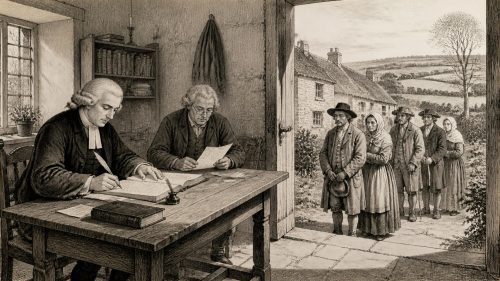
In Dublin, the parliamentary session that had begun in October 1773 ended on 2 June 1774. Its most important development for Ireland’s Catholic majority was the passage of an act entitled An Act to enable His Majesty’s subjects of whatever persuasion to testify their allegiance to him. The measure allowed Catholics to take an oath of allegiance rather than the oath of supremacy. It was a modest but meaningful departure from a legal order that had treated Catholic loyalty as suspect and had imposed religious tests designed to uphold the Protestant establishment. Later historians have reasonably identified this oath legislation as an early step in the gradual dismantling of the penal code.
Its limits are as important as its novelty. The act did not establish civil equality, restore Catholic political representation, or remove the extensive restrictions affecting property, education and public life. During the same session, proposals that would have permitted Catholics to lend money securely on mortgages and to enjoy wider leasehold rights were defeated or allowed to lapse. The proposed lease measure, for example, would have extended the short and insecure terms available to Catholic tenants. Its opponents explicitly framed Catholic economic security as a danger to Protestant power. Thus 1774 brought a loyalty oath that could be presented as conciliation, while retaining the structures that made land, political authority and corporate status predominantly Protestant possessions.
The contrast helps explain the character of Irish politics. Ireland had its own parliament at College Green, but legislative initiative operated under the constraints of Poynings’ Law and the influence of the British executive. Its electorate was restricted, Catholics could not sit in it, and borough patronage gave great landowners substantial control. The Octennial Act of 1768 had at least ended the practice by which a parliament could last for an entire reign, making elections more frequent; it had not made representation broad. In 1774, constitutional debate and sectarian privilege were therefore inseparable. The oath marked a change in the language of government, but not a transfer of power to the people most affected by the penal laws.
Armagh’s Institutional Landscape
At Armagh, Archbishop Richard Robinson continued a programme of building which made the ecclesiastical capital of the Church of Ireland into an ordered Georgian centre. The County Infirmary and a new building for the Royal School are both dated to 1774; the town’s military barracks had been established in the preceding year. Robinson had been Archbishop of Armagh and Primate of All Ireland since 1765, and his patronage had already produced the public library, registry and landscaped Mall. The infirmary and school were therefore not isolated benefactions but parts of a deliberate remodelling of the town around Anglican, educational and county institutions.
These works demonstrate both investment and hierarchy. An infirmary offered organised medical care at county level, while the Royal School served formal Protestant education. The barracks represented the state’s continuing reliance on military presence. Taken together, they linked health, learning, religion and security in one provincial town. They also reveal why the language of ‘improvement’ must be used carefully. Robinson’s Armagh was handsomely improved, but the institutions and influence concentrated there belonged principally to the established church and governing class, not to the Catholic population as a whole.
Water, Trade and the Wider Economy
On 4 May, parliament continued and amended legislation for making the River Lagan navigable and opening water communication between Lough Neagh and Belfast. The scheme had encountered financial and engineering difficulties, and the 1774 act did not complete a continuous route to Lough Neagh. Still, it is evidence of an important economic priority: improving the movement of heavy goods between the hinterland and Belfast’s harbour. Inland navigation promised cheaper transport for fuel, grain, timber and building materials, while offering rural producers better access to export markets.
That aspiration belonged to an economy in which linen was Ireland’s principal manufacturing export and much of the actual spinning and weaving remained dispersed through households and farms. Belfast was already an important linen centre, but it was not yet the giant industrial city of later memory. The same distinction applies to the Poor House: it was created amid commercial growth, but before mechanised factory production transformed urban employment. A 1774 pamphlet on the decay and possible improvement of the linen manufacture is a reminder that expansion and insecurity could coexist. Producers, merchants and labouring families depended on credit, harvests, demand and the regulations of an imperial trading system.
Books, Death and a Future Surveyor
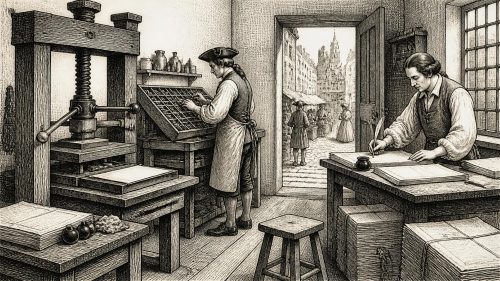
The year also has quieter cultural markers. In Dublin, Thomas Leland’s History of Ireland from the Invasion of Henry II appeared in a corrected third edition. Written by a Church of Ireland clergyman and historian, it exemplified the growing eighteenth-century appetite for a continuous, printed national past, although its interpretation was shaped by the political and religious assumptions of its author and readers. Books, libraries and schools were among the means by which educated elites debated what Ireland had been and what kind of kingdom it should become.
On 4 April, Oliver Goldsmith died in London. Born and educated in Ireland, including at Trinity College Dublin, Goldsmith had become one of the leading writers in English of his generation. His death was an Irish cultural loss, even though his professional life had been conducted largely in Britain. In May, Francis Beaufort was born at Navan, County Meath, into the family of the Revd Daniel Augustus Beaufort. Nothing in 1774 could foretell his later work as a naval hydrographer, but his birth belongs securely to the year and connects Georgian Ireland with the expanding worlds of science, surveying and maritime navigation.
Seen together, the year’s events make 1774 neither a simple beginning nor a settled interval. Belfast’s new Poor House acknowledged urban need while placing relief under elite supervision. The Catholic oath admitted a limited form of allegiance while leaving unequal power largely intact. Armagh’s new institutions projected order, learning and established religion. Navigation legislation looked towards commerce, but did not remove economic risk. Ireland in 1774 was being built, regulated and argued over—often by people who described improvement in generous terms, but who disagreed profoundly about who should share in its benefits.
Primary Sources
- About Us | Clifton House
- History | Belfast Charitable Society
- Acts of Parliament | Belfast Charitable Society
- Belfast Charitable Society and the Provision of Water
- Belfast: The Making of the City, 1800–1914
- Archbishop Richard Robinson, 1708–1794
- Irish Legislation Database: Acts of Parliament by Session
- History of Parliament in Ireland
- Ecclesiastical Politics and the Dismantling of the Penal Laws in Ireland, 1774–82
- The Origins, Evolution, and Political Consequences of Catholic Relief in Ireland, 1774–1793
- Ireland’s Catholic Records | CQR Database
- A History of the Penal Laws Against the Irish Catholics
- History of the Commercial and Financial Relations Between England and Ireland from the Period of the Restoration
- Remarks on the Decay of the Linen Manufacture of Ireland
- Minutes of Evidence Given at Twelve Sessions of the Committee to Consider the State of the Linen Trade in Britain and Ireland
- Lagan History
- Pre-Union Irish Statutes
- The History of Ireland from the Invasion of Henry II
- Goldsmith, Oliver | Dictionary of Irish Biography
- Oliver Goldsmith | Eighteenth-Century Poetry Archive
- St Mary’s Church of Ireland | Navan & District Historical Society
- Beaufort, Sir Francis (1774–1857), Naval Officer and Hydrographer
- Longitude Acts