Cork Caves, Fermanagh Wetlands
Archived: 23 September 2026
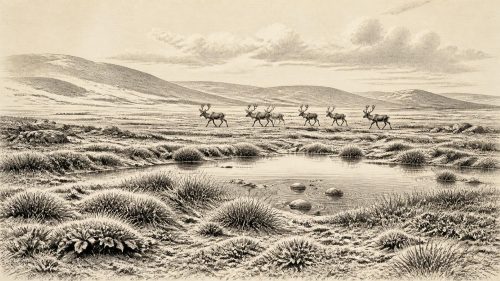
Around 30,837 BCE, Ireland lay within the climatically unstable MIS 3 phase of the Late Pleistocene, not a recoverable calendar year. Inter-till deposits at Derryvree and other Fermanagh sites record temporary ice-free freshwater wetlands, with sedges, mosses, insects and sparse treeless vegetation, between glacial advances. Castlepook Cave in Cork preserves a time-mixed Ice Age faunal assemblage, including mammoth, reindeer, giant deer, bear and hyaena, demonstrating viable habitats. A possibly stone-tool-marked reindeer femur may indicate brief human activity, but cannot prove settlement or continuous occupation. Evidence supports a shifting mosaic of ice, wetlands, open ground and animal corridors, rather than uniformity.