Cork Caves, Fermanagh Silts31867 BCE
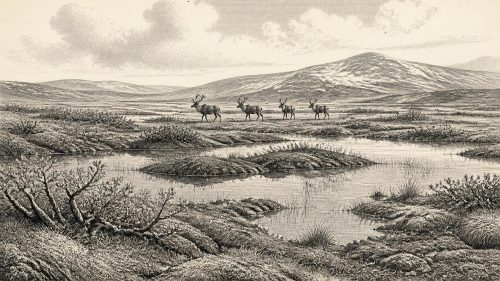
Around 31,867 BCE, Ireland formed part of a climatically unstable late Last Glacial Period landscape, rather than a recognisable historical year. Fermanagh deposits at Derryvree and Greenagho indicate local freshwater, tundra and periglacial conditions before major ice-sheet expansion. Open vegetation supported changing assemblages of cold-stage mammals, documented especially by mixed cave remains at Castlepook, County Cork. A cut-marked reindeer bone there may suggest brief human activity around 33,000 years ago, but cannot establish permanent settlement. Lower sea levels altered possible routes, without proving a land bridge. Later glaciation destroyed or obscured evidence, leaving environmental fragments rather than evidence of societies.
Dateline
31,867 BCE is not a year that can be isolated in Ireland’s archaeological record. It is a modern calendar label applied to a period for which there are no written sources, named communities, annual deposits or securely dated events. A simple conversion places it roughly 33,800 years before AD 1950, the conventional reference point for ‘before present’, but that is not a calibrated archaeological date. Radiocarbon ages must be converted through calibration curves, and, at this depth of time, the proper language is of broad ranges rather than a single calendar year. The most responsible picture is therefore of Ireland during the later part of the Last Glacial Period, generally within Marine Isotope Stage 3, not of an Irish ‘year’ in any modern sense.
A Landscape Before the Ice Peak
This was a time of climatic instability. The great British–Irish Ice Sheet had not yet reached its later maximum extent, but glaciers and ice caps occupied parts of Ireland’s uplands and northern districts. The island was neither uniformly ice-covered nor a mild, settled landscape. Conditions changed markedly over long spans, with cold phases, short-lived ameliorations, advancing ice and areas of exposed ground. Modern reconstructions of the ice sheet underline both the scale of this change and the difficulty of assigning a precise local climate to one numbered BCE year. They show substantial ice growth across the British Isles between about 31,000 and 23,000 years ago, with differing sectors advancing at different times.
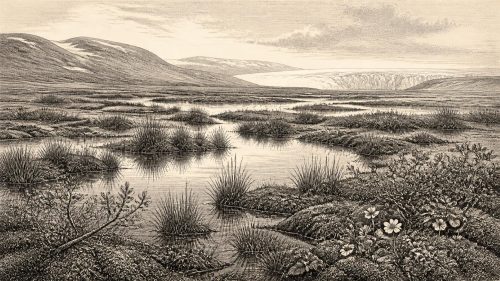
For Ireland around the date represented here, the strongest evidence comes from places whose sediments survived beneath later ice. At Derryvree, near Maguiresbridge in County Fermanagh, roadworks exposed freshwater silts and fine sands trapped between two distinct tills within a drumlin. Their organic material produced a radiocarbon age of 30,500 years before present, with a sizeable uncertainty; subsequent discussion has expressed this as an approximate calibrated range of 36,900–31,700 years ago. That range overlaps the broad chronological horizon represented by 31,867 BCE. The deposits preserve the remains of an open tundra environment and a periglacial climate: land shaped by frost, sparse vegetation and seasonal severity rather than by woodland or farmland.
Derryvree is not a snapshot of all Ireland. It is a local archive from north-central Ireland, and its dates refer to deposited organic material, not to a national climatic boundary. Yet it is exceptionally important because it demonstrates that land now buried beneath glacial sediments could, during part of this long interval, support freshwater environments and tundra vegetation. Comparable deposits at Greenagho near Belcoo, also in Fermanagh, reinforce the point that ice-free or lightly glaciated conditions existed in parts of the north before the major later expansion of the ice sheet. The evidence is geological and palaeoecological; it tells us about ground, water, plants and climate, not about named human groups.
Open Ground and Moving Animals
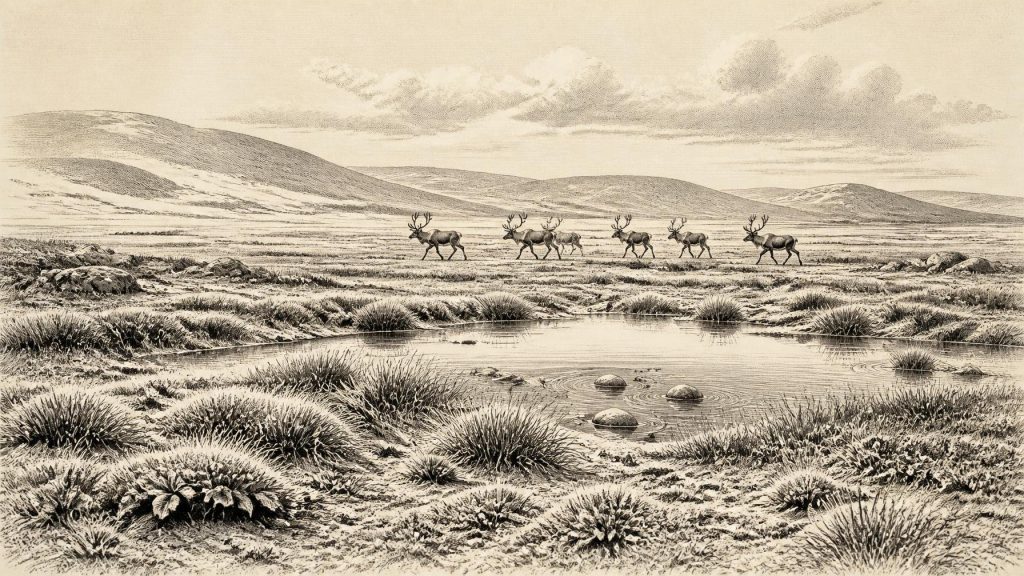
The Irish landscape was likely an open, treeless or near-treeless mosaic where grass, sedges, dwarf shrubs and herbs could persist in sheltered or better-drained places. Such vegetation could sustain grazing animals, although the abundance of any species varied through time and by region. Fossils and animal bones provide the clearest evidence. The Late Pleistocene Irish record includes reindeer, woolly mammoth, giant deer, brown bear, wolf, Arctic fox, hare, lemmings and spotted hyaena. It is essential not to imagine all of them together in one herd-filled scene: many specimens come from disturbed cave collections and date to different episodes across tens of millennia. Their combined presence instead reveals that Ireland repeatedly formed part of wider north-west European ecological networks before the coldest stage of the last glaciation.
Castlepook Cave, near Doneraile in north County Cork, is central to this story. Cave exploration there in the late nineteenth and early twentieth centuries recovered a striking quantity of animal bone. The site’s galleries preserved traces of animals that used the cave, died near it, or whose remains were carried in by predators, scavengers, water and sediment. Later reassessment and dating work has shown why such collections are both precious and difficult: old excavations did not always record exact layers, and bones from different periods may have become mixed. New excavations, begun again in 2022 under licence, seek undisturbed deposits capable of linking fauna, sediment and date more securely.
For everyday life in the animal world, mobility was probably decisive. Reindeer and other herbivores could have moved through broad feeding ranges as weather, snow cover, forage and predation altered. Carnivores, including hyaenas and wolves, followed opportunities created by those prey populations. Caves were not necessarily peaceful shelters; they could be dens, traps, feeding places or repositories into which bones accumulated over generations. The dramatic cave fauna does not prove a dense animal population throughout the island. It does prove that parts of Ireland were habitable to a wider range of cold-stage mammals than the later, more restricted native fauna might suggest.
The Human Question at Castlepook
Human presence is the most delicate question. There is no excavated settlement, hearth, stone-tool assemblage, burial, house, artwork or monument that can be assigned to Ireland in 31,867 BCE. Accordingly, there can be no responsible account of Irish rulers, political institutions, diplomacy, warfare, religion, formal learning or trade at this date. None is evidenced. The absence of such evidence does not demonstrate that no person ever crossed the landscape, but it does rule out elaborate narratives of a settled Ice Age society.
The closest possible indication is a reindeer femur from Castlepook Cave that has been interpreted as carrying a cut mark made during carcass processing with a sharp stone tool. It has been presented as evidence that people may have reached Ireland around 33,000 years ago. If that interpretation and chronology are sustained, it would indicate a brief act of butchery rather than a permanent colony: perhaps one or more hunter-gatherers exploiting a reindeer, probably within a wider pattern of movement across north-west Europe. It cannot identify their language, origin, kinship, beliefs or route, and it cannot be tied to 31,867 BCE itself. The bone is significant precisely because the direct evidence is so slight.
Caution is strengthened by what has happened to other Irish cave chronologies. The Irish Quaternary Fauna Project was groundbreaking in applying accelerator radiocarbon dating to animal remains, but later ultrafiltration and redating have demonstrated that some earlier results require revision. At Alice and Gwendoline Cave in County Clare, for example, a butchered brown-bear kneecap gives well-supported terminal Pleistocene dates of about 12,810–12,590 calibrated years before present—far later than the period considered here. Its value is methodological as much as chronological: direct dates on a particular bone, careful taphonomic analysis and independent replication are vital before claims for very early human activity can be made securely.
Routes, Coasts and Uncertainty
Lower global sea level exposed land now beneath the sea around north-west Europe, changing the outlines of coasts and the distances between regions. That fact should not be converted into a simple image of an easy land bridge to Ireland. Ice, sea channels, changing shorelines and local topography governed movement. Research on the Irish Sea has long warned against assuming a continuous, walkable Late Quaternary connection, while more recent palaeogeographic work shows that exposed shelves and ice margins changed through time. Animals and any visiting people may have moved by routes that are now submerged, glacially eroded or archaeologically invisible; the precise route is unknown.
There is likewise no evidence for an economy in the later prehistoric sense. No farming occurred: there were no fields, domestic livestock, crops, metalwork or markets. If people were present intermittently, their subsistence would have depended on hunting, scavenging, gathering and the careful use of animal materials, as among contemporary Upper Palaeolithic communities elsewhere in Europe. That is a comparative interpretation, not a demonstrated Irish settlement pattern. A cut-marked reindeer bone, if accepted, supports the narrow proposition that meat or carcass processing occurred; it does not disclose the full diet, seasonal round or social organisation of those involved.
An Archive of Fragments
The most important historical development represented by 31,867 BCE is therefore environmental, not political: Ireland lay within a shifting Ice Age world shortly before the fullest expansion of the last ice sheet. Fermanagh’s buried freshwater sediments show cold, open ground and periglacial conditions. Cork’s caves preserve evidence of mammals able to live in, or pass through, parts of the island during broader Marine Isotope Stage 3. Castlepook also raises the possibility of a very early human visit, but not yet of a documented population.
Later ice sheets eroded landscapes, rearranged sediments and obscured the traces that archaeologists would most like to find. This is why Ireland’s deep prehistory must be written with unusual restraint. Around 31,867 BCE there were no Irish kingdoms, no known communities and no calendar-aware witnesses. There was, however, a changing terrain of frost, water, exposed ground and animal movement—an environment whose surviving bones and silts offer rare, fragmentary evidence of Ireland before the ice reached its greatest power.
Primary Sources
- A reconsideration of the radiocarbon dating of the Marine Isotope Stage 3 fauna from southern Ireland
- The Irish Quaternary Fauna Project
- Middle Midlandian Freshwater Series at Derryvree, Maguiresbridge, County Fermanagh, Northern Ireland
- Trimlines, blockfields and the vertical extent of the last ice sheet in southern Ireland
- Growth and retreat of the last British–Irish Ice Sheet, 31,000 to 15,000 years ago: the BRITICE-CHRONO reconstruction
- The timing and magnitude of the British–Irish Ice Sheet between Marine Isotope Stages 5d and 2: implications for glacio-isostatic adjustment, high relative sea levels and ‘giant erratic’ emplacement
- The deglaciation of the western sector of the Irish Ice Sheet from the inner continental shelf to its terrestrial margin
- The IntCal20 Northern Hemisphere Radiocarbon Age Calibration Curve (0–55 cal kBP)
- The Island of Ireland: Drowning the Myth of an Irish Land-Bridge?
- The problem of a late Quaternary landbridge between Britain and Ireland
- The subdivision of the Quaternary Period in Ireland
- Palaeoecology
- 2022:564 – Castlepook Cave, Castlepook South, Cork
- New insights on the fauna of Ireland’s Younger Dryas and Early Holocene from Alice & Gwendoline Cave
- First evidence of a Late Upper Palaeolithic human presence in Ireland
- The Mesolithic in Ireland: when was it?
- Phylogeographic, ancient DNA, fossil and morphometric analyses reveal ancient and modern introductions of a large mammal: the complex case of red deer (Cervus elaphus) in Ireland
- Exploring controls of the early and stepped deglaciation on the western margin of the British-Irish Ice Sheet
- Middle Midlandian Interstadial Deposits at Greenagho, Near Belcoo, County Fermanagh, Northern Ireland
- Early Midlandian–Middle Midlandian, Pleistocene, Northern Ireland