

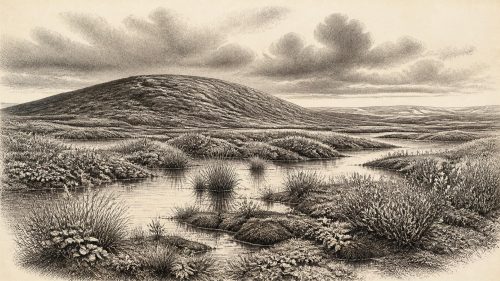
BIRM-166’s Bogbean Shore
Archived: 4 October 2026
About 30,286 BCE, Ireland lay within a changing late Ice Age landscape rather than a documented historical world. At Derryvree, County Fermanagh, organic freshwater sediments between tills, dated broadly to 34,950–29,750 BCE, preserve evidence of locally ice-free tundra wetland, including bogbean, sedges, mosses and dwarf willow. Castlepook Cave, County Cork, indicates varied Marine Isotope Stage 3 fauna, including giant deer, hyaena, reindeer and mammoth, while a possibly cut-marked reindeer bone offers inconclusive evidence of human presence. Growing ice sheets soon transformed the island. No securely dated settlements, political institutions, economies or social practices can be confidently assigned to this period.