

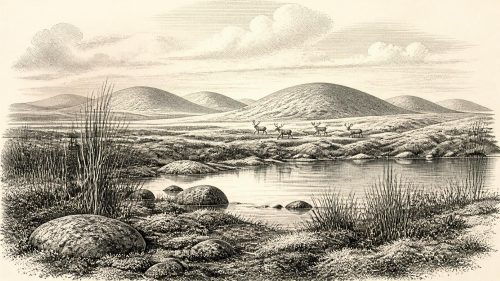
Derryvree’s Intertill Muskeg
Archived: 2 October 2026
Around 30,368 BCE, Ireland’s environment is best understood through Derryvree, a freshwater organic deposit beneath glacial tills near Maguiresbridge, County Fermanagh. Radiocarbon dating places it broadly within 36,900–31,700 calibrated years BP, rather than at a single year. Pollen, plants, mosses and insects indicate an ice-free, treeless, cold periglacial wetland during Marine Isotope Stage 3, before maximum British-Irish ice cover. Castlepook Cave fauna shows that cold-adapted mammals reached Ireland during this wider period. A possibly butchered reindeer bone suggests, but cannot confirm, brief human presence. No evidence supports permanent settlement, society or economy. Derryvree preserves an ecological record of pre-glacial Ireland.